FEASTING
ON TOWLINE
GLIDERS
By Tom Hallman | maxfliart@hallmanstudio.com
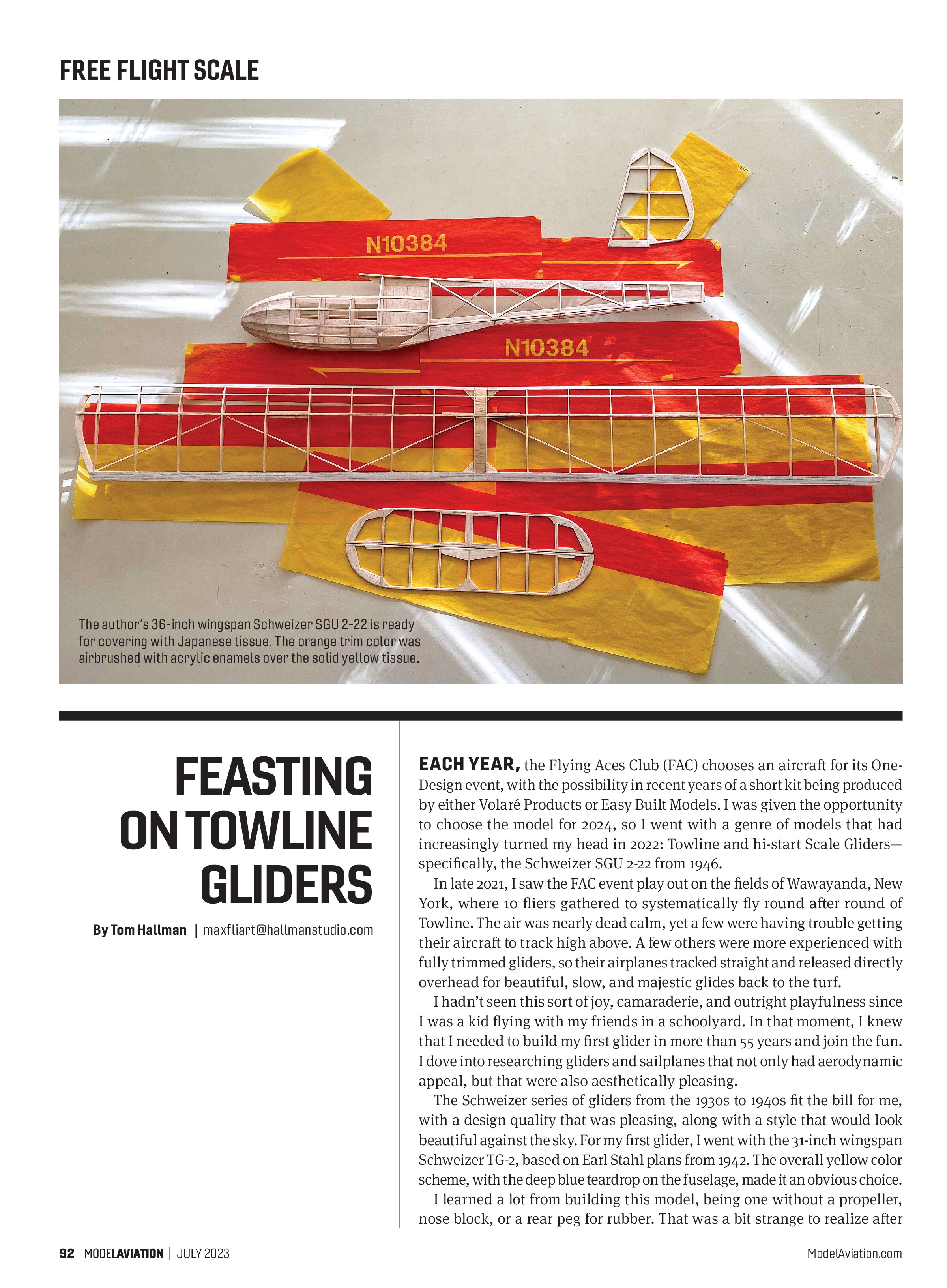
EACH YEAR, the Flying Aces Club (FAC) chooses an aircraft for its One-Design event, with the possibility in recent years of a short kit being produced by either Volaré Products or Easy Built Models. I was given the opportunity to choose the model for 2024, so I went with a genre of models that had increasingly turned my head in 2022: Towline and hi-start Scale Gliders—specifically, the Schweizer SGU 2-22 from 1946.
In late 2021, I saw the FAC event play out on the fields of Wawayanda, New York, where 10 fliers gathered to systematically fly round after round of Towline. The air was nearly dead calm, yet a few were having trouble getting their aircraft to track high above. A few others were more experienced with fully trimmed gliders, so their airplanes tracked straight and released directly overhead for beautiful, slow, and majestic glides back to the turf.
I hadn’t seen this sort of joy, camaraderie, and outright playfulness since I was a kid flying with my friends in a schoolyard. In that moment, I knew that I needed to build my first glider in more than 55 years and join the fun. I dove into researching gliders and sailplanes that not only had aerodynamic appeal, but that were also aesthetically pleasing.
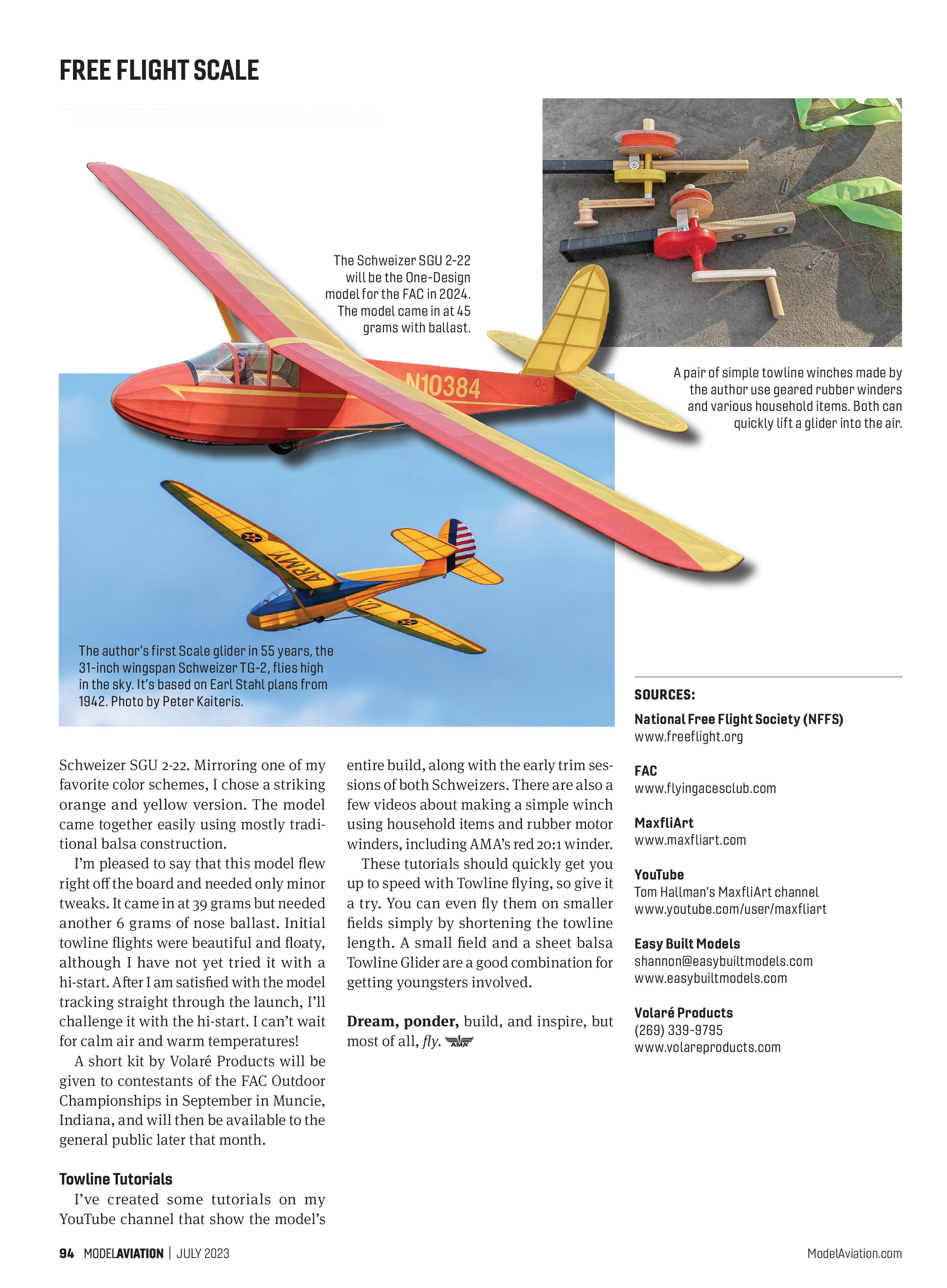
The Schweizer series of gliders from the 1930s to 1940s fit the bill for me, with a design quality that was pleasing, along with a style that would look beautiful against the sky. For my first glider, I went with the 31-inch wingspan Schweizer TG-2, based on Earl Stahl plans from 1942. The overall yellow color scheme, with the deep blue teardrop on the fuselage, made it an obvious choice.
I learned a lot from building this model, being one without a propeller, nose block, or a rear peg for rubber. That was a bit strange to realize after

30-plus years of building for rubber power. The lack of extra weight, however, was a pleasure to see when the model came in at 24 grams, compared with twice that for a similar rubber-powered model. My learning curve skyrocketed through the first few trim sessions, using a generic 7-inch diameter kite reel and 10-pound-test braided fishing line that was 164 feet long.
With only 22 inches of line pull through each turn of the kite reel crank, I had to work furiously to get the model into the air. Subsequently, with the help of a few friends (especially Peter Kaiteris and Rick Pendzick, who designed winches using various geared rubber winders), I was able to use a winch that gave me a pull rate closer to 90 inches per turn. This easily lifted the model into the sky, eventually releasing it high above after the model came into trim.
The Schweizer also tracked well using the hi-start method, where the line was 125 feet long with an additional 25 feet of 1/16-inch rubber. This can surely lead to higher releases, but I would only go this route after the model tracks straight using a towline; otherwise, the model is on its own with a hi-start launch.
If it’s pulled off course and tracks to the left or to the right, the model could have an unavoidable and powerful collision with the turf. Should the same start to happen with a towline launch, you simply stop winding, allowing the model to release early or to recover and center again, and then continue reeling it in for an eventual release overhead.
Focus on the One-Design
The Schweizer TG-2 flew well, but I wanted more, so I decided to build the


Schweizer SGU 2-22. Mirroring one of my favorite color schemes, I chose a striking orange and yellow version. The model came together easily using mostly traditional balsa construction.
I’m pleased to say that this model flew right off the board and needed only minor tweaks. It came in at 39 grams but needed another 6 grams of nose ballast. Initial towline flights were beautiful and floaty, although I have not yet tried it with a hi-start. After I am satisfied with the model tracking straight through the launch, I’ll challenge it with the hi-start. I can’t wait for calm air and warm temperatures!
A short kit by Volaré Products will be given to contestants of the FAC Outdoor Championships in September in Muncie, Indiana, and will then be available to the general public later that month.
Towline Tutorials
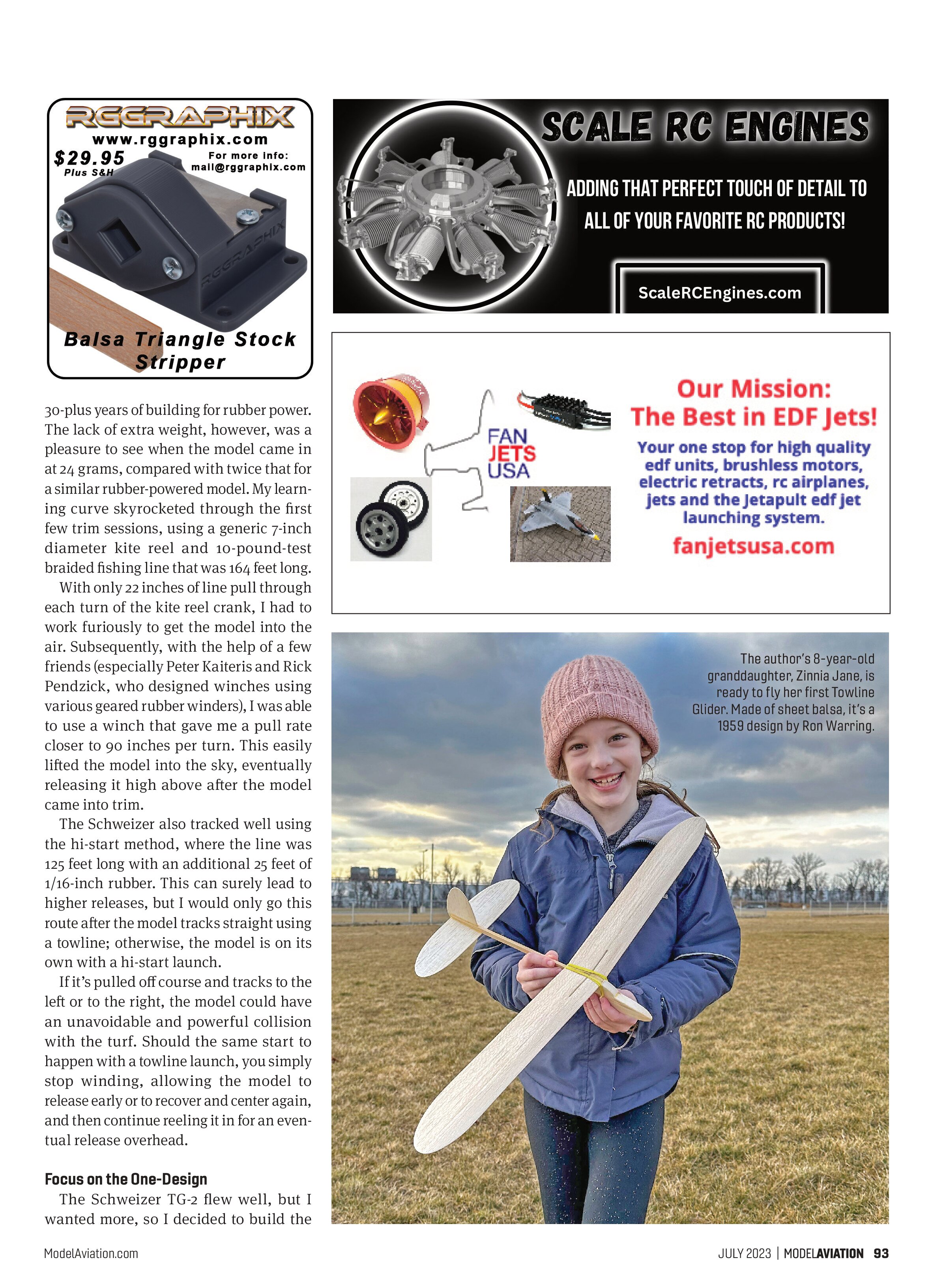
I’ve created some tutorials on my YouTube channel that show the model’s entire build, along with the early trim sessions of both Schweizers. There are also a few videos about making a simple winch using household items and rubber motor winders, including AMA’s red 20:1 winder. These tutorials should quickly get you up to speed with Towline flying, so give it a try. You can even fly them on smaller fields simply by shortening the towline length. A small field and a sheet balsa Towline Glider are a good combination for getting youngsters involved.
Dream, ponder, build, and inspire, but most of all, fly.
SOURCES:
National Free Flight Society (NFFS)
www.freeflight.org
Maxfl iArt
www.maxfliart.com
YouTube
Tom Hallman’s MaxfliArt channel
www.youtube.com/user/maxfliart
Easy Built Models
shannon@easybuiltmodels.com
www.easybuiltmodels.com
Volaré Products
(269) 339-9795
www.volareproducts.com