E-FLITE F-14 TOMCAT TWIN
40MM EDF BNF BASIC
An impressive balance of scalelike accuracy and flight
performance
By Terry Dunn | terrydunn74@gmail.com
Photos by the author
AVIATION BUFFS of my generation have a particular fondness for the Grumman F-14 Tomcat. Perhaps the “movie star” status of this broad-shouldered U.S. Navy fighter contributes to its cultlike popularity. Despite its fame, RC models of the Tomcat remain somewhat rare.
Let’s face it, the F-14 is a large and complex airplane. It only makes sense that most of the RC Tomcats I have seen are also relatively large and complex. That changed with the release of E-flite’s rendition of the F-14. It captures the essence of this classic jet fighter in a conveniently sized package.
About the E-flite F-14
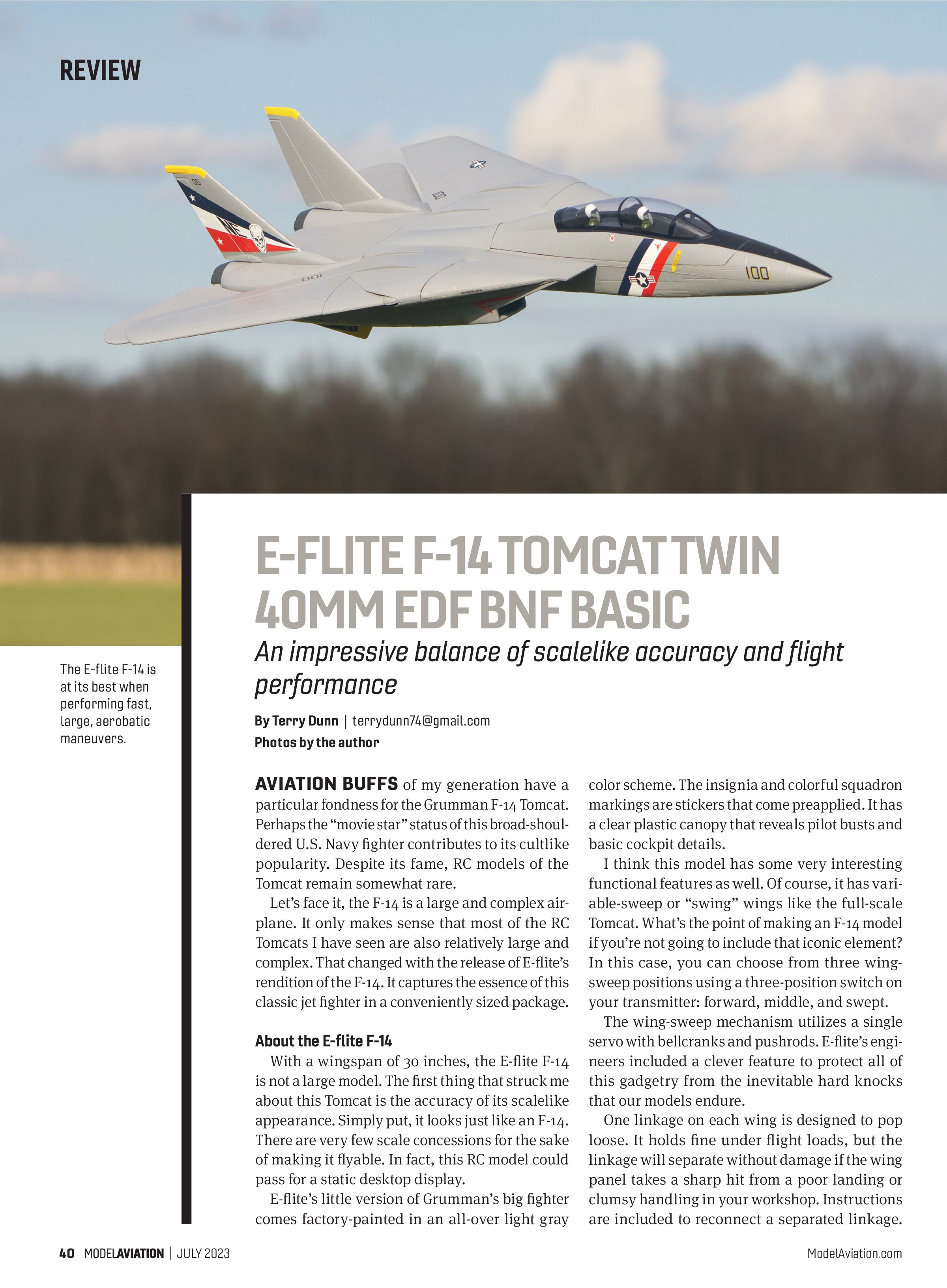
With a wingspan of 30 inches, the E-flite F-14 is not a large model. The first thing that struck me about this Tomcat is the accuracy of its scalelike appearance. Simply put, it looks just like an F-14. There are very few scale concessions for the sake of making it flyable. In fact, this RC model could pass for a static desktop display.
E-flite’s little version of Grumman’s big fighter comes factory-painted in an all-over light gray color scheme. The insignia and colorful squadron markings are stickers that come preapplied. It has a clear plastic canopy that reveals pilot busts and basic cockpit details.
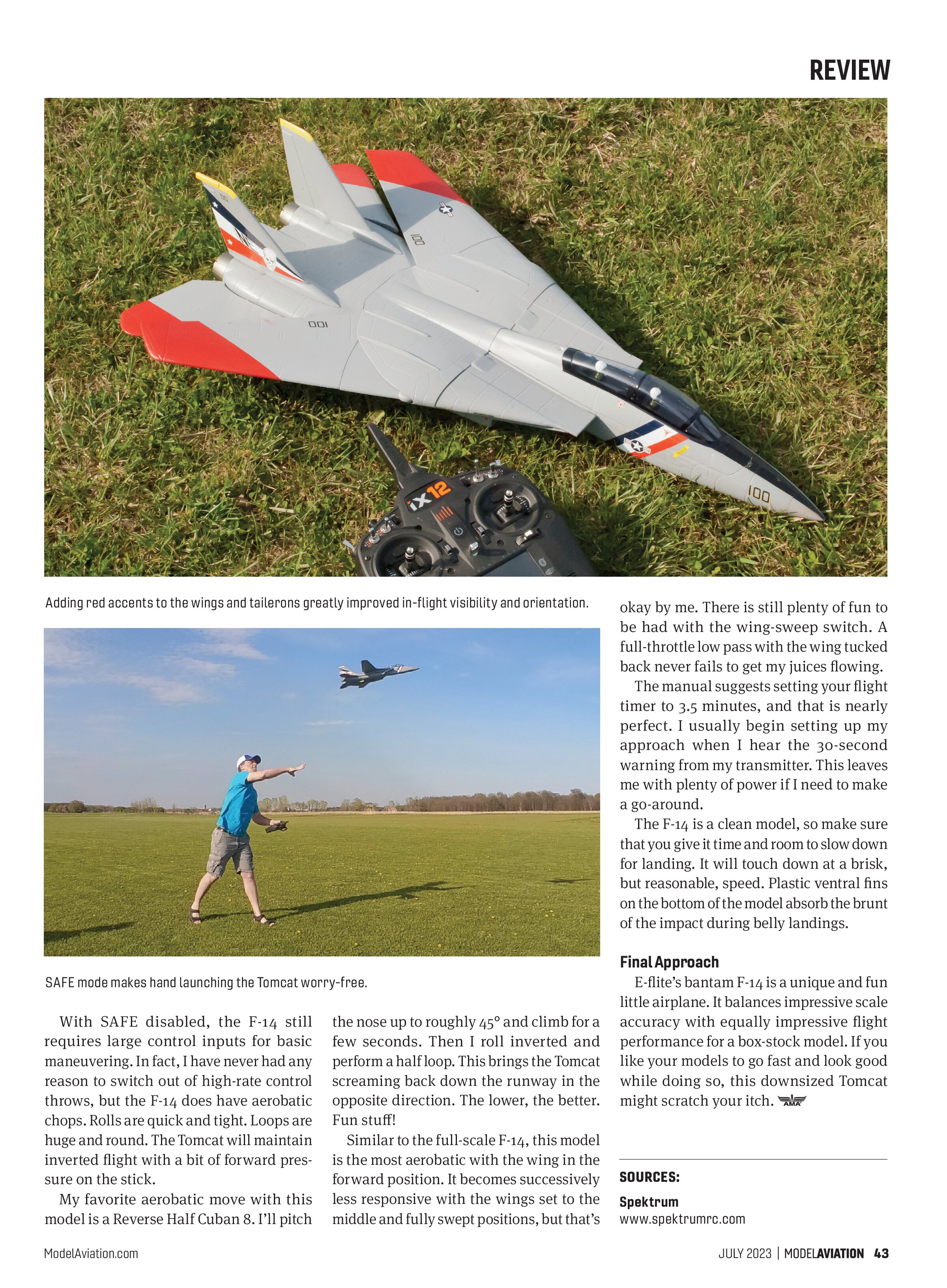
I think this model has some very interesting functional features as well. Of course, it has variable-sweep or “swing” wings like the full-scale Tomcat. What’s the point of making an F-14 model if you’re not going to include that iconic element? In this case, you can choose from three wing-sweep positions using a three-position switch on your transmitter: forward, middle, and swept.
The wing-sweep mechanism utilizes a single servo with bellcranks and pushrods. E-flite’s engineers included a clever feature to protect all of this gadgetry from the inevitable hard knocks that our models endure.
One linkage on each wing is designed to pop loose. It holds fine under flight loads, but the linkage will separate without damage if the wing panel takes a sharp hit from a poor landing or clumsy handling in your workshop. Instructions are included to reconnect a separated linkage.

At a Glance
Specifications
Type: Semiscale EDF
Wingspan: 30 inches
Length: 29.5 inches
Radio: Spektrum iX12 2.4 GHz transmitter; Spektrum A3240 Flight Controller (included); two 2.9-gram linear servos for tailerons (included); one 2.3-gram linear servo for nose wheel steering (included); a three-position linear actuator for wing sweep (included)
Components needed to complete:
Six-plus-channel DSM2/DSMX transmitter; four-cell 2,200 mAh 30C LiPo battery; charger
Power system: Two 40mm fan units with 6,800 Kv outrunner brushless motors (included); E-flite 4S 2,200mAh 30C LiPo battery
Power output: 34.7 amps, 528 watts, 327 watts per pound
Flying weight: 25.8 ounces
Flight time: 3.5 to 4 minutes
Minimal flying area: RC club field
Price: $299.99
Manufacturer/Distributor
Horizon Hobby
www.e-fliterc.com
Pluses
- Impressive scalelike appearance.
- Zippy flight performance.
- Variable-sweep wings.
Minuses
- Low-visibility paint scheme.
This 5-minute job is much preferred to replacing broken parts.
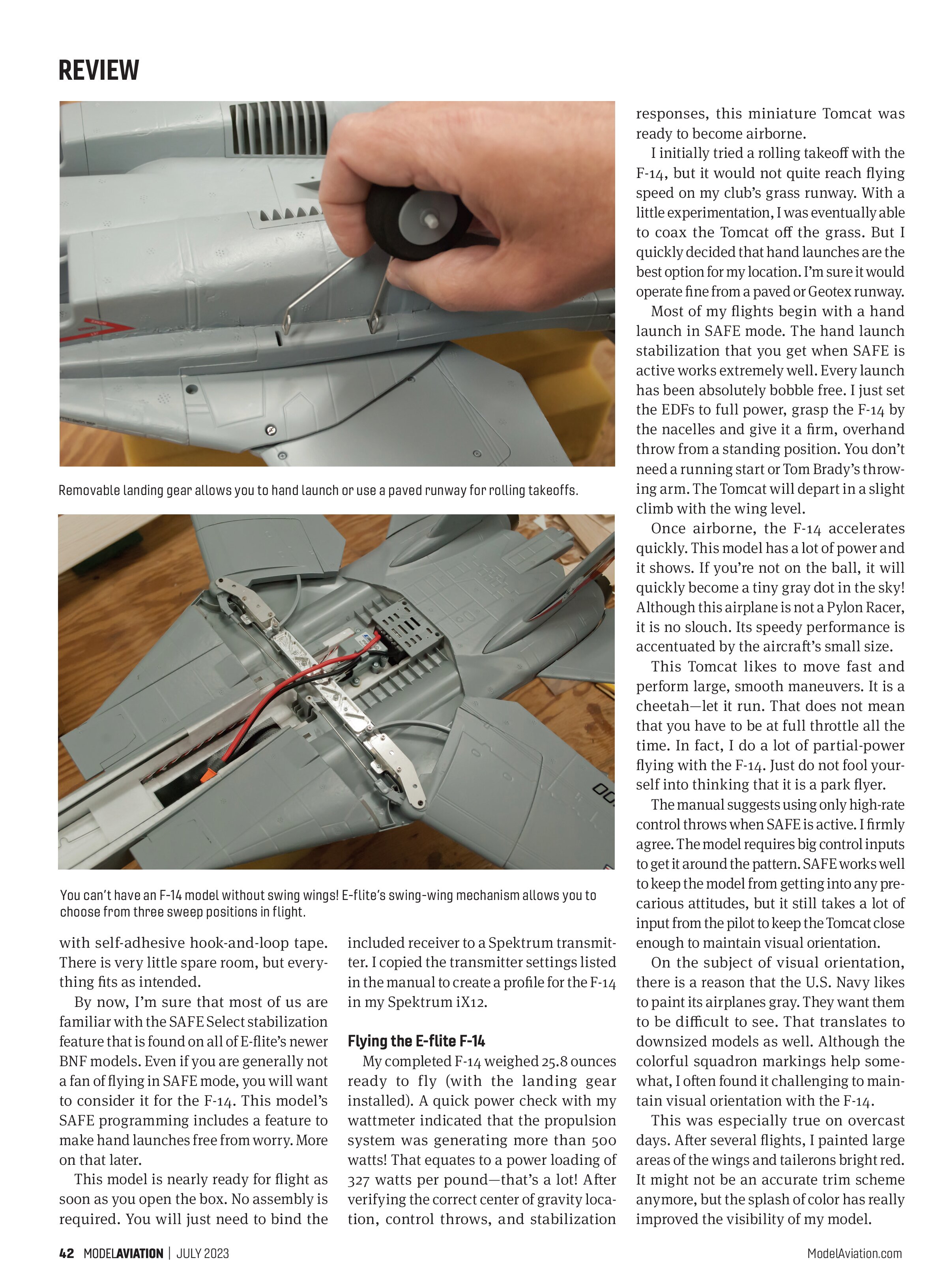
All directional control in the air is achieved by utilizing the horizontal stabilizers as tailerons. These full-flying surfaces work independently to provide pitch and roll control, much like the elevators on a flying wing. Each surface is driven by a dedicated, factory-installed linear servo.
Optional fixed landing gear is included for rolling takeoffs. The pieces can be press-fitted into plastic hardpoints on the fuselage. When the landing gear is being used, a linear servo provides nosewheel steering.
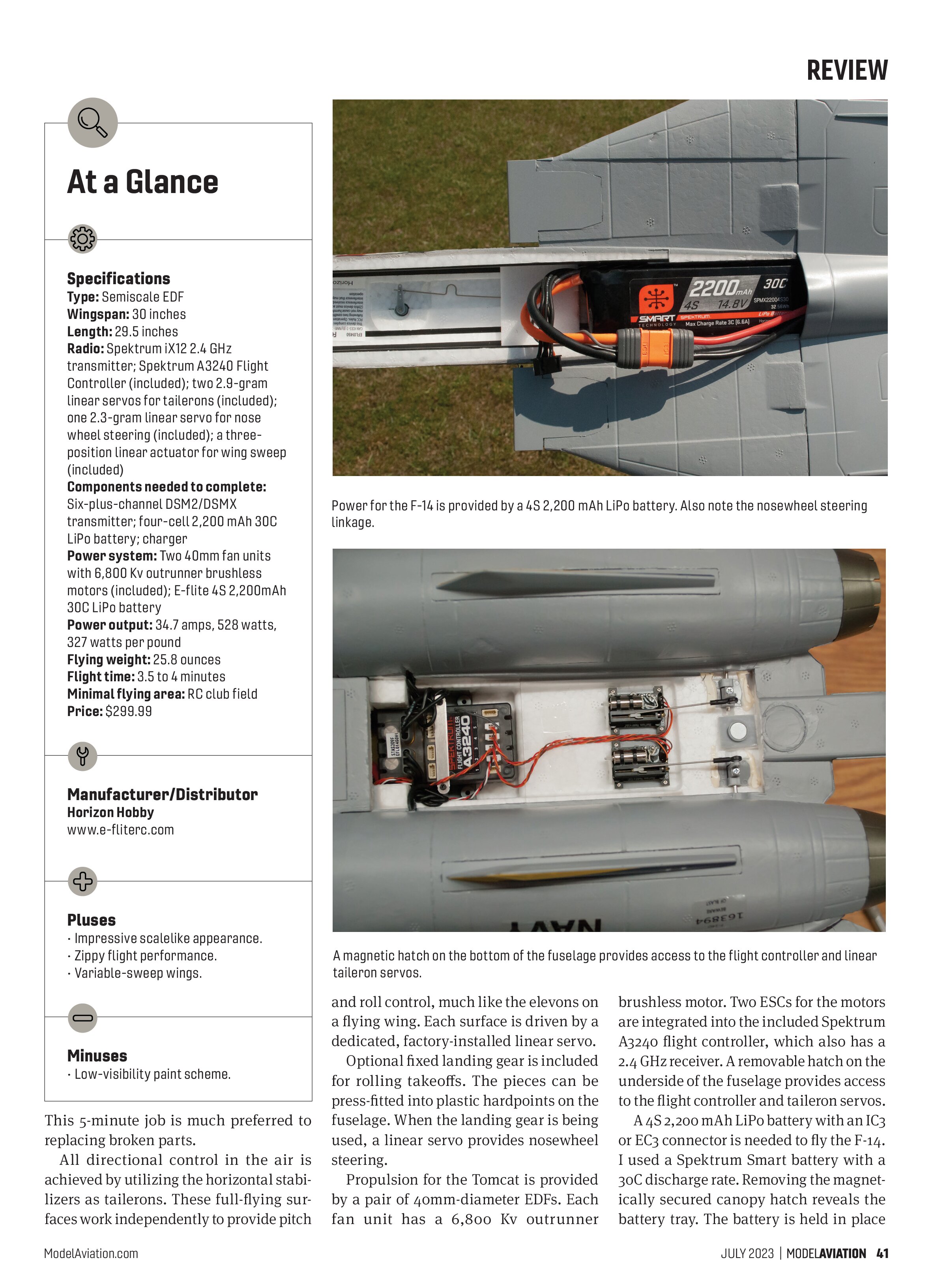
Propulsion for the Tomcat is provided by a pair of 40mm-diameter EDFs. Each fan unit has a 6,800 Kv outrunner brushless motor.
Two ESCs for the motors are integrated into the included Spektrum A3240 flight controller, which also has a 2.4 GHz receiver. A removable hatch on the underside of the fuselage provides access to the flight controller and taileron servos.
A 4S 2,200 mAh LiPo battery with an IC3 or EC3 connector is needed to fly the F-14. I used a Spektrum Smart battery with a 30C discharge rate. Removing the magnetically secured canopy hatch reveals the battery tray. The battery is held in place.


responses, this miniature Tomcat was ready to become airborne.
I initially tried a rolling takeoff with the F-14, but it would not quite reach flying speed on my club’s grass runway. With a little experimentation, I was eventually able to coax the Tomcat off the grass. But I quickly decided that hand launches are the best option for my location. I’m sure it would operate fine from a paved or Geotex runway.
Most of my flights begin with a hand launch in SAFE mode. The hand launch stabilization that you get when SAFE is active works extremely well. Every launch has been absolutely bobble free. I just set the EDFs to full power, grasp the F-14 by the nacelles and give it a firm, overhand throw from a standing position. You don’t need a running start or Tom Brady’s throwing arm. The Tomcat will depart in a slight climb with the wing level.
Once airborne, the F-14 accelerates quickly. This model has a lot of power and it shows. If you’re not on the ball, it will quickly become a tiny gray dot in the sky! Although this airplane is not a Pylon Racer, it is no slouch. Its speedy performance is accentuated by the aircraft’s small size.
This Tomcat likes to move fast and perform large, smooth maneuvers. It is a cheetah—let it run. That does not mean that you have to be at full throttle all the time. In fact, I do a lot of partial-power flying with the F-14. Just do not fool yourself into thinking that it is a park flyer.
The manual suggests using only high-rate control throws when SAFE is active. I firmly agree. The model requires big control inputs to get it around the pattern. SAFE works well to keep the model from getting into any precarious attitudes, but it still takes a lot of input from the pilot to keep the Tomcat close enough to maintain visual orientation.
On the subject of visual orientation, there is a reason that the U.S. Navy likes to paint its airplanes gray. They want them to be difficult to see. That translates to downsized models as well. Although the colorful squadron markings help somewhat, I often found it challenging to maintain visual orientation with the F-14. This was especially true on overcast days. After several flights, I painted large areas of the wings and tailerons bright red. It might not be an accurate trim scheme anymore, but the splash of color has really improved the visibility of my model.

with self-adhesive hook-and-loop tape. There is very little spare room, but everything fits as intended.
By now, I’m sure that most of us are familiar with the SAFE Select stabilization feature that is found on all of E-flite’s newer BNF models. Even if you are generally not a fan of flying in SAFE mode, you will want to consider it for the F-14. This model’s SAFE programming includes a feature to make hand launches free from worry. More on that later.
This model is nearly ready for flight as soon as you open the box. No assembly is required. You will just need to bind the included receiver to a Spektrum transmitter. I copied the transmitter settings listed in the manual to create a profile for the F-14 in my Spektrum iX12.
Flying the E-flite F-14
My completed F-14 weighed 25.8 ounces ready to fly (with the landing gear installed). A quick power check with my wattmeter indicated that the propulsion system was generating more than 500 watts! That equates to a power loading of 327 watts per pound—that’s a lot! After verifying the correct center of gravity location, control throws, and stabilization

okay by me. There is still plenty of fun to be had with the wing-sweep switch. A full-throttle low pass with the wing tucked back never fails to get my juices flowing.
The manual suggests setting your flight timer to 3.5 minutes, and that is nearly perfect. I usually begin setting up my approach when I hear the 30-second warning from my transmitter. This leaves me with plenty of power if I need to make a go-around.
The F-14 is a clean model, so make sure that you give it time and room to slow down for landing. It will touch down at a brisk, but reasonable, speed. Plastic ventral fins on the bottom of the model absorb the brunt of the impact during belly landings.
Final Approach
E-flite’s bantam F-14 is a unique and fun little airplane. It balances impressive scale accuracy with equally impressive flight performance for a box-stock model. If you like your models to go fast and look good while doing so, this downsized Tomcat might scratch your itch.
With SAFE disabled, the F-14 still requires large control inputs for basic maneuvering. In fact, I have never had any reason to switch out of high-rate control throws, but the F-14 does have aerobatic chops. Rolls are quick and tight. Loops are huge and round. The Tomcat will maintain inverted flight with a bit of forward pressure on the stick.
My favorite aerobatic move with this model is a Reverse Half Cuban 8. I’ll pitch the nose up to roughly 45° and climb for a few seconds. Then I roll inverted and perform a half loop. This brings the Tomcat screaming back down the runway in the opposite direction. The lower, the better. Fun stuff!
Similar to the full-scale F-14, this model is the most aerobatic with the wing in the forward position. It becomes successively less responsive with the wings set to the middle and fully swept positions, but that’s okay by me.
There is still plenty of fun to be had with the wing-sweep switch.
SOURCES:
Spektrum
www.spektrumrc.com