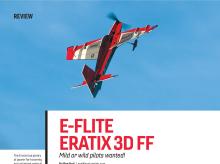
E-FLITE ERATIX 3D FF
Mild or wild pilots wanted!
By Ron Hull | ron@rcplanelab.com
Photos by the author

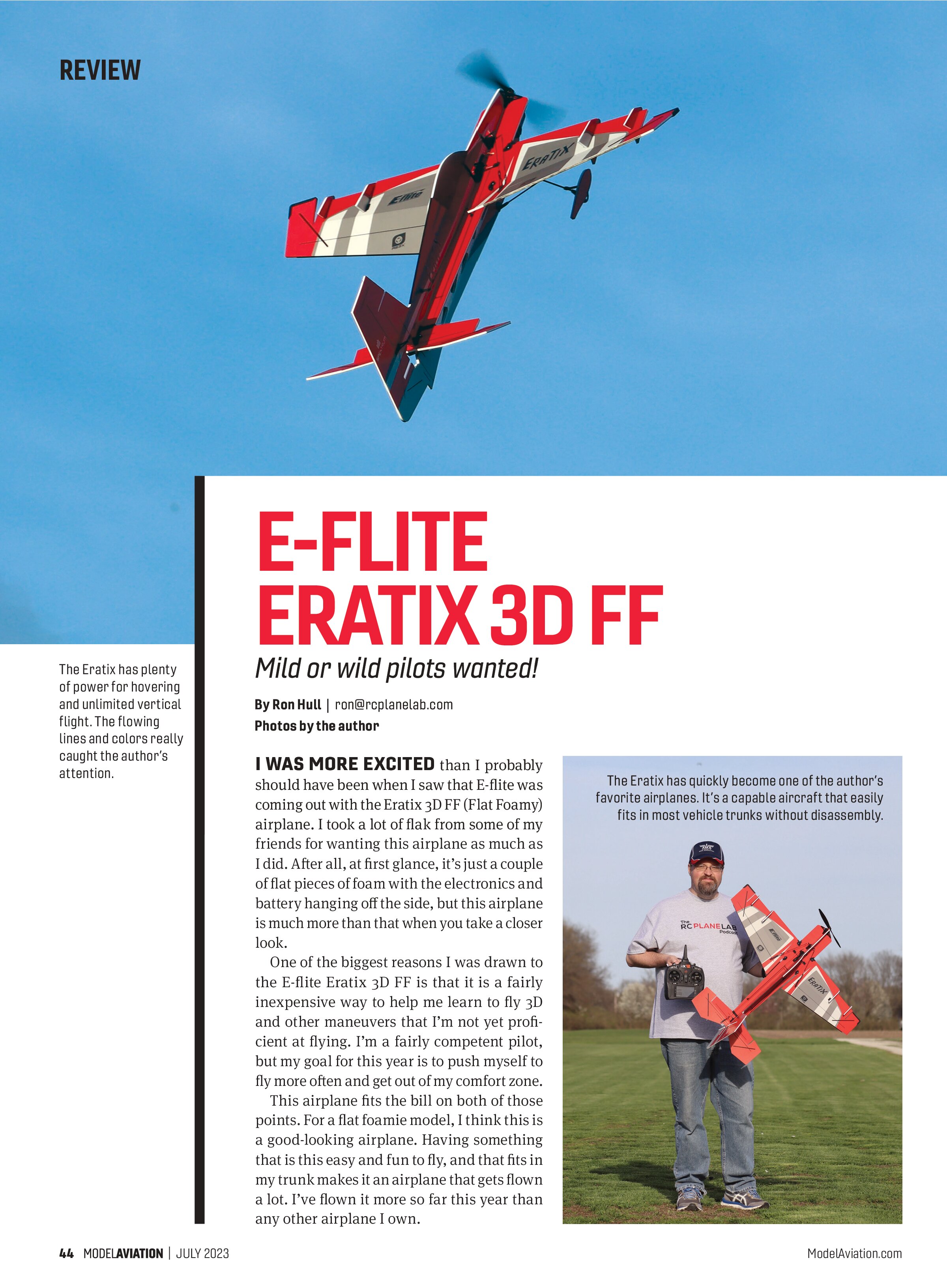
I WAS MORE EXCITED than I probably should have been when I saw that E-flite was coming out with the Eratix 3D FF (Flat Foamy) airplane. I took a lot of flak from some of my friends for wanting this airplane as much as I did. After all, at first glance, it’s just a couple of flat pieces of foam with the electronics and battery hanging off the side, but this airplane is much more than that when you take a closer look.
One of the biggest reasons I was drawn to the E-flite Eratix 3D FF is that it is a fairly inexpensive way to help me learn to fly 3D and other maneuvers that I’m not yet proficient at flying. I’m a fairly competent pilot, but my goal for this year is to push myself to fly more often and get out of my comfort zone.
This airplane fits the bill on both of those points. For a flat foamie model, I think this is a good-looking airplane. Having something that is this easy and fun to fly, and that fits in my trunk makes it an airplane that gets flown a lot. I’ve flown it more so far this year than any other airplane I own.

At a Glance
Specifications
Type: Aerobatic electric, flat foamie
Wingspan: 34 inches
Length: 35.69 inches
Radio: Spektrum iX12 2.4 GHz transmitter; Spektrum AR630 receiver (included); four Spektrum A347 submicro digital servos (included)
Components needed to complete: Four-plus-channel DSM2/DSMX transmitter; 600 to 850 mAh 3S LiPo battery with IC2 or EC2 connector; charger
Minimum flying area: Medium-size park
Power system: 2405-1200 Kv Spektrum Avian Brushless Outrunner motor (included); 9 x 4.6 electric slow fly propeller (included); Spektrum Avian 15-amp brushless Smart ESC (included); 600 mAh to 850 mAh 3S LiPo battery with IC2 or EC2 connector
Flying weight: 13.1 ounces
Flight time: 5 to 8 minutes
Price: $219.99 Smart BNF Basic; $199.99 Smart PNP
Manufacturer/Distributor
Horizon Hobby
www.horizonhobby.com/e-flite-1/
Pluses
- Easy to assemble.
- It’s a good size for transport; fits in most trunks.
- Wide flight envelope, from mild to wild.
- Prop saver, just in case.
Minuses
- Small wheels make landing in tall grass difficult.
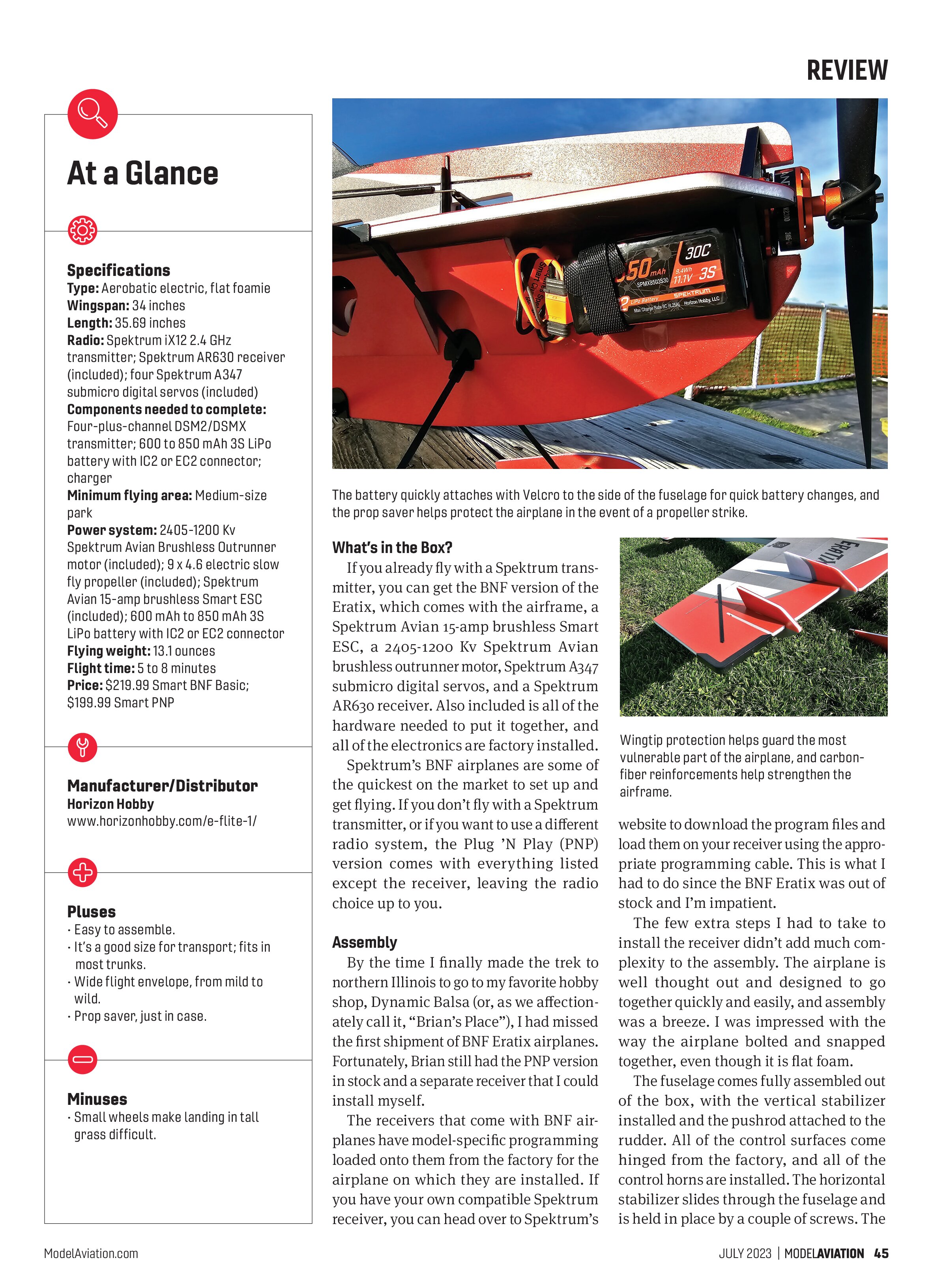
The battery quickly attaches with Velcro to the side of the fuselage for quick battery changes, and the prop saver helps protect the airplane in the event of a propeller strike.

What’s in the Box?
If you already fly with a Spektrum transmitter, you can get the BNF version of the Eratix, which comes with the airframe, a Spektrum Avian 15-amp brushless Smart ESC, a 2405-1200 Kv Spektrum Avian brushless outrunner motor, Spektrum A347 submicro digital servos, and a Spektrum AR630 receiver. Also included is all of the hardware needed to put it together, and all of the electronics are factory installed.
Spektrum’s BNF airplanes are some of the quickest on the market to set up and get flying. If you don’t fly with a Spektrum transmitter, or if you want to use a different radio system, the Plug ’N Play (PNP) version comes with everything listed except the receiver, leaving the radio choice up to you.
Assembly
By the time I finally made the trek to northern Illinois to go to my favorite hobby shop, Dynamic Balsa (or, as we affectionately call it, “Brian’s Place”), I had missed the first shipment of BNF Eratix airplanes. Fortunately, Brian still had the PNP version in stock and a separate receiver that I could install myself.
The receivers that come with BNF airplanes have model-specific programming loaded onto them from the factory for the airplane on which they are installed. If you have your own compatible Spektrum receiver, you can head over to Spektrum’s website to download the program files and load them on your receiver using the appropriate programming cable. This is what I had to do since the BNF Eratix was out of stock and I’m impatient.
The few extra steps I had to take to install the receiver didn’t add much complexity to the assembly. The airplane is well thought out and designed to go together quickly and easily, and assembly was a breeze. I was impressed with the way the airplane bolted and snapped together, even though it is flat foam.
The fuselage comes fully assembled out of the box, with the vertical stabilizer installed and the pushrod attached to the rudder. All of the control surfaces come hinged from the factory, and all of the control horns are installed. The horizontal stabilizer slides through the fuselage and is held in place by a couple of screws. The
carbon-fiber landing gear legs slide into a slot in the fuselage and lock into place with a satisfactory click so you know that they’re fully seated.
The two wing halves slide over a square, carbon-fiber spar and are screwed to the fuselage. Wing struts are installed with a screw on the fuselage and a clevis on the wing. The side-force generators need to be installed so that the colors align with the design on the wing. It took me a minute to figure that out, but because they just push on it was easy to fix my mistake! The pushrods are installed on the horizontal stabilizer and each aileron.
The last thing to do is to put the propeller on. The Eratix comes with a prop saver, so the propeller is held on with an O-ring. This helps to lessen airframe damage if you have a propeller strike. Overall, assembling this airplane was easy and only took roughly 10 minutes.

Setup
After the Eratix was assembled, I spent some time setting the airplane up the way I wanted it and making sure that everything was correct—especially since the receiver didn’t come preprogrammed with the airplane. I fly with a Spektrum iX12, so I was also able to download the transmitter setup file and a picture for the display. After I bound it, I checked that the control surfaces moved the right way, the surface deflection was set to what was called for in the manual, and checked the exponential settings.
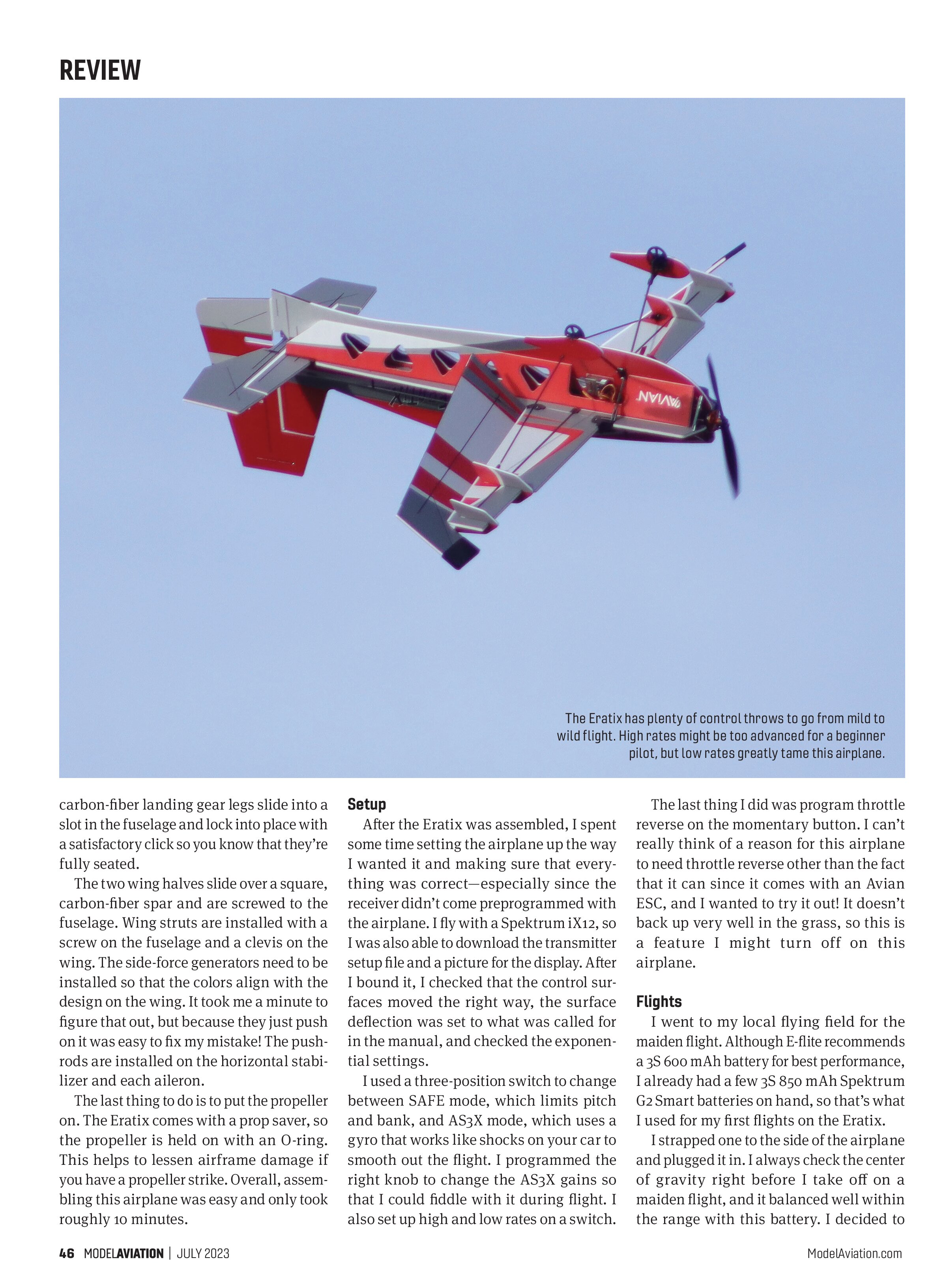
I used a three-position switch to change between SAFE mode, which limits pitch and bank, and AS3X mode, which uses a gyro that works like shocks on your car to smooth out the flight. I programmed the right knob to change the AS3X gains so that I could fiddle with it during flight. I also set up high and low rates on a switch.
The last thing I did was program throttle reverse on the momentary button. I can’t really think of a reason for this airplane to need throttle reverse other than the fact that it can since it comes with an Avian ESC, and I wanted to try it out. It doesn’t back up very well in the grass, so this is a feature I might turn off on this airplane.
Flights
I went to my local flying field for the maiden flight. Although E-flite recommends a 3S 600 mAh battery for best performance, I already had a few 3S 850 mAh Spektrum G2 Smart batteries on hand, so that’s what I used for my first flights on the Eratix.
I strapped one to the side of the airplane and plugged it in. I always check the center of gravity right before I take off on a maiden flight, and it balanced well within the range with this battery. I decided to try a rolling takeoff because our field was cut nice and short. I turned the AS3X gains as low as they could go, ran through a quick preflight check, then taxied out on the runway.
I was surprised at how well it rolled through the grass, because I’ve seen other small airplanes get their wheels caught in the grass and flip over at our field. I gave it some throttle and it took off within about 20 feet.
After I got some altitude, I started to raise the AS3X gains until it was set where I wanted it. There wasn’t a lot of wind, so AS3X didn’t have to work too hard, but I could definitely tell a difference when it was switched on. This is a fairly lightweight airplane with a lot of flat surfaces, so you will notice the wind, but the AS3X does a good job of smoothing out the flight.
I played around with SAFE mode. I put it in an upside down spin, flipped it to SAFE, and it quickly reoriented itself. After a couple of laps, I switched it to high rates to see what it could really do. The roll rate is phenomenal, high-alpha flight is simple, and there is plenty of rudder throw for a knife-edge maneuver.

This is not a fast airplane though. I was slightly disappointed by its lack of top-end speed, but that is more than made up for by how well it flies. Landings are simple, but it’s easy to flip over after touchdown in longer grass. After all, the wheels aren’t very big, and there’s no wind blowing over the elevator from the motor.
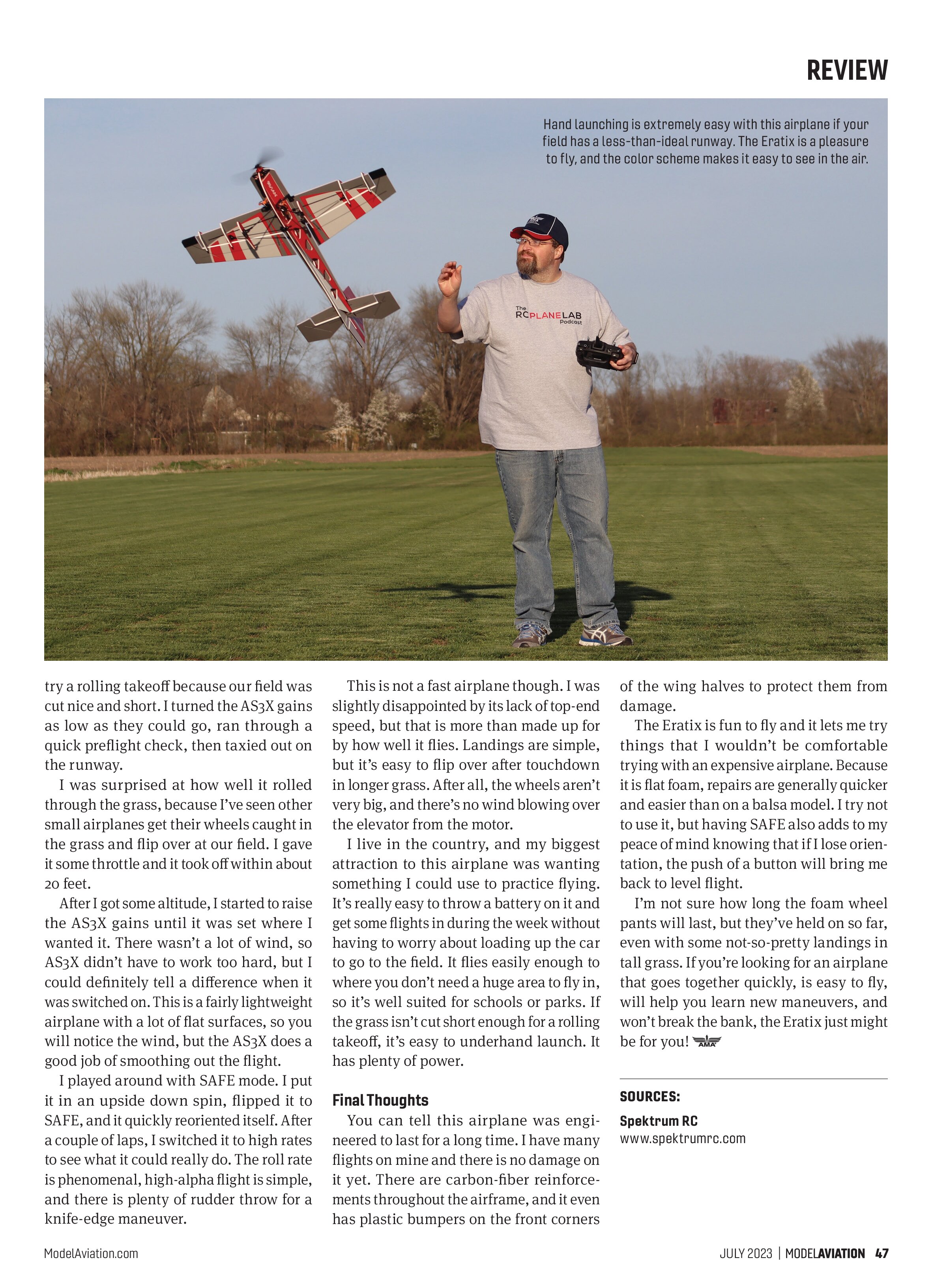
I live in the country, and my biggest attraction to this airplane was wanting something I could use to practice flying. It’s really easy to throw a battery on it and get some flights in during the week without having to worry about loading up the car to go to the field. It flies easily enough to where you don’t need a huge area to fly in, so it’s well suited for schools or parks. If the grass isn’t cut short enough for a rolling takeoff, it’s easy to underhand launch. It has plenty of power.
Final Thoughts
You can tell this airplane was engineered to last for a long time. I have many flights on mine and there is no damage on it yet. There are carbon-fiber reinforcements throughout the airframe, and it even has plastic bumpers on the front corners of the wing halves to protect them from damage.
The Eratix is fun to fly and it lets me try things that I wouldn’t be comfortable trying with an expensive airplane. Because it is flat foam, repairs are generally quicker and easier than on a balsa model. I try not to use it, but having SAFE also adds to my peace of mind knowing that if I lose orientation, the push of a button will bring me back to level flight.
I’m not sure how long the foam wheel pants will last, but they’ve held on so far, even with some not-so-pretty landings in tall grass. If you’re looking for an airplane that goes together quickly, is easy to fly, will help you learn new maneuvers, and won’t break the bank, the Eratix just might be for you!
SOURCES:
Spektrum RC
www.spektrumrc.com