LOU PROCTOR
Photos provided by Norm Arndt | arndtbuddy@gmail.com

IN 1970, Norm Arndt (Livermore, California) moved to San Diego to continue his career in civil engineering. In early 1971, he decided it was time to get into RC, finding that transmitters were just beginning to have proportional control versus the push-button control boxes of previous years.
After several models, including the Mini Ugly Stick, he noticed an advertisement in RC magazines of a World War I-looking RC airplane known as the ANTIC and that the kits were manufactured in San Diego. “Although more expensive than most kits of the day, I called the phone number on the ad and Louis “Lou” Proctor answered. I was soon to discover that these kits were special—and beautifully made. No balsa in those kits!” Norm wrote.
This began a three-plus-year close relationship with Lou, until Norm’s family duties took over. Lou sold Norm the 88-inch ANTIC kit and he proceeded to build it in his garage. “We flew together every weekend at the abandoned Army Air Force airstrip near the Del Mar racetrack [in Del Mar, California],” Norm stated. “The airstrip was partially covered over by Interstate 5, so only the west section was available for us, but RC worked fine down there, and we were secluded.” After approximately two months of Lou tolerating Norm’s Ugly Stick (“Lou was strictly a Scale guy”), the ANTIC was finished and they flew the two together every weekend.
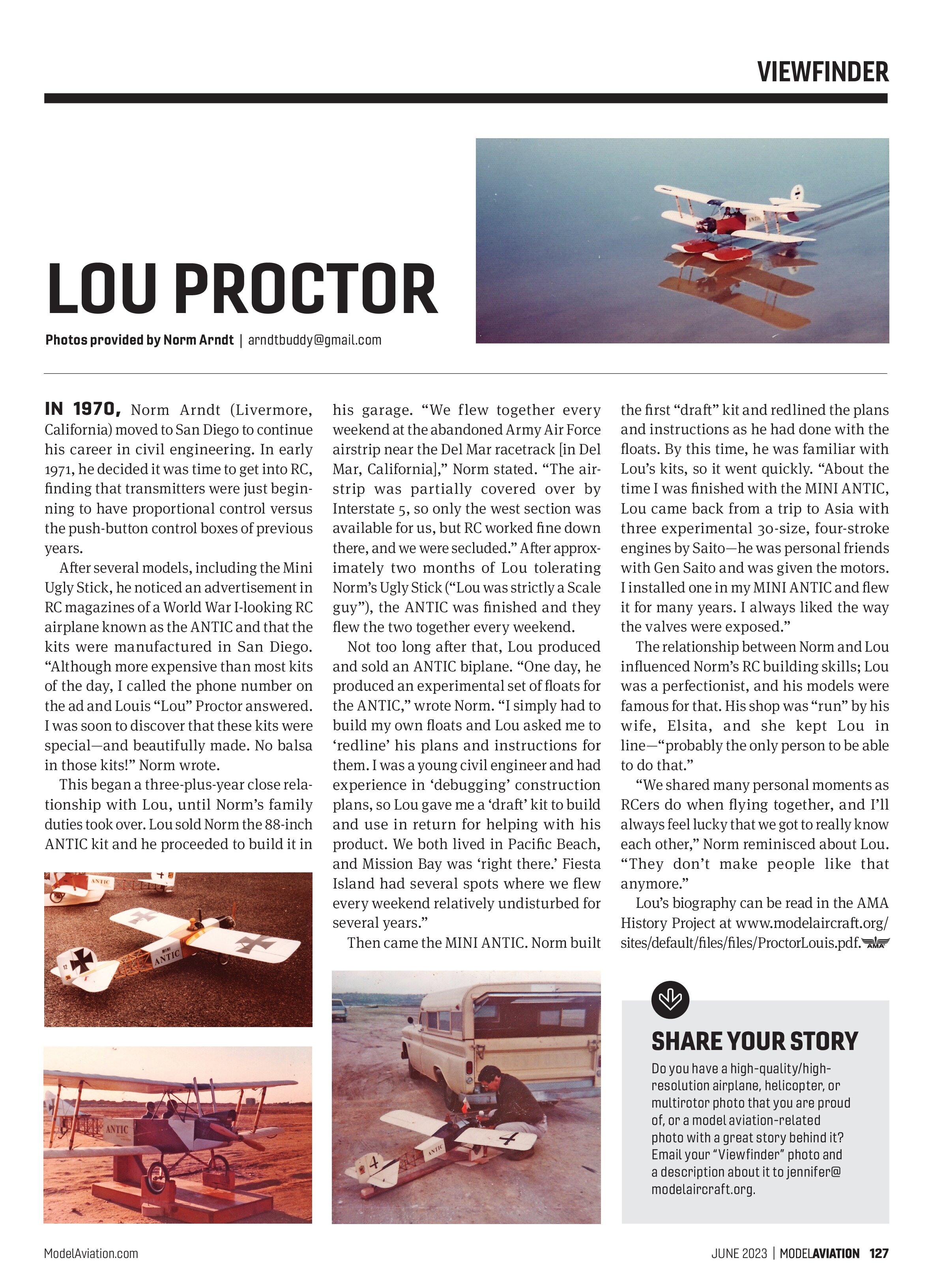
Not too long after that, Lou produced and sold an ANTIC biplane. “One day, he produced an experimental set of floats for the ANTIC,” wrote Norm. “I simply had to build my own floats and Lou asked me to ‘redline’ his plans and instructions for them. I was a young civil engineer and had experience in ‘debugging’ construction plans, so Lou gave me a ‘draft’ kit to build and use in return for helping with his product. We both lived in Pacific Beach, and Mission Bay was ‘right there.’ Fiesta Island had several spots where we flew every weekend relatively undisturbed for several years.”
Then came the MINI ANTIC. Norm built the first “draft” kit and redlined the plans and instructions as he had done with the floats. By this time, he was familiar with Lou’s kits, so it went quickly. “About the time I was finished with the MINI ANTIC, Lou came back from a trip to Asia with three experimental 30-size, four-stroke engines by Saito—he was personal friends with Gen Saito and was given the motors. I installed one in my MINI ANTIC and flew it for many years. I always liked the way the valves were exposed.”


The relationship between Norm and Lou influenced Norm’s RC building skills; Lou was a perfectionist, and his models were famous for that. His shop was “run” by his wife, Elsita, and she kept Lou in line—“probably the only person to be able to do that.”
“We shared many personal moments as RCers do when flying together, and I’ll always feel lucky that we got to really know each other,” Norm reminisced about Lou. “They don’t make people like that anymore.”
Lou’s biography can be read in the AMA History Project at www.modelaircraft.org/sites/default/files/files/ProctorLouis.pdf.