SMALL-FIELD FLYING
DUSTING OFF FALSE STARTS
By Pat Tritle | patscustommodels@gmail.com

HOW MANY OF US have started a project and just never quite got around to finishing it? Believe me, I know how that goes. At one time or another, we have all started a project that, for one reason or another, ended up sidelined.
It might be because of a crash repair on our favorite weekend flier. It could be because another new kit has caught our eye. Or perhaps we hit a rough spot in that current project and laid it aside to think it through for a day or two, which turned into months—or even years. Whatever the reason, it happens to the best of us, and I don’t know too many serious modelers who don’t have a false start or two lying around the shop, including myself.
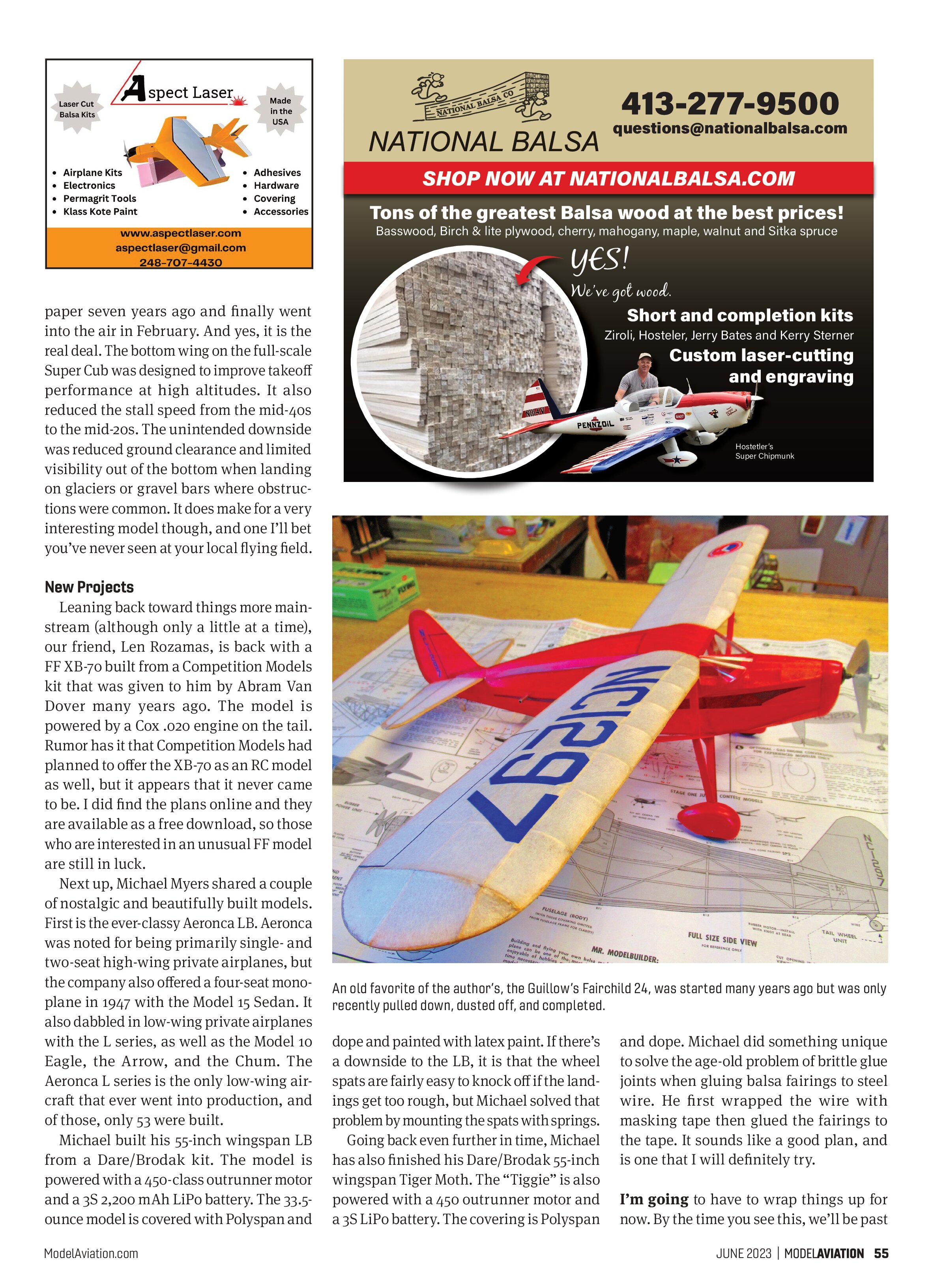
As modelers, we all have an old favorite that we’ve built at one time or another. One of mine is the Guillow’s Free Flight (FF) Fairchild 24. I’ve probably built three or four of them throughout the years, and I recently came across one that I started many years ago. The model was framed and partially covered—and pretty well covered with dust—so I thought it would be a good time to finally finish it. In the end, it turned out great and I shortened the list of false starts (although that’s not the last of it) by one, and I hope to eventually knock them all out.
While I’m on the subject of false starts, there was one that I thought about many years ago in my plastic modeling days that would make for a fun and unusual RC model. Having always been drawn toward things out of the ordinary, and also being a lover of Piper Cubs (which are anything but out of the ordinary), a blend of the two could be interesting.
The result was the Super Cub Biplane. The idea started to go down on paper seven years ago and finally went into the air in February. And yes, it is the real deal. The bottom wing on the full-scale Super Cub was designed to improve takeoff performance at high altitudes. It also reduced the stall speed from the mid-40s to the mid-20s. The unintended downside was reduced ground clearance and limited visibility out of the bottom when landing on glaciers or gravel bars where obstructions were common. It does make for a very interesting model though, and one I’ll bet you’ve never seen at your local flying field.
New Projects
Leaning back toward things more mainstream (although only a little at a time), our friend, Len Rozamas, is back with a FF XB-70 built from a Competition Models kit that was given to him by Abram Van Dover many years ago. The model is powered by a Cox .020 engine on the tail. Rumor has it that Competition Models had planned to offer the XB-70 as an RC model as well, but it appears that it never came to be. I did find the plans online and they are available as a free download, so those who are interested in an unusual FF model are still in luck.
Next up, Michael Myers shared a couple of nostalgic and beautifully built models. First is the ever-classy Aeronca LB. Aeronca was noted for being primarily single- and two-seat high-wing private airplanes, but the company also offered a four-seat monoplane in 1947 with the Model 15 Sedan. It also dabbled in low-wing private airplanes with the L series, as well as the Model 10 Eagle, the Arrow, and the Chum. The Aeronca L series is the only low-wing aircraft that ever went into production, and of those, only 53 were built.
Michael built his 55-inch wingspan LB from a Dare/Brodak kit. The model is powered with a 450-class outrunner motor and a 3S 2,200 mAh LiPo battery. The 33.5-ounce model is covered with Polyspan and paper seven years ago and finally went into the air in February. And yes, it is the real deal. The bottom wing on the full-scale Super Cub was designed to improve takeoff performance at high altitudes. It also reduced the stall speed from the mid-40s to the mid-20s. The unintended downside was reduced ground clearance and limited visibility out of the bottom when landing on glaciers or gravel bars where obstructions were common. It does make for a very interesting model though, and one I’ll bet you’ve never seen at your local flying field.
dope and painted with latex paint. If there’s a downside to the LB, it is that the wheel spats are fairly easy to knock off if the landings get too rough, but Michael solved that problem by mounting the spats with springs.
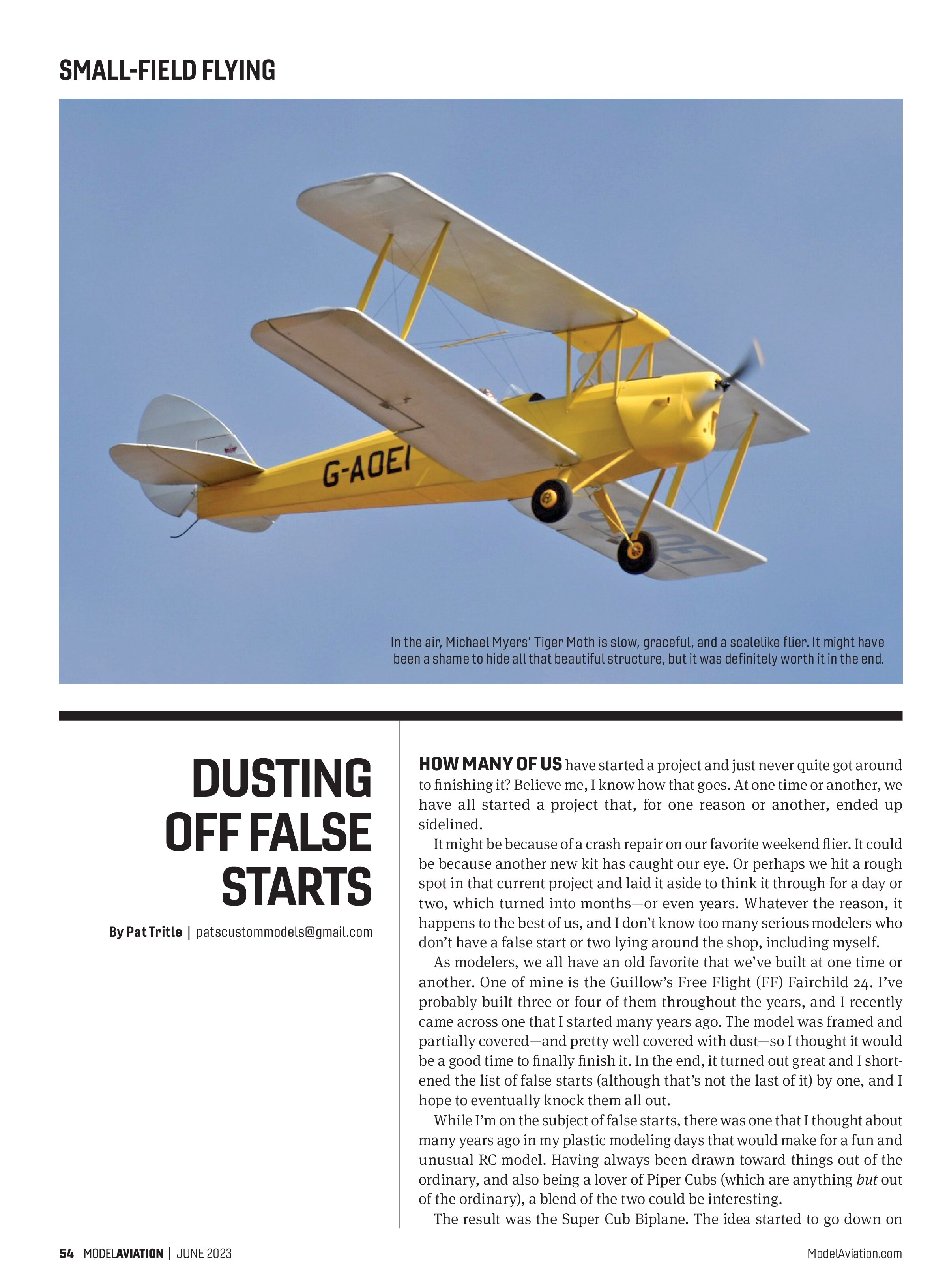
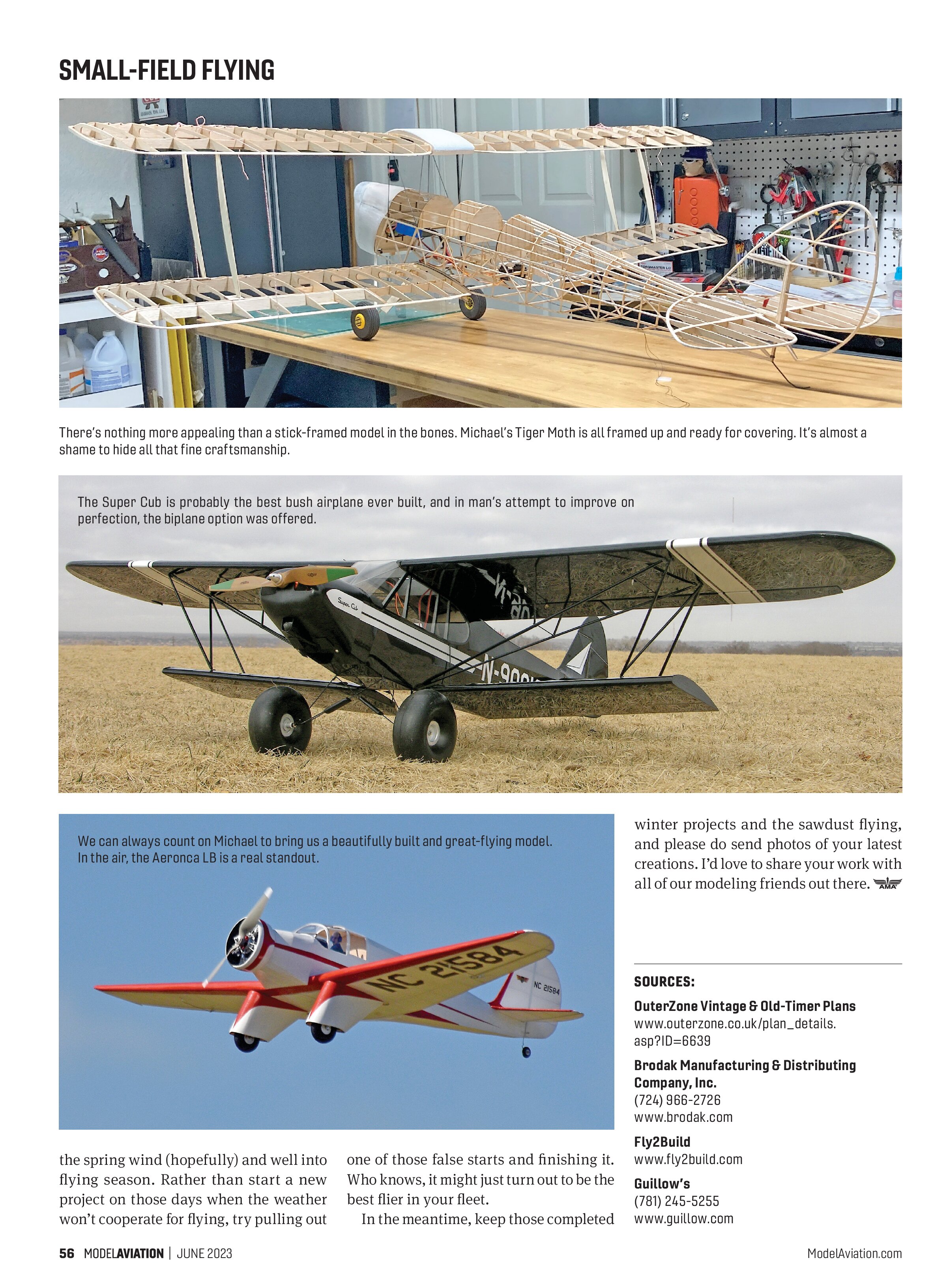
Going back even further in time, Michael has also finished his Dare/Brodak 55-inch wingspan Tiger Moth. The “Tiggie” is also powered with a 450 outrunner motor and a 3S LiPo battery. The covering is Polyspan and dope. Michael did something unique to solve the age-old problem of brittle glue joints when gluing balsa fairings to steel wire. He first wrapped the wire with masking tape then glued the fairings to the tape. It sounds like a good plan, and is one that I will definitely try.
I’m going to have to wrap things up for now. By the time you see this, we’ll be past


the spring wind (hopefully) and well into flying season. Rather than start a new project on those days when the weather won’t cooperate for flying, try pulling out
one of those false starts and finishing it. Who knows, it might just turn out to be the best flier in your fleet.
In the meantime, keep those completed winter projects and the sawdust flying, and please do send photos of your latest creations. I’d love to share your work with all of our modeling friends out there.
SOURCES:
OuterZone Vintage & Old-Timer Plans
www.outerzone.co.uk/plan_details.asp?ID=6639
Brodak Manufacturing & Distributing Company, Inc.
(724) 966-2726
www.brodak.com
Fly2Build
www.fly2build.com
Guillow’s
(781) 245-5255
www.guillow.com