RC SLOPE SOARING

PIBROS
By Greg Schutte | gshouty@yahoo.com
LAST SUMMER, I was motivated to expand my model building skills. I decided to learn how to make fiberglass fuselages. By the time I had scratched that itch, there was a mountain of new supplies, fiberglass molds, and building tools.
Finding space to store all of that stuff in my building area was not an easy task. The amount of time and energy required to build a working model was staggering, and I had burned myself out on doing another major project.
This past winter, I still wanted to build another model, but I couldn’t find anything that excited me. While I was having lunch with my cousin, Rob, one day, the subject of flying was brought up and we started reminiscing about the good old days. Rob is responsible for teaching me how to fly RC airplanes.
One of the memories we talked about was the very simple and easy-to-build flying wing called the Pibros. The Pibros is a delta wing designed by Marcel Guwang. The plans and building instructions are free on the internet (see the link in “Sources”). When I got home, I did a quick internet search and pulled up Marcel’s webpage. It looks just like it did when I first found it back in the day.
The Pibros was the first flying wing that I ever built and flew. I had found Marcel’s webpage around 1999 to 2000 while looking into foam airplanes. I had just learned to fly Slope Soaring RC balsa gliders and was interested in this thing called Slope Combat. I had bought and was flying a blue-foam airplane called The Sniper, from JK Aerotech. I was looking at the Zagi but was hesitant to purchase one. I had never flown a wing design before, and both Rob and I were skeptical about how stable it would fly. We decided that the free plans for the Pibros seemed worth the time to build.

The biggest hurdle we had with building the Pibros was finding the foam sheet. The local hobby shops didn’t stock the foam sheets the plans called for. To my surprise, I already had the foam. At the time, I was going to school to be an architect and used foam board for projects. The foam was close to the right thickness needed to build the Pibros plans. The only problem was that it had paper on both sides.
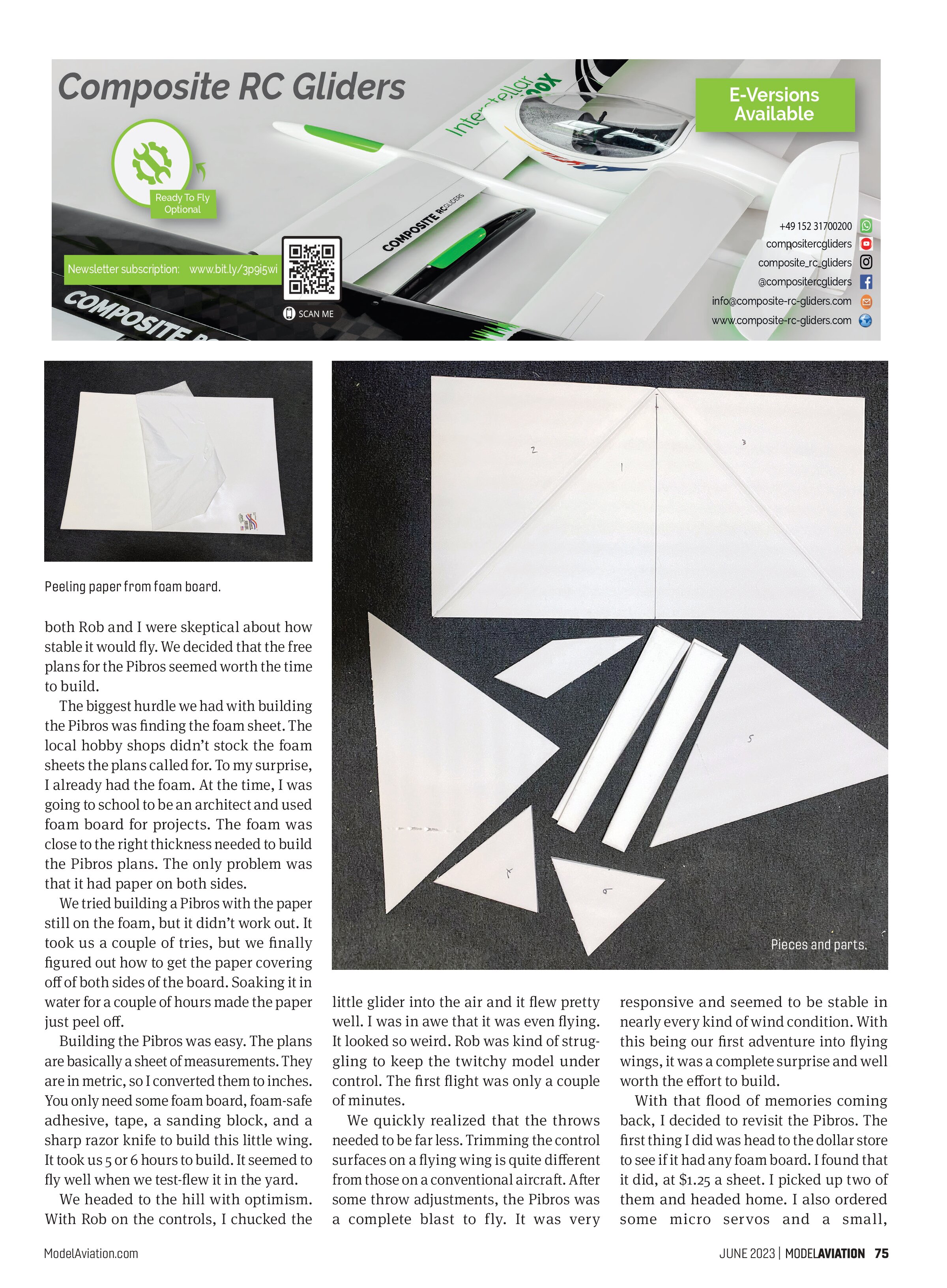
We tried building a Pibros with the paper still on the foam, but it didn’t work out. It took us a couple of tries, but we finally figured out how to get the paper covering off of both sides of the board. Soaking it in water for a couple of hours made the paper just peel off.

Building the Pibros was easy. The plans are basically a sheet of measurements. They are in metric, so I converted them to inches. You only need some foam board, foam-safe adhesive, tape, a sanding block, and a sharp razor knife to build this little wing. It took us 5 or 6 hours to build. It seemed to fly well when we test-flew it in the yard.
We headed to the hill with optimism. With Rob on the controls, I chucked the little glider into the air and it flew pretty well. I was in awe that it was even flying. It looked so weird. Rob was kind of struggling to keep the twitchy model under control. The first flight was only a couple of minutes.
We quickly realized that the throws needed to be far less. Trimming the control surfaces on a flying wing is quite different from those on a conventional aircraft. After some throw adjustments, the Pibros was a complete blast to fly. It was very responsive and seemed to be stable in nearly every kind of wind condition. With this being our first adventure into flying wings, it was a complete surprise and well worth the effort to build.
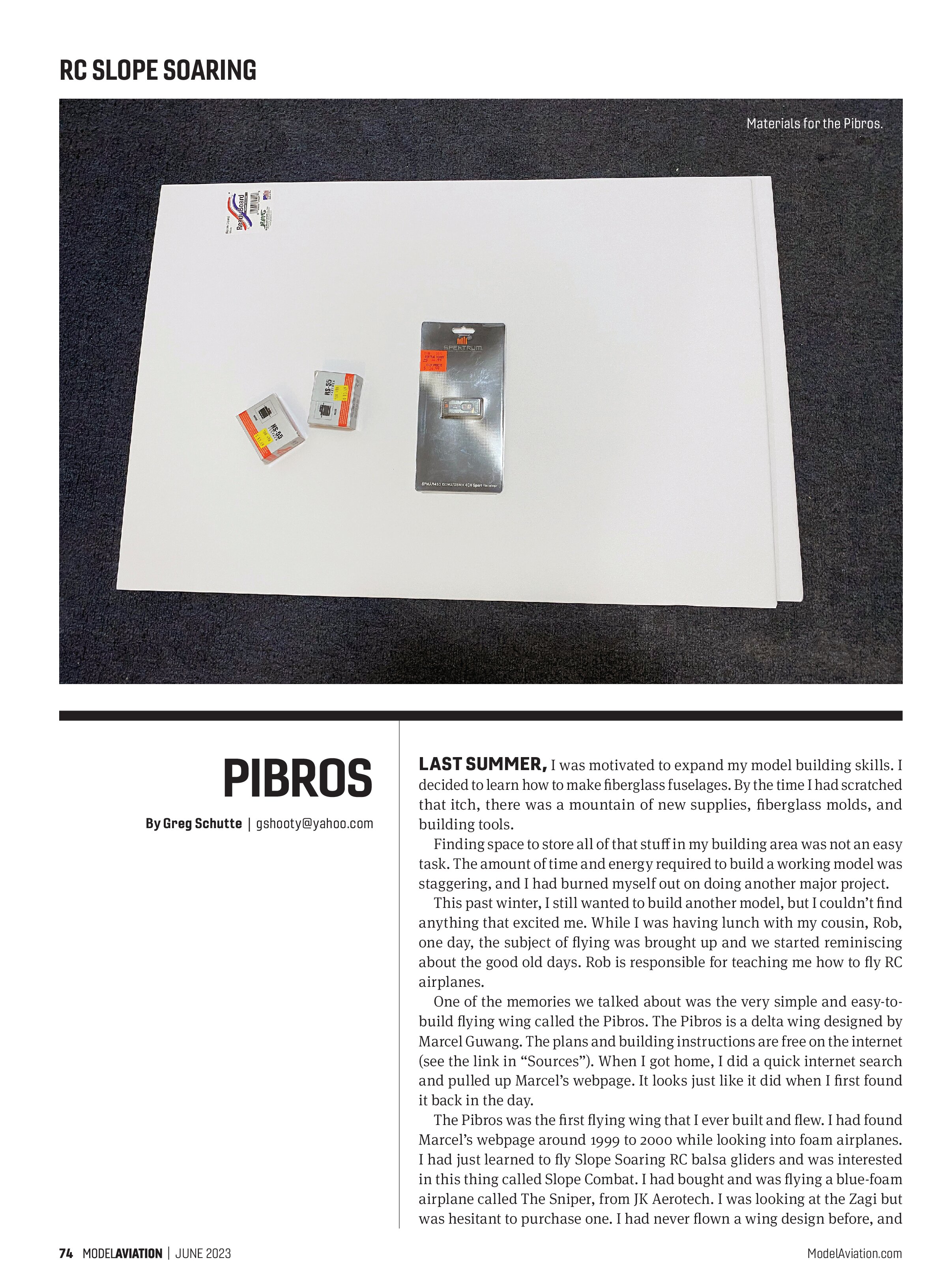
With that flood of memories coming back, I decided to revisit the Pibros. The first thing I did was head to the dollar store to see if it had any foam board. I found that it did, at $1.25 a sheet. I picked up two of them and headed home. I also ordered some micro servos and a small,


four-channel receiver. I already had fiber tape, spray glue, a sanding block, a razor knife, a battery pack, and control linkages.
The cheap dollar store foam board doesn’t have that high-quality paper covering. With a soaking of cold water and waiting 10 minutes, the paper just peeled right off. The foam boards I bought aren’t very big, so I drew the parts up onto two different sheets. After that, I just followed the building instructions on Marcel’s website.
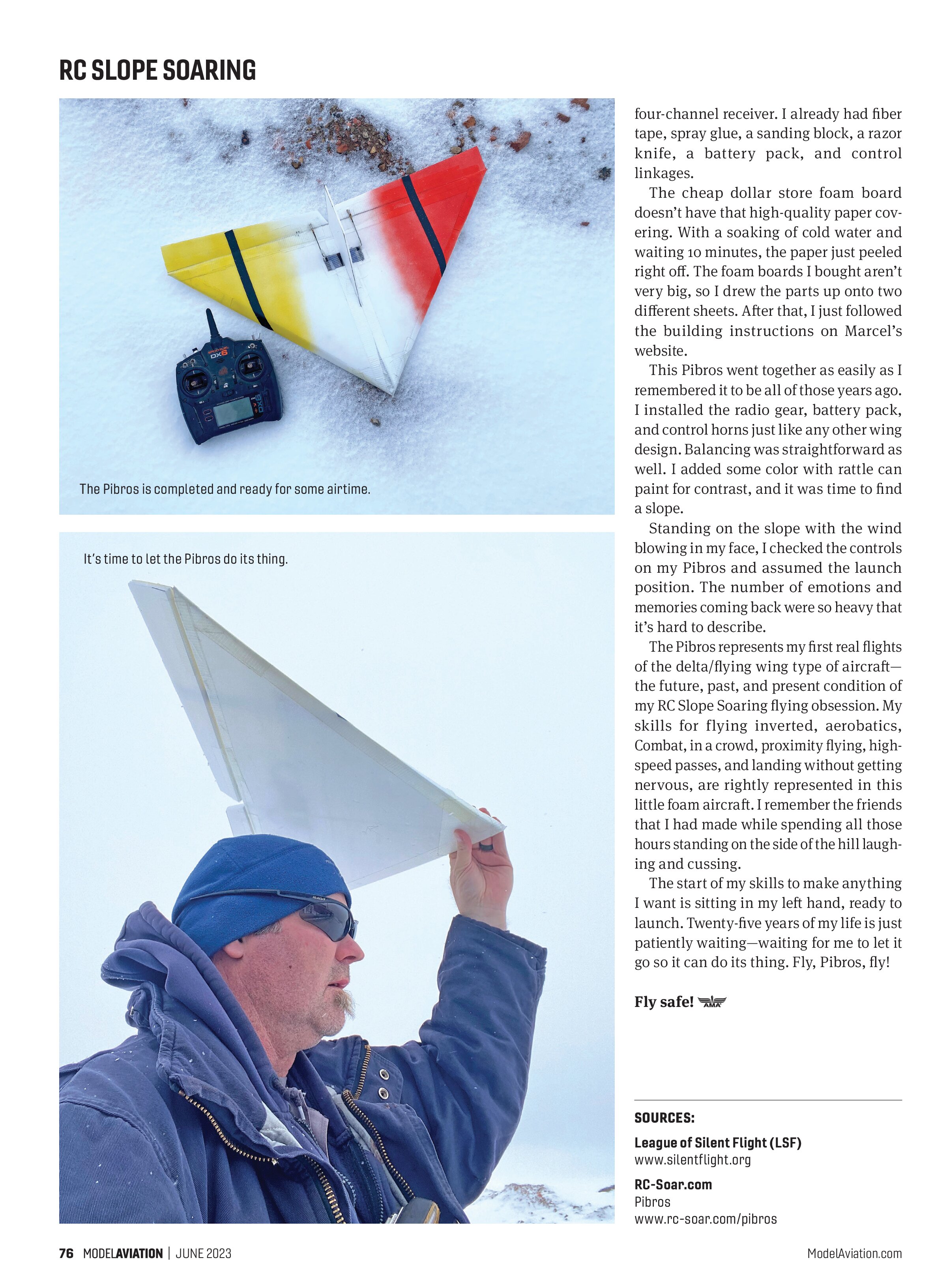
This Pibros went together as easily as I remembered it to be all of those years ago. I installed the radio gear, battery pack, and control horns just like any other wing design. Balancing was straightforward as well. I added some color with rattle can paint for contrast, and it was time to find a slope.
Standing on the slope with the wind blowing in my face, I checked the controls on my Pibros and assumed the launch position. The number of emotions and memories coming back were so heavy that it’s hard to describe.
The Pibros represents my first real flights of the delta/flying wing type of aircraft—the future, past, and present condition of my RC Slope Soaring flying obsession. My skills for flying inverted, aerobatics, Combat, in a crowd, proximity flying, high-speed passes, and landing without getting nervous, are rightly represented in this little foam aircraft. I remember the friends that I had made while spending all those hours standing on the side of the hill laughing and cussing.
The start of my skills to make anything I want is sitting in my left hand, ready to launch. Twenty-five years of my life is just patiently waiting—waiting for me to let it go so it can do its thing. Fly, Pibros, fly!
Fly safe!
SOURCES:
League of Silent Flight (LSF)
www.silentflight.org
RC-Soar.com
Pibros
www.rc-soar.com/pibros