RC SCALE AEROBATICS

THE BENEFITS OF CONSTANT-SPEED FLIGHT
By John Gle zellis | jgle zellis@gmail.com
WITHIN THE WORLD of International Miniature Aerobatic Club (IMAC) competition, a pilot will fly a sequence of pre-established maneuvers in front of a panel of judges, where he or she will be judged on various individual elements that include, but are not limited to, the geometry of the figures being flown, the smoothness and overall precision of the flight, adherence to the sequence, and the positioning of individual maneuvers.
Although the speed at which a sequence is flown is not judged, it will impact a few items. This month, not only will I examine the benefits behind constant-speed flight, but I will also look at the engine setup with respect to servo settings, carburetor adjustments, and propeller selection, to allow the pilot to focus on the best presentation of each individual figure that is required in hopes of achieving a perfect score.
Constant-Speed Ponderings
More than 40 years ago, pilots such as Hanno Prittner worked to achieve constant speed throughout their precision aerobatic flights. Having the airplane fly at a similar speed regardless of orientation—whether traveling in horizontal upright or inverted flight or on a vertical upline or downline—resulted in a beautiful cadence throughout each maneuver. With the speed remaining relatively unchanged, it was easy to view line segment lengths.
Now, if you are flying at slower speeds, the pitch angle of the aircraft will be impacted in order to maintain the correct flight path. Judges disregard this difference in attitude and only concentrate on the flight path described by the aircraft and the total line segments being flown, which will require

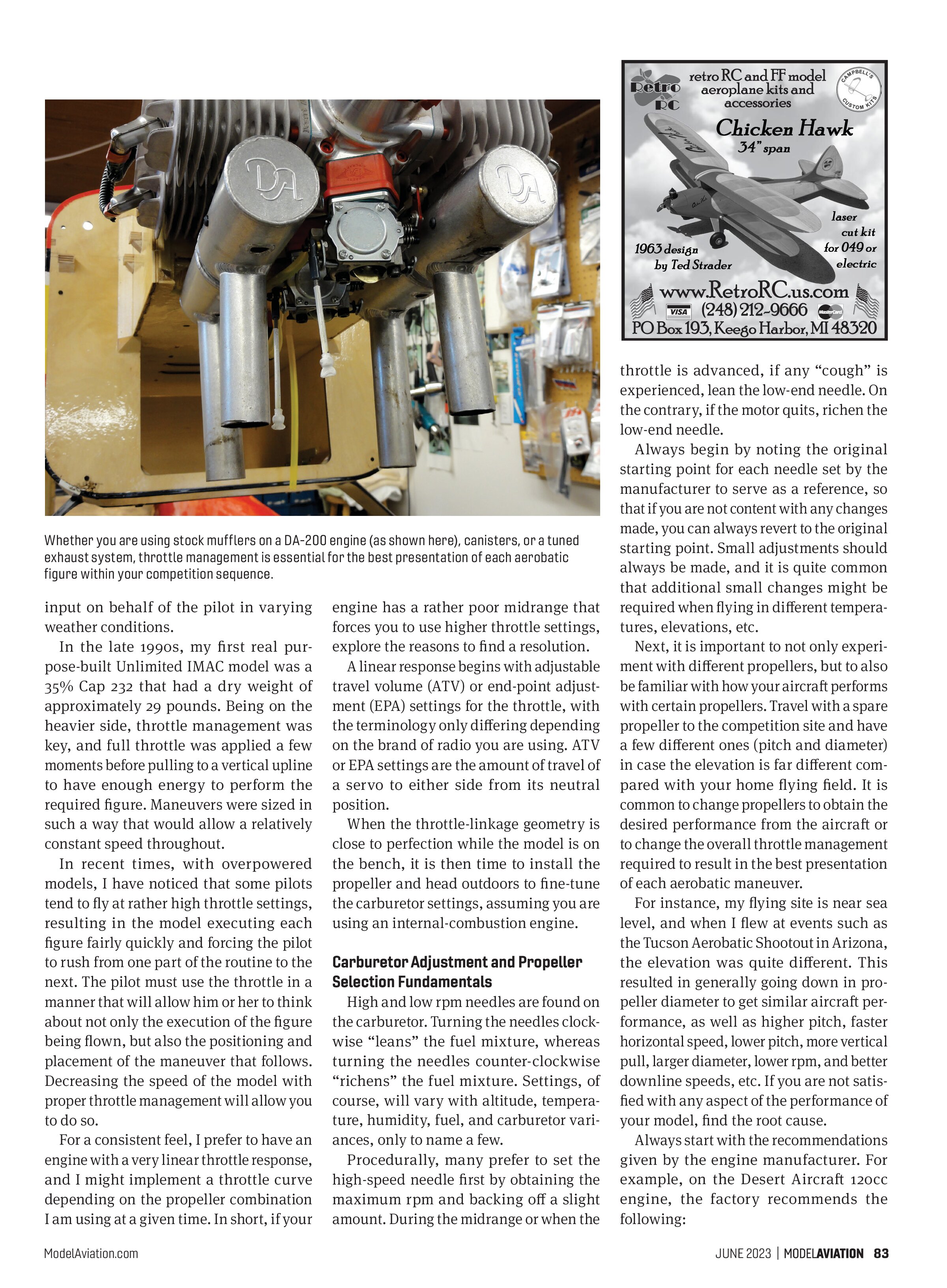
Whether you are using stock mufflers on a DA-200 engine (as shown here), canisters, or a tuned exhaust system, throttle management is essential for the best presentation of each aerobatic figure within your competition sequence.
input on behalf of the pilot in varying weather conditions.
In the late 1990s, my first real purpose-built Unlimited IMAC model was a 35% Cap 232 that had a dry weight of approximately 29 pounds. Being on the heavier side, throttle management was key, and full throttle was applied a few moments before pulling to a vertical upline to have enough energy to perform the required figure. Maneuvers were sized in such a way that would allow a relatively constant speed throughout.
In recent times, with overpowered models, I have noticed that some pilots tend to fly at rather high throttle settings, resulting in the model executing each figure fairly quickly and forcing the pilot to rush from one part of the routine to the next. The pilot must use the throttle in a manner that will allow him or her to think about not only the execution of the figure being flown, but also the positioning and placement of the maneuver that follows. Decreasing the speed of the model with proper throttle management will allow you to do so.
For a consistent feel, I prefer to have an engine with a very linear throttle response, and I might implement a throttle curve depending on the propeller combination I am using at a given time. In short, if your engine has a rather poor midrange that forces you to use higher throttle settings, explore the reasons to find a resolution.
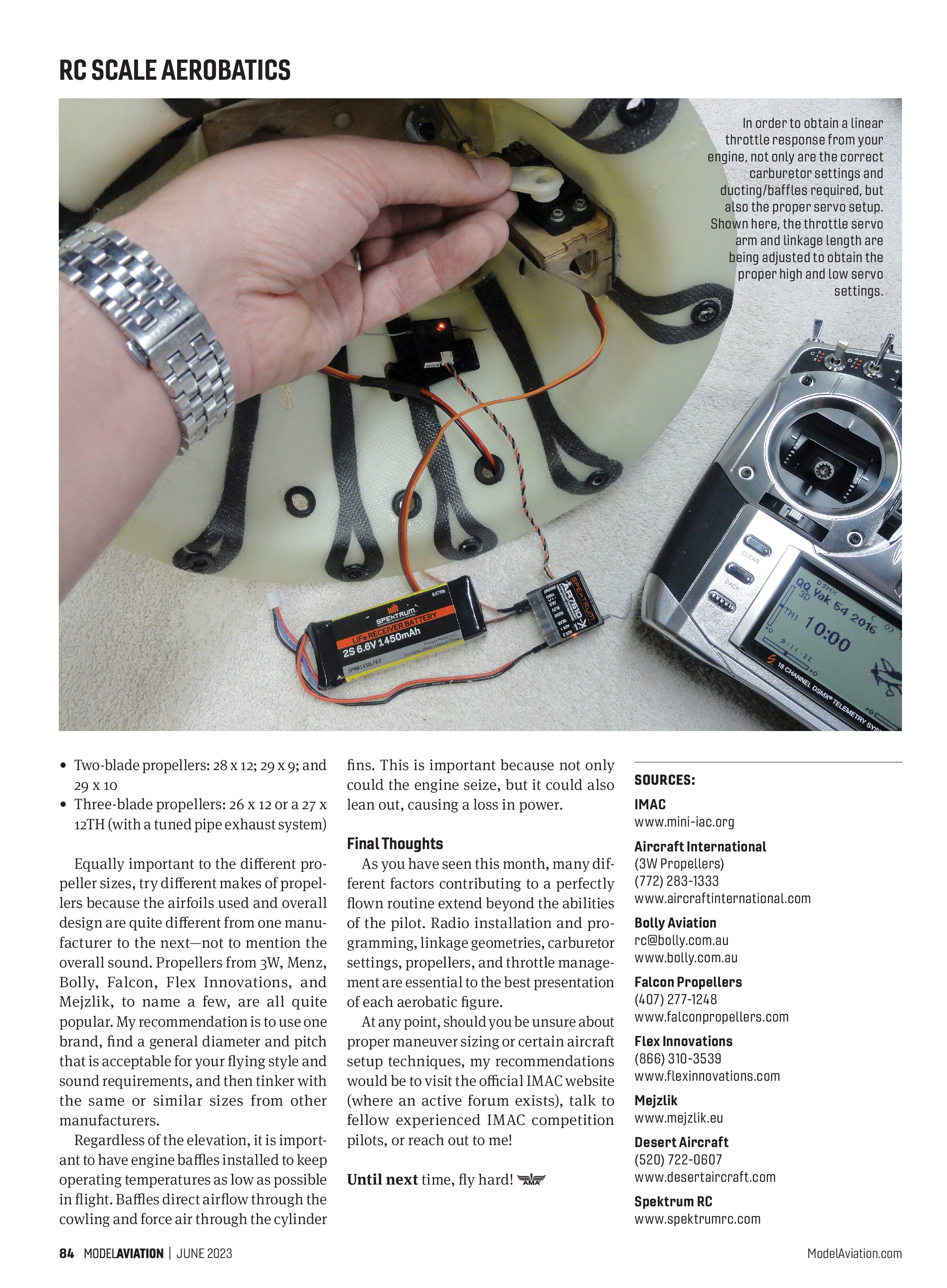
A linear response begins with adjustable travel volume (ATV) or end-point adjustment (EPA) settings for the throttle, with the terminology only differing depending on the brand of radio you are using. ATV or EPA settings are the amount of travel of a servo to either side from its neutral position.
When the throttle-linkage geometry is close to perfection while the model is on the bench, it is then time to install the propeller and head outdoors to fine-tune the carburetor settings, assuming you are using an internal-combustion engine.
Carburetor Adjustment and Propeller Selection Fundamentals
High and low rpm needles are found on the carburetor. Turning the needles clockwise “leans” the fuel mixture, whereas turning the needles counter-clockwise “richens” the fuel mixture. Settings, of course, will vary with altitude, temperature, humidity, fuel, and carburetor variances, only to name a few.
Procedurally, many prefer to set the high-speed needle first by obtaining the maximum rpm and backing off a slight amount. During the midrange or when the throttle is advanced, if any “cough” is experienced, lean the low-end needle. On the contrary, if the motor quits, richen the low-end needle.
Always begin by noting the original starting point for each needle set by the manufacturer to serve as a reference, so that if you are not content with any changes made, you can always revert to the original starting point. Small adjustments should always be made, and it is quite common that additional small changes might be required when flying in different temperatures, elevations, etc.
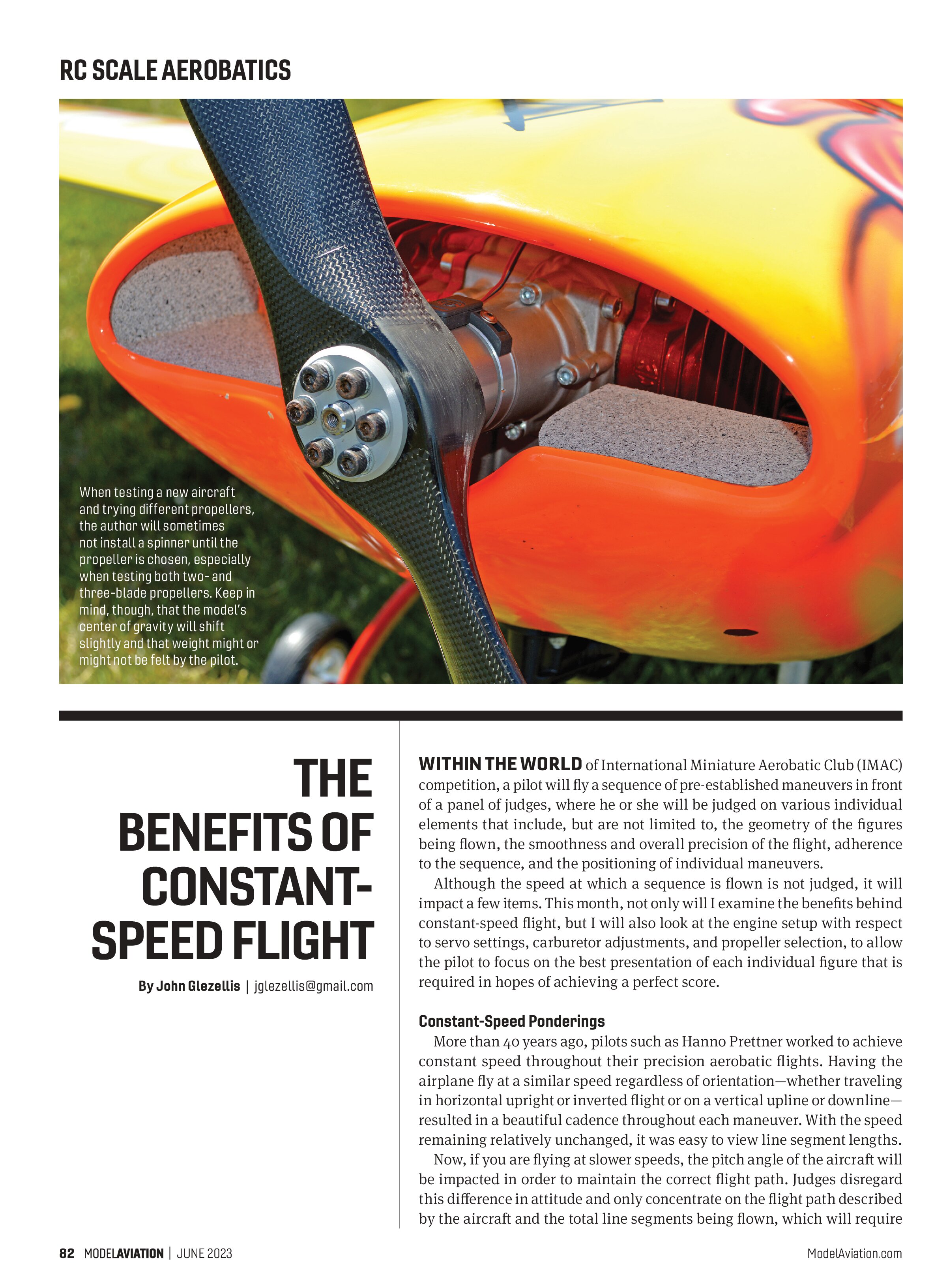
Next, it is important to not only experiment with different propellers, but to also be familiar with how your aircraft performs with certain propellers. Travel with a spare propeller to the competition site and have a few different ones (pitch and diameter) in case the elevation is far different compared with your home flying field. It is common to change propellers to obtain the desired performance from the aircraft or to change the overall throttle management required to result in the best presentation of each aerobatic maneuver.
For instance, my flying site is near sea level, and when I flew at events such as the Tucson Aerobatic Shootout in Arizona, the elevation was quite different. This resulted in generally going down in propeller diameter to get similar aircraft performance, as well as higher pitch, faster horizontal speed, lower pitch, more vertical pull, larger diameter, lower rpm, and better downline speeds, etc. If you are not satisfied with any aspect of the performance of your model, find the root cause.
Always start with the recommendations given by the engine manufacturer. For example, on the Desert Aircraft 120cc engine, the factory recommends the following:

- Two-blade propellers: 28 x 12; 29 x 9; and 29 x 10
- Three-blade propellers: 26 x 12 or a 27 x 12TH (with a tuned pipe exhaust system)
Equally important to the different propeller sizes, try different makes of propellers because the airfoils used and overall design are quite different from one manufacturer to the next—not to mention the overall sound. Propellers from 3W, Menz, Bolly, Falcon, Flex Innovations, and Mejzlik, to name a few, are all quite popular. My recommendation is to use one brand, find a general diameter and pitch that is acceptable for your flying style and sound requirements, and then tinker with the same or similar sizes from other manufacturers.
Regardless of the elevation, it is important to have engine baffles installed to keep operating temperatures as low as possible in flight. Baffles direct airflow through the cowling and force air through the cylinder fins. This is important because not only could the engine seize, but it could also lean out, causing a loss in power.
Final Thoughts
As you have seen this month, many different factors contributing to a perfectly flown routine extend beyond the abilities of the pilot. Radio installation and programming, linkage geometries, carburetor settings, propellers, and throttle management are essential to the best presentation of each aerobatic figure.
At any point, should you be unsure about proper maneuver sizing or certain aircraft setup techniques, my recommendations would be to visit the official IMAC website (where an active forum exists), talk to fellow experienced IMAC competition pilots, or reach out to me!
Until next time, fly hard!
SOURCES:
IMAC
www.mini-iac.org
Aircraft International
(3W Propellers)
(772) 283-1333
www.aircraftinternational.com
Bolly Aviation
rc@bolly.com.au
www.bolly.com.au
Falcon Propellers
(407) 277-1248
www.falconpropellers.com
Flex Innovations
(866) 310-3539
www.flexinnovations.com
Mejzlik
www.mejzlik.eu
Desert Aircraft
(520) 722-0607
www.desertaircraft.com
Spektrum RC
www.spektrumrc.com