RC HELICOPTERS

TRON 5.8 HELICOPTER
By James Wang | heloeditor@gmail.com
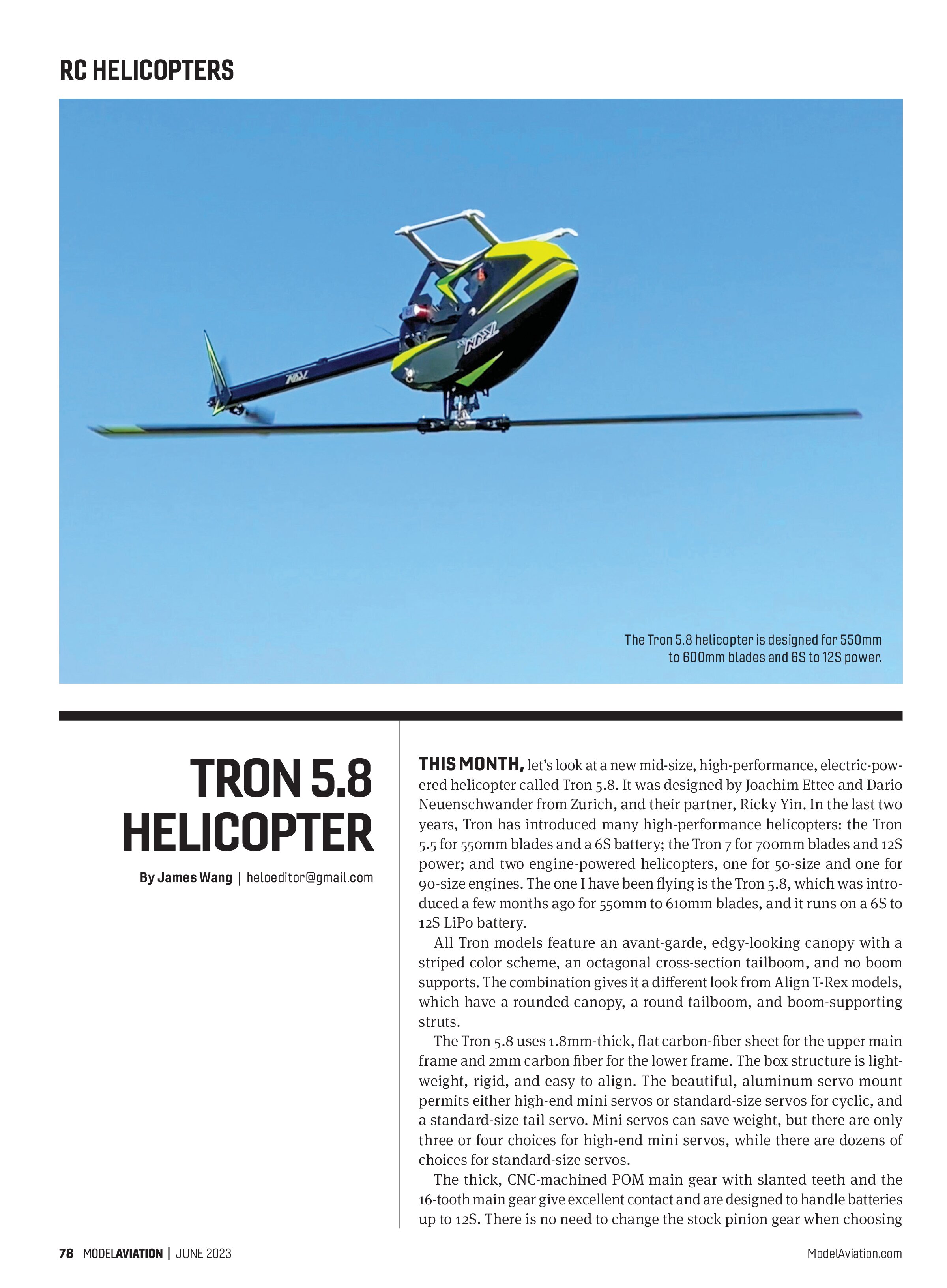
THIS MONTH, let’s look at a new mid-size, high-performance, electric-powered helicopter called Tron 5.8. It was designed by Joachim Ettee and Dario Neuenschwander from Zurich, and their partner, Ricky Yin. In the last two years, Tron has introduced many high-performance helicopters: the Tron 5.5 for 550mm blades and a 6S battery; the Tron 7 for 700mm blades and 12S power; and two engine-powered helicopters, one for 50-size and one for 90-size engines. The one I have been flying is the Tron 5.8, which was introduced a few months ago for 550mm to 610mm blades, and it runs on a 6S to 12S LiPo battery.
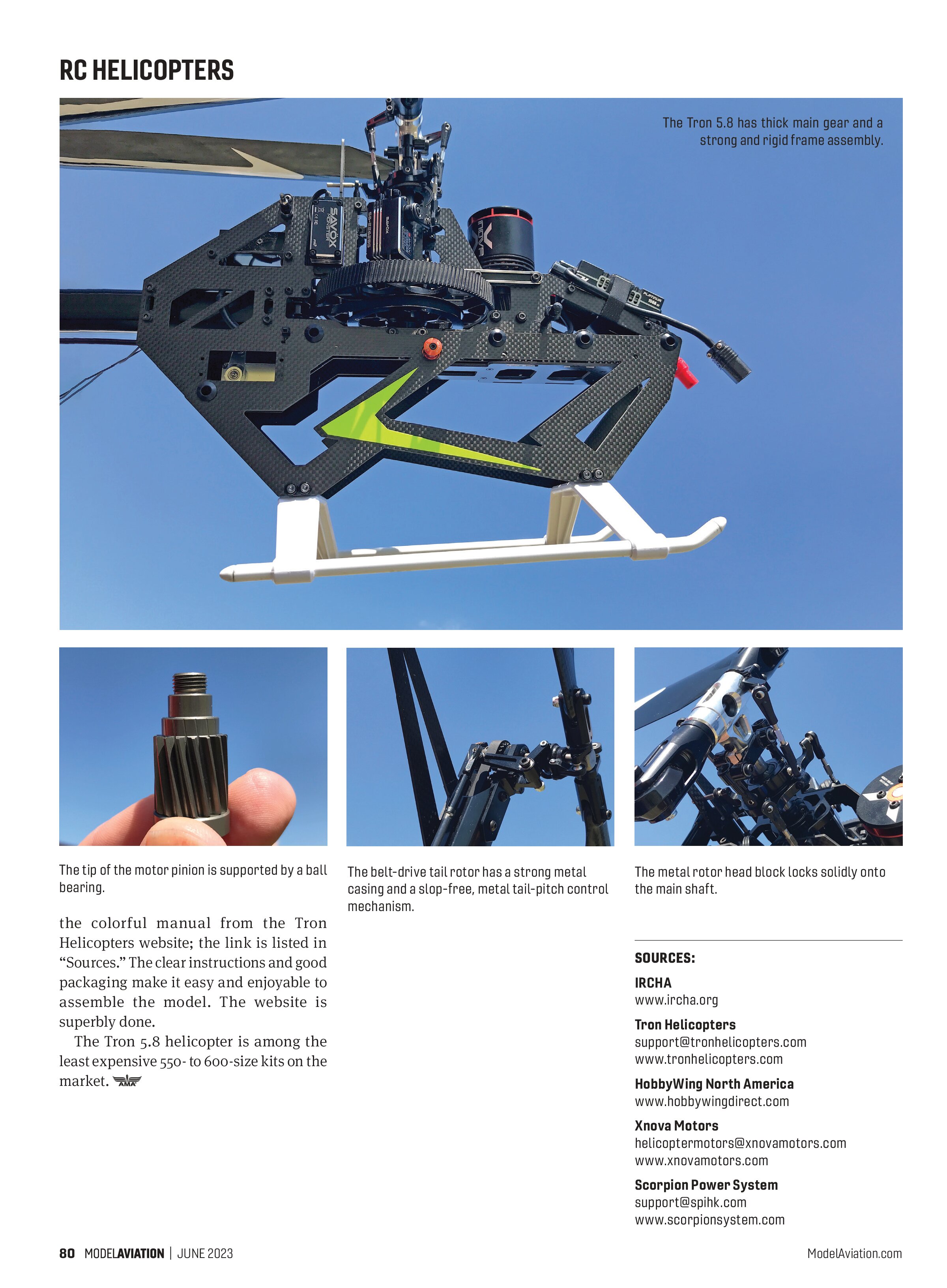
All Tron models feature an avant-garde, edgy-looking canopy with a striped color scheme, an octagonal cross-section tailboom, and no boom supports. The combination gives it a different look from Align T-Rex models, which have a rounded canopy, a round tailboom, and boom-supporting struts.
The Tron 5.8 uses 1.8mm-thick, flat carbon-fiber sheet for the upper main frame and 2mm carbon fiber for the lower frame. The box structure is lightweight, rigid, and easy to align. The beautiful, aluminum servo mount permits either high-end mini servos or standard-size servos for cyclic, and a standard-size tail servo. Mini servos can save weight, but there are only three or four choices for high-end mini servos, while there are dozens of choices for standard-size servos.
The thick, CNC-machined POM main gear with slanted teeth and the 16-tooth main gear give excellent contact and are designed to handle batteries up to 12S. There is no need to change the stock pinion gear when choosing 6S or 12S power. I use an Xnova 4025-size motor with 1,120 Kv for a 6S battery and a HobbyWing 120-amp 6S ESC. I recommend installing the capacitor that comes with the HobbyWing ESC because it prevents the receiver from a brownout when the servos are working vigorously during 3D flying and drawing a lot of current from the ESC’s BEC.
For either Xnova or Scorpion motors, I recommend the 4025 size and not the 4020 size, because the stator for 4025 is 5mm taller and yields more power. For 12S LiPo power, simply use the stock pinion with 500 to 560 Kv motors.
My Tron 5.8 with a 6S 5,000 mAh battery, 600mm main blades, and 95mm tail blades gives a 4-minute flight when pushed hard and a 6-minute flight when doing big-air aerobatics. With 600mm blades, the model feels light and floats when doing an auto-rotation. I use 1,650 rpm for Normal mode, 1,850 rpm for Idle-Up 1, and 2,050 rpm for Idle-Up 2. Don’t run too high of a rotor speed with 600mm blades and 6S power, because that combination could draw too much current and bubble up the battery or overheat the ESC.
I have also tested 560mm blades with Idle-Up 1 at 2,000 rpm and Idle-Up 2 at 2,200 rpm, and the model was very agile. You need to test both combinations to feel the handling difference then decide which suits your flying style. Blades at 580mm could be ideal, but there are fewer choices of 580mm blades.
The Tron 5.8 is a well-engineered and manufactured helicopter. The CNC-machined parts and hardware bolts are of excellent quality. I love the rugged one-way bearing on the main rotor shaft, the extra support bearing, the innovative rubber-dampened gyro mount, the quick-release locking battery tray, the adjustable free-play swashplate, the strong antirotation scissor link, and the responsive handling. All ball links fit the steel balls. The ball bearings work smoothly, and after assembly, the shafts and moving components have no free play. The turnbuckle link is used for the pushrod connecting the servos, and the swashplate allows easy adjustment for the pushrod length.
Tron kits do not include the main or tail blades. It weighs 3.3 pounds without battery and blades, which helps give the lively performance. You must download

6S or 12S power. I use an Xnova 4025-size motor with 1,120 Kv for a 6S battery and a HobbyWing 120-amp 6S ESC. I recommend installing the capacitor that comes with the HobbyWing ESC because it prevents the receiver from a brownout when the servos are working vigorously during 3D flying and drawing a lot of current from the ESC’s BEC.


the colorful manual from the Tron Helicopters website; the link is listed in “Sources.” The clear instructions and good packaging make it easy and enjoyable to assemble the model. The website is superbly done.
The Tron 5.8 helicopter is among the least expensive 550- to 600-size kits on the market.
SOURCES:
IRCHA
www.ircha.org
Tron Helicopters
support@tronhelicopters.com
www.tronhelicopters.com
HobbyWing North America
www.hobbywingdirect.com
Xnova Motors
helicoptermotors@xnovamotors.com
www.xnovamotors.com
Scorpion Power System
support@spihk.com
www.scorpionsystem.com