SELDOM-MODELED AERIAL ODDITY
By Sal Calvagna | rcgiants@optonline.net

WELCOME BACK. Winter is a distant memory and we’re well into the 2023 flying season. I hope it’s a great season for all of our readers. This month’s column features an aerial oddity that’s seldom modeled for good reason, a beautiful turboprop, and a radial-powered Butcher Bird. Enjoy!
1932 Stipa-Caproni
Rich Feroldi, of Winter Springs, Florida, is well known for his many beautifully constructed and finished Giant Scale World War I-era aircraft. It must be the attraction of stick-built, cloth-covered tail-draggers that are festooned with wires to keep them from falling apart. Every year, Rich, along with his extended family, attends the annual Mid-Hudson Radio Control Society Rhinebeck Jamboree, held at the Old Rhinebeck Aerodrome in Red Hook, New York. He’s also a frequent competitor in the Top Gun Invitational competition that is held in Lakeland, Florida.
You must imagine the surprise when he showed up at the Old Rhinebeck Aerodrome in 2022 with one of the ugliest aircraft ever designed: a 1932 Stipa-Caproni. Rich built the model using his own plans, three-views, and some historical data. It is 1/4 scale, spans 140 inches, weighs 39 pounds, and is powered by a DLE-62 gas engine. The wing is covered with Sig Koverall and the fuselage is covered with 1/32-inch aircraft-grade plywood. The model is painted using a combination of Home Depot exterior latex and Rust-Oleum paints. The markings are by Callie Graphics.
The full-scale aircraft was an experimental design in 1932 by Luigi Stipa and built by the Caproni Aircraft Company. It featured a round, hollow fuselage, where the pilot and copilot rode on top in an aerodynamic-shaped nacelle. The engine and propeller were completely enclosed in the fuselage, making it a sort of ducted-fan configuration.
Luigi’s idea was to test Bernoulli’s principle of fluid movements to make the propeller more efficient. While test flights proved the aircraft to be extremely stable, its performance was no better than a conventional aircraft. The Italian Royal Air Force, Regia Aeronautica, canceled further development.
Rich did a great job recreating the Stipa-Caproni. I just wish that I could have taken some flight shots.
PC-21 and Fw 190
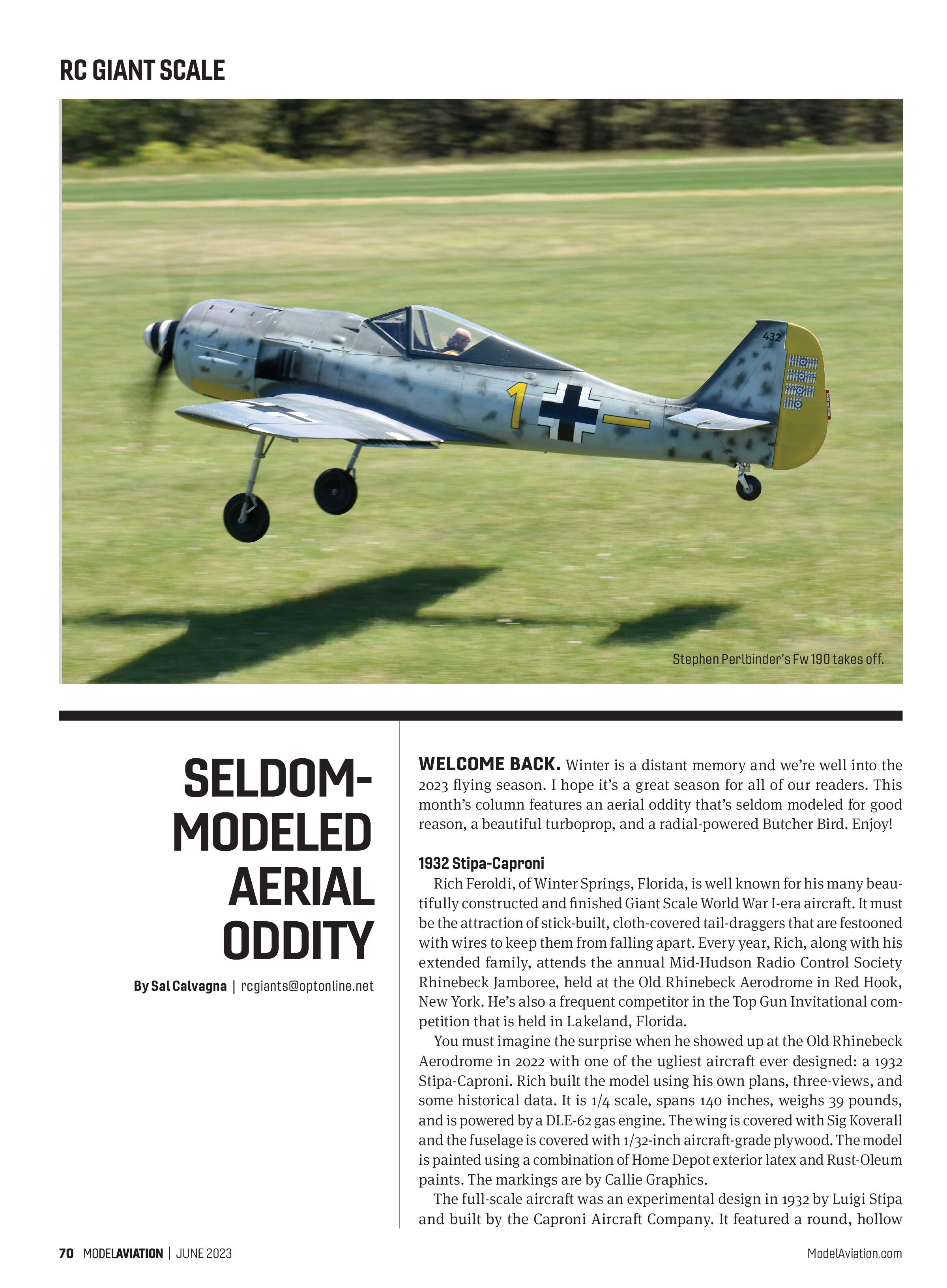
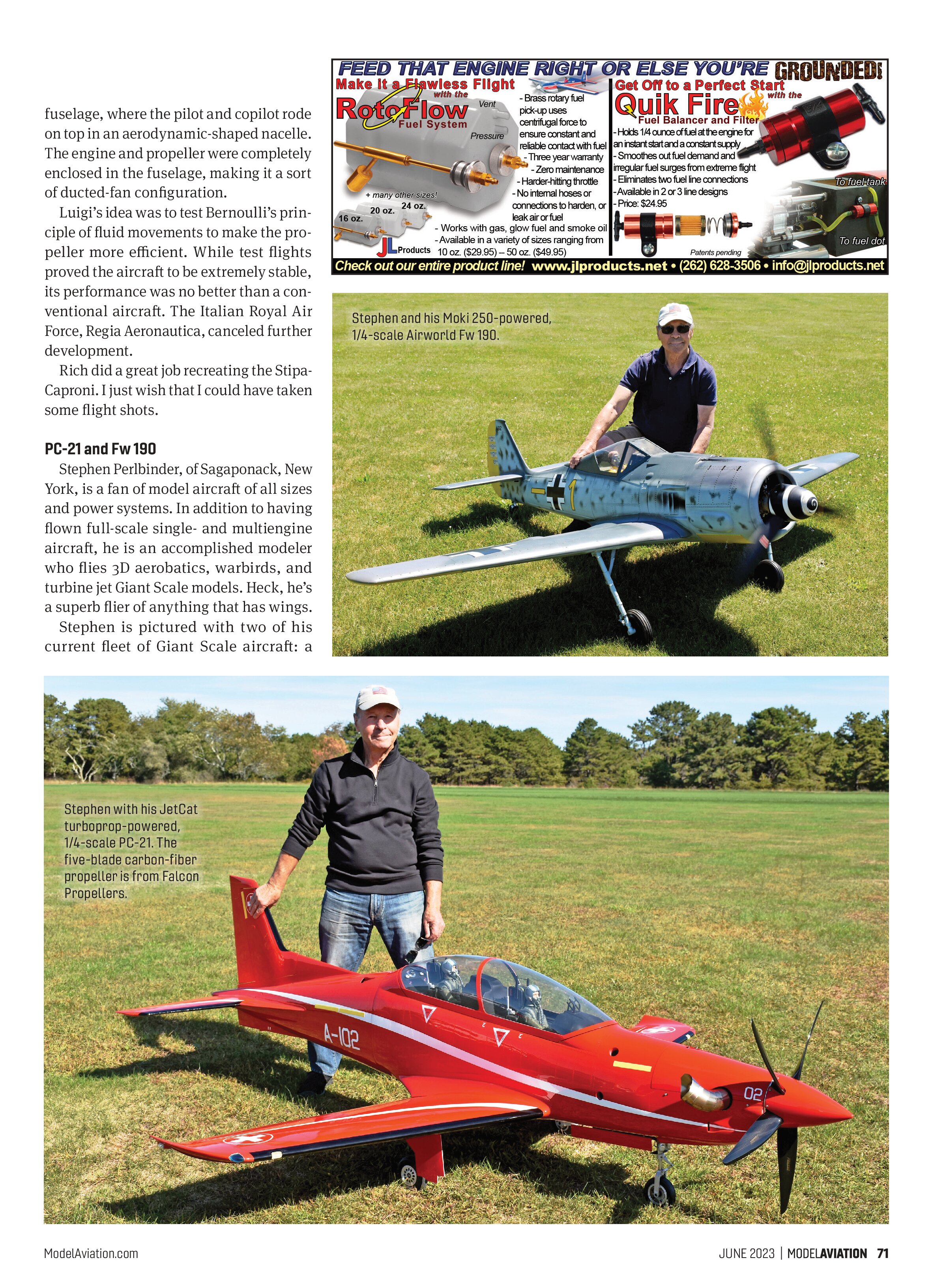
Stephen Perlbinder, of Sagaponack, New York, is a fan of model aircraft of all sizes and power systems. In addition to having flown full-scale single- and multiengine aircraft, he is an accomplished modeler who flies 3D aerobatics, warbirds, and turbine jet Giant Scale models. Heck, he’s a superb flier of anything that has wings.
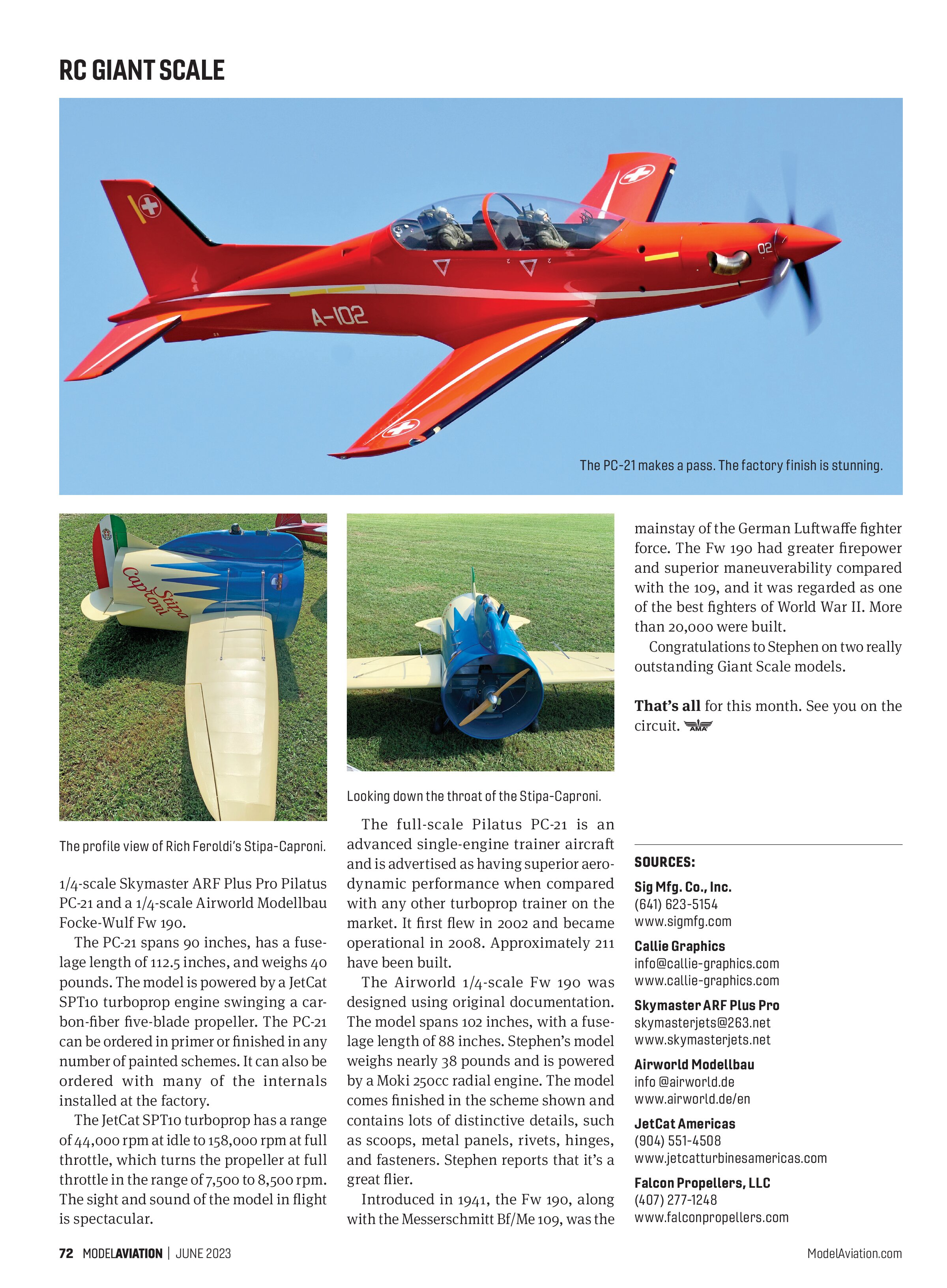
Stephen is pictured with two of his current fleet of Giant Scale aircraft: a


1/4-scale Skymaster ARF Plus Pro Pilatus PC-21 and a 1/4-scale Airworld Modellbau Focke-Wulf Fw 190.
The PC-21 spans 90 inches, has a fuselage length of 112.5 inches, and weighs 40 pounds. The model is powered by a JetCat SPT10 turboprop engine swinging a carbon-fiber five-blade propeller. The PC-21 can be ordered in primer or finished in any number of painted schemes. It can also be ordered with many of the internals installed at the factory.
The JetCat SPT10 turboprop has a range of 44,000 rpm at idle to 158,000 rpm at full throttle, which turns the propeller at full throttle in the range of 7,500 to 8,500 rpm. The sight and sound of the model in flight is spectacular.
mainstay of the German Luftwaffe fighter force. The Fw 190 had greater firepower and superior maneuverability compared with the 109, and it was regarded as one of the best fighters of World War II. More than 20,000 were built.
Congratulations to Stephen on two really outstanding Giant Scale models.
That’s all for this month. See you on the circuit.

The full-scale Pilatus PC-21 is an advanced single-engine trainer aircraft and is advertised as having superior aerodynamic performance when compared with any other turboprop trainer on the market. It first flew in 2002 and became operational in 2008. Approximately 211 have been built.
The Airworld 1/4-scale Fw 190 was designed using original documentation. The model spans 102 inches, with a fuselage length of 88 inches. Stephen’s model weighs nearly 38 pounds and is powered by a Moki 250cc radial engine. The model comes finished in the scheme shown and contains lots of distinctive details, such as scoops, metal panels, rivets, hinges, and fasteners. Stephen reports that it’s a great flier.
Introduced in 1941, the Fw 190, along with the Messerschmitt Bf/Me 109, was the mainstay of the German Luftwaffe fighter force. The Fw 190 had greater firepower and superior maneuverability compared with the 109, and it was regarded as one of the best fighters of World War II. More than 20,000 were built.
Congratulations to Stephen on two really outstanding Giant Scale models.
That’s all for this month. See you on the circuit.
SOURCES:
Sig Mfg. Co., Inc.
(641) 623-5154
www.sigmfg.com
Callie Graphics
info@callie-graphics.com
www.callie-graphics.com
Skymaster ARF Plus Pro
skymasterjets@263.net
www.skymasterjets.net
Airworld Modellbau
info@airworld.de
www.airworld.de/en
JetCat Americas
(904) 551-4508
www.jetcatturbinesamericas.com
Falcon Propellers, LLC
(407) 277-1248
www.falconpropellers.com