WORKING WITH THE FAA
By Bob Angel | samrcflier@verizon.net

AMA AND THE FAA have successfully worked out a path to reduce adverse impacts on a large number of RC model pilots by eliminating the burdensome requirement of adding a new piece of electronics equipment to every RC model airplane so that they can be identified and tracked precisely during flight.
By establishing FAA-Recognized Identification Areas (FRIAs), a club can eliminate the necessity of having to install such equipment in every model flown. I’m addressing this here because many builders of Old-Timer (OT) RC models have a large accumulation of historic aircraft, each of which would otherwise have to have new electronic equipment added before flying.
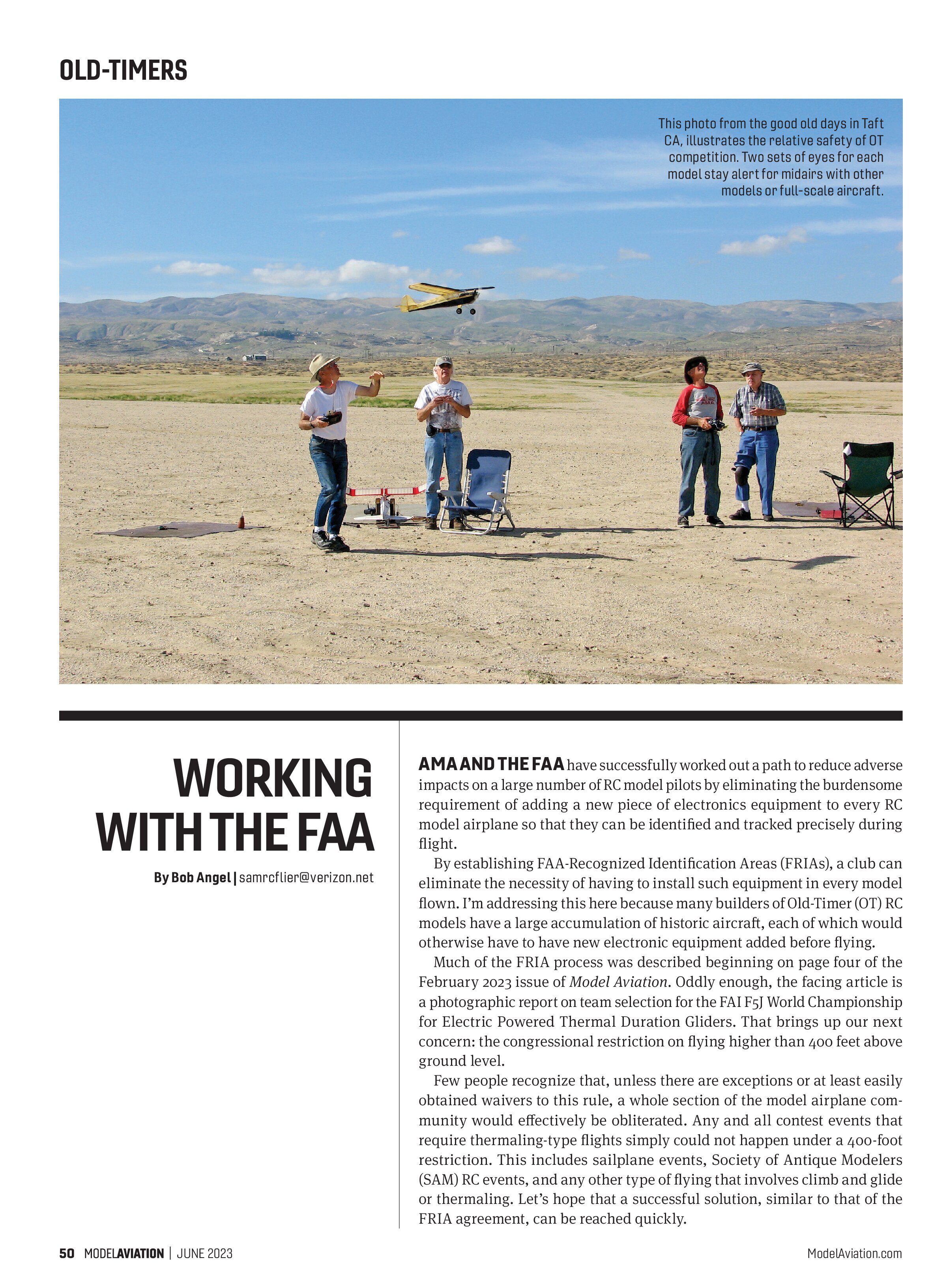
Much of the FRIA process was described beginning on page four of the February 2023 issue of Model Aviation. Oddly enough, the facing article is a photographic report on team selection for the FAI F5J World Championship for Electric Powered Thermal Duration Gliders. That brings up our next concern: the congressional restriction on flying higher than 400 feet above ground level.
Few people recognize that, unless there are exceptions or at least easily obtained waivers to this rule, a whole section of the model airplane community would effectively be obliterated. Any and all contest events that require thermaling-type flights simply could not happen under a 400-foot restriction. This includes sailplane events, Society of Antique Modelers (SAM) RC events, and any other type of flying that involves climb and glide or thermaling. Let’s hope that a successful solution, similar to that of the FRIA agreement, can be reached quickly.
Meanwhile, earlier this year, I had to cancel what would have been the 48th annual running of the historic John Pond Commemorative OT/RC contest because of the convergence of the FRIA agreement and the 400-foot altitude limit. Our local SAM chapter had, like many other model clubs, progressively been pushed out of various flying sites because of “progress” and population growth. As a result, we currently do not have a home flying field, but we’ve been well treated for several years as guests of a friendly RC club that has a large, rural field suitable for our contests.
We’d gotten an okay from our hosts for this year’s contest date to be held in late March, and we had also obtained our AMA sanction. Meanwhile, our host field applied for FRIA status while some in the club’s current leadership might have been unaware at first that our events regularly required flying well above that 400-foot zone. They also felt that the current status of the 400-foot limitation was presently unclear and any violation might well hamper their FRIA approval. Should an incident of any kind occur, they were also concerned about legal liability.
As guests, we shared their concern and certainly couldn’t dismiss it. Under legal advice and an abundance of caution, our host club rightfully insisted on seeing some positive form of proof of the exception to the 400-foot rule, at which time we’d be welcome to proceed with our contest.
By using this column space, I’m seeking to resolve the problem of exactly where all RC Soaring groups sit with respect to the 400-foot rule at the moment. I had hoped that our little problem was temporary and was limited to our group. I also hoped that I might have just overlooked something that could be simply clarified by a reader. In any case, I had anticipated that, by the time you read this, we might have solved our problem and conducted our contest, or at least had it rescheduled.
Much, or possibly most, new legislation is enacted with a later date attached to it, at which time it becomes effective for enforcement. I looked for such a date for the 400-foot rule. I began searching the internet and found voluminous coverage about the new FAA rules on “drones” and other unmanned aerial vehicles in the congressional records. If it’s been published, however, I simply didn’t find it. It’s possible that it just hasn’t yet been established.
The timing was becoming tight, and our contest date was approaching, so I had to cancel the sanction while we could still get the word out to potential attendees in time to change plans, cancel motel reservations, etc. Unfortunately, timing was also so tight that I don’t have answers to the final outcome just yet, but I hope to

provide an update in my next column.
I requested information on the rule from Tyler Dobbs, the principal AMA Government Affairs representative to the FAA. Tyler was quite busy in Washington, D.C., for a week or more, but meanwhile, AMA President Rich Hanson informed me that an announcement was forthcoming as an initial step in mitigating the altitude restriction.
Indeed it was, because the very next day, Tyler appeared on the AMA website announcing that the 400-foot altitude limit could be immediately extended to as high as 1,200 feet as part of contest sanctions (see “Sources” for a link to the video).
Those new altitude limitations seem high enough to routinely allow such things as an RC Aerobatics competition and ducted-fan events. Exceptions higher than 1,200 feet were also mentioned, but further specifics are apparently still being worked out. It might be that 1,200 feet is still not high enough to cover all thermal competition under some existing rules and model types.
Hazard Comparison
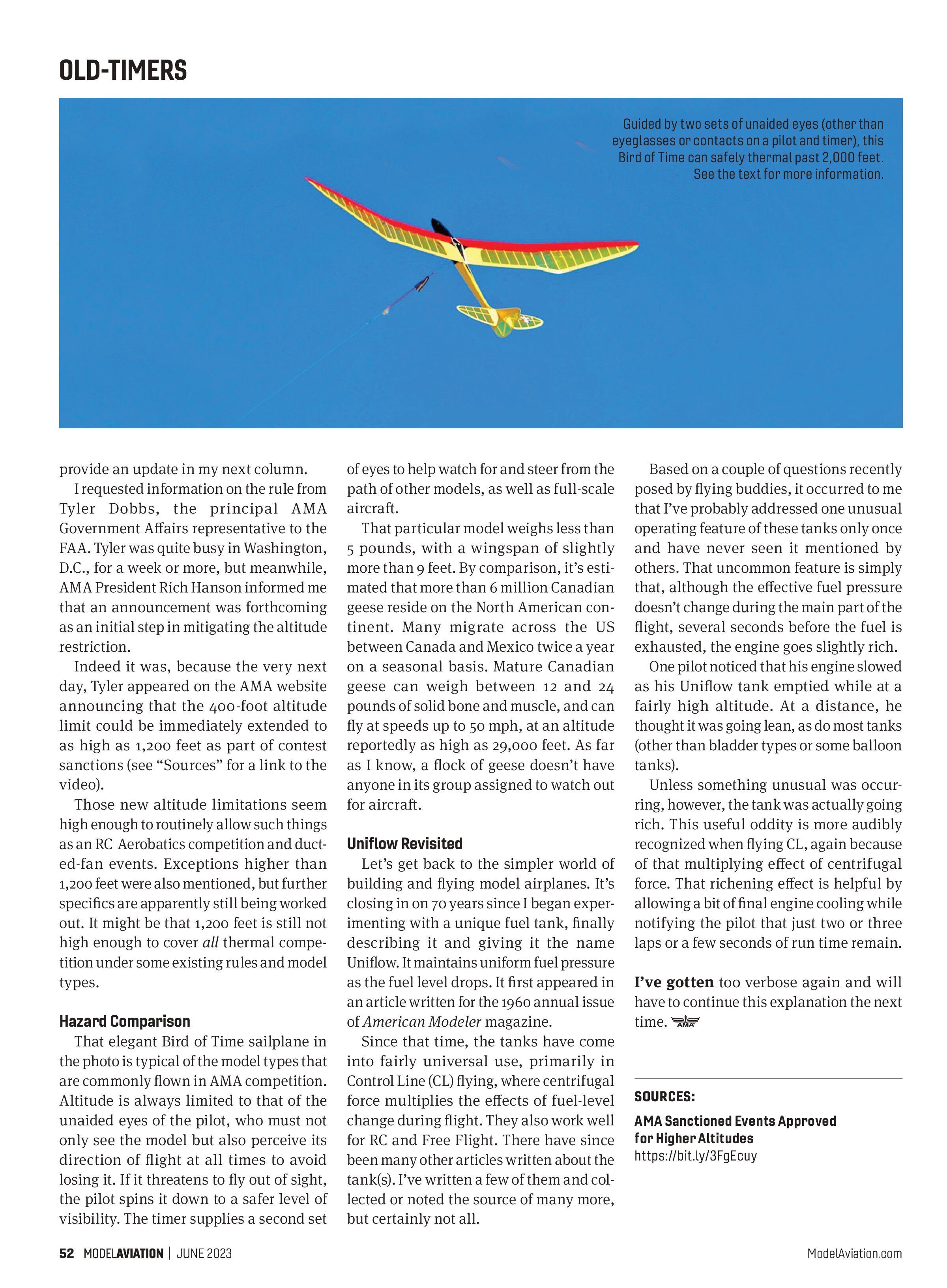
That elegant Bird of Time sailplane in the photo is typical of the model types that are commonly flown in AMA competition. Altitude is always limited to that of the unaided eyes of the pilot, who must not only see the model but also perceive its direction of flight at all times to avoid losing it. If it threatens to fly out of sight, the pilot spins it down to a safer level of visibility. The timer supplies a second set of eyes to help watch for and steer from the path of other models, as well as full-scale aircraft.
That particular model weighs less than 5 pounds, with a wingspan of slightly more than 9 feet. By comparison, it’s estimated that more than 6 million Canadian geese reside on the North American continent. Many migrate across the US between Canada and Mexico twice a year on a seasonal basis. Mature Canadian geese can weigh between 12 and 24 pounds of solid bone and muscle, and can fly at speeds up to 50 mph, at an altitude reportedly as high as 29,000 feet. As far as I know, a flock of geese doesn’t have anyone in its group assigned to watch out for aircraft.
Uniflow Revisited
Let’s get back to the simpler world of building and flying model airplanes. It’s closing in on 70 years since I began experimenting with a unique fuel tank, finally describing it and giving it the name Uniflow. It maintains uniform fuel pressure as the fuel level drops. It first appeared in an article written for the 1960 annual issue of American Modeler magazine.
Since that time, the tanks have come into fairly universal use, primarily in Control Line (CL) flying, where centrifugal force multiplies the effects of fuel-level change during flight. They also work well for RC and Free Flight. There have since been many other articles written about the tank(s). I’ve written a few of them and collected or noted the source of many more, but certainly not all.
Based on a couple of questions recently posed by flying buddies, it occurred to me that I’ve probably addressed one unusual operating feature of these tanks only once and have never seen it mentioned by others. That uncommon feature is simply that, although the effective fuel pressure doesn’t change during the main part of the flight, several seconds before the fuel is exhausted, the engine goes slightly rich.
One pilot noticed that his engine slowed as his Uniflow tank emptied while at a fairly high altitude. At a distance, he thought it was going lean, as do most tanks (other than bladder types or some balloon tanks).
Unless something unusual was occurring, however, the tank was actually going rich. This useful oddity is more audibly recognized when flying CL, again because of that multiplying effect of centrifugal force. That richening effect is helpful by allowing a bit of final engine cooling while notifying the pilot that just two or three laps or a few seconds of run time remain.
I’ve gotten too verbose again and will have to continue this explanation the next time.
SOURCES:
AMA Sanctioned Events Approved for Higher Altitudes
https://bit.ly/3FgEcuy