FOCAL POINT
Interested in sharing your handiwork? Visit www.ModelAviation.com for submission guidelines.
Do 26 Seeadler
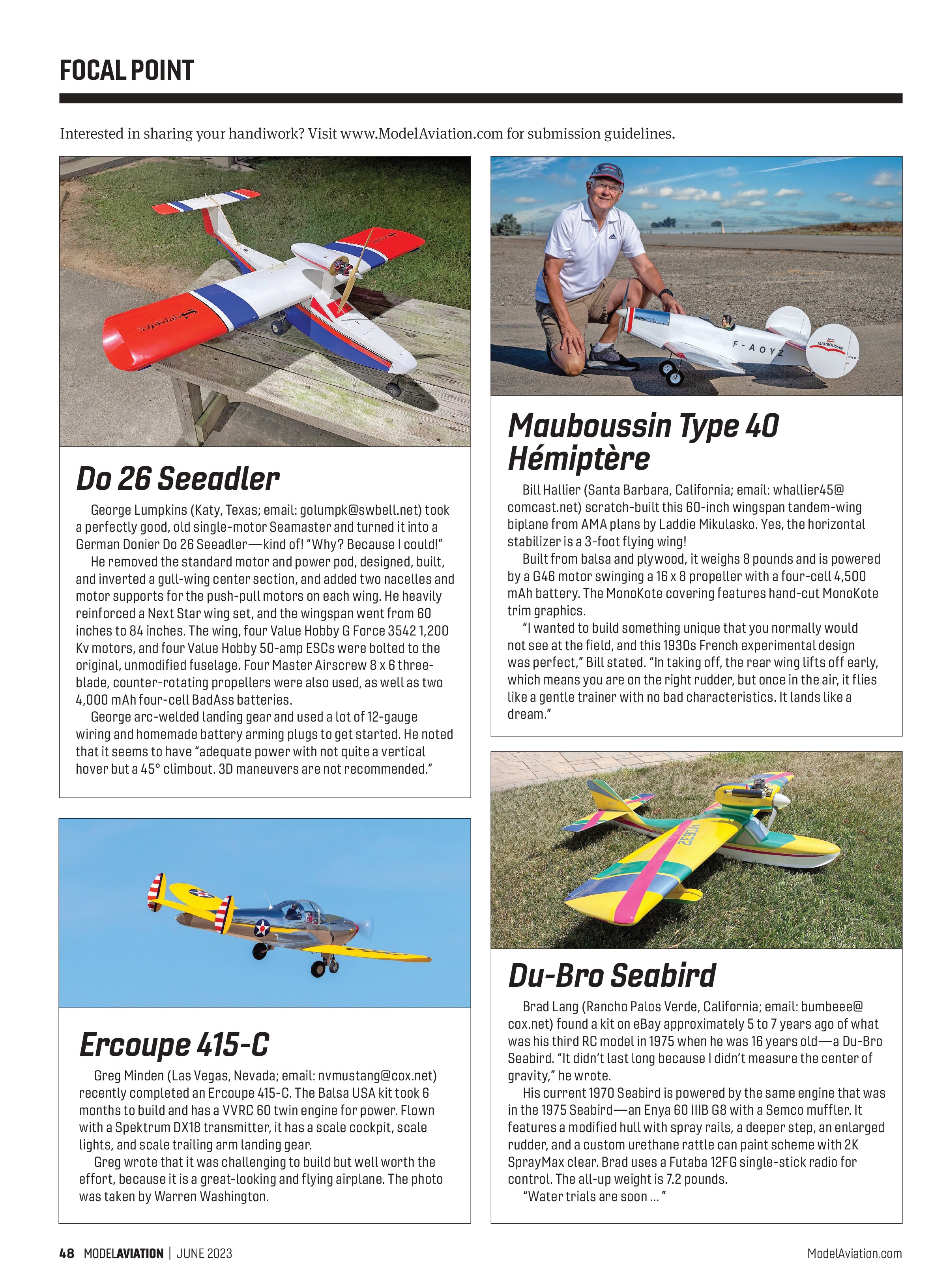
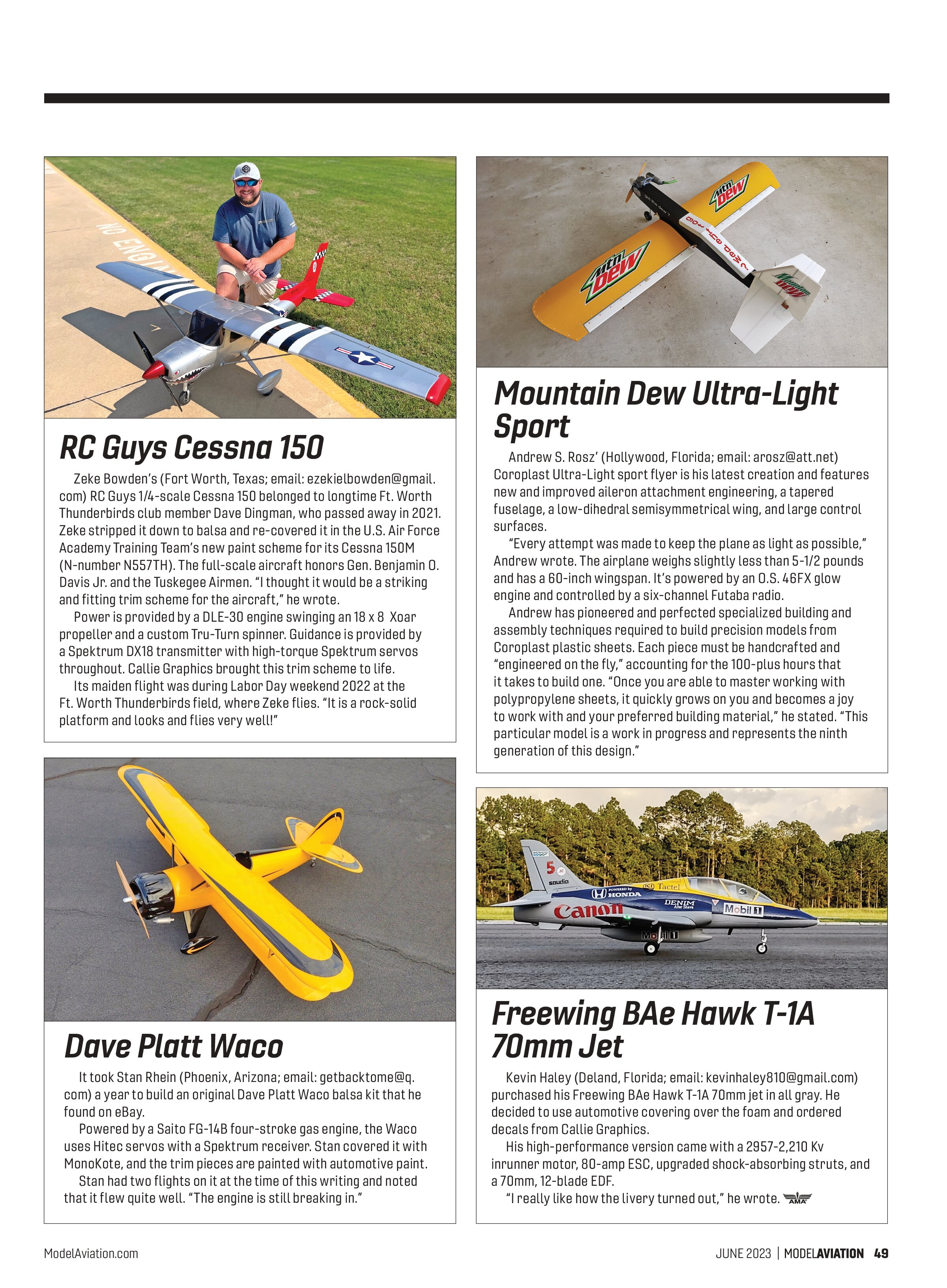
George Lumpkins (Katy, Texas; email: golumpk@swbell.net) took a perfectly good, old single-motor Seamaster and turned it into a German Dornier Do 26 Seeadler—kind of! “Why? Because I could!”
He removed the standard motor and power pod, designed, built, and inverted a gull-wing center section, and added two nacelles and motor supports for the push-pull motors on each wing. He heavily reinforced a Next Star wing set, and the wingspan went from 60 inches to 84 inches. The wing, four Value Hobby G Force 3542 1,200 Kv motors, and four Value Hobby 50-amp ESCs were bolted to the original, unmodified fuselage. Four Master Airscrew 8 x 6 three-blade, counter-rotating propellers were also used, as well as two 4,000 mAh four-cell BadAss batteries.
George arc-welded landing gear and used a lot of 12-gauge wiring and homemade battery arming plugs to get started. He noted that it seems to have “adequate power with not quite a vertical hover but a 45° climbout. 3D maneuvers are not recommended.”

Ercoupe 415-C
Greg Minden (Las Vegas, Nevada; email: nvmustang@cox.net) recently completed an Ercoupe 415-C. The Balsa USA kit took 6 months to build and has a VVRC 60 twin engine for power. Flown with a Spektrum DX18 transmitter, it has a scale cockpit, scale lights, and scale trailing arm landing gear.
Greg wrote that it was challenging to build but well worth the effort, because it is a great-looking and flying airplane. The photo was taken by Warren Washington.

Mauboussin Type 40 Hémiptère
Bill Hallier (Santa Barbara, California; email: whallier45@comcast.net) scratch-built this 60-inch wingspan tandem-wing biplane from AMA plans by Laudie Mikulasku. Yes, the horizontal stabilizer is a 3-foot flying wing!
Built from balsa and plywood, it weighs 8 pounds and is powered by a G46 motor swinging a 16 x 8 propeller with a four-cell 4,500 mAh battery. The MonoKote covering features hand-cut MonoKote trim graphics.
“I wanted to build something unique that you normally would not see at the field, and this 1930s French experimental design was perfect,” Bill stated. “In taking off, the rear wing lifts off early, which means you are on the right rudder, but once in the air, it flies like a gentle trainer with no bad characteristics. It lands like a dream.”

Du-Bro Seabird
Brad Lang (Rancho Palos Verde, California; email: bumbeee@cox.net) found a kit on eBay approximately 5 to 7 years ago of what was his third RC model in 1975 when he was 16 years old—a Du-Bro Seabird. “It didn’t last long because I didn’t measure the center of gravity,” he wrote.
His current 1970 Seabird is powered by the same engine that was in the 1975 Seabird—an Enya 60 III B G8 with a Semco muffler. It features a modified hull with spray rails, a deeper step, an enlarged rudder, and a custom urethane rattle can paint scheme with 2K SprayMax clear. Brad uses a Futaba 12FG single-stick radio for control. The all-up weight is 7.2 pounds.
“Water trials are soon ...”

RC Guys Cessna 150
Zeke Bowden’s (Fort Worth, Texas; email: ezekielbowden@gmail.com) RC Guys 1/4-scale Cessna 150 belonged to longtime Ft. Worth Thunderbirds club member Dave Dingman, who passed away in 2021. Zeke stripped it down to balsa and re-covered it in the U.S. Air Force Academy Training Team’s new paint scheme for its Cessna 150M (N-number N557TH). The full-scale aircraft honors Gen. Benjamin O. Davis Jr. and the Tuskegee Airmen. “I thought it would be a striking and fitting trim scheme for the aircraft,” he wrote.
Power is provided by a DLE-30 engine swinging an 18 x 8 Xoar propeller and a custom Tru-Turn spinner. Guidance is provided by a Spektrum DX18 transmitter with high-torque Spektrum servos throughout. Callie Graphics brought this trim scheme to life.
Its maiden flight was during Labor Day weekend 2022 at the Ft. Worth Thunderbirds field, where Zeke flies. “It is a rock-solid platform and looks and flies very well!”

Mountain Dew Ultra-Light Sport
Andrew S. Rosz’ (Hollywood, Florida; email: arosz@att.net) Coroplast Ultra-Light sport flyer is his latest creation and features new and improved aileron attachment engineering, a tapered fuselage, a low-dihedral semisymmetrical wing, and large control surfaces.
“Every attempt was made to keep the plane as light as possible,” Andrew wrote. The airplane weighs slightly less than 5-1/2 pounds and has a 60-inch wingspan. It’s powered by an O.S. 46FX glow engine and controlled by a six-channel Futaba radio.
Andrew has pioneered and perfected specialized building and assembly techniques required to build precision models from Coroplast plastic sheets. Each piece must be handcrafted and “engineered on the fly,” accounting for the 100-plus hours that it takes to build one. “Once you are able to master working with polypropylene sheets, it quickly grows on you and becomes a joy to work with and your preferred building material,” he stated. “This particular model is a work in progress and represents the ninth generation of this design.”

Dave Platt Waco
It took Stan Rhein (Phoenix, Arizona; email: getbacktome@q.com) a year to build an original Dave Platt Waco balsa kit that he found on eBay.
Powered by a Saito FG-14B four-stroke gas engine, the Waco uses Hitec servos with a Spektrum receiver. Stan covered it with MonoKote, and the trim pieces are painted with automotive paint.
Stan had two flights on it at the time of this writing and noted that it flew quite well. “The engine is still breaking in.”

Freewing BAe Hawk T-1A 70mm Jet
Kevin Haley (Deland, Florida; email: kevinhaley810@gmail.com) purchased his Freewing BAe Hawk T-1A 70mm jet in all gray. He decided to use automotive covering over the foam and ordered decals from Callie Graphics.
His high-performance version came with a 2957-2,210 Kv inrunner motor, 80-amp ESC, upgraded shock-absorbing struts, and a 70mm, 12-blade EDF.
“I really like how the livery turned out,” he wrote.