ELECTRICS
FABULOUS
READER
PROJECTS
By Terry Dunn | terrydunn74@gmail.com

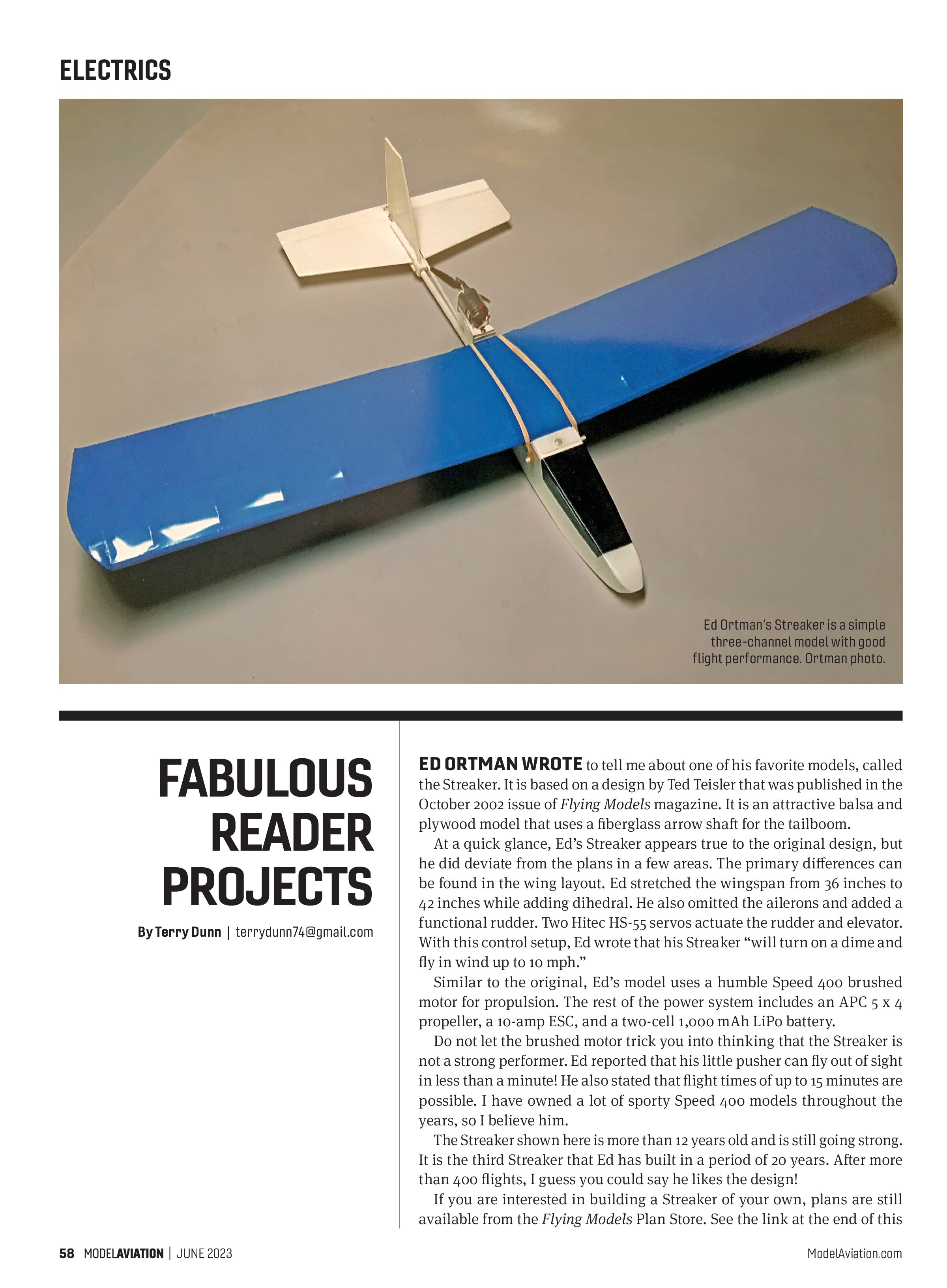
ED ORTMAN WROTE to tell me about one of his favorite models, called the Streaker. It is based on a design by Ted Teisler that was published in the October 2002 issue of Flying Models magazine. It is an attractive balsa and plywood model that uses a fiberglass arrow shaft for the tailboom.
At a quick glance, Ed’s Streaker appears true to the original design, but he did deviate from the plans in a few areas. The primary differences can be found in the wing layout. Ed stretched the wingspan from 36 inches to 42 inches while adding dihedral. He also omitted the ailerons and added a functional rudder. Two Hitec HS-55 servos actuate the rudder and elevator. With this control setup, Ed wrote that his Streaker “will turn on a dime and fly in wind up to 10 mph.”
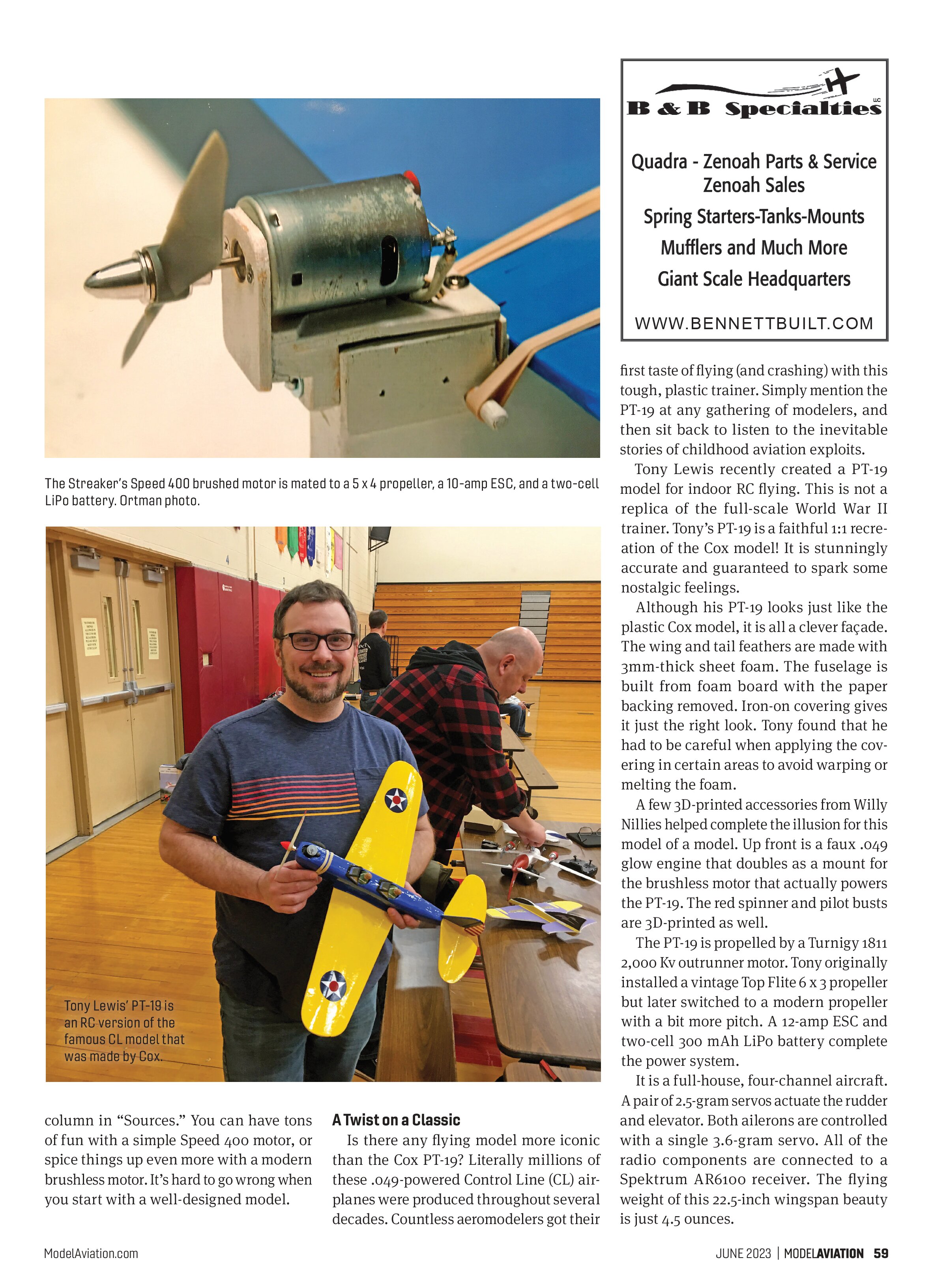
Similar to the original, Ed’s model uses a humble Speed 400 brushed motor for propulsion. The rest of the power system includes an APC 5 x 4 propeller, a 10-amp ESC, and a two-cell 1,000 mAh LiPo battery.
Do not let the brushed motor trick you into thinking that the Streaker is not a strong performer. Ed reported that his little pusher can fly out of sight in less than a minute! He also stated that flight times of up to 15 minutes are possible. I have owned a lot of sporty Speed 400 models throughout the years, so I believe him.
The Streaker shown here is more than 12 years old and is still going strong. It is the third Streaker that Ed has built in a period of 20 years. After more than 400 flights, I guess you could say he likes the design!
If you are interested in building a Streaker of your own, plans are still available from the Flying Models Plan Store. See the link at the end of this


column in “Sources.” You can have tons of fun with a simple Speed 400 motor, or spice things up even more with a modern brushless motor. It’s hard to go wrong when you start with a well-designed model.
A Twist on a Classic
Is there any flying model more iconic than the Cox PT-19? Literally millions of these .049-powered Control Line (CL) airplanes were produced throughout several decades. Countless aeromodelers got their first taste of flying (and crashing) with this tough, plastic trainer. Simply mention the PT-19 at any gathering of modelers, and then sit back to listen to the inevitable stories of childhood aviation exploits.
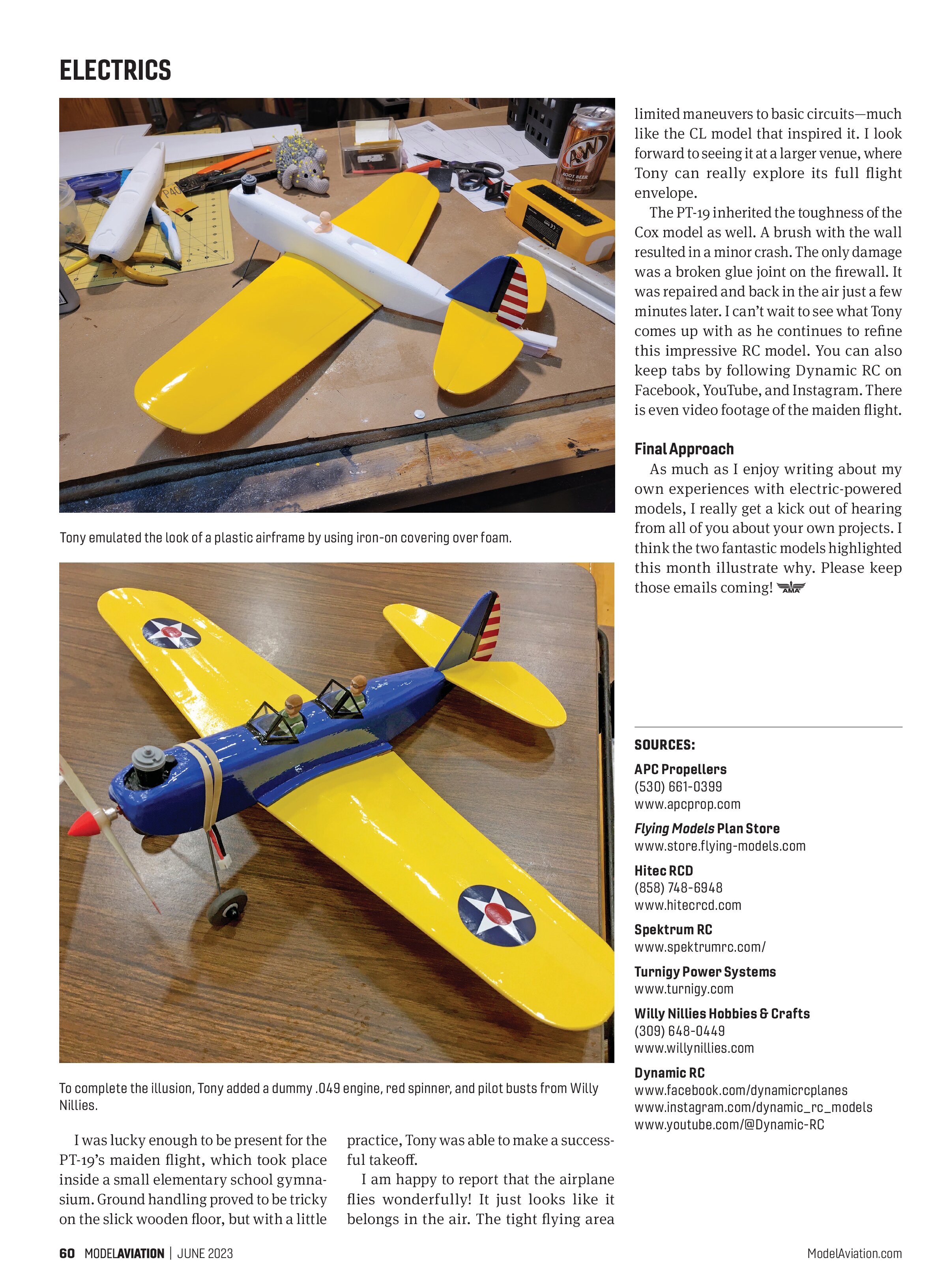
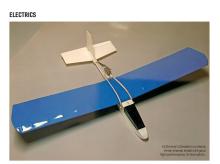
Tony Lewis recently created a PT-19 model for indoor RC flying. This is not a replica of the full-scale World War II trainer. Tony’s PT-19 is a faithful 1:1 recreation of the Cox model. It is stunningly accurate and guaranteed to spark some nostalgic feelings.
Although his PT-19 looks just like the plastic Cox model, it is all a clever façade. The wing and tail feathers are made with 3mm-thick sheet foam. The fuselage is built from foam board with the paper backing removed. Iron-on covering gives it just the right look. Tony found that he had to be careful when applying the covering in certain areas to avoid warping or melting the foam.
A few 3D-printed accessories from Willy Nillies helped complete the illusion for this model of a model. Up front is a faux .049 glow engine that doubles as a mount for the brushless motor that actually powers the PT-19. The red spinner and pilot busts are 3D-printed as well.
The PT-19 is propelled by a Turnigy 1811 2,000 Kv outrunner motor. Tony originally installed a vintage Top Flite 6 x 3 propeller but later switched to a modern propeller with a bit more pitch. A 12-amp ESC and two-cell 300 mAh LiPo battery complete the power system.
It is a full-house, four-channel aircraft. A pair of 2.5-gram servos actuate the rudder and elevator. Both ailerons are controlled with a single 3.6-gram servo. All of the radio components are connected to a Spektrum AR6100 receiver. The flying weight of this 22.5-inch wingspan beauty is just 4.5 ounces.


limited maneuvers to basic circuits—much like the CL model that inspired it. I look forward to seeing it at a larger venue, where Tony can really explore its full flight envelope.
The PT-19 inherited the toughness of the Cox model as well. A brush with the wall resulted in a minor crash. The only damage was a broken glue joint on the firewall. It was repaired and back in the air just a few minutes later. I can’t wait to see what Tony comes up with as he continues to refine this impressive RC model. You can also keep tabs by following Dynamic RC on Facebook, YouTube, and Instagram. There is even video footage of the maiden flight.
Final Approach
As much as I enjoy writing about my own experiences with electric-powered models, I really get a kick out of hearing from all of you about your own projects. I think the two fantastic models highlighted this month illustrate why. Please keep those emails coming!
I was lucky enough to be present for the PT-19’s maiden flight, which took place inside a small elementary school gymnasium. Ground handling proved to be tricky on the slick wooden floor, but with a little practice, Tony was able to make a successful takeoff.
I am happy to report that the airplane flies wonderfully! It just looks like it belongs in the air. The tight flying area
SOURCES:
APC Propellers
(530) 661-0399
www.apcprop.com
Flying Models Plan Store
www.store.flying-models.com
Hitec RCD
(858) 748-6948
www.hitecrcd.com
Spektrum RC
www.spektrumrc.com/
Turnigy Power Systems
www.turnigy.com
Willy Nillies Hobbies & Crafts
(309) 648-0449
www.willynillies.com
Dynamic RC
www.facebook.com/dynamicrcplanes
www.instagram.com/dynamic_rc_models
www.youtube.com/@Dynamic-RC