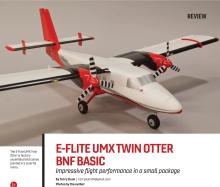
E-Flite UMX Twin Otter BNF Basic
Impressive flight performance in a small package
By Terry Dunn | terrydunn74@gmail.com
Photos by the author

SINCE ITS INTRODUCTION in 1965, the de Havilland Twin Otter has established itself as a utilitarian jack-of-all-trades. This high-wing workhorse has served in commercial and military fleets around the world, hauling passengers, cargo, and skydivers.
With double-slotted flaps and two powerful turboprop engines, the Twin Otter can operate from short, unimproved runways. You can also find float-equipped Twin Otters flying out of Caribbean bays and Yukon lakes.
About the UMX Twin Otter
Horizon Hobby has had a few Twin Otters in its lineup of RC models throughout the years. First came the example from Hangar 9. It was a balsa and plywood ARF that spanned 82 inches and could be flown with glow or electric power. More recently, E-flite introduced a 48-inch wingspan foam variant with electric power.
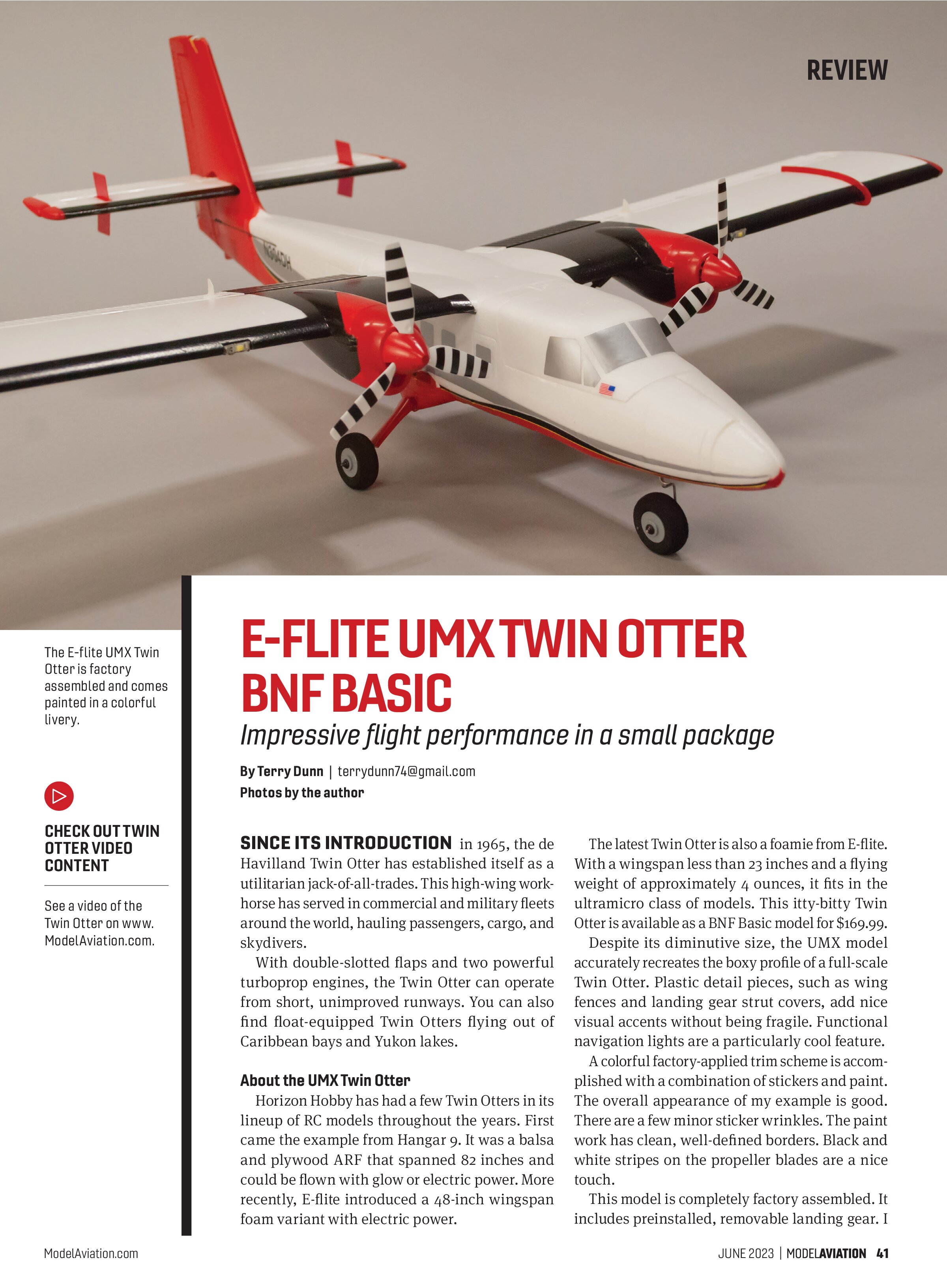
The latest Twin Otter is also a foamie from E-flite. With a wingspan less than 23 inches and a flying weight of approximately 4 ounces, it fits in the ultramicro class of models. This ity-bitty Twin Otter is available as a BNF Basic model for $169.99.
Despite its diminutive size, the UMX model accurately recreates the boxy profile of a full-scale Twin Otter. Plastic detail pieces, such as wing fences and landing gear strut covers, add nice visual accents without being fragile. Functional navigation lights are a particularly cool feature.
A colorful factory-applied trim scheme is accomplished with a combination of stickers and paint. The overall appearance of my example is good. There are a few minor sticker wrinkles. The paint work has clean, well-defined borders. Black and white stripes on the propeller blades are a nice touch.
This model is completely factory assembled. It includes preinstalled, removable landing gear. I
At a Glance
Specifications
Type: Ultramicro scale electric
Wingspan: 22.6 inches
Wing area: 69 sq. in.
Length: 17.5 inches
Radio: Spektrum DX8 2.4 GHz transmitter; Spektrum receiver/ESC unit (included); and four long-throw linear servos (included)
Components needed to complete: Four-plus channel DSM2/DSMX transmitter; 1S 800 mAh 30C LiPo battery; and charger
Minimum flying area: Indoor sports field
Power system: Two 1206-7,500 Kv outrunner brushless motors (included); 80mm x 50mm three-blade propellers; and E-flite 1S 800mAh 30C LiPo battery
Power output: 7.8 amps, 28 watts (114 watts per pound)
Flying weight: 3.9 ounces (112 grams) with landing gear; 4.3 ounces (123 grams) with floats
Wing loading: 8.1 ounces per square foot
Flight time: 7 to 8 minutes
Price: $169.99
Manufacturer/Distributor
Horizon Hobby
www.horizonhobby.com/e-flite-1/
Pluses
- Very impressive flight performance.
- Accurate scale appearance.
Minuses
- Loose battery tray.

removed the landing gear because my initial flights were made off of snow I will use the optional float set. I will cover more on that later. No tools are required to install the stock landing gear or floats.

The only mandatory prep work involves radio setup. You will need to create a model profile in your DSM2/DSMX transmitter and configure it according to the table in the Twin Otter’s manual. I use a first-generation Spektrum DX8 transmitter for most of my ultramicro models. I had no trouble mating it to the UMX Twin Otter.
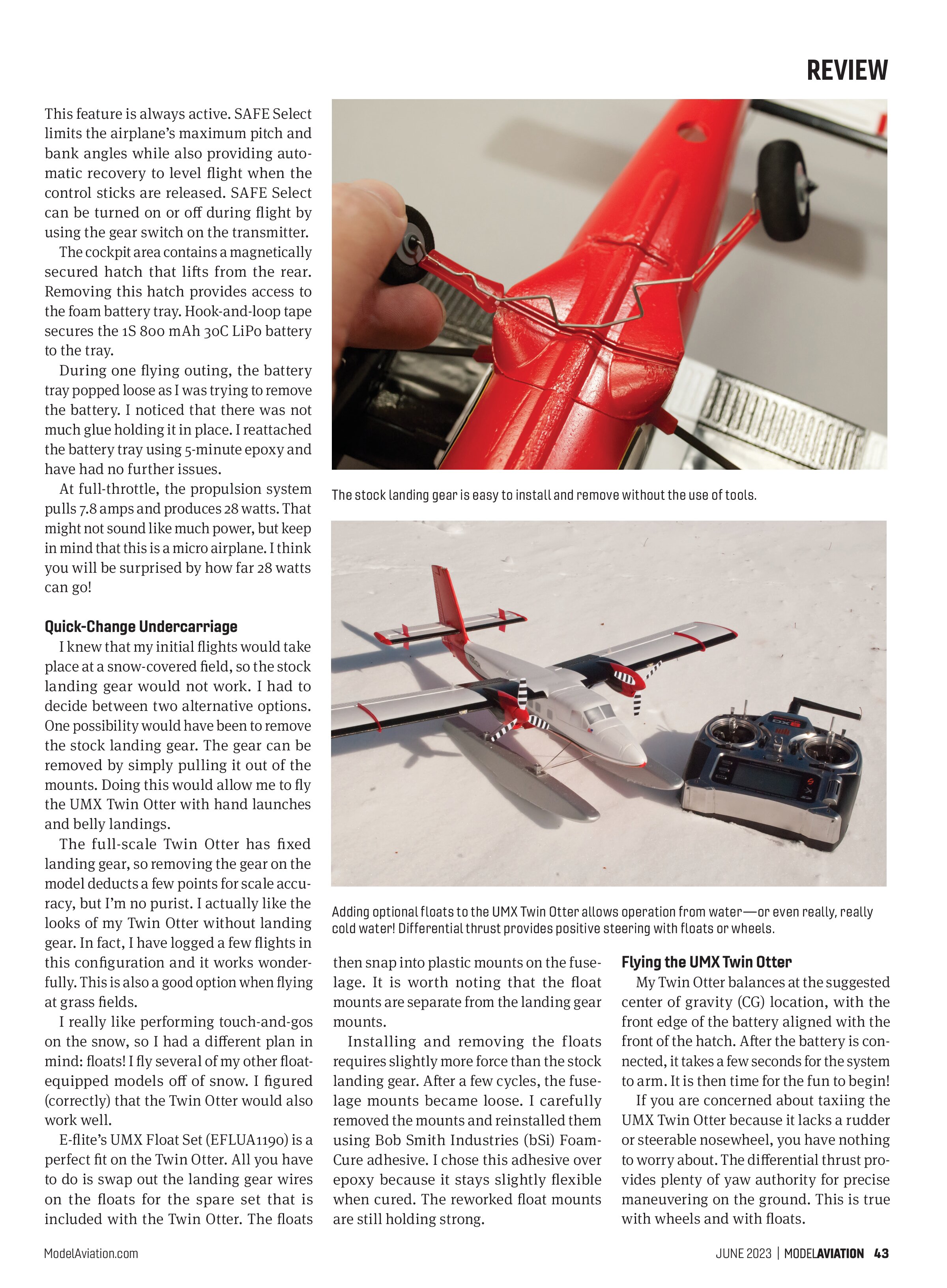
The onboard radio gear consists of a DSM2/DSMX-compatible receiver with dual brushless ESCs. A linear servo mounted within the fuselage actuates the elevator. Two additional linear servos, mounted on the underside of the wing, drive the ailerons. Yaw control is achieved through differential thrust of the wing-mounted motors.
This micro hauler is propelled by a pair of 12mm diameter, 7,500 Kv brushless motors spinning the 80mm diameter three-blade propellers. These outrunner motors might be small, but they generate an impressive amount of power for the Twin Otter.
AS3X and SAFE Select stabilization are built into the receiver of the Twin Otter. AS3X makes constant, miniscule corrections to keep the airplane on a smooth flight path in bumpy flying conditions.
This feature is always active. SAFE Select limits the airplane’s maximum pitch and bank angles while also providing automatic recovery to level flight when the control sticks are released. SAFE Select can be turned on or off during flight by using the gear switch on the transmitter.
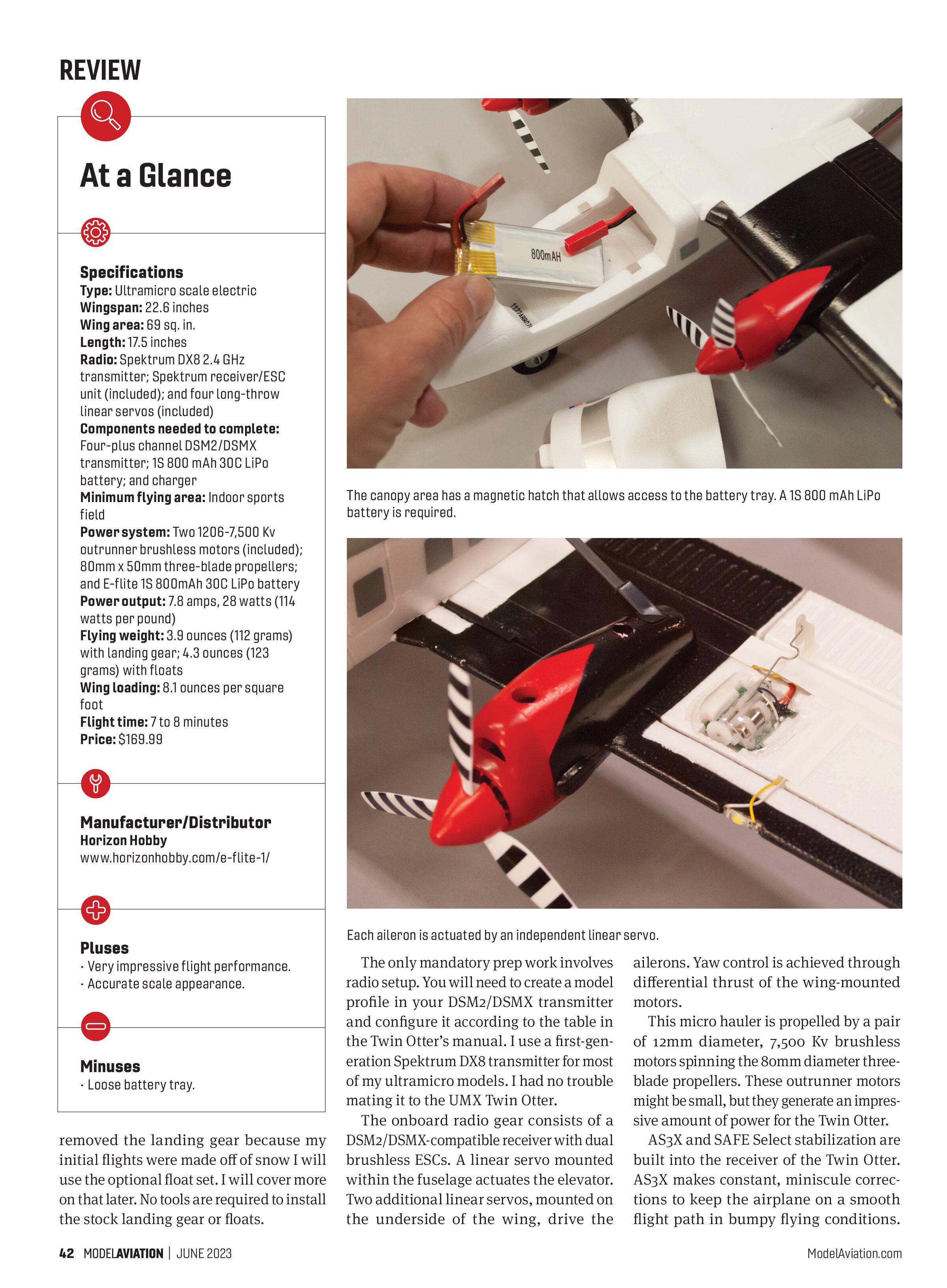
The cockpit area contains a magnetically secured hatch that lifts from the rear. Removing this hatch provides access to the foam battery tray. Hook-and-loop tape secures the 1S 800 mAh 30C LiPo battery to the tray.
During one flying outing, the battery tray popped loose as I was trying to remove the battery. I noticed that there was not much glue holding it in place. I reattached the battery tray using 5-minute epoxy and have had no further issues.
At full-throttle, the propulsion system pulls 7.8 amps and produces 28 watts. That might not sound like much power, but keep in mind that this is a micro airplane. I think you will be surprised by how far 28 watts can go!
Quick-Change Undercarriage
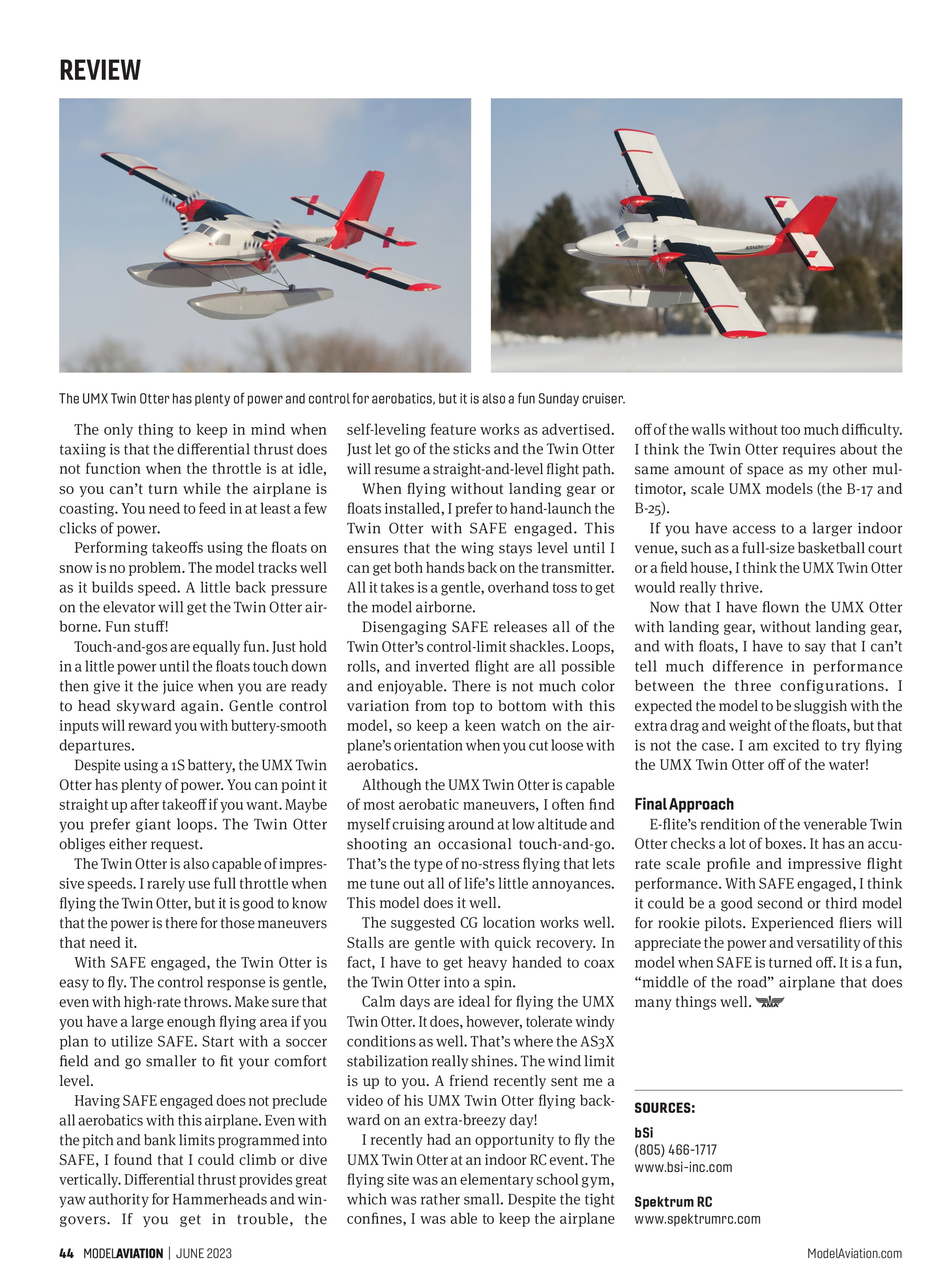
I knew that my initial flights would take place at a snow-covered field, so the stock landing gear would not work. I had to decide between two alternative options. One possibility would have been to remove the stock landing gear. The gear can be removed by simply pulling it out of the mounts. Doing this would allow me to fly the UMX Twin Otter with hand launches and belly landings.
The full-scale Twin Otter has fixed landing gear, so removing the gear on the model deducts a few points for scale accuracy, but I’m no purist. I actually like the looks of my Twin Otter without landing gear. In fact, I have logged a few flights in this configuration and it works wonderfully. This is also a good option when flying at grass fields.
I really like performing touch-and-gos on the snow, so I had a different plan in mind: floats! I fly several of my other float-equipped models off of snow. I figured (correctly) that the Twin Otter would also work well.
E-flite’s UMX Float Set (EFLUA1190) is a perfect fit on the Twin Otter. All you have to do is swap out the landing gear wires on the floats for the spare set that is included with the Twin Otter. The floats then snap into plastic mounts on the fuselage. It is worth noting that the float mounts are separate from the landing gear mounts.
Installing and removing the floats requires slightly more force than the stock landing gear. After a few cycles, the fuselage mounts became loose. I carefully removed the mounts and reinstalled them using Bob Smith Industries (bSi) Foam-Cure adhesive. I chose this adhesive over epoxy because it stays slightly flexible when cured. The reworked float mounts are still holding strong.


Flying the UMX Twin Otter
My Twin Otter balances at the suggested center of gravity (CG) location, with the front edge of the battery aligned with the front of the hatch. After the battery is connected, it takes a few seconds for the system to arm. It is then time for the fun to begin!
If you are concerned about taxiing the UMX Twin Otter because it lacks a rudder or steerable nosewheel, you have nothing to worry about. The differential thrust provides plenty of yaw authority for precise maneuvering on the ground. This is true with wheels and with floats.
The UMX Twin Otter has plenty of power and control for aerobatics, but it is also a fun Sunday cruiser.
The only thing to keep in mind when taxiing is that the differential thrust does not function when the throttle is at idle, so you can’t turn while the airplane is coasting. You need to feed in at least a few clicks of power.
Performing takeoffs using the floats on snow is no problem. The model tracks well as it builds speed. A little back pressure on the elevator will get the Twin Otter airborne. Fun stuff!
Touch-and-gos are equally fun. Just hold in a little power until the floats touch down then give it the juice when you are ready to head skyward again. Gentle control inputs will reward you with buttery-smooth departures.
Despite using a 1S battery, the UMX Twin Otter has plenty of power. You can point it straight up after takeoff if you want. Maybe you prefer giant loops. The Twin Otter obliges either request.
The Twin Otter is also capable of impressive speeds. I rarely use full throttle when flying the Twin Otter, but it is good to know that the power is there for those maneuvers that need it.
With SAFE engaged, the Twin Otter is easy to fly. The control response is gentle, even with high-rate throws. Make sure that you have a large enough flying area if you plan to utilize SAFE. Start with a soccer field and go smaller to fit your comfort level.
Having SAFE engaged does not preclude all aerobatics with this airplane. Even with the pitch and bank limits programmed into SAFE, I found that I could climb or dive vertically. Differential thrust provides great yaw authority for Hammerheads and wingovers. If you get in trouble, the self-leveling feature works as advertised. Just let go of the sticks and the Twin Otter will resume a straight-and-level flight path.
When flying without landing gear or floats installed, I prefer to hand-launch the Twin Otter with SAFE engaged. This ensures that the wing stays level until I can get both hands back on the transmitter. All it takes is a gentle, overhand toss to get the model airborne.
Disengaging SAFE releases all of the Twin Otter’s control-limit shackles. Loops, rolls, and inverted flight are all possible and enjoyable. There is not much color variation from top to bottom with this model, so keep a keen watch on the airplane’s orientation when you cut loose with aerobatics.
Although the UMX Twin Otter is capable of most aerobatic maneuvers, I often find myself cruising around at low altitude and shooting an occasional touch-and-go. That’s the type of no-stress flying that lets me tune out all of life’s little annoyances. This model does it well.
The suggested CG location works well. Stalls are gentle with quick recovery. In fact, I have to get heavy handed to coax the Twin Otter into a spin.
Calm days are ideal for flying the UMX Twin Otter. It does, however, tolerate windy conditions as well. That’s where the AS3X stabilization really shines. The wind limit is up to you. A friend recently sent me a video of his UMX Twin Otter flying backward on an extra-breezy day!
I recently had an opportunity to fly the UMX Twin Otter at an indoor RC event. The flying site was an elementary school gym, which was rather small. Despite the tight confines, I was able to keep the airplane off of the walls without too much difficulty. I think the Twin Otter requires about the same amount of space as my other mult imotor, scale UMX models (the B-17 and B-25).
If you have access to a larger indoor venue, such as a full-size basketball court or a field house, I think the UMX Twin Otter would really thrive.
Now that I have flown the UMX Otter with landing gear, without landing gear, and with floats, I have to say that I can’t tell much difference in performance between the three configurations. I expected the model to be sluggish with the extra drag and weight of the floats, but that is not the case. I am excited to try flying the UMX Twin Otter off of the water!
Final Approach
E-flite’s rendition of the venerable Twin Otter checks a lot of boxes. It has an accurate scale profile and impressive flight performance. With SAFE engaged, I think it could be a good second or third model for rookie pilots. Experienced fliers will appreciate the power and versatility of this model when SAFE is turned off. It is a fun, “middle of the road” airplane that does many things well.
SOURCES:
bSi
(805) 466-1717
www.bsi-inc.com
Spektrum RC
www.spektrumrc.com