FIFTY YEARS AGO: MAY 1973
By Bob Noll | bobrcc@aol.com

THIS MONTH, I will return to my normal column of writing about the things that were published in our hobby magazines 50 years ago. I found four May 1973 magazines in my file cabinets.
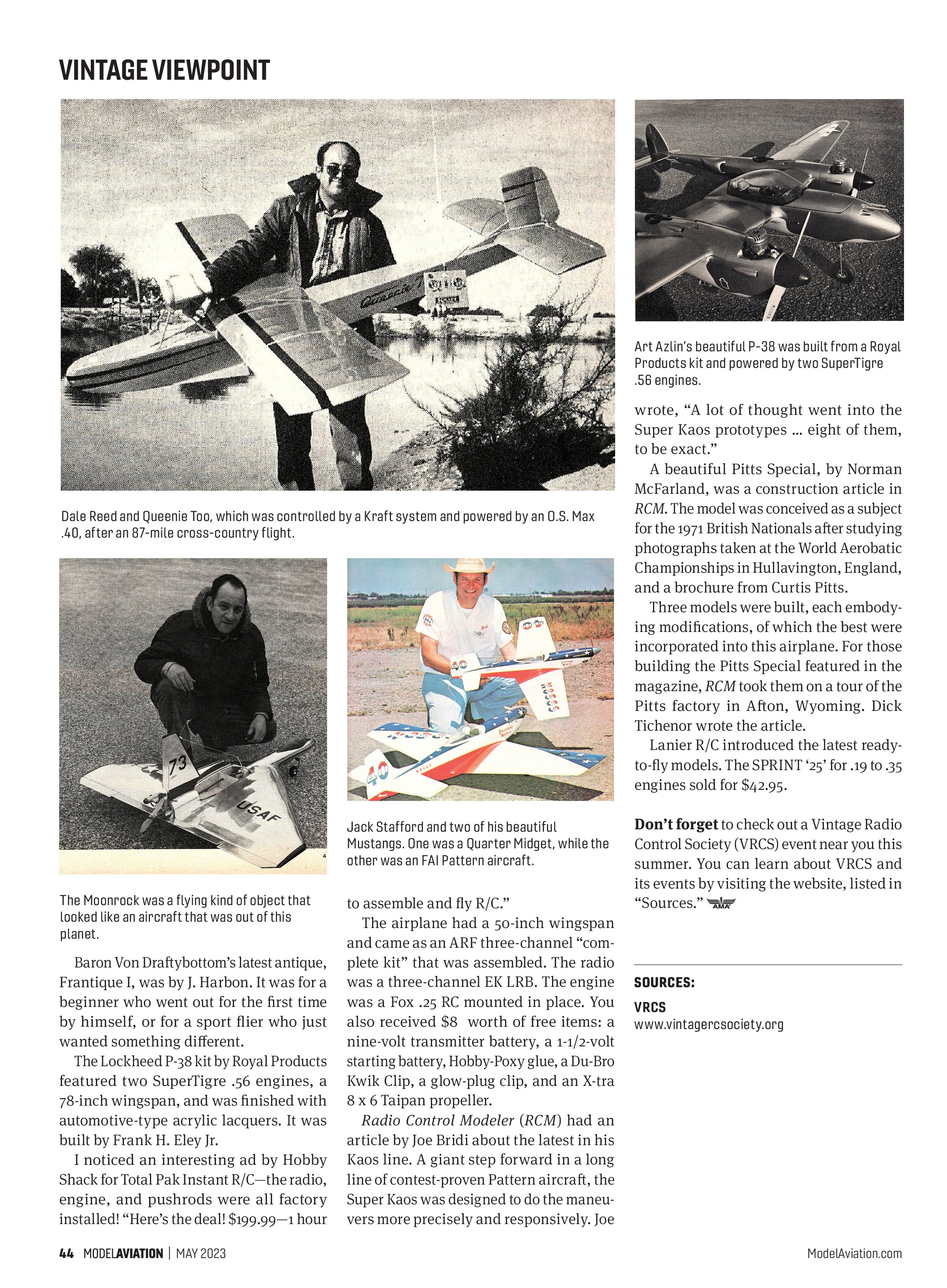
In Flying Models (FM), Jim Boyd had an article about the BD-5 model and also the BD-5 full-scale airplane. The exact, 1/4-scale model built by Loren Tragellas, of Newton, Kansas, was undoubtedly the most successful model of a BD-5 to date. It was used by Bede Aircraft test engineers to determine spin entry and recovery techniques. Powered by an HP .61 engine, the model had a six-channel Kraft radio, Rom-Air retracts, and weighed 9 pounds.
FM also had an “out of this world” chromed delta-wing aircraft called the Moonrock, by Lou Cubillos. The Moonrock was not exactly a spaceship or a stone from the moon, but it was a kind of flying object that looked like an aircraft from outside of this planet. It had a MicroAvionics radio and was powered by an Enya .45 engine. The basic design started with just a delta wing, and then a long, sleek fuselage was added with a vertical fin and rudder in the rear. It was completely covered with chrome Top Flite MonoKote.
Dale Reed had an article about how seaplane records were wrestled from the Russians. Sand, sage, and quicksand made a strange setting for this desert-borne flying boat called Queenie Too. The saga of Dale’s successful and unsuccessful sieges on the Russian seaplane records was interesting. A Kraft system and O.S. Max .40 were fitted to Queenie Too.
Dale wrote, “I think one of the most exciting and rewarding adventures that I have ever experienced was on that pleasant February day when I steered old ‘Queenie Too’ to a dead stick landing on the Mojave River after an 87-mile cross-country trek starting in the Tehachapi foothills.” Yes, the airplane was named for Dale’s wife.
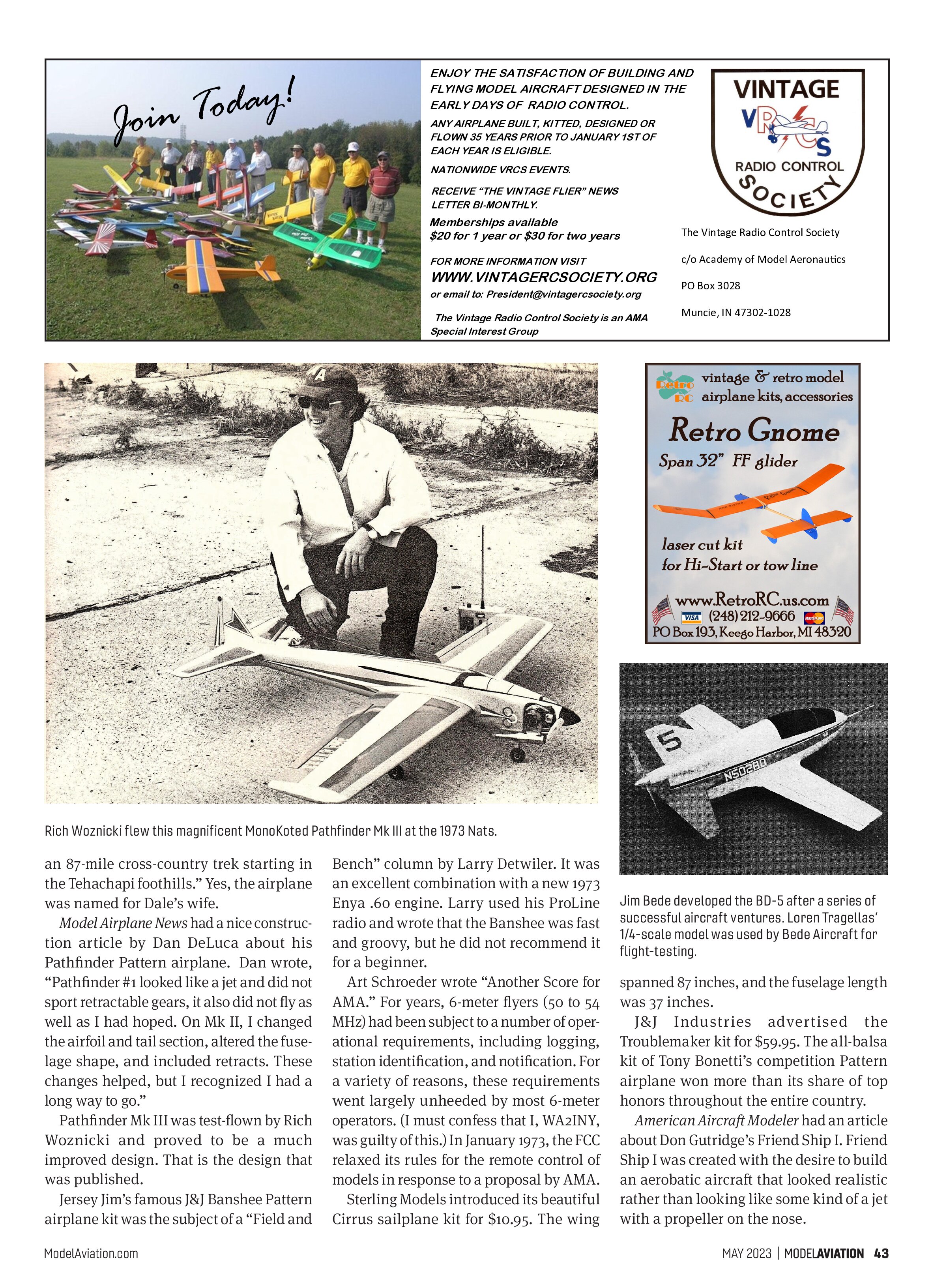
Model Airplane News had a nice construction article by Dan DeLuca about his Pathfinder Pattern airplane. Dan wrote, “Pathfinder #1 looked like a jet and did not sport retractable gears, it also did not fly as well as I had hoped. On Mk II, I changed the airfoil and tail section, altered the fuselage shape, and included retracts. These changes helped, but I recognized I had a long way to go.”
Pathfinder Mk III was test-flown by Rich Woznicki and proved to be a much improved design. That is the design that was published.
Jersey Jim’s famous J&J Banshee Pattern airplane kit was the subject of a “Field and Bench” column by Larry Detwiler. It was an excellent combination with a new 1973 Enya .60 engine. Larry used his ProLine radio and wrote that the Banshee was fast and groovy, but he did not recommend it for a beginner.
Art Schroeder wrote “Another Score for AMA.” For years, 6-meter flyers (50 to 54 MHz) had been subject to a number of operational requirements, including logging, station identification, and notification. For a variety of reasons, these requirements went largely unheeded by most 6-meter operators. (I must confess that I, WA2INY, was guilty of this.) In January 1973, the FCC relaxed its rules for the remote control of models in response to a proposal by AMA.
Sterling Models introduced its beautiful Cirrus sailplane kit for $10.95. The wing

J&J Industries advertised the Troublemaker kit for $59.95. The all-balsa kit of Tony Bonetti’s competition Pattern airplane won more than its share of top honors throughout the entire country.
American Aircraft Modeler had an article about Don Gutridge’s Friend Ship I. Friend Ship I was created with the desire to build an aerobatic aircraft that looked realistic rather than looking like some kind of a jet with a propeller on the nose.


Baron Von Draftybottom’s latest antique, Frantique I, was by J. Harbon. It was for a beginner who went out for the first time by himself, or for a sport flier who just wanted something different.
The Lockheed P-38 kit by Royal Products featured two SuperTigre .56 engines, a 78-inch wingspan, and was finished with automotive-type acrylic lacquers. It was built by Frank H. Eley Jr.
I noticed an interesting ad by Hobby Shack for Total Pak Instant R/C—the radio, engine, and pushrods were all factory installed! “Here’s the deal! $199.99—1 hour to assemble and fly R/C.”
The airplane had a 50-inch wingspan and came as an ARF three-channel “complete kit” that was assembled. The radio was a three-channel EK LRB. The engine was a Fox .25 RC mounted in place. You also received $8 worth of free items: a nine-volt transmitter battery, a 1-1/2-volt starting battery, Hobby-Poxy glue, a Du-Bro Kwik Clip, a glow-plug clip, and an X-tra 8 x 6 Taipan propeller.
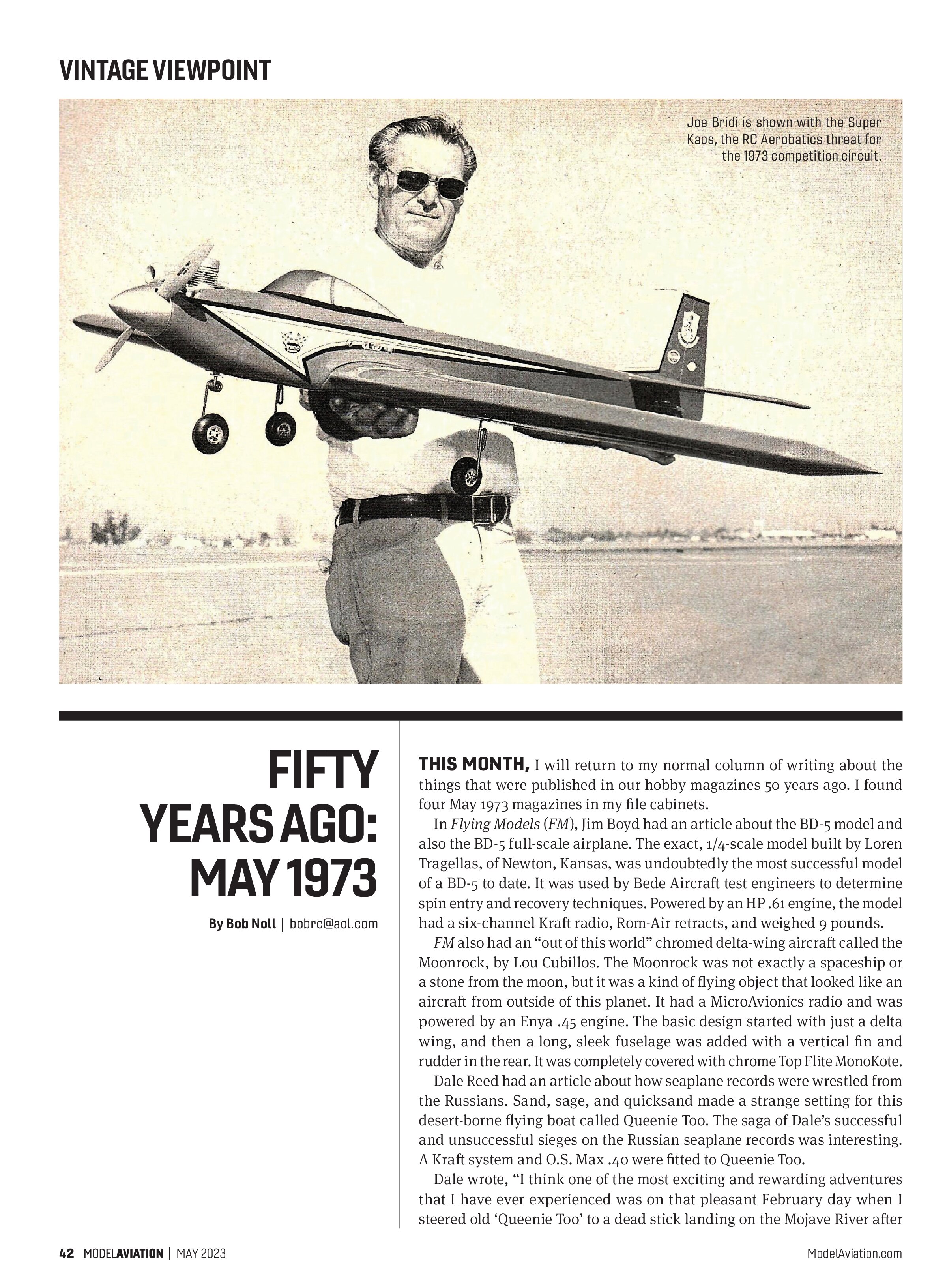
Radio Control Modeler (RCM) had an article by Joe Bridi about the latest in his Kaos line. A giant step forward in a long line of contest-proven Pattern aircraft, the Super Kaos was designed to do the maneuvers more precisely and responsively. Joe wrote, “A lot of thought went into the Super Kaos prototypes ... eight of them, to be exact.”
A beautiful Pitts Special, by Norman McFarland, was a construction article in RCM. The model was conceived as a subject for the 1971 British Nationals after studying photographs taken at the World Aerobatic Championships in Hullavington, England, and a brochure from Curtis Pitts.
Three models were built, each embodying modifications, of which the best were incorporated into this airplane. For those building the Pitts Special featured in the magazine, RCM took them on a tour of the Pitts factory in Afton, Wyoming. Dick Tichenor wrote the article.
Lanier R/C introduced the latest ready-to-fly models. The SPRINT ‘25’ for .19 to .35 engines sold for $42.95.
Don’t forget to check out a Vintage Radio Control Society (VRCS) event near you this summer. You can learn about VRCS and its events by visiting the website, listed in “Sources.”
SOURCES:
VRCS
www.vintagercsociety.org