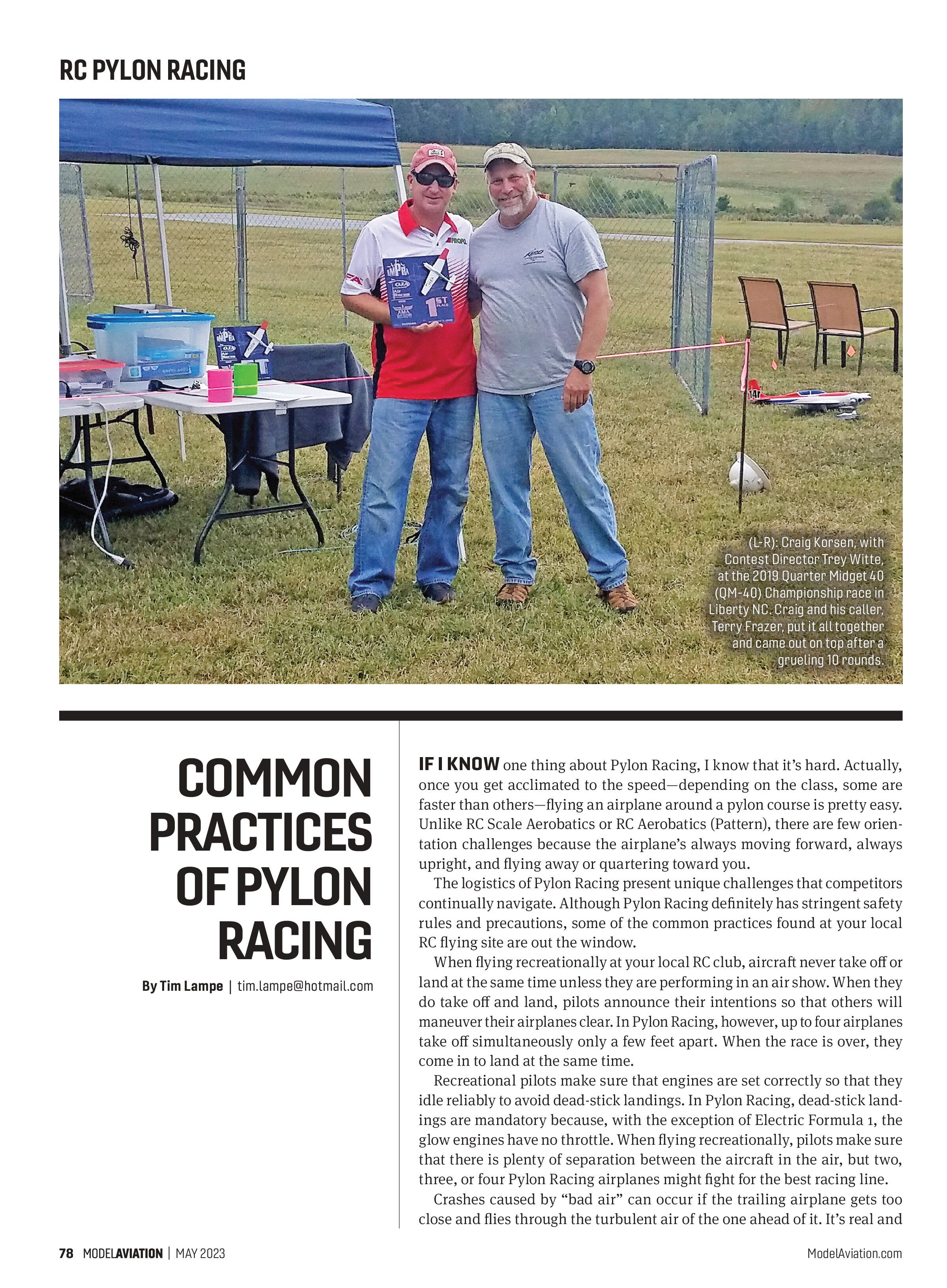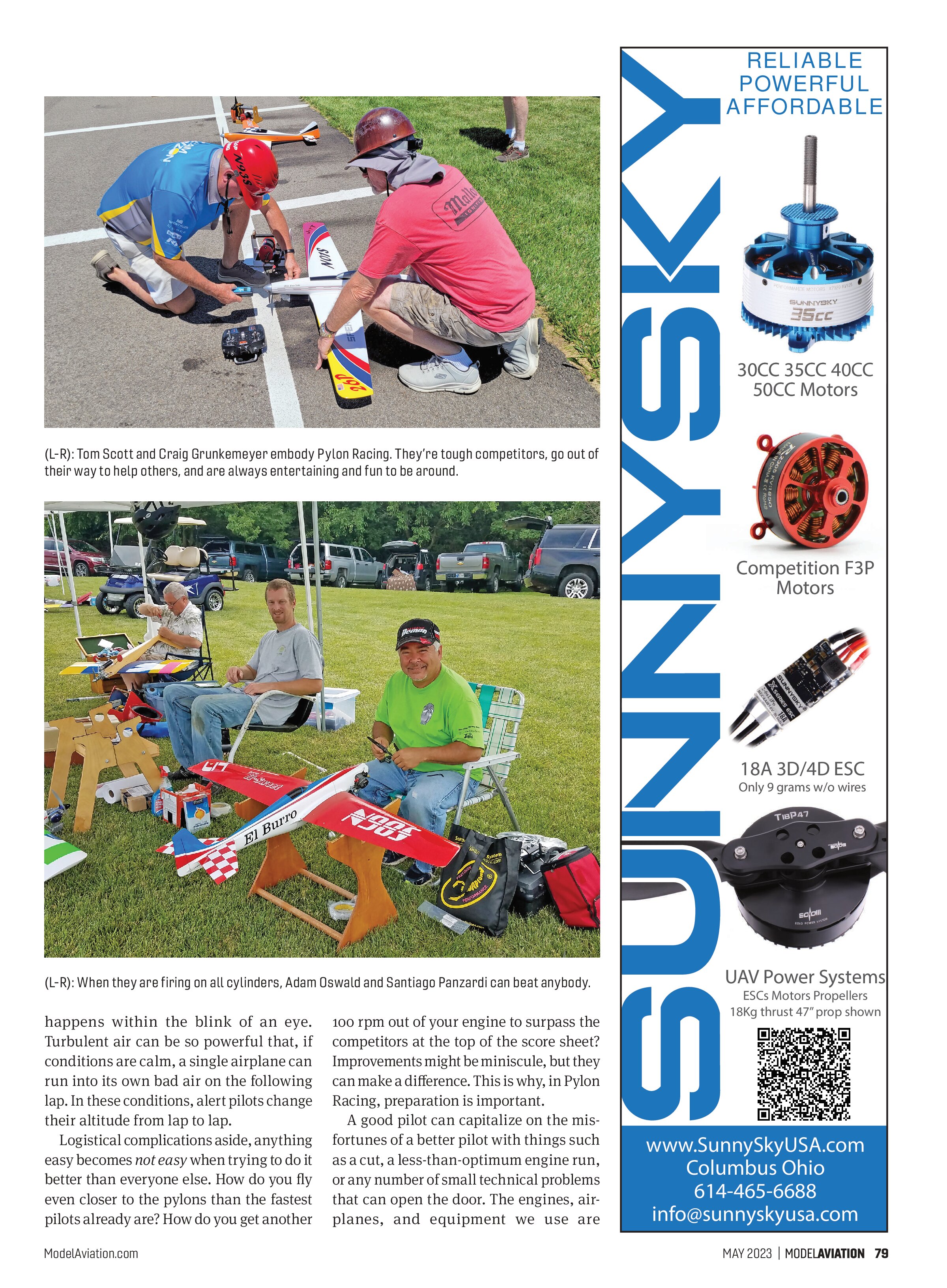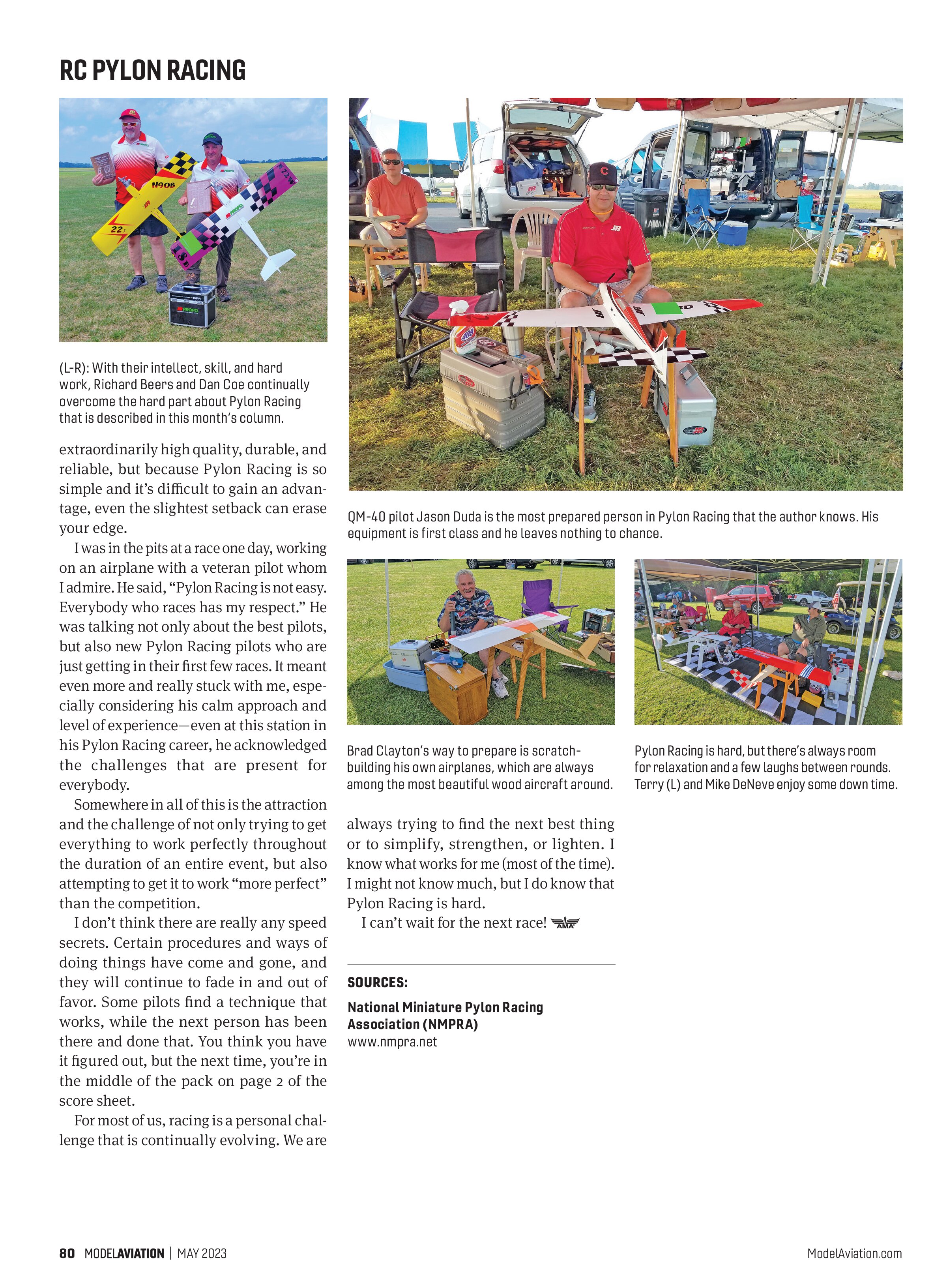
RC PYLON RACING

COMMON
PRACTICES
OF PYLON
RACING
By Tim Lampe | tim.lampe@hotmail.com
IF I KNOW one thing about Pylon Racing, I know that it’s hard. Actually, once you get acclimated to the speed—depending on the class, some are faster than others—flying an airplane around a pylon course is pretty easy. Unlike RC Scale Aerobatics or RC Aerobatics (Pattern), there are few orientation challenges because the airplane’s always moving forward, always upright, and flying away or quartering toward you.
The logistics of Pylon Racing present unique challenges that competitors continually navigate. Although Pylon Racing definitely has stringent safety rules and precautions, some of the common practices found at your local RC flying site are out the window.
When flying recreationally at your local RC club, aircraft never take off or land at the same time unless they are performing in an air show. When they do take off and land, pilots announce their intentions so that others will maneuver their airplanes clear. In Pylon Racing, however, up to four airplanes take off simultaneously only a few feet apart. When the race is over, they come in to land at the same time.
Recreational pilots make sure that engines are set correctly so that they idle reliably to avoid dead-stick landings. In Pylon Racing, dead-stick landings are mandatory because, with the exception of Electric Formula 1, the glow engines have no throttle. When flying recreationally, pilots make sure that there is plenty of separation between the aircraft in the air, but two, three, or four Pylon Racing airplanes might fight for the best racing line.
Crashes caused by “bad air” can occur if the trailing airplane gets too close and flies through the turbulent air of the one ahead of it. It’s real and happens within the blink of an eye.


Turbulent air can be so powerful that, if conditions are calm, a single airplane can run into its own bad air on the following lap. In these conditions, alert pilots change their altitude from lap to lap.
Logistical complications aside, anything easy becomes not easy when trying to do it better than everyone else. How do you fly even closer to the pylons than the fastest pilots already are? How do you get another 100 rpm out of your engine to surpass the competitors at the top of the score sheet? Improvements might be miniscule, but they can make a difference. This is why, in Pylon Racing, preparation is important.
A good pilot can capitalize on the misfortunes of a better pilot with things such as a cut, a less-than-optimum engine run, or any number of small technical problems that can open the door. The engines, airplanes, and equipment we use are

extraordinarily high quality, durable, and reliable, but because Pylon Racing is so simple and it’s difficult to gain an advantage, even the slightest setback can erase your edge.
I was in the pits at a race one day, working on an airplane with a veteran pilot whom I admire. He said, “Pylon Racing is not easy. Everybody who races has my respect.” He was talking not only about the best pilots, but also new Pylon Racing pilots who are just getting in their first few races. It meant even more and really stuck with me, especially considering his calm approach and level of experience—even at this station in his Pylon Racing career, he acknowledged the challenges that are present for everybody.
Somewhere in all of this is the attraction and the challenge of not only trying to get everything to work perfectly throughout the duration of an entire event, but also attempting to get it to work “more perfect” than the competition.
I don’t think there are really any speed secrets. Certain procedures and ways of doing things have come and gone, and they will continue to fade in and out of favor. Some pilots find a technique that works, while the next person has been there and done that. You think you have it figured out, but the next time, you’re in the middle of the pack on page 2 of the score sheet.
For most of us, racing is a personal challenge that is continually evolving. We are


always trying to find the next best thing or to simplify, strengthen, or lighten. I know what works for me (most of the time). I might not know much, but I do know that Pylon Racing is hard.
I can’t wait for the next race!

SOURCES:
National Miniature Pylon Racing Association (NMPRA)
www.nmpra.net