
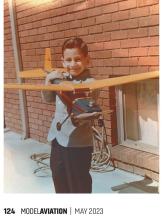
EDWARD SARKISIAN
Former airline pilot
By Jay Smith | jays@modelaircraft.org
JAY SMITH: How did you become involved in model aviation?
EDWARD SARKISIAN: My father had great natural abilities to build things, such as model aircraft, and it was evident in his workmanship. I and I rebuilt his Cessna 180 together only a few years ago, allowing us to do so with RC micro-electronics. Other aircraft that my father had built throughout the years were a motivational force to me as well, including various small- to medium-sized Free Flight balsa gliders.
I attended the inaugural Westchester Radio Aero Modelers (WRAM) Show with my dad and my son, Daniel, and we attended many more in the following years. This hobby and science are great learning tools and could serve as a jump-start into full-scale aviation.
JS: How has model aviation impacted your life and/or career?
ES: My experiences included occasionally stopping on Sunday afternoons with my family at the Teterboro Airport, a local general aviation airport close to us in New Jersey.

The combination of building and flying the model aircraft with my father, as well as seeing the full-scale aircraft close up, has yielded a lifelong love for aviation. Without the gyros and electronics available today that serve to stabilize and augment flight characteristics, it was trial and error. Modeling led to an interest in flying full-scale aircraft. Living near La Guardia, Newark, and Teterboro, as well as the local seaplane base, were also factors in honing my interest.
JS: What disciplines of modeling do you currently participate in?
ES: My core interest is building RC replicas of the World War II Pacific carrier-based aircraft. I hope to honor the pilots and crew members, as well as those who served on the decks of the great aircraft carriers. I’ve built Scale models for the USS Yorktown CV-10 Association and other entities. Each aircraft is built to emulate a particular squadron and pilot who served on the Yorktown.
As far as RC aircraft go, so far I’ve stayed with ARFs. I recently completed an ARF jet aircraft model emulating the P8-A Poseidon, the U.S. Navy aircraft that Daniel commands. I also enjoy gliders and seaplanes.
JS: What other hobbies do you have?
ES: As a family, we enjoy kayaking, hiking, sailing, cycling, and cooking. I also thoroughly enjoy taking individuals up for flights in full-scale general aviation aircraft such as a Cessna 172.
Whether it’s over the hills of northwestern New Jersey, or within the complex airspace over the Hudson River at 2,500 feet, seeing the joy in the face of those onboard is a lasting joy.
JS: Who or what has influenced you the most?
ES: My father was an original crew member of the aircraft carrier USS Yorktown in the Pacific and was an anti-aircraft gunner in the U.S. Marines detachment onboard. When it came to accomplishing a project, there was a “see it through to the end and get it done” mindset. This was accomplished with the gentle and guiding discipline of a hard-working father who cared and placed his family first.
Somehow, he always made time to build incredible model aircraft and some sailboat models. He would say, “Put your mind to it, and get it done!” I attribute much of this to God-given talents and abilities, and I thank our Lord God for the abilities and talents that are passed on through the generations.
JS: What advice do you have for modelers who are interested in becoming pilots?
ES: If you have an interest in flying, go take a flight lesson at a local flight school with a fellow modeler! Invest some time into looking for a local flight school and take a friend. Share the joy of a flight!
My first flight was in 1974 and it was a $5 seaplane ride at the Little Ferry Seaplane Base, in Little Ferry, New Jersey. I was unaware that my father had worked at that same seaplane base in the 1930s for several months to earn a flight lesson.
It takes a great deal of hard work and perseverance and is an investment in your future. I’ve been in aviation since my first lesson back in 1974. Follow through and open doors.

