FOCAL POINT
Interested in sharing your handiwork? Visit www.ModelAviation.com for submission guidelines.
Clean Cut Sport Pattern
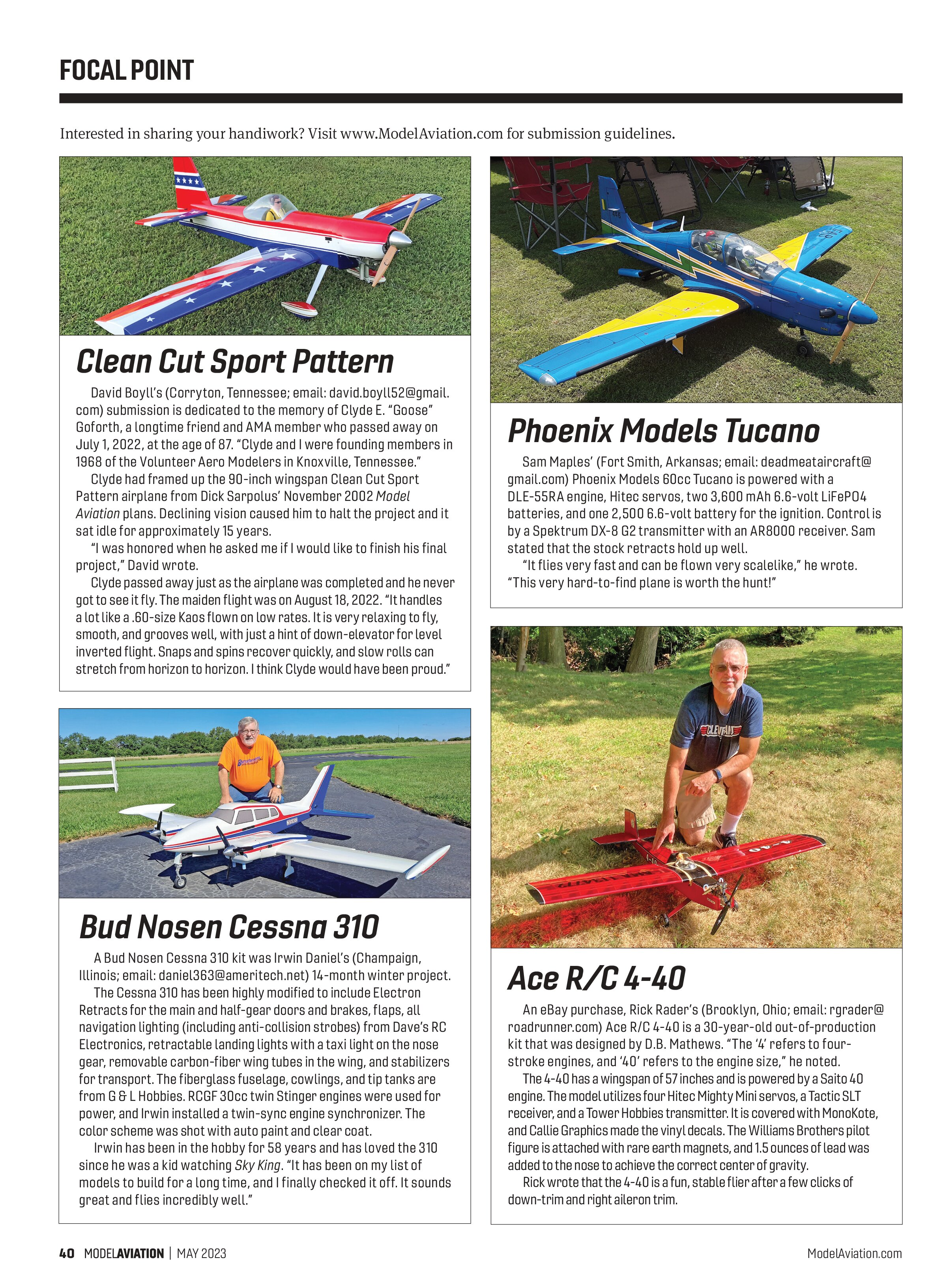
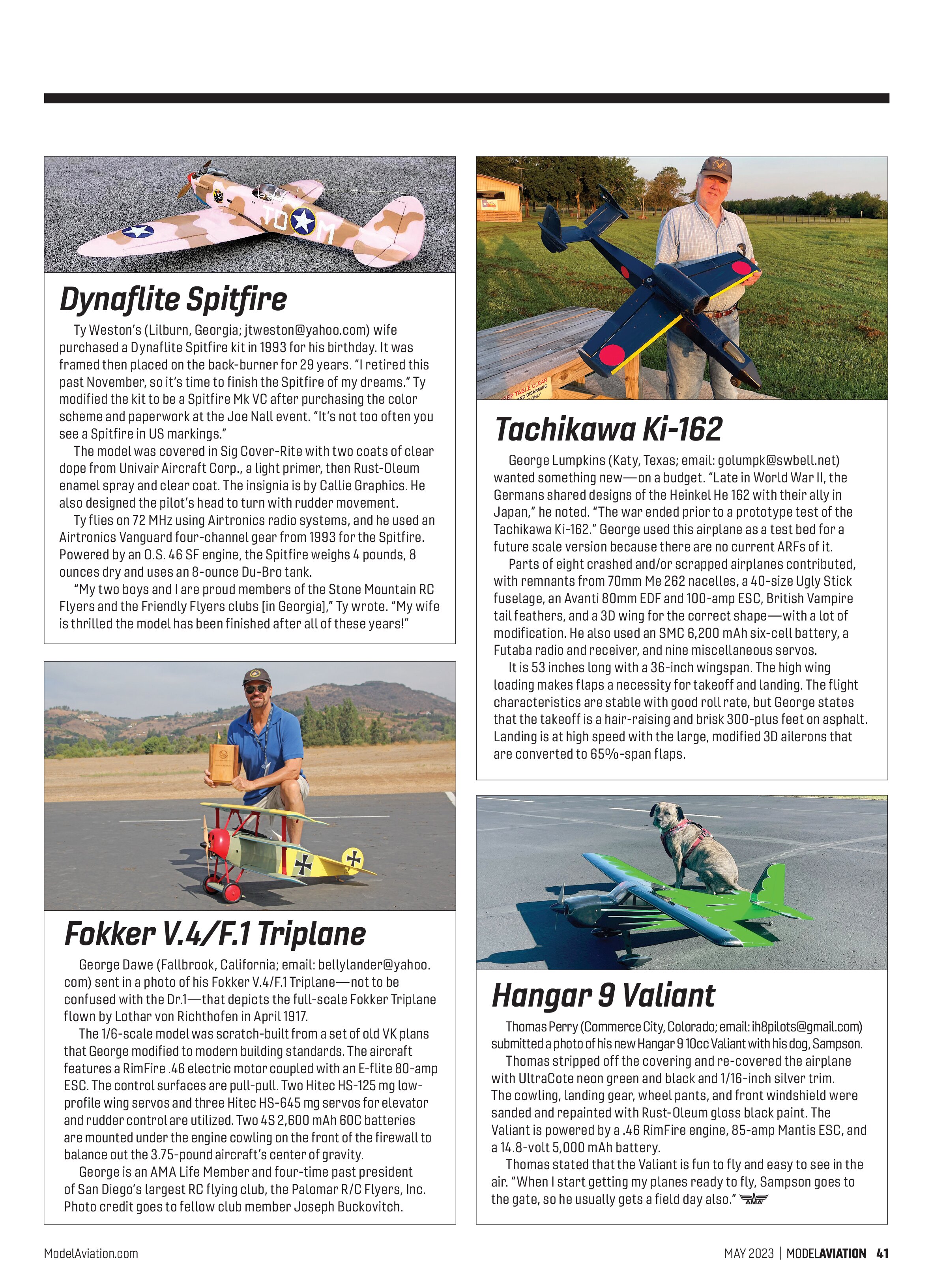
David Boyll’s (Corryton, Tennessee; email: david.boyll52@gmail.com) submission is dedicated to the memory of Clyde E. “Goose” Goforth, a longtime friend and AMA member who passed away on July 1, 2022, at the age of 87. “Clyde and I were founding members in 1968 of the Volunteer Aero Modelers in Knoxville, Tennessee.”
Clyde had framed up the 90-inch wingspan Clean Cut Sport Pattern airplane from Dick Sarpolus’ November 2002 Model Aviation plans. Declining vision caused him to halt the project and it sat idle for approximately 15 years.
“I was honored when he asked me if I would like to finish his final project,” David wrote.
Clyde passed away just as the airplane was completed and he never got to see it fly. The maiden flight was on August 18, 2022. “It handles a lot like a .60-size Kaos flown on low rates. It is very relaxing to fly, smooth, and grooves well, with just a hint of down-elevator for level inverted flight. Snaps and spins recover quickly, and slow rolls can stretch from horizon to horizon. I think Clyde would have been proud.”

Bud Nosen Cessna 310
A Bud Nosen Cessna 310 kit was Irwin Daniel’s (Champaign, Illinois; email: daniel363@ameritech.net) 14-month winter project. The Cessna 310 has been highly modified to include Electron Retracts for the main and half-gear doors and brakes, flaps, all navigation lighting (including anti-collision strobes) from Dave’s RC Electronics, retractable landing lights with a taxi light on the nose gear, removable carbon-fiber wing tubes in the wing, and stabilizers for transport. The fiberglass fuselage, cowlings, and tip tanks are from G & L Hobbies. RCGF 30cc twin Stinger engines were used for power, and Irwin installed a twin-sync engine synchronizer. The color scheme was shot with auto paint and clear coat.
Irwin has been in the hobby for 58 years and has loved the 310 since he was a kid watching Sky King. “It has been on my list of models to build for a long time, and I finally checked it off. It sounds great and flies incredibly well.”

Phoenix Models Tucano
Sam Maples’ (Fort Smith, Arkansas; email: deadmeataircraft@gmail.com) Phoenix Models 60cc Tucano is powered with a DLE-55RA engine, Hitec servos, two 3,600 mAh 6.6-volt LiFePO4 batteries, and one 2,500 6.6-volt battery for the ignition. Control is by a Spektrum DX-8 G2 transmitter with an AR8000 receiver. Sam stated that the stock retracts hold up well.
“It flies very fast and can be flown very scalelike,” he wrote. “This very hard-to-find plane is worth the hunt!”

Ace R/C 4-40
An eBay purchase, Rick Rader’s (Brooklyn, Ohio; email: rg[email protected]) Ace R/C 4-40 is a 30-year-old out-of-production kit that was designed by D.B. Mathews. “The ‘4’ refers to four-stroke engines, and ‘40’ refers to the engine size,” he noted.
The 4-40 has a wingspan of 57 inches and is powered by a Saito 40 engine. The model utilizes four Hitec Mighty Mini servos, a Tactic SLT receiver, and a Tower Hobbies transmitter. It is covered with MonoKote, and Callie Graphics made the vinyl decals. The Williams Brothers pilot figure is attached with rare earth magnets, and 1.5 ounces of lead was added to the nose to achieve the correct center of gravity.
Rick wrote that the 4-40 is a fun, stable flier after a few clicks of down-trim and right aileron trim.

Dynaflite Spitfire
Ty Weston’s (Lilburn, Georgia; jtweston@yahoo.com) wife purchased a Dynaflite Spitfire kit in 1993 for his birthday. It was framed then placed on the back-burner for 29 years. “I retired this past November, so it’s time to finish the Spitfire of my dreams.” Ty modified the kit to be a Spitfire Mk VC after purchasing the color scheme and paperwork at the Joe Nall event. “It’s not too often you see a Spitfire in US markings.”
The model was covered in Sig Cover-Rite with two coats of clear dope from Univair Aircraft Corp., a light primer, then Rust-Oleum enamel spray and clear coat. The insignia is by Callie Graphics. He also designed the pilot’s head to turn with rudder movement.
Ty flies on 72 MHz using Airtronics radio systems, and he used an Airtronics Vanguard four-channel gear from 1993 for the Spitfire. Powered by an O.S. 46 SF engine, the Spitfire weighs 4 pounds, 8 ounces dry and uses an 8-ounce Du-Bro tank.
“My two boys and I are proud members of the Stone Mountain RC Flyers and the Friendly Flyers clubs [in Georgia],” Ty wrote. “My wife is thrilled the model has been finished after all of these years!”

Fokker V.4/F.1 Triplane
George Dawe (Fallbrook, California; email: bellylander@yahoo.com) sent in a photo of his Fokker V.4/F.1 Triplane—not to be confused with the Dr.1—that depicts the full-scale Fokker Triplane flown by Lothar von Richthofen in April 1917.
The 1/6-scale model was scratch-built from a set of old VK plans that George modified to modern building standards. The aircraft features a RimFire .46 electric motor coupled with an E-flite 80-amp ESC. The control surfaces are pull-pull. Two Hitec HS-125 mg low-profile wing servos and three Hitec HS-645 mg servos for elevator and rudder control are utilized. Two 4S 2,600 mAh 60C batteries are mounted under the engine cowling on the front of the firewall to balance out the 3.75-pound aircraft’s center of gravity.
George is an AMA Life Member and four-time past president of San Diego’s largest RC flying club, the Palomar R/C Flyers, Inc. Photo credit goes to fellow club member Joseph Buckovitch.

Tachikawa Ki-162
George Lummkins (Katy, Texas; email: golumk@shwell.net) wanted something new—on a budget. “Late in World War II, the Germans shared designs of the Heinkel He 162 with their ally in Japan,” he noted. “The war ended prior to a prototype test of the Tachikawa Ki-162.” George used this airplane as a test bed for a future scale version because there are no current ARFs of it.
Parts of eight crashed and/or scrapped airplanes contributed, with remnants from 70mm Me 262 nacelles, a 40-size Ugly Stick fuselage, an Avanti 80mm EDF and 100-amp ESC, British Vampire tail feathers, and a 3D wing for the correct shape—with a lot of modification. He also used an SMC 6,200 mAh six-cell battery, a Futaba radio and receiver, and nine miscellaneous servos.
It is 53 inches long with a 36-inch wingspan. The high wing loading makes flaps a necessity for takeoff and landing. The flight characteristics are stable with good roll rate, but George states that the takeoff is a hair-raising and brisk 300-plus feet on asphalt. Landing is at high speed with the large, modified 3D ailerons that are converted to 65%-span flaps.

Hangar 9 Valiant
Thomas Perry (Commerce City, Colorado; email: ih8pilots@gmail.com) submitted a photo of his new Hangar 9 10cc Valiant with his dog, Sampson. Thomas stripped off the covering and re-covered the airplane with UltraCote neon green and black and 1/16-inch silver trim. The cowling, landing gear, wheel pants, and front windshield were sanded and repainted with Rust-Oleum gloss black paint. The Valiant is powered by a .46 RimFire engine, 85-amp Mantis ESC, and a 14.8-volt 5,000 mAh battery.
Thomas stated that the Valiant is fun to fly and easy to see in the air. “When I start getting my planes ready to fly, Sampson goes to the gate, so he usually gets a field day also.”