SMALL-FIELD FLYING

VARIETY IS
THE SPICE
OF LIFE
By Pat Tritle | patscustommodels@gmail.com
THE WINTER BUILDING SEASON is in full swing now, with much progress being made on several fronts. I have managed to finish not only a couple of ongoing RC projects, but also a few Free Flight (FF) models. I’ve even found the time to finish a couple of plastic model projects that have been ongoing.
It’s been said that “variety is the spice of life,” and working in a number of different areas of modeling does tend to keep things interesting. A variety of hobbies also comes in handy when it’s cold outside, the snow is flying, and staying outside longer than it takes to gather up the newspaper is the farthest thing from my mind.
The best part of all of this is that even though the modeling techniques and mediums can be different, there are definitely crossovers between the three, and the skills learned in one area often cross over to the other areas of modeling. What’s even better is that when you run into a problem that’s evading a simple solution, sometimes walking away and delving into something different will clear the fog, with the solution coming when you least expect it. Admittedly, I’m not the world’s greatest at multitasking, but sometimes a bit of creative distraction is just what the doctor ordered when things get a little complicated.
When it comes to variety, Brian Allen has it pretty well figured out. This time around, he has come to us in two ways. First is with his 54-inch wingspan Comet Taylorcraft. The model came to Brian framed up for FF; however, the large-scale Comet kits are ideal candidates for RC conversions, which is exactly what Brian did.

The plans had been modified with ailerons drawn in, but the model was framed without them, so the T-Craft was finished with three-channel control. Other modifications include a one-piece, bolt-on wing and a functional cabin door on the right side for battery access that doesn’t require removing the wing. The model is powered with an E-flite Park 370 motor, a Castle Creations Talon 15 ESC, and a 1,000 mAh 2S LiPo battery. The 18-ounce model is covered with The World Models Lightex. The T-Craft flies well, but it is slightly sluggish in turns because of the somewhat understated dihedral.
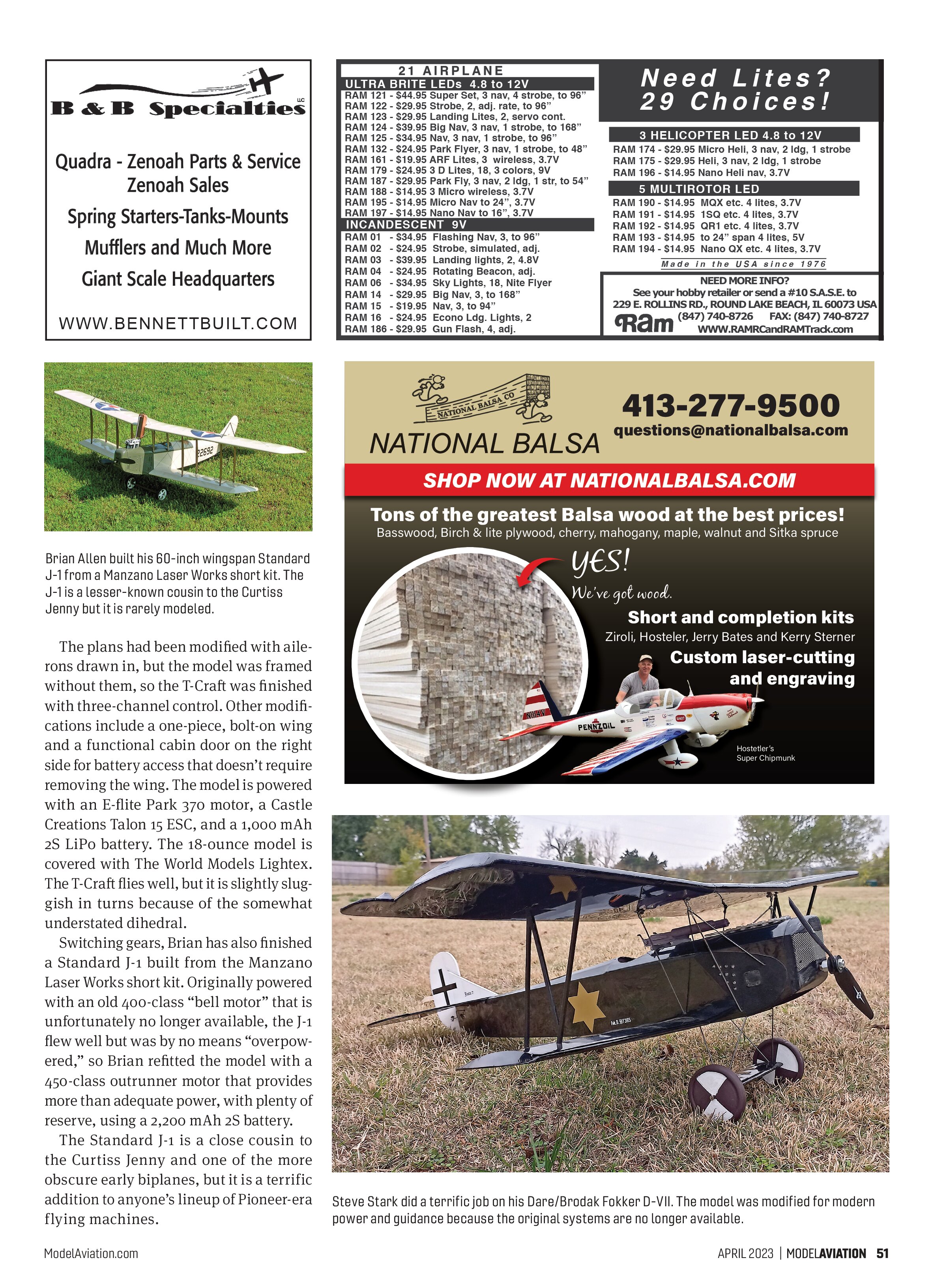
Switching gears, Brian has also finished a Standard J-1 built from the Manzano Laser Works short kit. Originally powered with an old 400-class “bell motor” that is unfortunately no longer available, the J-1 flew well but was by no means “overpowered,” so Brian refitted the model with a 450-class outrunner motor that provides more than adequate power, with plenty of reserve, using a 2,200 mAh 2S battery.
The Standard J-1 is a close cousin to the Curtiss Jenny and one of the more obscure early biplanes, but it is a terrific addition to anyone’s lineup of Pioneer-era flying machines.


Brian’s 54-inch wingspan Taylorcraft was built from a Comet FF kit and modified for electric power and three-channel RC. These old kits are perfect candidates for simple RC conversions.

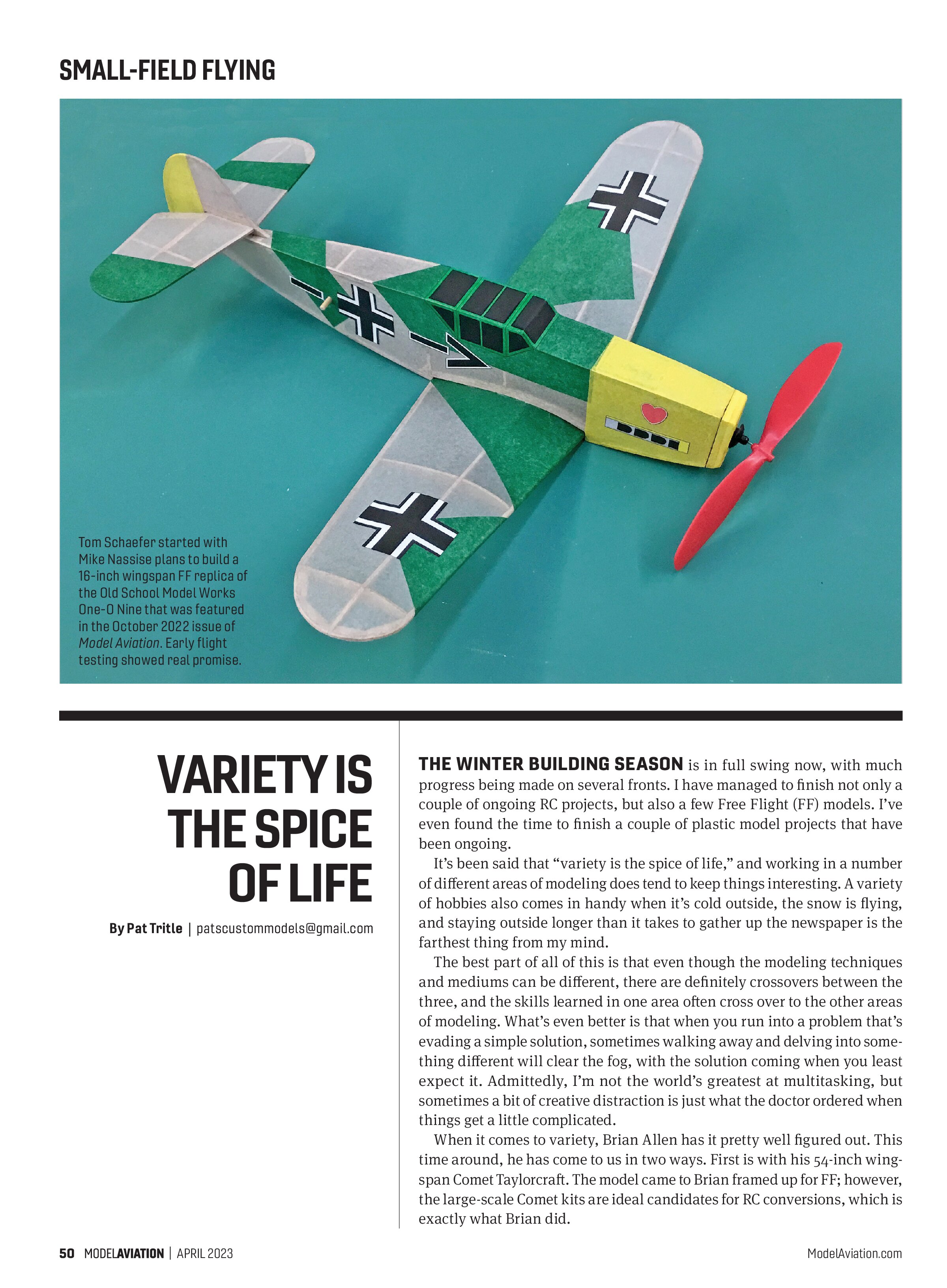
Moving on into the FF realm, after seeing the photo of the Old School Model Works One-O Nine on the cover of the October 2022 issue of Model Aviation, Tom Schaefer decided it would make a terrific 16-inch wingspan FF model. The model was framed up using Mike Nassise plans that were modified to look as close to the cover photo as possible. It’s essentially built as a No-Cal but with a 1-inch wide fuselage.
The One-O Nine is set up with a Guillow’s 6-inch propeller and was powered with a single loop of 1/8-inch rubber for flight testing. Although it was slightly underpowered, the early test flights looked promising, so flight trimming was continued using a single loop of 3/16-inch rubber.
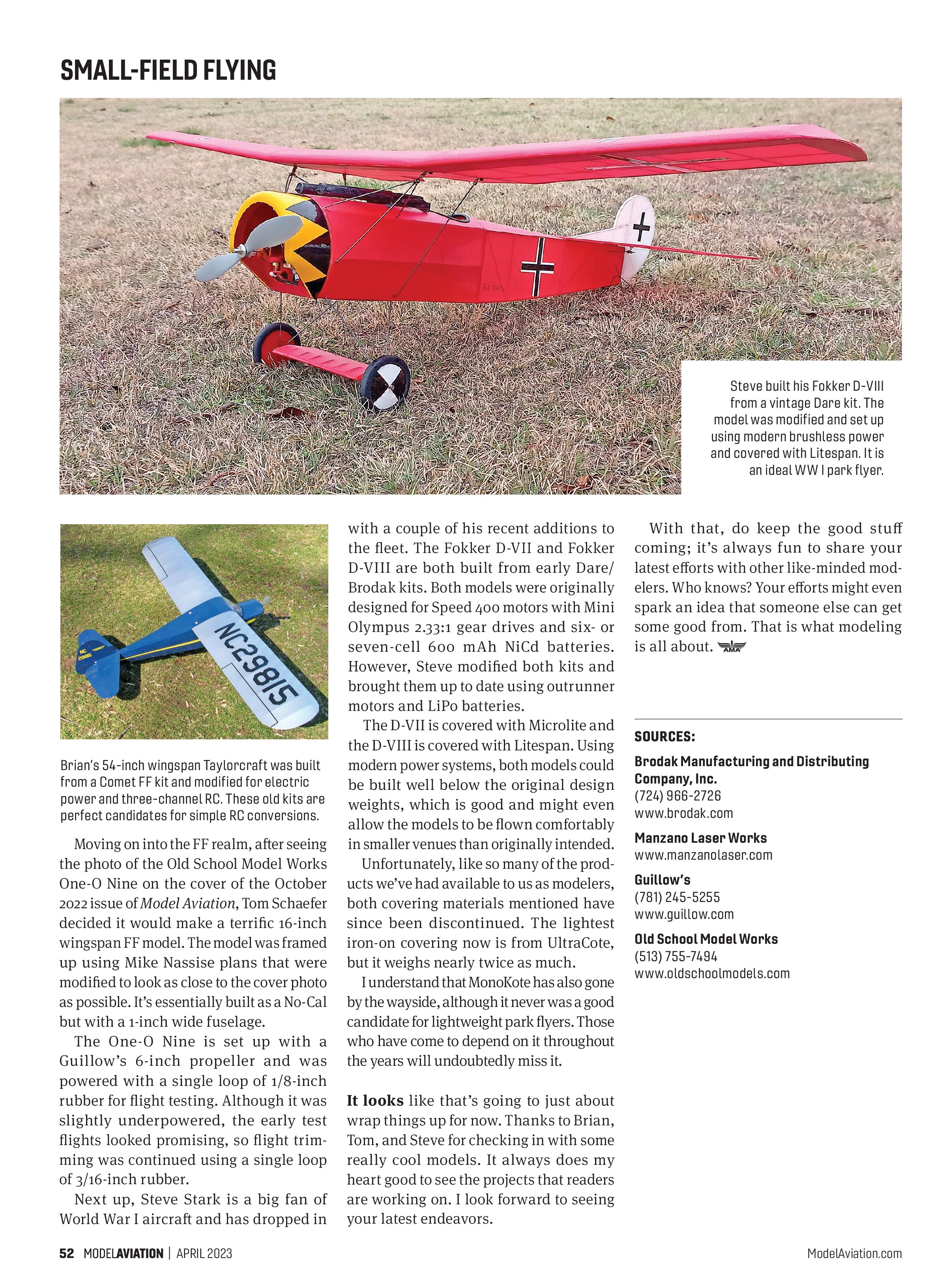
Next up, Steve Stark is a big fan of World War I aircraft and has dropped in with a couple of his recent additions to the fleet. The Fokker D-VII and Fokker D-VIII are both built from early Dare/Brodak kits. Both models were originally designed for Speed 400 motors with Mini Olympus 2.33:1 gear drives and six- or seven-cell 600 mAh NiCd batteries. However, Steve modified both kits and brought them up to date using outrunner motors and LiPo batteries.
The D-VII is covered with Microlite and the D-VIII is covered with Litespan. Using modern power systems, both models could be built well below the original design weights, which is good and might even allow the models to be flown comfortably in smaller venues than originally intended.
Unfortunately, like so many of the products we’ve had available to us as modelers, both covering materials mentioned have since been discontinued. The lightest iron-on covering now is from UltraCote, but it weighs nearly twice as much.
I understand that MonoKote has also gone by the wayside, although it never was a good candidate for lightweight park flyers. Those who have come to depend on it throughout the years will undoubtedly miss it.
It looks like that’s going to just about wrap things up for now. Thanks to Brian, Tom, and Steve for checking in with some really cool models. It always does my heart good to see the projects that readers are working on. I look forward to seeing your latest endeavors.
With that, do keep the good stuff coming; it’s always fun to share your latest efforts with other like-minded modelers. Who knows? Your efforts might even spark an idea that someone else can get some good from. That is what modeling is all about.
SOURCES:
Brodak Manufacturing and Distributing Company, Inc.
(724) 966-2726
www.brodak.com
Manzano Laser Works
www.manzanolaser.com
Guillow’s
(781) 245-5255
www.guillow.com
Old School Model Works
(513) 755-7494
www.oldschoolmodels.com