RC SCALE AEROBATICS
THE IMMELMANN, JUDGED ELEMENTS, AND SETUP TECHNIQUES
By John Glezellis | jglezellis@gmail.com

THROUGHOUT THE PAST few columns, my discussions have heavily revolved around proper aircraft setup to provide pilots with an airframe that is well-trimmed so that they can focus on perfecting the competition sequence at hand. The 2023 International Miniature Aerobatic Club (IMAC) Known programs for all classes were recently released and this is the appropriate time to put that trimmed model—and the pilot’s capabilities—to the test.
If you are new to the wonderful world of RC Scale Aerobatics, it is important to note that the sequences found are based on a catalog of maneuvers adopted by the FAI for full-scale aircraft aerobatics. The catalog of maneuvers consists of nine families of figures. As you progress from one class to the next, the same basic forms of a maneuver are found but include added complexity.
To illustrate this, I will look at two versions of the Immelmann, a few elements that a pilot will be judged against, and a few setup techniques that you might benefit from to cater the response of the aircraft to your liking.
Without further delay, let’s get started!
Key Element Exploration
While the 2023 Basic schedule consists of an Immelmann in the original form—a half inside loop with a half roll that is to be performed upon the exit—the 2023 Sportsman Known program features an Immelmann that contains a positive snap roll at the start with two points of a four-point roll at the very end. The pilot must know not only the control inputs required, but also what elements contribute to a perfectly flown figure so that unnecessary downgrades do not occur.
For the Immelmann, a constant radius must exist from start to finish and roll elements performed at the entry or exit must not contain a line segment between the roll and the partial loop. For the Basic variant, no visible line will be shown once the model completes the loop because you must immediately begin the half roll to upright level flight.
For the Sportsman variation, after the snap roll is complete, the pilot must immediately begin the half loop and as the model approaches the completion of the half loop, two points of a four-point roll are performed. The half loops in this sub-family must be of a constant radius and wind-corrected to appear as a perfect half circle. Should the pilot begin the half loop before the snap roll is complete or start the hesitation roll early, a half-point deduction will occur for every 5° of half loop remaining for which the roll element was performed.
For the snap roll, the autorotation must be initiated either simultaneously with the pitch departure or immediately following it. If a judge is certain that autorotation of the snap roll did not occur, the maneuver shall receive a zero, even if the rest of it was perfectly flown. For the hesitation roll segment, which is the two points of a four-point roll, each pause must be of identical duration. Any variation in the duration of the pause segments is downgraded by a total of one point, and errors in degrees of rotation are downgraded at a half point per 5°.
Besides having the knowledge needed to understand the rule book, the pilot must cater the response of the airplane to his or her liking. Should there be excessive deflection amounts, the model will respond in an irregular manner, which will result in downgrades.
Radio Setup Considerations
Far too often, I have seen pilots attempt to use excessive control-surface deflection amounts for precision flight. Having 45° of control-surface deflection is great for extreme
aerobatic maneuvers, but not for precision flight. I prefer the use of flight modes on my aerobatic models, where all rates are found on a single, three-position switch.
Using the Spektrum NX10 transmitter as an example, I use Switch G, where one position is for precision flight and Hammerheads (Position 2); another for snap rolls and spins (Position 1); and the last position (Position 0) for either 3D maneuvers or tailslides, if applicable. See the chart for example rates and percentages for the first two positions.
With the above setup, the Basic schedule Immelmann would occur all on Position 2. Looking at the Immelmann found in the Sportsman program, I would recommend using Position 2 for the snap roll segment only, and as soon as pitch departure is shown and the rotation is complete, immediately switch to Position 1 for the rest of the figure.
While some pilots prefer to keep all rates on individual switches, moving a switch from one position to another and, in some cases, multiple switches can be a bit overwhelming. To simplify matters, others prefer certain stick conditions where they can, for example, lead with elevator input to allow for a visible break for the snap rotation. Once a certain amount of deflection occurs on the aileron stick and aileron and rudder are applied for the snap rotation, the elevator and rudder amounts are both decreased automatically. This simplifies the control input process because the pilot can corner all sticks and let the aircraft unload the snap roll via settings found on the radio system in an automatic fashion.
A certain amount of aileron deflection is needed to activate these conditions, so you can still use this rate for the half loop and point roll because they will have precision control around neutral stick, which is ideally suited for the remainder of the figure. While I do not use this particular configuration, it is one to consider.
Lastly, some might prefer to simply fly on a single rate for precision flight, snap rolls, and spins by utilizing end-point values mentioned in the earlier table but with higher exponential settings to allow precise control around neutral stick and extreme deflection amounts once full rate has been commanded.
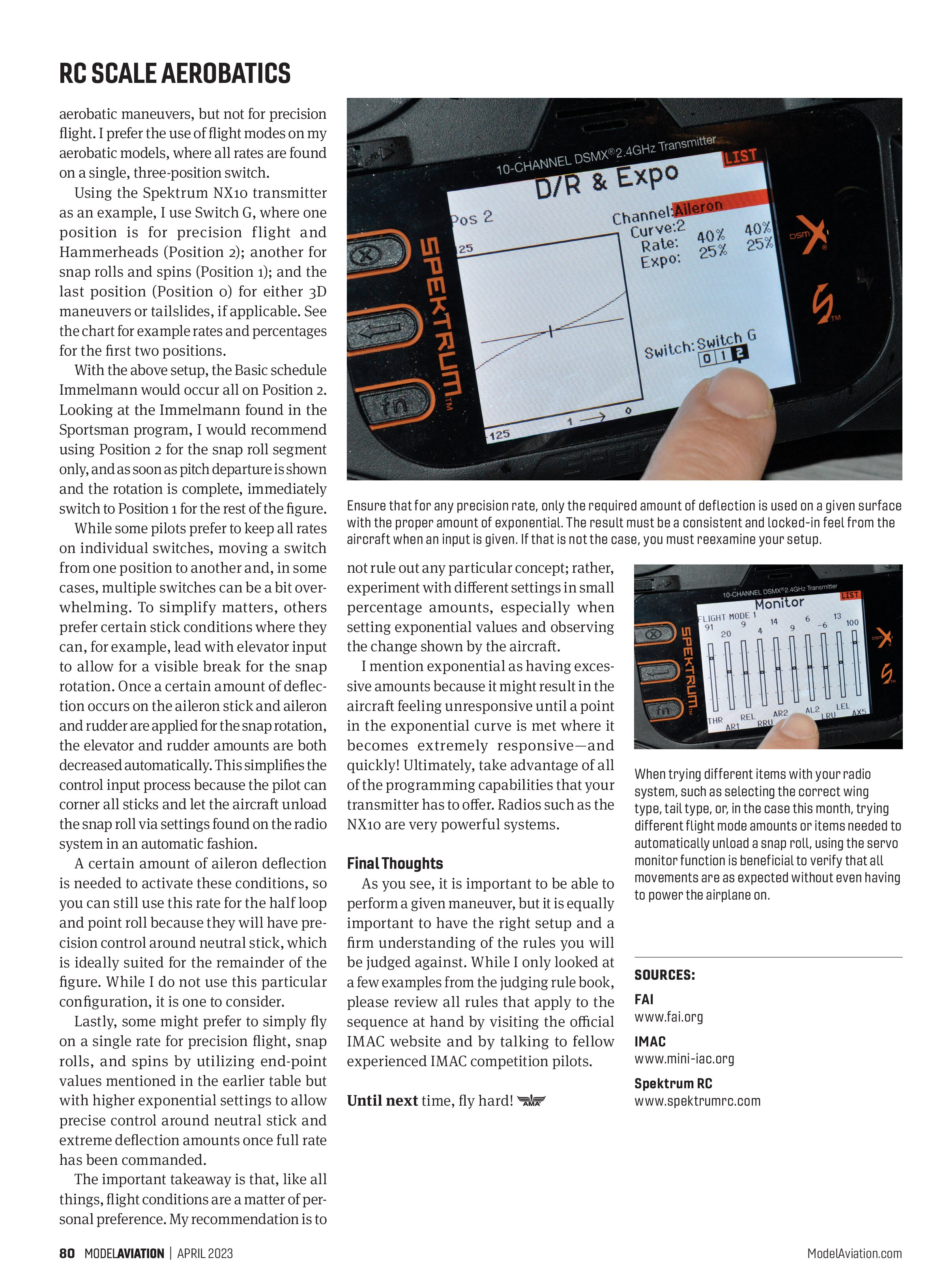
The important takeaway is that, like all things, flight conditions are a matter of personal preference. My recommendation is to not rule out any particular concept; rather, experiment with different settings in small percentage amounts, especially when setting exponential values and observing the change shown by the aircraft.
I mention exponential as having excessive amounts because it might result in the aircraft feeling unresponsive until a point in the exponential curve is met where it becomes extremely responsive—and quickly! Ultimately, take advantage of all of the programming capabilities that your transmitter has to offer. Radios such as the NX10 are very powerful systems.
Final Thoughts
As you see, it is important to be able to perform a given maneuver, but it is equally important to have the right setup and a firm understanding of the rules you will be judged against. While I only looked at a few examples from the judging rule book, please review all rules that apply to the sequence at hand by visiting the official IMAC website and by talking to fellow experienced IMAC competition pilots.
Until next time, fly hard!
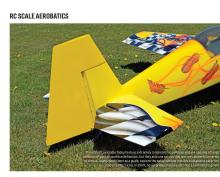
When trying different items with your radio system, such as selecting the correct wing type, tail type, or, in the case this month, trying different flight mode amounts or items needed to automatically unload a snap roll, using the servo monitor function is beneficial to verify that all movements are as expected without even having to power the airplane on.


SOURCES:
FAI
www.fai.org
IMAC
www.mini-iac.org
Spektrum RC
www.spektrumrc.com