WHAT’S IN YOUR TOOLBOX?
By Tim DiPeri | timd iperi@caseco-inc.com

TECHNOLOGY HAS SURELY CHANGED in the 50 years that I’ve been involved in model aviation. Throughout the years, I have added—not so much subtracted—tools to my arsenal for building, maintaining, and (sometimes) rebuilding model helicopters.
For this column, I wanted to discuss the tools that I feel make the hobby easier to enjoy. As I prepared this article, I was pleased to find that I still use some tools years (or decades) after my original purchase. I wanted to not only share my thoughts but the thoughts of several others who have various experiences, as well as tools that are imperative—or at least very useful—for model helicopter use.
I thought that it would be appropriate to separate the tools into sets of items. There are some items that always come with me (mostly in my transmitter case) and some that stay on the bench in my shop. Others are “semi-mobile,” based on what I want to accomplish.
Set One: Necessary Tools
- Hex tools (1.5mm, 2.0mm, 2.5mm, etc.): These tools are the lifeblood of your model helicopter build/maintenance experience. Although a set of hex wrenches from Home Depot or Lowe’s might work, invest in a good set of hardened drivers that will last for years. I have multiple sets in my transmitter case, field box, and shop.
- Basic hand tools: These include pliers, wire cutters, and quality screwdrivers. Pay attention to the Philips screwdrivers so that you have the correct size for your needs.
- Measuring devices: To this day, I use a small, 6-inch engineering ruler ($5). Something to accurately measure control rods, etc., is all that you need at this point.
- Pitch gauge: There are a number of good, low-cost digital pitch gauges available. I have digital ones but have used mechanical tools for years. I also keep a set of batteries for the pitch gauge in my tool bag.
- Ball link pliers: I originally did not have this as a necessary tool, but I realized that I always have one with me—and that I have several. This tool provides a way to remove ball links quickly and safely. Heli pilots tend to do this often, at least during setup.
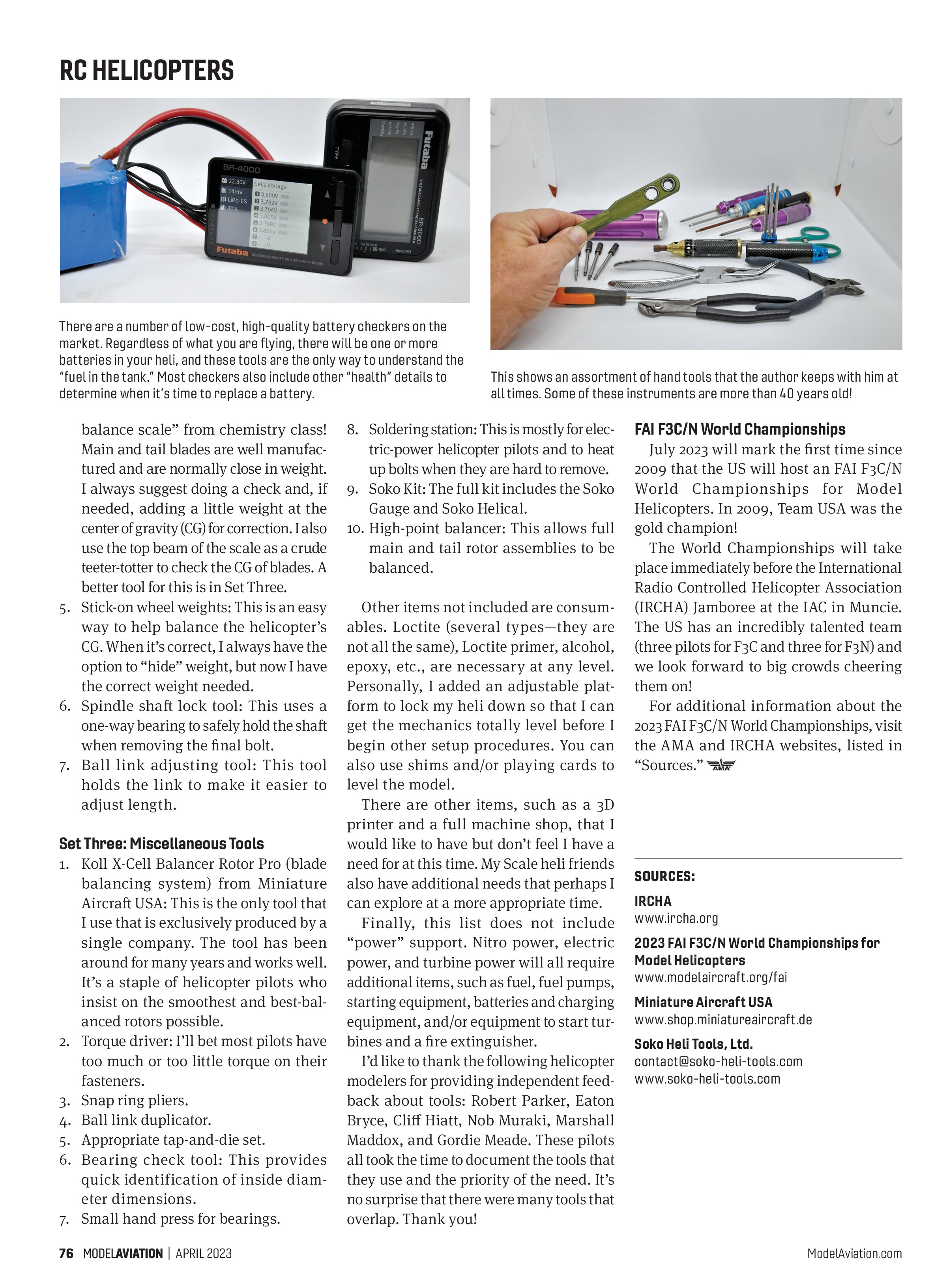
- Battery checker (regardless of whether you fly nitro-powered or electric-powered helis): This is the only way to know the health of your batteries at the time of use.
- Hemostat: This low-cost tool (unless you want hospital grade) allows the grip to be locked.
- Electrical tape: This is good for a variety of things, including moving small amounts of weight, for use on blades, or to smooth out the model test.
- Modeling knife: We always need a knife!
Set Two: Useful Tools
- Swashplate leveler: During setup, it’s important for the swashplate to be level. A variety of tools that range in cost and quality are widely available.
- Calipers: Calipers do not have to be expensive and are available at places such as Harbor Freight or Northern Tools at reasonable prices.
- Optical tachometer: This allows for a direct measurement of rotor rpm (not through telemetry).
- Scale: I still use an old “triple-beam
balance scale” from chemistry class! Main and tail blades are well manufactured and are normally close in weight. I always suggest doing a check and, if needed, adding a little weight at the center of gravity (CG) for correction. I also use the top beam of the scale as a crude teeter-totter to check the CG of blades. A better tool for this is in Set Three.

There are a number of low-cost, high-quality battery checkers on the market. Regardless of what you are flying, there will be one or more batteries in your heli, and these tools are the only way to understand the “fuel in the tank.” Most checkers also include other “health” details to determine when it’s time to replace a battery.
- Stick-on wheel weights: This is an easy way to help balance the helicopter’s CG. When it’s correct, I always have the option to “hide” weight, but now I have the correct weight needed.
- Spindle shaft lock tool: This uses a one-way bearing to safely hold the shaft when removing the final bolt.
- Ball link adjusting tool: This tool holds the link to make it easier to adjust length.
Set Three: Miscellaneous Tools
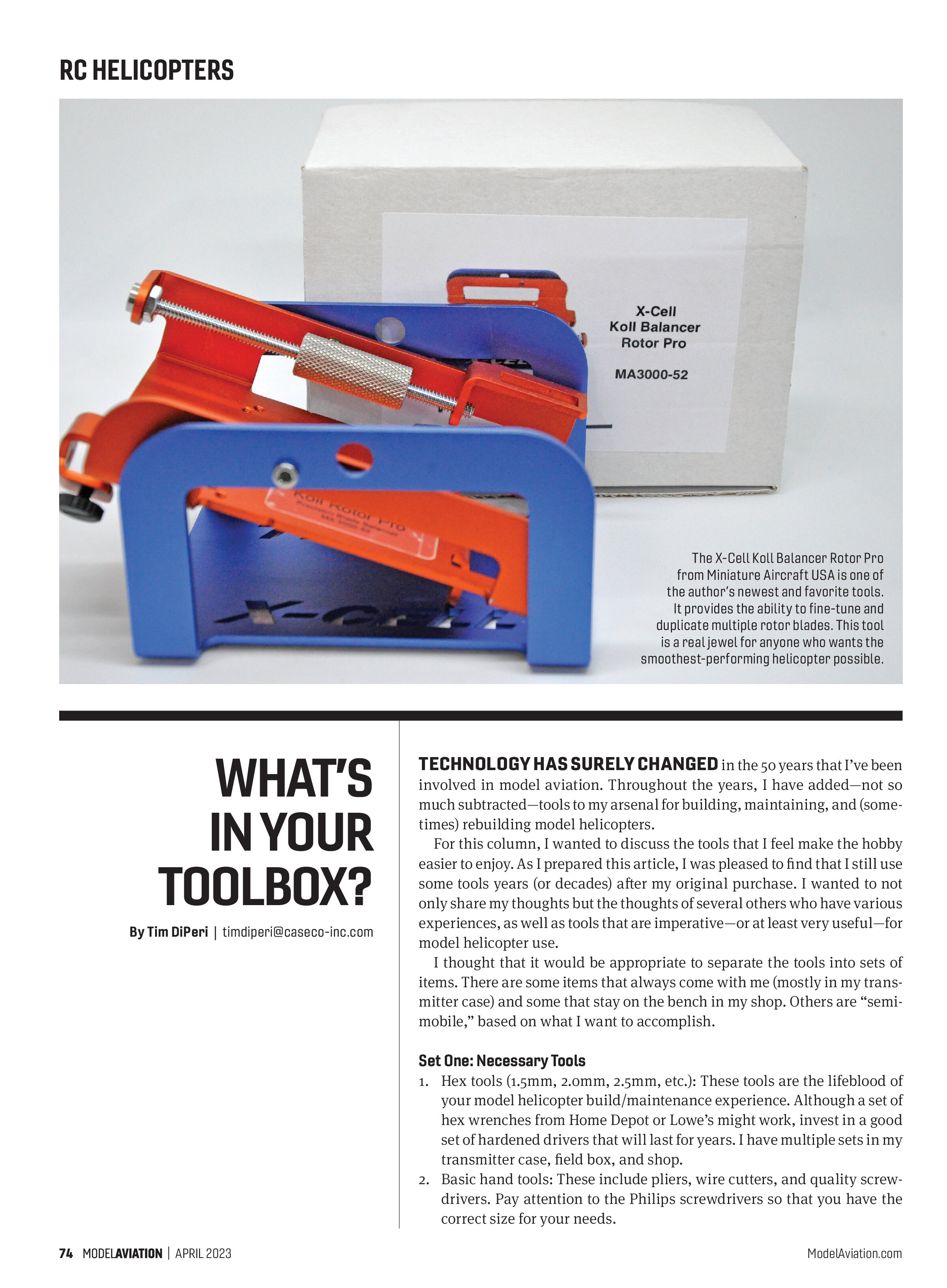
- Koll X-Cell Balancer Rotor Pro (blade balancing system) from Miniature Aircraft USA: This is the only tool that I use that is exclusively produced by a single company. The tool has been around for many years and works well. It’s a staple of helicopter pilots who insist on the smoothest and best-balanced rotors possible.
- Torque driver: I’ll bet most pilots have too much or too little torque on their fasteners.
- Snap ring pliers.
- Ball link duplicator.
- Appropriate tap-and-die set.
- Bearing check tool: This provides quick identification of inside diameter dimensions.
- Small hand press for bearings.
- Soldering station: This is mostly for electric-power helicopter pilots and to heat up bolts when they are hard to remove.
- Soko Kit: The full kit includes the Soko Gauge and Soko Helical.
- High-point balancer: This allows full main and tail rotor assemblies to be balanced.
Other items not included are consumables. Loctite (several types—they are not all the same), Loctite primer, alcohol, epoxy, etc., are necessary at any level. Personally, I added an adjustable platform to lock my heli down so that I can get the mechanics totally level before I begin other setup procedures. You can also use shims and/or playing cards to level the model.
There are other items, such as a 3D printer and a full machine shop, that I would like to have but don’t feel I have a need for at this time. My Scale heli friends also have additional needs that perhaps I can explore at a more appropriate time.
Finally, this list does not include “power” support. Nitro power, electric power, and turbine power will all require additional items, such as fuel, fuel pumps, starting equipment, batteries and charging equipment, and/or equipment to start turbines and a fire extinguisher.
I’d like to thank the following helicopter modelers for providing independent feedback about tools: Robert Parker, Eaton Bryce, Cliff Hiatt, Nob Muraki, Marshall Maddox, and Gordie Meade. These pilots all took the time to document the tools that they use and the priority of the need. It’s no surprise that there were many tools that overlap. Thank you!