OLD-TIMERS

FOX MANUFACTURING COMPANY
By Bob Angel | samrcflier@verizon.net
IN MY DECEMBER 2022 COLUMN, I discussed the fact that Duke Fox bought the remains of the Berkeley Model Company in approximately 1959. By then, Duke had moved his company from the Los Angeles area to Fort Smith, Arkansas, where business and living conditions were friendlier.
Even with the help of Berkeley founder Bill Effinger, Fox Manufacturing wasn’t able to revive Berkeley in the face of changing modeling interests. Fox then sold Berkeley to Sig Manufacturing, which sold some more kits before finally closing out the operation.
In response to my column, Ron Roberts, who had worked for Fox, contacted me and we exchanged correspondence. Ron had some first-hand stories about working for Fox, so we’ll steer off in that direction and add to the history of Fox Manufacturing.
As an AMA Model Aviation Hall of Fame member, Duke submitted his own AMA History Project autobiography, which, at 23 pages, is one of the longer biographies in the collection. Fox Manufacturing Company, however, doesn’t yet have an entry in the Company Histories section of the History Project archives. Maybe Ron’s experiences will give it a start.
Ron got hooked on Control Line (CL) flying at age 6 during a family picnic, where some men were flying CL models. He soon bought an OK Cub engine and ran it almost every day while he built models and learned to fly CL by himself. He was a teenager in 1955 when his family moved to Fort Smith.
The day they moved in, Ron followed the sound of a running engine, where he met and became a lifelong flying buddy of Bill Calvert. Later that summer, another sound of a running engine attracted the pair to locate the Fox Manufacturing Company.
Ron and Bill discovered a barrel of rejected engine parts out back and rummaged through them after closing time. They salvaged enough parts to assemble four or five fairly nice-running engines. At first, they paired the engines with Ringmaster kits and improved their flying skills. From there, Ron built a Nobler and a Flite Streak and started flying in contests.
One day at a contest, the Nobler’s engine was running poorly. A gentleman gave Ron some suggestions about cleaning and checking out the fuel system, but his turn to fly was coming up, so he instead switched to the Flite Streak and flew it to a third-place finish. He later found a crack in the Nobler’s fuel line.
A few months later, Ron graduated from high school and applied for a job at Fox Manufacturing. The personnel manager hired him, subject to the approval of Duke Fox, who had a policy of personally interviewing each potential employee. Here are Ron’s words:
“When I was shown into Duke’s office, I quickly recognized him as the gentleman I’d seen at the flying field several times—the same one who had offered the engine check-out suggestions that I’d declined. I thought to myself, ‘I won’t be getting this job!’ But in that little meeting, which might have lasted all of 3 minutes, he asked me only one question: Would I accept and follow his suggestions or not? I said I would and he told me I was hired.
“My pay was $1 per hour, and I worked a 40-hour week with time and a half for overtime. My first assignment was working in the engine run-in room under the tutelage of Duke himself. He demonstrated exactly how he expected each motor to be run. It wasn’t until he was satisfied that I knew what he expected that he left, but he also checked back a few times over the next few days.
“If you bought a Fox .29 or .35 Stunt engine produced in the last half of 1958, I probably test-ran that engine. To ensure that each Fox engine would start and run right out of the box, each was started and ran for several minutes and checked for a minimum of 10,000 rpm. Needle valves were left slightly on the rich side, so if you bought one, you probably found it easy to start and run as long as you didn’t change the needle setting first.
“Duke had designed the run-in room and test stands for efficiency, allowing an engine to be quickly clamped into place and a propeller, fuel line, and glow lighter attached. We could quickly run as many as four at a time. One day, working with another friend and model builder, Jay Davis, we set a record by running 526 engines.
“Occasionally, Duke would show up unannounced and stand in the corner watching for 10 to 15 minutes. Sometimes he would have us take a break while he selected five or six engines from the ones we’d run and check them out personally with his own tachometer. If we did our jobs correctly, the engines would pass Duke’s inspection and he was happy. If not, it was a bad day for everybody.
“After the run-in room, the engines were sent to the degreasing room, where they were dipped in a heated vat containing trichloroethylene, which we now know to be very toxic and has largely been removed from workplaces. A second vat contained a mixture of kerosene and oil to prevent rust after the thorough degreasing. And such was life in the run-in room!
“After a few months in the run-in room and several conversations with Duke in his office, I was moved into the main plant and eventually worked in all sections, becoming familiar with all aspects of the operation as I completed an apprenticeship as a tool and die maker.”
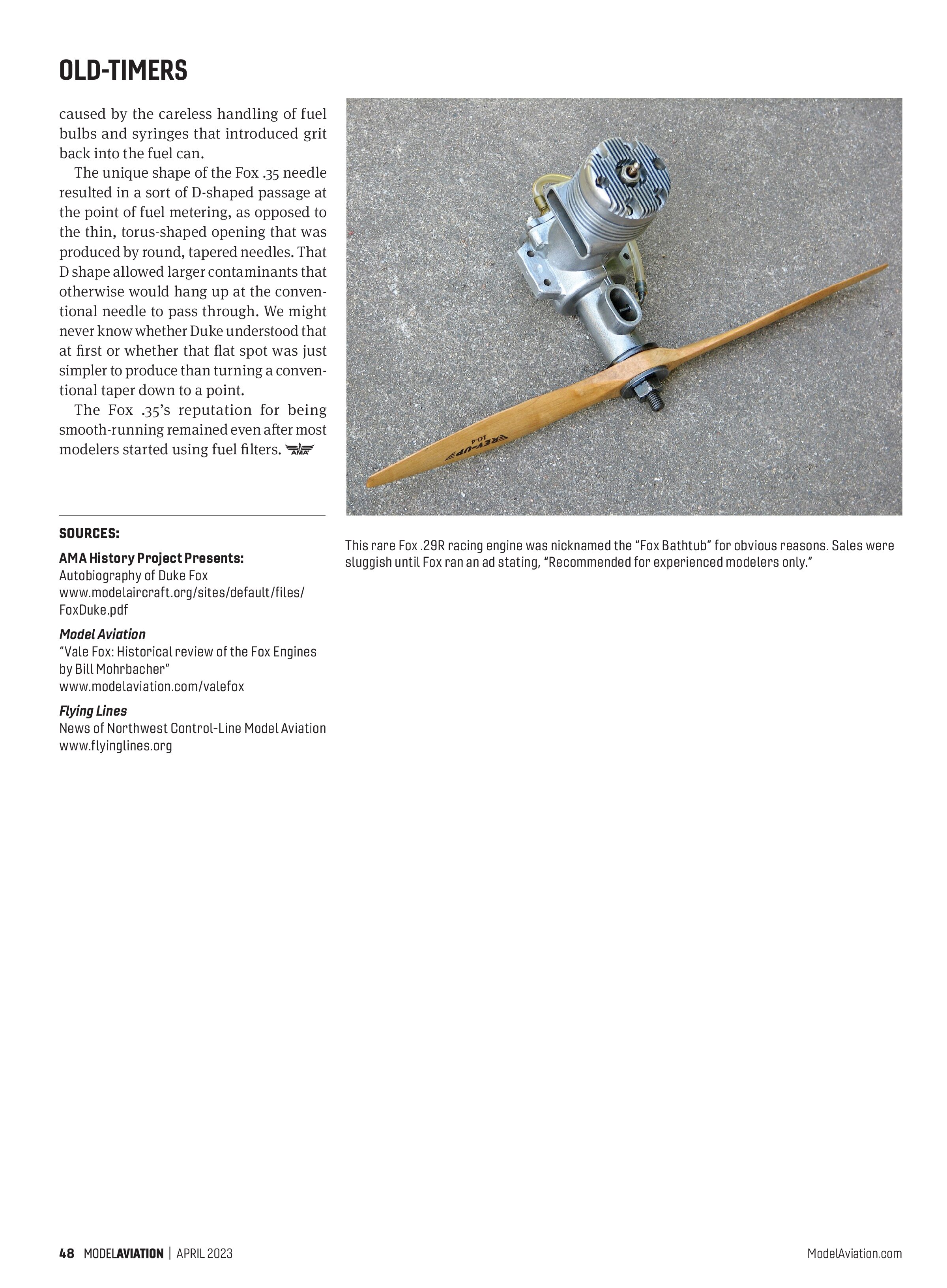
Obviously, Fox Manufacturing was run not by a board of directors but by Duke. Throughout the years, the venerable Fox .35 Stunt engine was often the product that kept the company operating during tougher times. The engines developed an early reputation for running more steadily than the competition. I formed a theory about that while the club members I flew with were using mostly Fox .35 and McCoy .35 engines in Ringmasters and similar profile models.

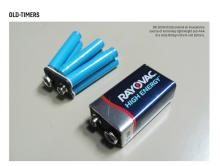
The Fox .35 uses a unique needle valve. Rather than a round, tapered needle, the Fox needle has a simple, tapered, flat ground at the tip. Few people used fuel filters early on, and they didn’t realize that a lot of their problems were caused by small contaminants in the fuel. This was often
caused by the careless handling of fuel bulbs and syringes that introduced grit back into the fuel can.
The unique shape of the Fox .35 needle resulted in a sort of D-shaped passage at the point of fuel metering, as opposed to the thin, torus-shaped opening that was produced by round, tapered needles. That D shape allowed larger contaminants that otherwise would hang up at the conventional needle to pass through. We might never know whether Duke understood that at first or whether that flat spot was just simpler to produce than turning a conventional taper down to a point.
The Fox .35’s reputation for being smooth-running remained even after most modelers started using fuel filters.
SOURCES:
AMA History Project Presents:
Autobiography of Duke Fox
www.modelaircraft.org/sites/default/files/
FoxDuke.pdf
Model Aviation
“Vale Fox: Historical review of the Fox Engines by Bill Mohrbacher”
www.modelaviation.com/valefox
Flying Lines
News of Northwest Control-Line Model Aviation
www.flyinglines.org