COUPE D’HIVER
By Don DeLoach | ddeloach@comcast.net
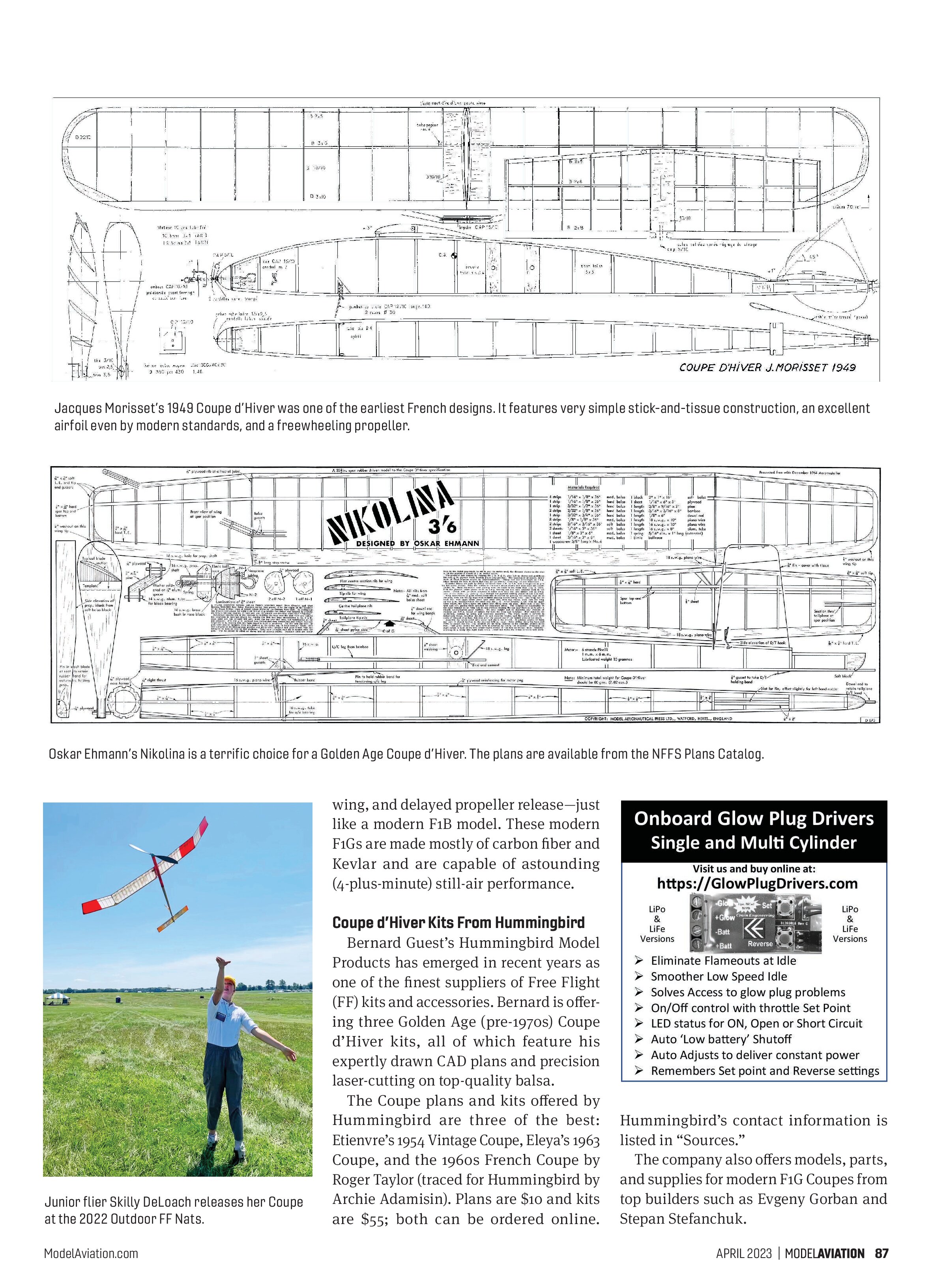
IN THE LATE 1930s, French modelers realized that a smaller, more compact Rubber class was needed for compact flying sites in France. They developed a simple Rubber model formula: 100-grams minimum airframe weight; 10-grams maximum rubber weight; 20 square cm of fuselage cross-sectional area; and models must rise-off-ground (ROG). They dubbed the event Coupe d’Hiver, or Winter Cup.
The first Coupe competition was held in France in 1945 and was an immediate success. Coupe d’Hiver’s popularity surged through the 1950s and ’60s, and in the 1970s, FAI adopted it as an international competition class with the designation of F1G.
Coupes were the first Duration Rubber models intended for smaller flying fields and shorter flights. The relatively small motors meant that the models had propeller runs of a minute or less and only flew approximately 2 minutes, which was long enough to have fun in the winter season on the smaller flying sites in continental Europe.
Modern Coupes
For the first three decades of its existence, Coupe d’Hiver was a very simple event. Wing areas were approximately 150 sq. in. and models flew nearly 2 minutes using a freewheeling or folding propeller. Around the early- to mid-1970s, wing aspect ratios increased and the still-air performance of Coupes went up. About this time, some innovative modelers also began to incorporate variable-incidence tails (VIT), which further increased performance.
By the 1990s, the best Coupes had VIT, auto rudder, a variable-incidence


Coupe d’Hiver Kits From Hummingbird
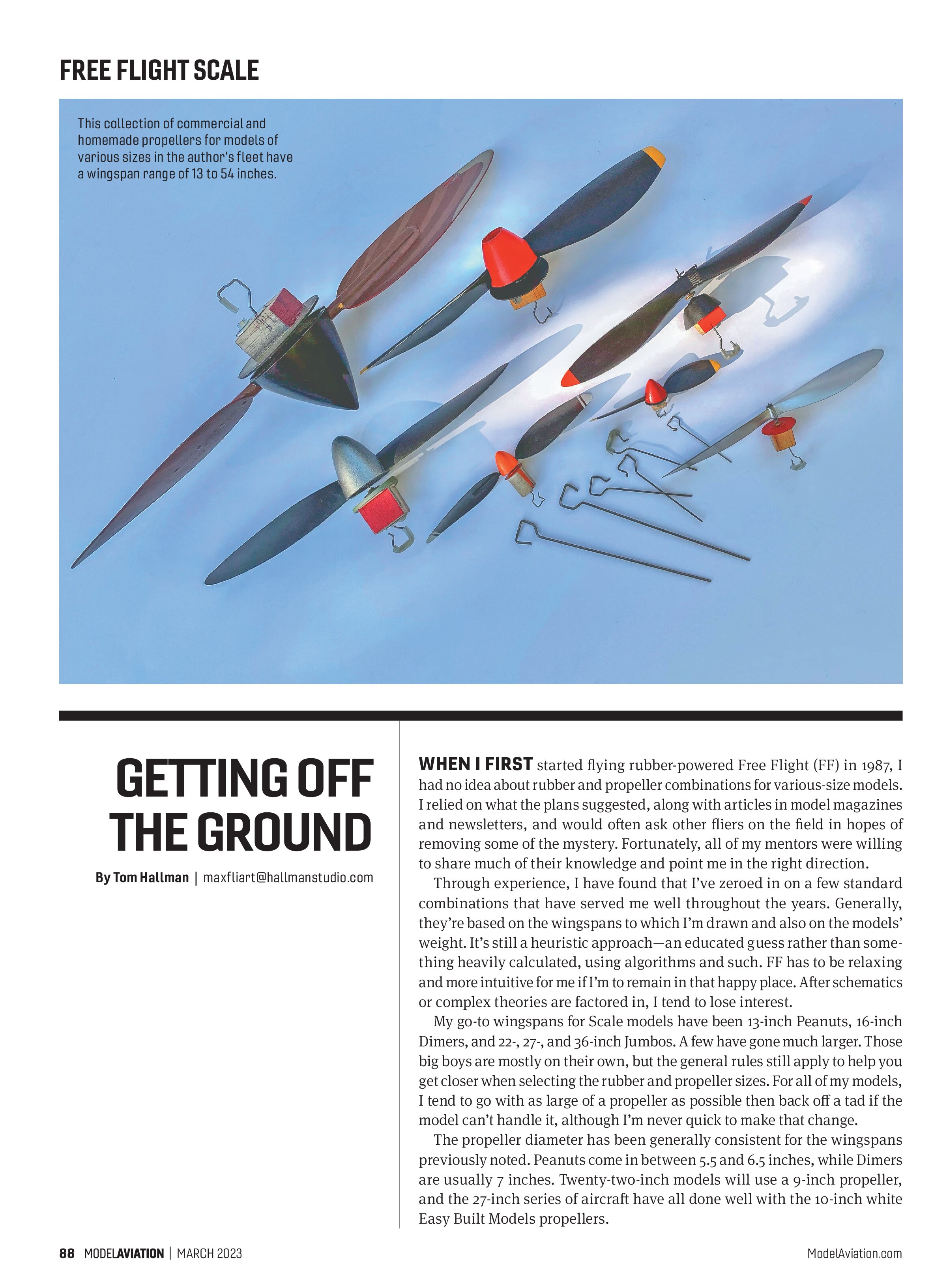
Bernard Guest’s Hummingbird Model Products has emerged in recent years as one of the finest suppliers of Free Flight (FF) kits and accessories. Bernard is offering three Golden Age (pre-1970s) Coupe d’Hiver kits, all of which feature his expertly drawn CAD plans and precision laser-cutting on top-quality balsa.
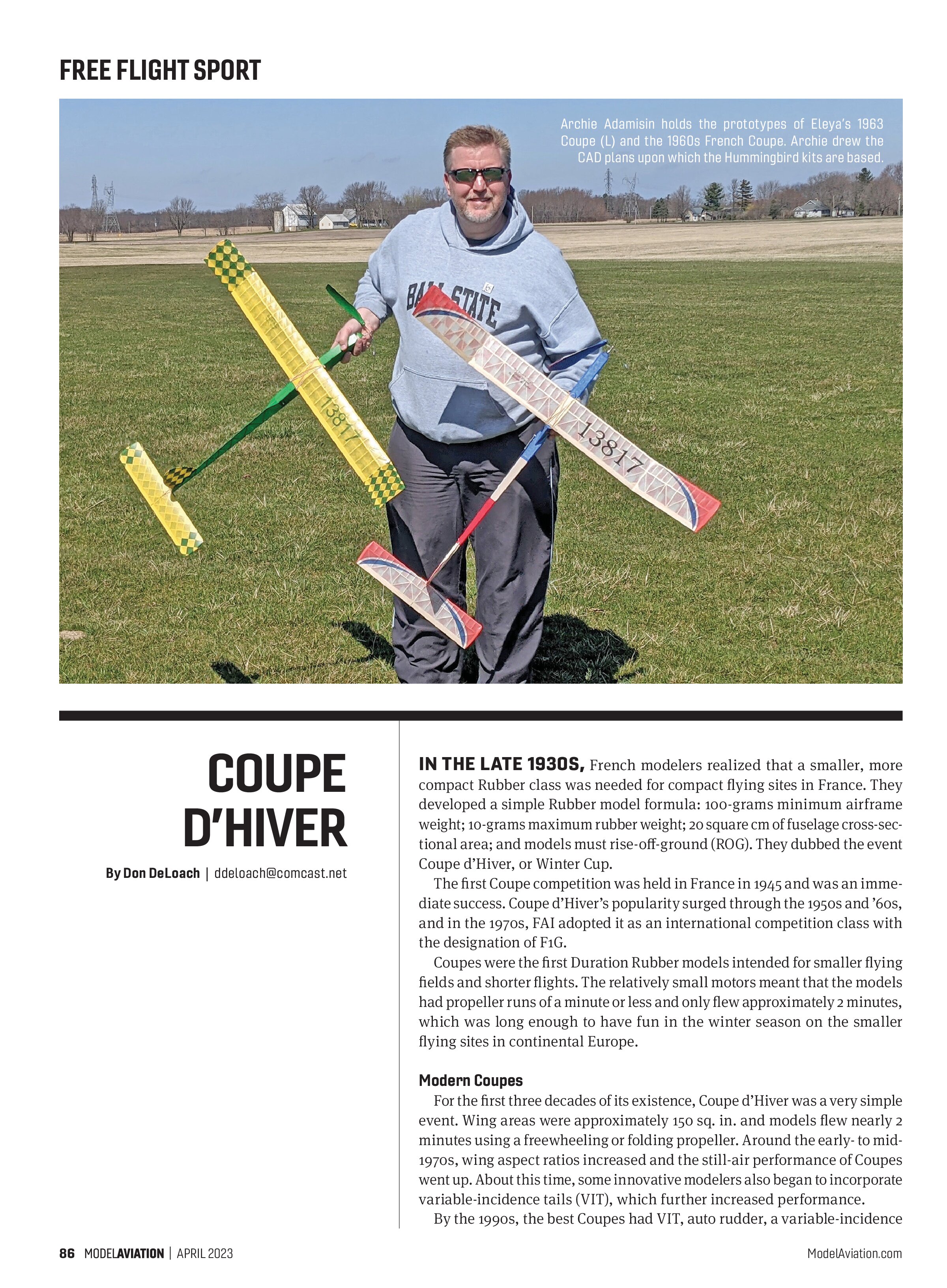
The Coupe plans and kits offered by Hummingbird are three of the best: Etienvre’s 1954 Vintage Coupe, Eleya’s 1963 Coupe, and the 1960s French Coupe by Roger Taylor (traced for Hummingbird by Archie Adamisin). Plans are $10 and kits are $55; both can be ordered online.
Hummingbird’s contact information is listed in “Sources.”
The company also offers models, parts, and supplies for modern F1G Coupes from top builders such as Evgeny Gorban and Stepan Stefanchuk.

GETTING OFF
THE GROUND
By Tom Hallman | maxfliart@hallmanstudio.com
WHEN I FIRST started flying rubber-powered Free Flight (FF) in 1987, I had no idea about rubber and propeller combinations for various-size models. I relied on what the plans suggested, along with articles in model magazines and newsletters, and would often ask other fliers on the field in hopes of removing some of the mystery. Fortunately, all of my mentors were willing to share much of their knowledge and point me in the right direction.
Through experience, I have found that I’ve zeroed in on a few standard combinations that have served me well throughout the years. Generally, they’re based on the wingspans to which I’m drawn and also on the models’ weight. It’s still a heuristic approach—an educated guess rather than something heavily calculated, using algorithms and such. FF has to be relaxing and more intuitive for me if I’m to remain in that happy place. After schematics or complex theories are factored in, I tend to lose interest.
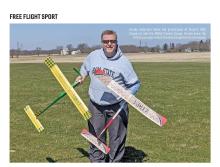
My go-to wingspans for Scale models have been 13-inch Peanuts, 16-inch Dimers, and 22-, 27-, and 36-inch Jumbos. A few have gone much larger. Those big boys are mostly on their own, but the general rules still apply to help you get closer when selecting the rubber and propeller sizes. For all of my models, I tend to go with as large of a propeller as possible then back off a tad if the model can’t handle it, although I’m never quick to make that change.
The propeller diameter has been generally consistent for the wingspans previously noted. Peanuts come in between 5.5 and 6.5 inches, while Dimers are usually 7 inches. Twenty-two-inch models will use a 9-inch propeller, and the 27-inch series of aircraft have all done well with the 10-inch white Easy Built Models propellers.