Focal Point
Interested in sharing your handiwork? Visit www.ModelAviation.com for submission guidelines.

J-5 Cub Cruiser
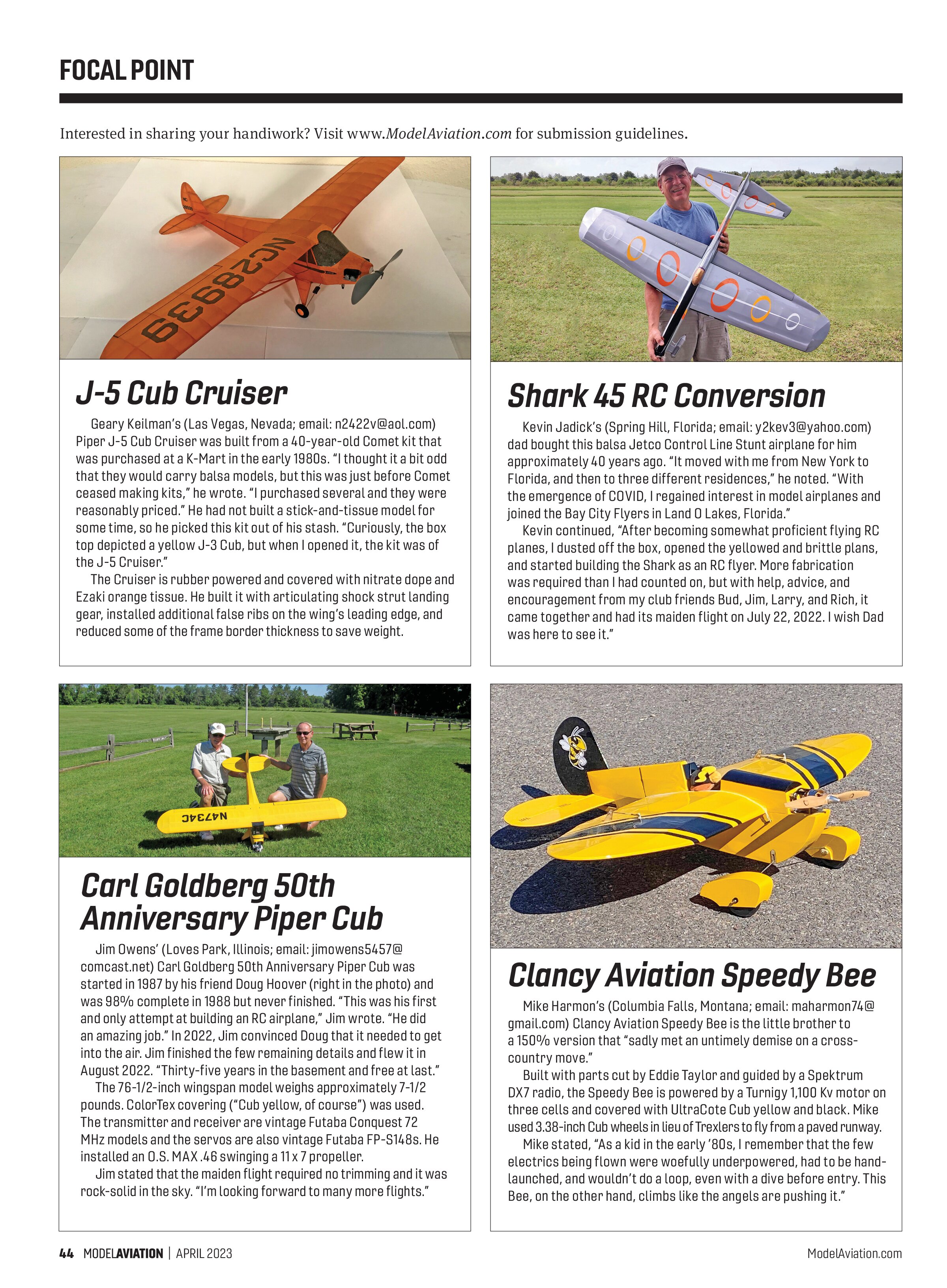
Geary Keilman’s (Las Vegas, Nevada; email: n2422v@aol.com) Piper J-5 Cub Cruiser was built from a 40-year-old Comet kit that was purchased at a K-Mart in the early 1980s. “I thought it a bit odd that they would carry balsa models, but this was just before Comet ceased making kits,” he wrote. “I purchased several and they were reasonably priced.” He had not built a stick-and-tissue model for some time, so he picked this kit out of his stash. “Curiously, the box top depicted a yellow J-3 Cub, but when I opened it, the kit was of the J-5 Cruiser.”
The Cruiser is rubber powered and covered with nitrate dope and Ezaki orange tissue. He built it with articulating shock strut landing gear, installed additional false ribs on the wing’s leading edge, and reduced some of the frame border thickness to save weight.

Shark 45 RC Conversion
Kevin Jadick’s (Spring Hill, Florida; email: y2kev3@yahoo.com) dad bought this balsa Jetco Control Line Stunt airplane for him approximately 40 years ago. “It moved with me from New York to Florida, and then to three different residences,” he noted. “With the emergence of COVID, I regained interest in model airplanes and joined the Bay City Flyers in Land O Lakes, Florida.”
Kevin continued, “After becoming somewhat proficient flying RC planes, I dusted off the box, opened the yellowed and brittle plans, and started building the Shark as an RC flyer. More fabrication was required than I had counted on, but with help, advice, and encouragement from my club friends Bud, Jim, Larry, and Rich, it came together and had its maiden flight on July 22, 2022. I wish Dad was here to see it.”

Carl Goldberg 50th Anniversary Piper Cub
Jim Owens’ (Loves Park, Illinois; email: jimowens5457@comcast.net) Carl Goldberg 50th Anniversary Piper Cub was started in 1987 by his friend Doug Hoover (right in the photo) and was 98% complete in 1988 but never finished. “This was his first and only attempt at building an RC airplane,” Jim wrote. “He did an amazing job.” In 2022, Jim convinced Doug that it needed to get into the air. Jim finished the few remaining details and flew it in August 2022. “Thirty-five years in the basement and free at last.”
The 76-1/2-inch wingspan model weighs approximately 7-1/2 pounds. ColorTex covering (“Cub yellow, of course”) was used. The transmitter and receiver are vintage Futaba Conquest 72 MHz models and the servos are also vintage Futaba FP-S148s. He installed an O.S. MAX .46 swinging a 11 x 7 propeller.
Jim stated that the maiden flight required no trimming and it was rock-solid in the sky. “I’m looking forward to many more flights.”

Clancy Aviation Speedy Bee
Mike Harmon’s (Columbia Falls, Montana; email: mahammon7@gmail.com) Clancy Aviation Speedy Bee is the little brother to a 150% version that “sadly met an untimely demise on a cross-country move.”
Built with parts cut by Eddie Taylor and guided by a Spektrum DX7 radio, the Speedy Bee is powered by a Turnigy 1,100 Kv motor on three cells and covered with UltraCote Cub yellow and black. Mike used 3.38-inch Cub wheels in lieu of Trexlers to fly from a paved runway.
Mike stated, “As a kid in the early ’80s, I remember that the few electrics being flown were woefully underpowered, had to be hand-launched, and wouldn’t do a loop, even with a dive before entry. This Bee, on the other hand, climbs like the angels are pushing it.”

BlitzRCWorks Super Sky Surfer Turned Night Flyer
Michael Bruno (Annapolis, Maryland/Port St Lucie, Florida; email: michaelbruno@gmail.com) turned his BlitzRCWorks Super Sky Surfer into a Night Flyer after watching a video of the E-flite Night Radian. The photo was taken in April 2022 at the Prince George’s Radio Control Club’s flying field near Washington, D.C. The powered glider had been in his hangar for approximately 10 years and wasn’t often flown, as he prefers flying EDF jets.
Michael purchased three Night Radian LED sets from Horizon Hobby and made the conversion into his winter project. Facing the LEDs inward was preferable to facing them outward, because the interior of the airplane is illuminated—“It really glows and kinda has a ghostly appearance.” The effect of the LEDs on the battery’s charge is negligible; flight times are 12 minutes, with plenty of charge remaining for another 3 or 4 minutes of flight.
Check out Michael’s YouTube video at https://youtu.be/WtXu29bWJ1o.

Wing Mfg. P-51 Mustang
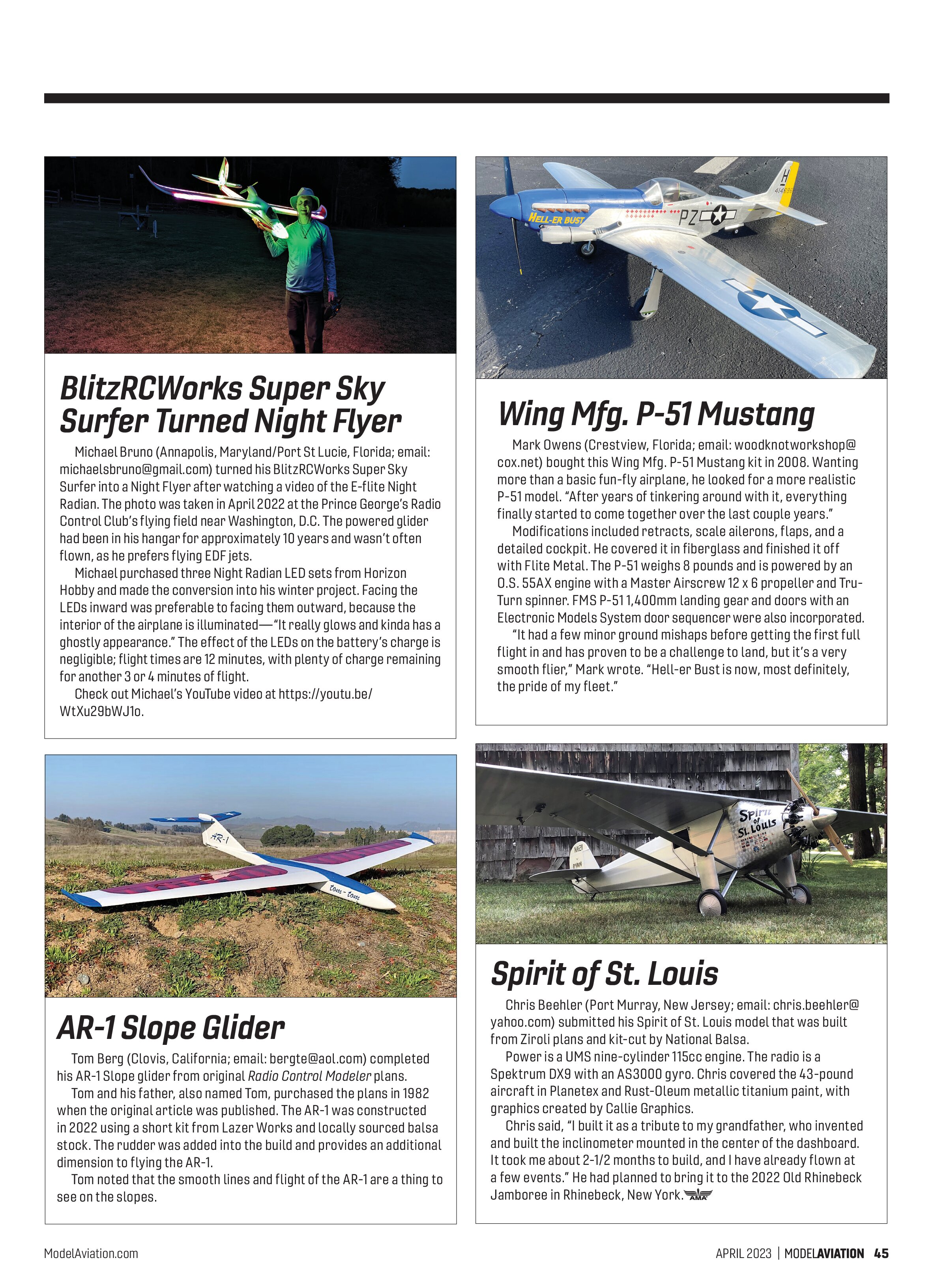
Mark Owens (Crestview, Florida; email: woodknotworkshop@cox.net) bought this Wing Mfg. P-51 Mustang kit in 2008. Wanting more than a basic fun-fly airplane, he looked for a more realistic P-51 model. “After years of tinkering around with it, everything finally started to come together over the last couple years.”
Modifications included retracts, scale ailerons, flaps, and a detailed cockpit. He covered it in fiberglass and finished it off with Flite Metal. The P-51 weighs 8 pounds and is powered by an O.S. 55AX engine with a Master Airscrew 12 x 6 propeller and Tru-Turn spinner. FMS P-51 1,400mm landing gear and doors with an Electronic Models System door sequencer were also incorporated.
“It had a few minor ground mishaps before getting the first full flight in and has proven to be a challenge to land, but it’s a very smooth flier,” Mark wrote. “Hell-er Bust is now, most definitely, the pride of my fleet.”

AR-1 Slope Glider
Tom Berg (Clovis, California; email: bergte@aol.com) completed his AR-1 Slope glider from original Radio Control Modeler plans.
Tom and his father, also named Tom, purchased the plans in 1982 when the original article was published. The AR-1 was constructed in 2022 using a short kit from Lazer Works and locally sourced balsa stock. The rudder was added into the build and provides an additional dimension to flying the AR-1.
Tom noted that the smooth lines and flight of the AR-1 are a thing to see on the slopes.

Spirit of St. Louis
Chris Beehler (Port Murray, New Jersey; email: chris.beehler@yahoo.com) submitted his Spirit of St. Louis model that was built from Ziroli plans and kit-cut by National Balsa.
Power is a UMS nine-cylinder 115cc engine. The radio is a Spektrum DX9 with an AS3000 gyro. Chris covered the 43-pound aircraft in Planatex and Rust-Oleum metallic titanium paint, with graphics created by Callie Graphics.
Chris said, “I built it as a tribute to my grandfather, who invented and built the inclinometer mounted in the center of the dashboard. It took me about 2-1/2 months to build, and I have already flown at a few events.” He had planned to bring it to the 2022 Old Rhinebeck Jamboree in Rhinebeck, New York.