
WORKSHOP SAFETY: THE NUMBER ONE RULE
By Terry Dunn | terrydunn74@gmail.com
I HAVE SEEN a lot of posts on RC-related internet forums that talk about injuries from electric-powered airplanes. There are many variations, but the basic theme is as old as electric flight itself. The victim was struck by the propeller of an electric-powered model that unexpectedly spooled up inside his or her workshop.
In most cases, the victim is the perpetrator of the accident. Adding insult to injury, it is also common to have collateral damage to surrounding models as the wayward airplane thrashes about. (Bloodstains do not count.)
Glow and gas engines require a series of specific steps to get started. It is unlikely that you will ever accidentally fire one up—sometimes not even on purpose. Electric motors, however, can come alive from a mistake as simple as bumping the throttle stick or reversing the wrong channel. These things are bound to happen sooner or later.
My philosophy is simple. When the battery is connected, I treat an electric model the same way I would a glow or gas model with the engine running.
There is a very easy way to avoid the danger posed by accidental run-ups in your workshop. Consider this the number-one rule—remove the propeller whenever you are working on a model that has the battery connected. This applies even if you are not working on the actual power system. It only takes a few seconds to be safe. Make this simple task a habit before you have the scars to remind you. Removing the propeller is the most effective way to avoid workshop injuries with electric-powered models.
If you are somehow under the mistaken impression that electric power systems will not cause injury, you have clearly never been bitten by one. Propellers are
sharp. Flesh is fragile. Even the power systems in some ultramicro models can ruin your day. Larger systems can cause gruesome injuries. Don’t take chances.
Unlike many wet-fuel engines, electric motors do not stop just because your finger gets in the way of the propeller. An electric motor will continue to turn (or try to turn) until the ESC is taken to idle or the battery is disconnected. You might receive multiple cuts, not to mention that you still have to somehow neutralize your rogue model while also tending to your injury.
I often ask readers of this column to send me stories of their experiences related to topics that I cover. This is not one of those times. Thanks, but I do not need to see gory photos from your trip to the emergency room!
However, I do ask that you help spread this very simple advice to your fellow electric pilots. Many modelers do not realize the myriad mistakes that can unintentionally throttle up an electric motor, and removing the propeller is not necessarily intuitive to everyone. Hopefully, your story will help them understand before they have ER photos of their own!
Frozen Batteries
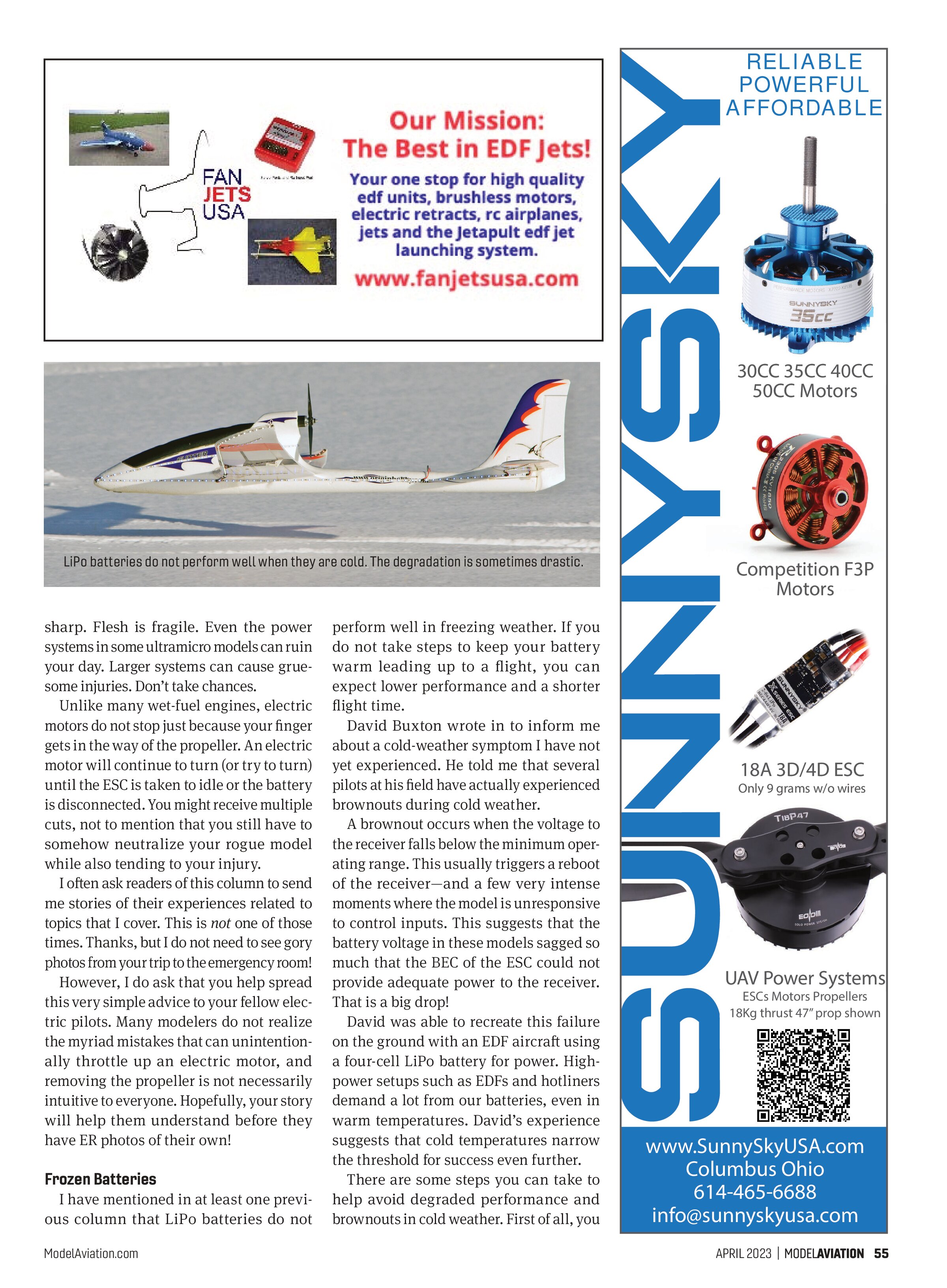
I have mentioned in at least one previous column that LiPo batteries do not

perform well in freezing weather. If you do not take steps to keep your battery warm leading up to a flight, you can expect lower performance and a shorter flight time.
David Buxton wrote in to inform me about a cold-weather symptom I have not yet experienced. He told me that several pilots at his field have actually experienced brownouts during cold weather.
A brownout occurs when the voltage to the receiver falls below the minimum operating range. This usually triggers a reboot of the receiver—and a few very intense moments where the model is unresponsive to control inputs. This suggests that the battery voltage in these models sagged so much that the BEC of the ESC could not provide adequate power to the receiver. That is a big drop!
David was able to recreate this failure on the ground with an EDF aircraft using a four-cell LiPo battery for power. High-power setups such as EDFs and hotliners demand a lot from our batteries, even in warm temperatures. David’s experience suggests that cold temperatures narrow the threshold for success even further.
There are some steps you can take to help avoid degraded performance and brownouts in cold weather. First of all, you

should verify that your battery is rated to provide the current (amps) that your power system demands.
That is a slightly complex topic that I can dig into in a future column. For now, I will summarize by saying that for ARF models, you should follow the manufacturer’s suggested battery in terms of voltage, capacity, and discharge rating.
It is also wise to make sure that your battery is still in good health. It might have degraded to the point that it is no longer viable for the intended application, or at least not in the cold. You can find tips for evaluating your battery’s condition in my August 2022 column.
My last bit of advice is to keep your battery warm until you are ready to fly. As I mentioned in my December 2021 column, I like to use a microwavable heating pad to keep the batteries toasty inside the transmitter case that I take to the field. There are plenty of equally viable alternative methods.
On this topic, I will ask you to share your experiences with me. Send me an email about your model’s poor performance or brownouts in cold weather. I am also interested to hear how you fellow Northerners keep your LiPos warm on those chilly flying days.
Winter Projects
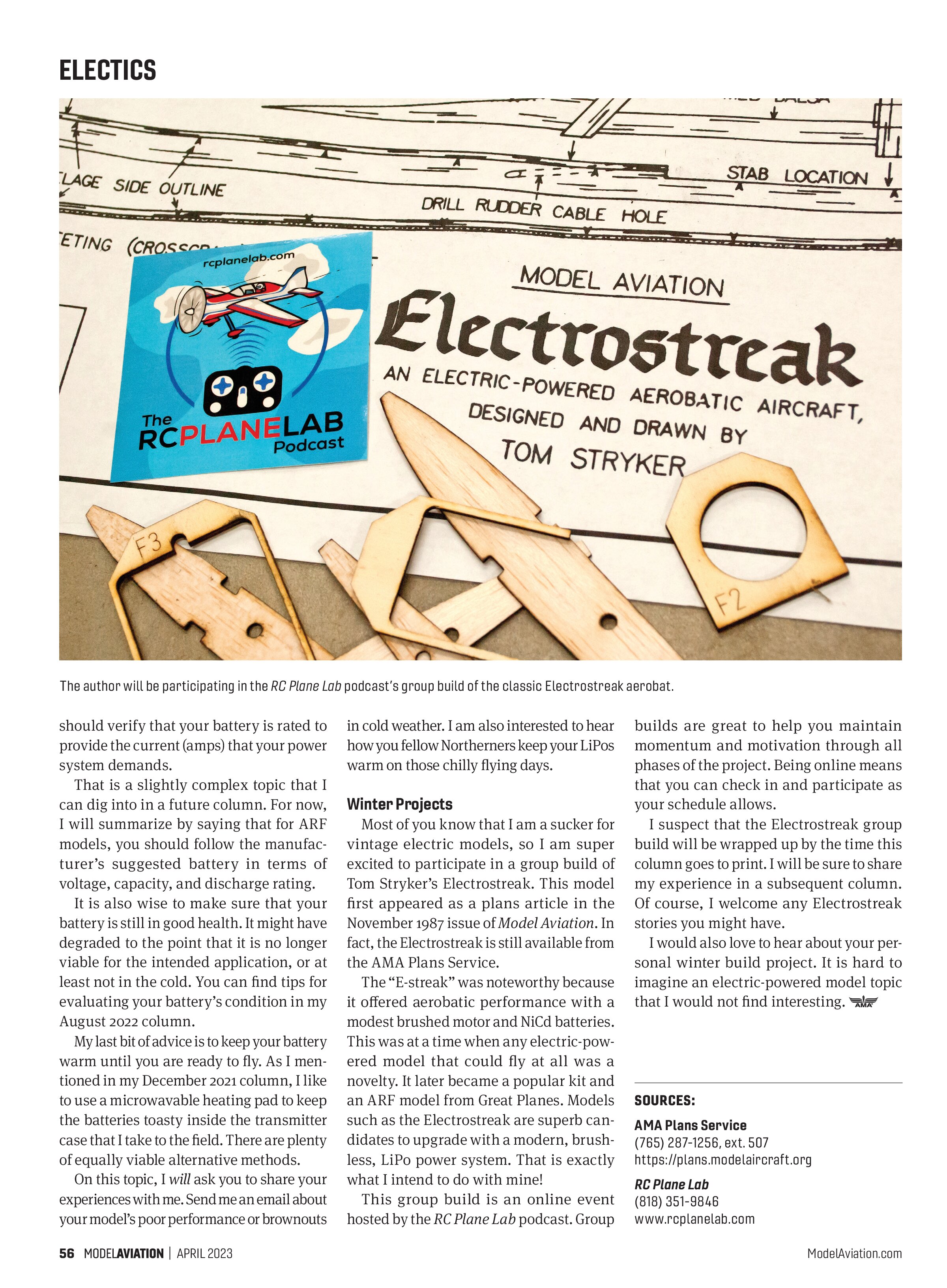
Most of you know that I am a sucker for vintage electric models, so I am super excited to participate in a group build of Tom Stryker’s Electrostreak. This model first appeared as a plans article in the November 1987 issue of Model Aviation. In fact, the Electrostreak is still available from the AMA Plans Service.
The “E-streak” was noteworthy because it offered aerobatic performance with a modest brushed motor and NiCd batteries. This was at a time when any electric-powered model that could fly at all was a novelty. It later became a popular kit and an ARF model from Great Planes. Models such as the Electrostreak are superb candidates to upgrade with a modern, brushless, LiPo power system. That is exactly what I intend to do with mine!
This group build is an online event hosted by the RC Plane Lab podcast. Group builds are great to help you maintain momentum and motivation through all phases of the project. Being online means that you can check in and participate as your schedule allows.
I suspect that the Electrostreak group build will be wrapped up by the time this column goes to print. I will be sure to share my experience in a subsequent column. Of course, I welcome any Electrostreak stories you might have.
I would also love to hear about your personal winter build project. It is hard to imagine an electric-powered model topic that I would not find interesting.
SOURCES:
AMA Plans Service
(765) 287-1256, ext. 507
https://plans.modelaircraft.org
RC Plane Lab
(818) 351-9846
www.rcplanelab.com