THE DEAL WITH DRONES

THE LE MANS
OF DRONE
RACING
By Susan Smith | susankaysmith@gmail.com
SHANNON BROUSSARD, from Louisiana, was an RC car enthusiast. What wasn’t to love? The adrenaline of races lasting for an hour or more, the strategy of refueling, working as partners. Then his local track closed. While driving to a meeting for a new track, he saw a drone and knew he had to try it.
For Shannon, however, drone racing was woefully short. Heats in the early days lasted 2-1/2 minutes. As pilots got faster and gear got better, that dropped to 90 seconds. Now elite pilots race for a minute or less. Could he bring extended races to drones?
Early Days
Shannon, who is the MultiGP director of chapters, experimented with four-person teams at his local club. Each team would race for an hour. “In a normal race day, you might get 10 or 15 batteries. With teams, everyone gets more packs, and you still have the same excitement.”
The idea took off. Pablo “SELAFPV” Mendez created a 200-lap “Masters of Endurance” race. Shannon loved it and followed suit with the first 200-lap MultiGP race called Mayhem.
A pilot then suggested 24 hours. It would be the Le Mans of drone racing. “He was joking, but the idea started taking off,” Shannon said. “We decided to start with a 12-hour race. Everyone thought I was crazy, but the pilots were excited.”
Mayhem has grown into one of the most well-known team races. The concept has even made it to small 65mm drones with the weBLEED 500 Tiny Whoop race.


Team Racing Strategy
The race was a hit. “Our team was interested in Mayhem the first time Shannon mentioned it to us,” said Alec “Lundy” Lunsford, the only person to have raced in every Mayhem. “The first event was an absolute blast. We had no real clue how the race was going to work, and strategy was something all teams developed on the spot.”
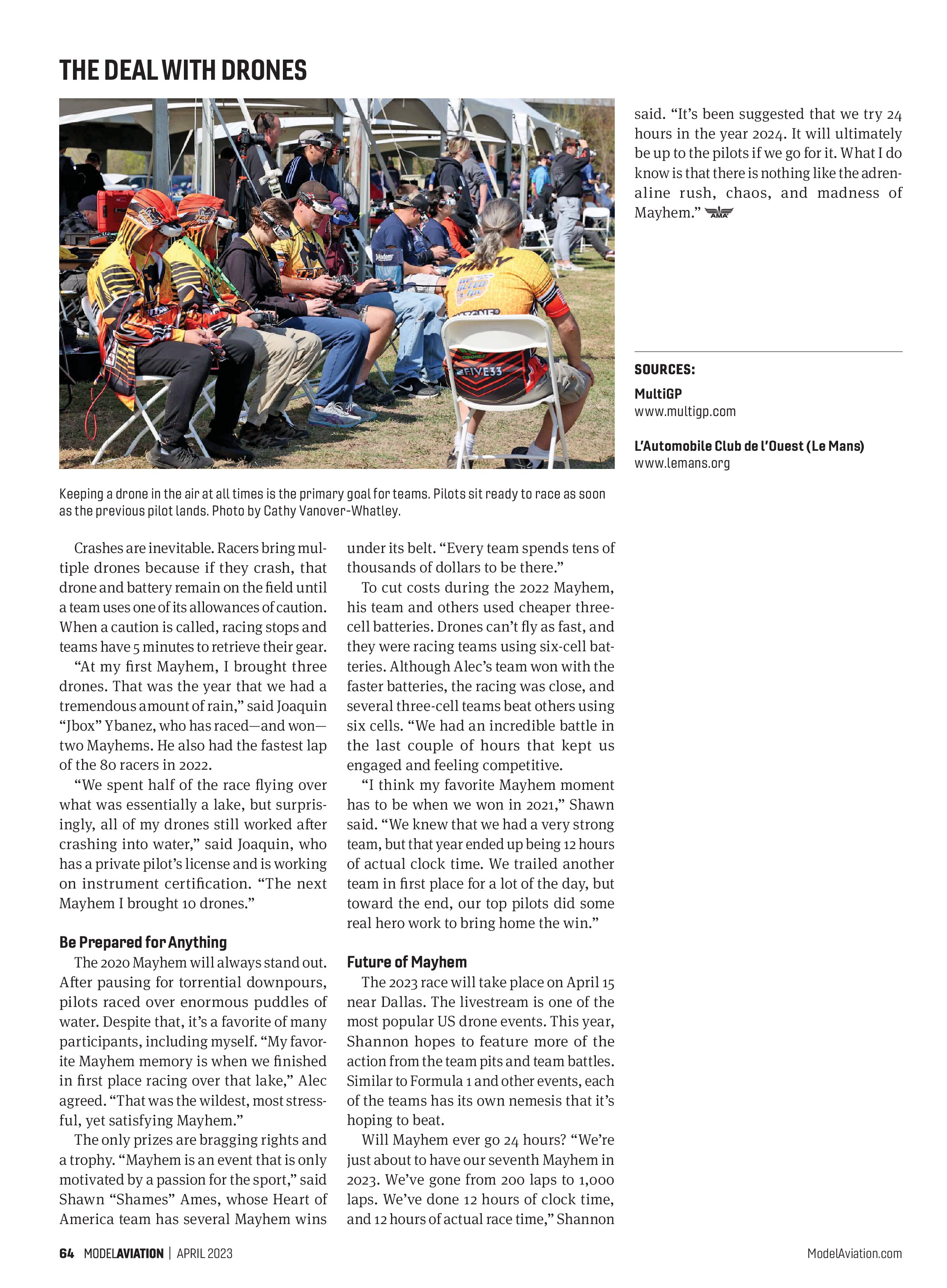
Coordination and communication are king. The goal is to have multiple pilots ready to take off at all times, and everyone plays a role. Some members need to charge batteries and change propellers, while others track the pilots. It’s stressful—and drone pilots love it.
“Mayhem is an interesting event,” Alec said. “There seems to always be a part of me during the first few hours that asks, ‘Why on earth are we doing this again?’ But at some point, things just click and you say to yourself, ‘Oh yeah, this is actually a ton of fun.’”
Efficient team races are enabled by a pit switch. Today, this is a standard feature of flight controllers. It allows drone pilots to turn off their FPV video. Each team shares a video channel, but multiple pilots can have their drones plugged into batteries.
For safety, each team has a dedicated landing area away from the pilots. “Taking off!” pilots shout. They head down the pit lane to the track and turn up the heat. With shouts of “Last lap! Landing!,” racers enter the pit for precision landings. It’s amazing to witness.
said. “It’s been suggested that we try 24 hours in the year 2024. It will ultimately be up to the pilots if we go for it. What I do know is that there is nothing like the adrenaline rush, chaos, and madness of Mayhem.”
SOURCES:
MultiGP
www.multigp.com
L’Automobile Club de l’Ouest (Le Mans)
www.lemans.org

Crashes are inevitable. Racers bring multiple drones because if they crash, that drone and battery remain on the field until a team uses one of its allowances of caution. When a caution is called, racing stops and teams have 5 minutes to retrieve their gear.
“At my first Mayhem, I brought three drones. That was the year that we had a tremendous amount of rain,” said Joaquin “Jbox” Ybanez, who has raced—and won—two Mayhems. He also had the fastest lap of the 80 racers in 2022.
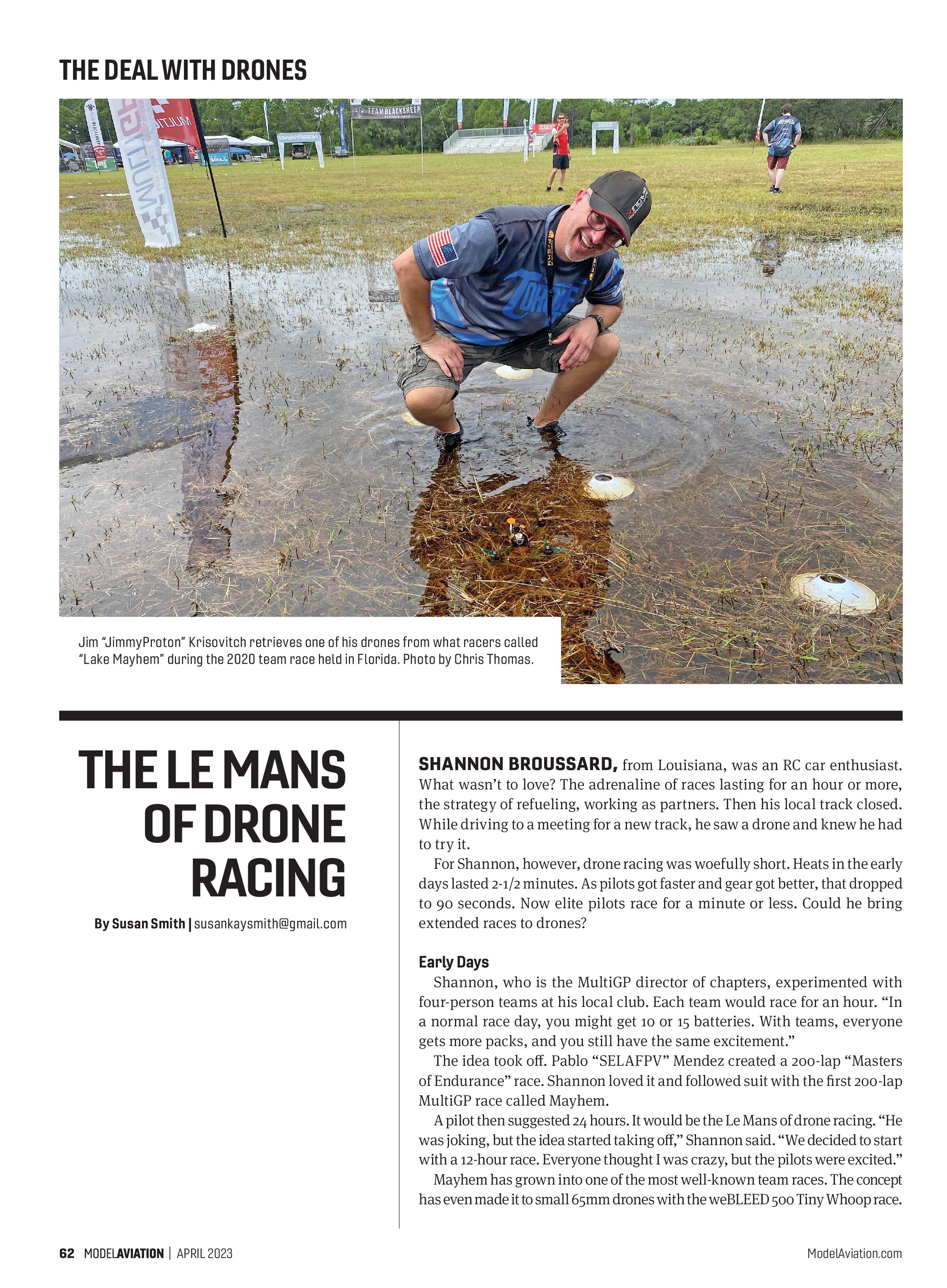
“We spent half of the race flying over what was essentially a lake, but surprisingly, all of my drones still worked after crashing into water,” said Joaquin, who has a private pilot’s license and is working on instrument certification. “The next Mayhem I brought 10 drones.”
Be Prepared for Anything
The 2020 Mayhem will always stand out. After pausing for torrential downpours, pilots raced over enormous puddles of water. Despite that, it’s a favorite of many participants, including myself. “My favorite Mayhem memory is when we finished in first place racing over that lake,” Alec agreed. “That was the wildest, most stressful, yet satisfying Mayhem.”
The only prizes are bragging rights and a trophy. “Mayhem is an event that is only motivated by a passion for the sport,” said Shawn “Shames” Ames, whose Heart of America team has several Mayhem wins under its belt. “Every team spends tens of thousands of dollars to be there.”
To cut costs during the 2022 Mayhem, his team and others used cheaper three-cell batteries. Drones can’t fly as fast, and they were racing teams using six-cell batteries. Although Alec’s team won with the faster batteries, the racing was close, and several three-cell teams beat others using six cells. “We had an incredible battle in the last couple of hours that kept us engaged and feeling competitive.
“I think my favorite Mayhem moment has to be when we won in 2021,” Shawn said. “We knew that we had a very strong team, but that year ended up being 12 hours of actual clock time. We trailed another team in first place for a lot of the day, but toward the end, our top pilots did some real hero work to bring home the win.”
Future of Mayhem
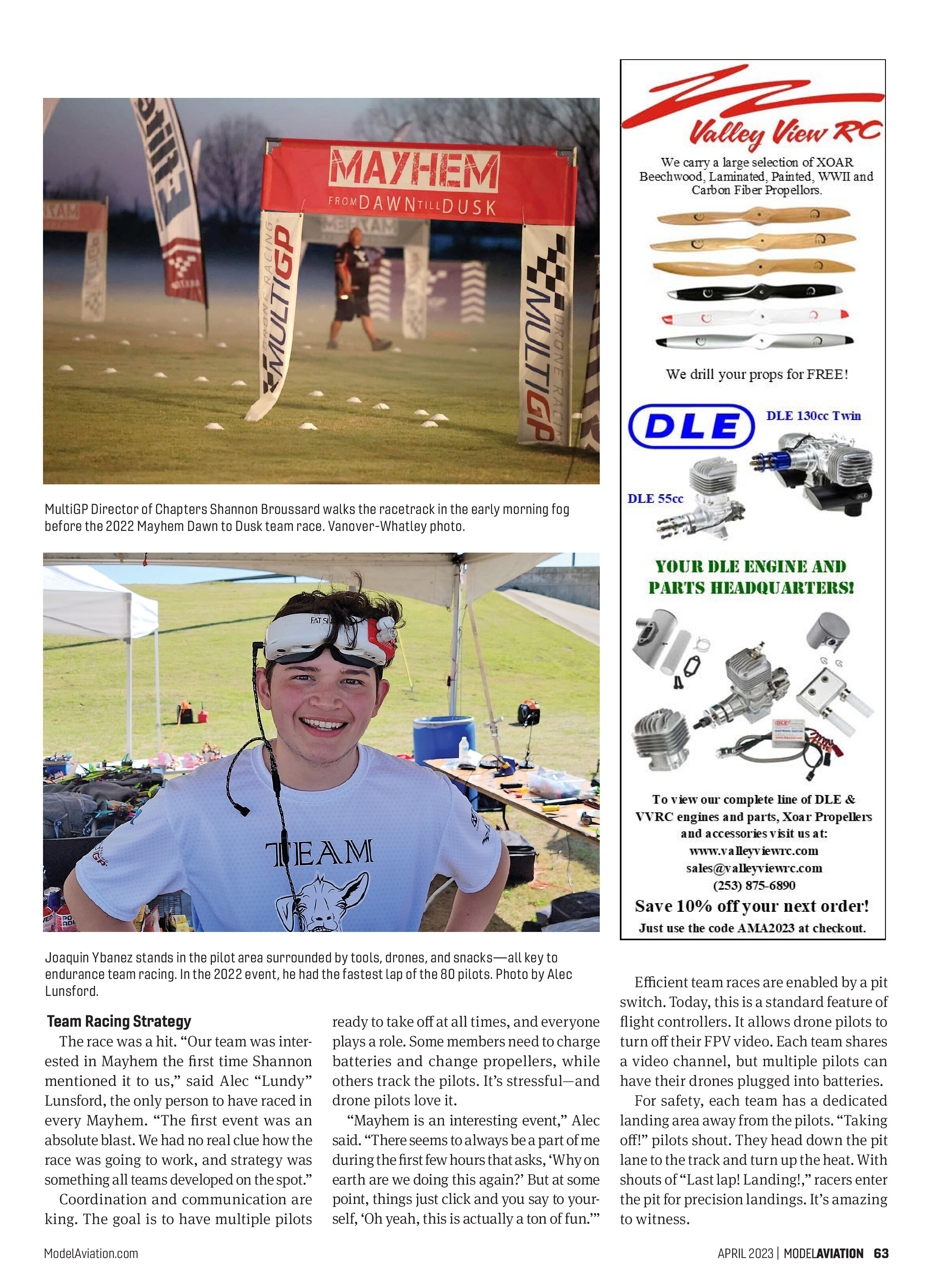
The 2023 race will take place on April 15 near Dallas. The livestream is one of the most popular US drone events. This year, Shannon hopes to feature more of the action from the team pits and team battles. Similar to Formula 1 and other events, each of the teams has its own nemesis that it’s hoping to beat.
Will Mayhem ever go 24 hours? “We’re just about to have our seventh Mayhem in 2023. We’ve gone from 200 laps to 1,000 laps. We’ve done 12 hours of clock time, and 12 hours of actual race time,” Shannon