LOA REMINDER: CHECK YOUR FLYING SITE’S LOCATION REQUIREMENTS!
DOES YOUR flying site require a Letter of Agreement (LOA) with the FAA? The FAA-Recognized Identification Area (FRIA) process has many members asking this very question.
AMA clubs are only required to have an LOA if their flying site is located in controlled airspace. Controlled airspace is depicted in the numbered grids on the UAS Facility Map.
To view this map, visit bit.ly/3IozLqj. Most AMA club flying sites are located in uncontrolled airspace and do not need to meet this requirement.
If your site is in controlled airspace and does not have an LOA completed, or you are unsure whether your site needs to meet the requirement, contact chrystal@modelaircraft.org for assistance.
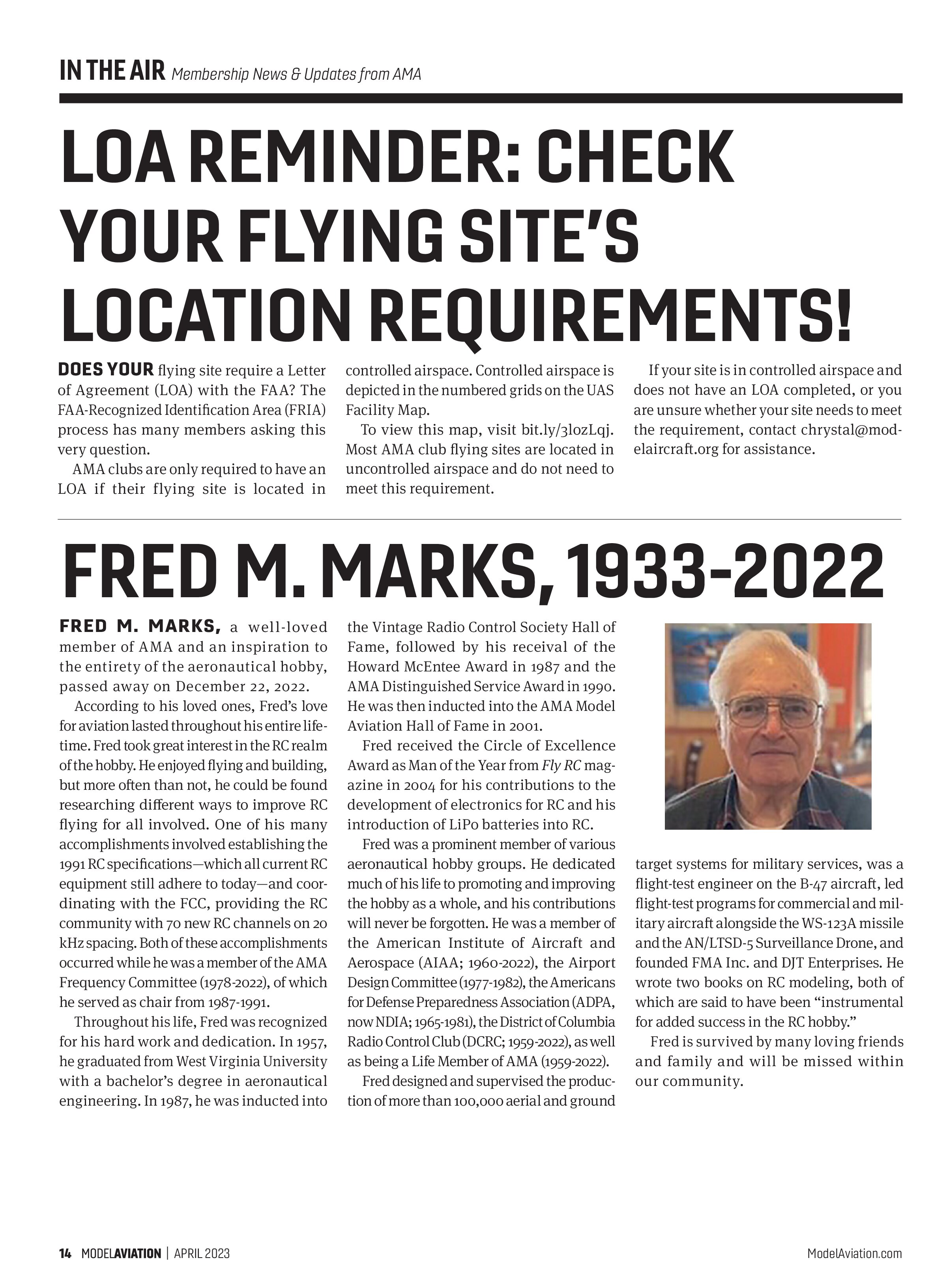
FRED M. MARKS, 1933-2022
FRED M. MARKS, a well-loved member of AMA and an inspiration to the entirety of the aeronautical hobby, passed away on December 22, 2022.
According to his loved ones, Fred’s love for aviation lasted throughout his entire lifetime. Fred took great interest in the RC realm of the hobby. He enjoyed flying and building, but more often than not, he could be found researching different ways to improve RC flying for all involved. One of his many accomplishments involved establishing the 1991 RC specifications—which all current RC equipment still adhere to today—and coordinating with the FCC, providing the RC community with 70 new RC channels on 20 kHz spacing. Both of these accomplishments occurred while he was a member of the AMA Frequency Committee (1978-2022), of which he served as chair from 1987-1991.
Throughout his life, Fred was recognized for his hard work and dedication. In 1957, he graduated from West Virginia University with a bachelor’s degree in aeronautical engineering. In 1987, he was inducted into the Vintage Radio Control Society Hall of Fame, followed by his receipt of the Howard McEntee Award in 1987 and the AMA Distinguished Service Award in 1990. He was then inducted into the AMA Model Aviation Hall of Fame in 2001.
Fred received the Circle of Excellence Award as Man of the Year from Fly RC magazine in 2004 for his contributions to the development of electronics for RC and his introduction of LiPo batteries into RC.
Fred was a prominent member of various aeronautical hobby groups. He dedicated much of his life to promoting and improving the hobby as a whole, and his contributions will never be forgotten. He was a member of the American Institute of Aircraft and Aerospace (AIAA; 1960-2022), the Airport Design Committee (1977-1982), the Americans for Defense Preparedness Association (ADPA, now NDIA; 1965-1981), the District of Columbia Radio Control Club (DCRC; 1959-2022), as well as being a Life Member of AMA (1959-2022).
Fred designed and supervised the production of more than 100,000 aerial and ground target systems for military services, was a flight-test engineer on the B-47 aircraft, led flight-test programs for commercial and military aircraft alongside the WS-123A missile and the AN/LTSD-5 Surveillance Drone, and founded FMA Inc. and DJT Enterprises. He wrote two books on RC modeling, both of which are said to have been “instrumental for added success in the RC hobby.”
Fred is survived by many loving friends and family and will be missed within our community.

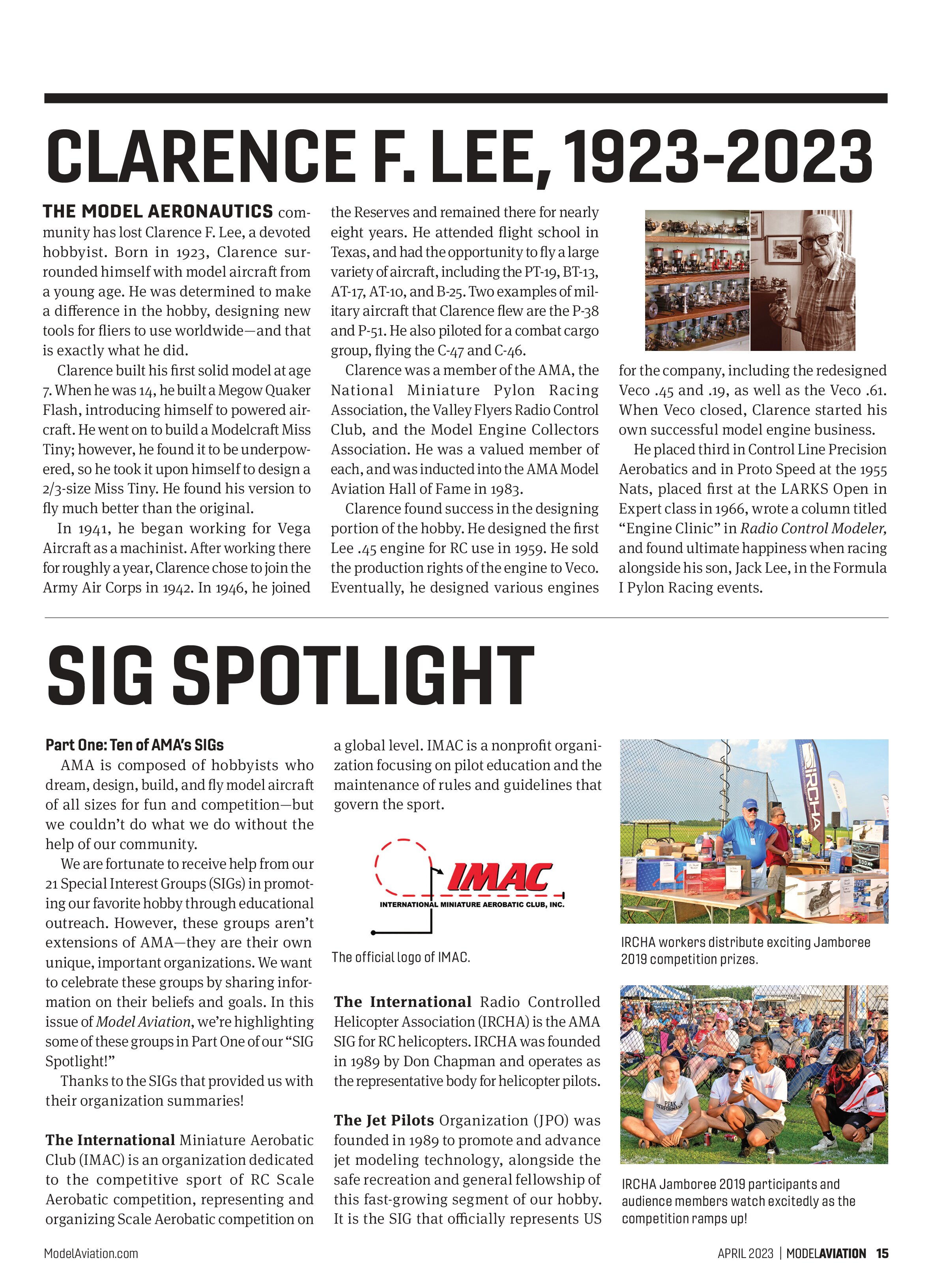
CLARENCE F. LEE, 1923-2023
THE MODEL AERONAUTICS community has lost Clarence F. Lee, a devoted hobbyist. Born in 1923, Clarence surrounded himself with model aircraft from a young age. He was determined to make a difference in the hobby, designing new tools for fliers to use worldwide—and that is exactly what he did.
Clarence built his first solid model at age 7. When he was 14, he built a Megow Quaker Flash, introducing himself to powered aircraft. He went on to build a Modelcraft Miss Tiny; however, he found it to be underpowered, so he took it upon himself to design a 2/3-size Miss Tiny. He found his version to fly much better than the original.
In 1941, he began working for Vega Aircraft as a machinist. After working there for roughly a year, Clarence chose to join the Army Air Corps in 1942. In 1946, he joined the Reserves and remained there for nearly eight years. He attended flight school in Texas, and had the opportunity to fly a large variety of aircraft, including the PT-19, BT-13, AT-17, AT-10, and B-25. Two examples of military aircraft that Clarence flew are the P-38 and P-51. He also piloted for a combat cargo group, flying the C-47 and C-46.
Clarence was a member of the AMA, the National Miniature Pylon Racing Association, the Valley Flyers Radio Control Club, and the Model Engine Collectors Association. He was a valued member of each, and was inducted into the AMA Model Aviation Hall of Fame in 1983.
Clarence found success in the designing portion of the hobby. He designed the first Lee .45 engine for RC use in 1959. He sold the production rights of the engine to Veco. Eventually, he designed various engines for the company, including the redesigned Veco .45 and .19, as well as the Veco .61. When Veco closed, Clarence started his own successful model engine business.
He placed third in Control Line Precision Aerobatics and in Proto Speed at the 1955 Nats, placed first at the LARKS Open in Expert class in 1966, wrote a column titled “Engine Clinic” in Radio Control Modeler, and found ultimate happiness when racing alongside his son, Jack Lee, in the Formula I Pylon Racing events.

SIG SPOTLIGHT
Part One: Ten of AMA’s SIGs
AMA is composed of hobbyists who dream, design, build, and fly model aircraft of all sizes for fun and competition—but we couldn’t do what we do without the help of our community.
We are fortunate to receive help from our 21 Special Interest Groups (SIGs) in promoting our favorite hobby through educational outreach. However, these groups aren’t extensions of AMA—they are their own unique, important organizations. We want to celebrate these groups by sharing information on their beliefs and goals. In this issue of Model Aviation, we’re highlighting some of these groups in Part One of our “SIG Spotlight!”
Thanks to the SIGs that provided us with their organization summaries!
The International Miniature Aerobatic Club (IMAC) is an organization dedicated to the competitive sport of RC Scale Aerobatic competition, representing and organizing Scale Aerobatic competition on a global level. IMAC is a nonprofit organization focusing on pilot education and the maintenance of rules and guidelines that govern the sport.
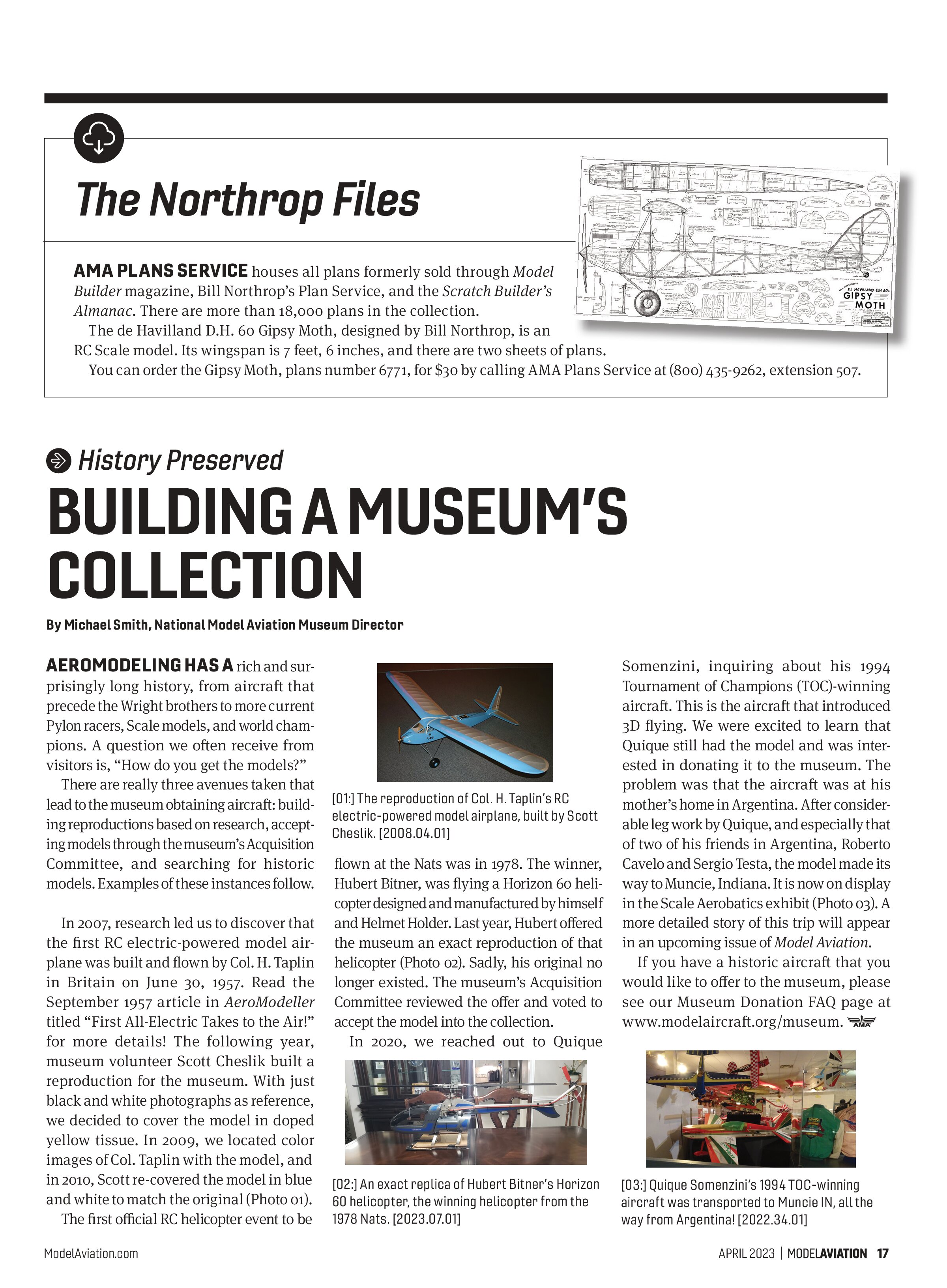
The International Radio Controlled Helicopter Association (IRCHA) is the AMA SIG for RC helicopters. IRCHA was founded in 1989 by Don Chapman and operates as the representative body for helicopter pilots.
The Jet Pilots Organization (JPO) was founded in 1989 to promote and advance jet modeling technology, alongside the safe recreation and general fellowship of this fast-growing segment of our hobby. It is the SIG that officially represents US


jet modelers to the AMA. The primary purpose of JPO is to promote and protect the hobby of RC jet modeling.

The League of Silent Flight (LSF) was established to provide a way for RC sailplane enthusiasts to come together and share their passion and knowledge. LSF supports and fosters sporting and competitive activities for model sailplanes, and encourages the advancement of the model aviation hobby.
The Miniature Aircraft Combat Association (MACA) is the recognized SIG for Control Line (CL) Combat. The organization exists to promote the sport of CL Combat in all of its forms by dissemination of information through its newsletter, website, and affiliation with the AMA, the NAA, and the Fédération Aéronautique Internationale.

The Model Engine Collectors Association (MECA) is a world-wide organization that seeks to promote the interest of miniature engine collecting as a recreational, educational, and historical hobby. Its interests include not only powerplants related to model aircraft but also tether cars and model boats. It covers engines of all nations and varied types, including glow, spark, diesel-ignition, jets, and compressed gas.

MultiGP is a drone racing league that represents approximately 30,000 drone racers across the world. Local chapters built up by MultiGP provide local, enjoyable environments for drone pilots to hone their skills.
MultiGP seeks to offer the opportunity for anyone interested in drones to become drone racing pilots.

The National Association of Scale Aeromodelers (NASA) is the official AMA SIG pertaining to Scale aeromodeling, supporting and helping Scale modelers both nationally and internationally. Its philosophy is to encourage, promote, and advance all phases of Scale aeromodeling, regardless of size, power, or mode of control.

The National Control Line Racing Association (NCLRA), formed in 1993, exists in support of CL Racing. The president of NCLRA, Bill Bischoff, states that NCLRA exists to promote participation in CL Racing events, especially at the local and casually competitive level.

The National Free Flight Society (NFFS) was formed in 1966 to advance the science and industry of flight by promoting aeronautical engineering research through experimentation with model aviation. NFFS operates exclusively as a nonprofit corporation with a purpose to preserve, enhance, and promote the interest in the sport and hobby of Free Flight model aircraft in all of its forms.

If you are interested in checking out any of these organizations, you can find an index of all SIGs on the AMA Education Blog at https://amablog.modelaircraft.org/amaeducation/2023/01/26/ama_sigs.
Part Two of this article will be in the May edition of Model Aviation, where we’ll cover the rest of our SIGs!