A LOOK BACK AT THE
PCS RADIO
SYSTEM
By Bob Noll | bobrc@aol.com

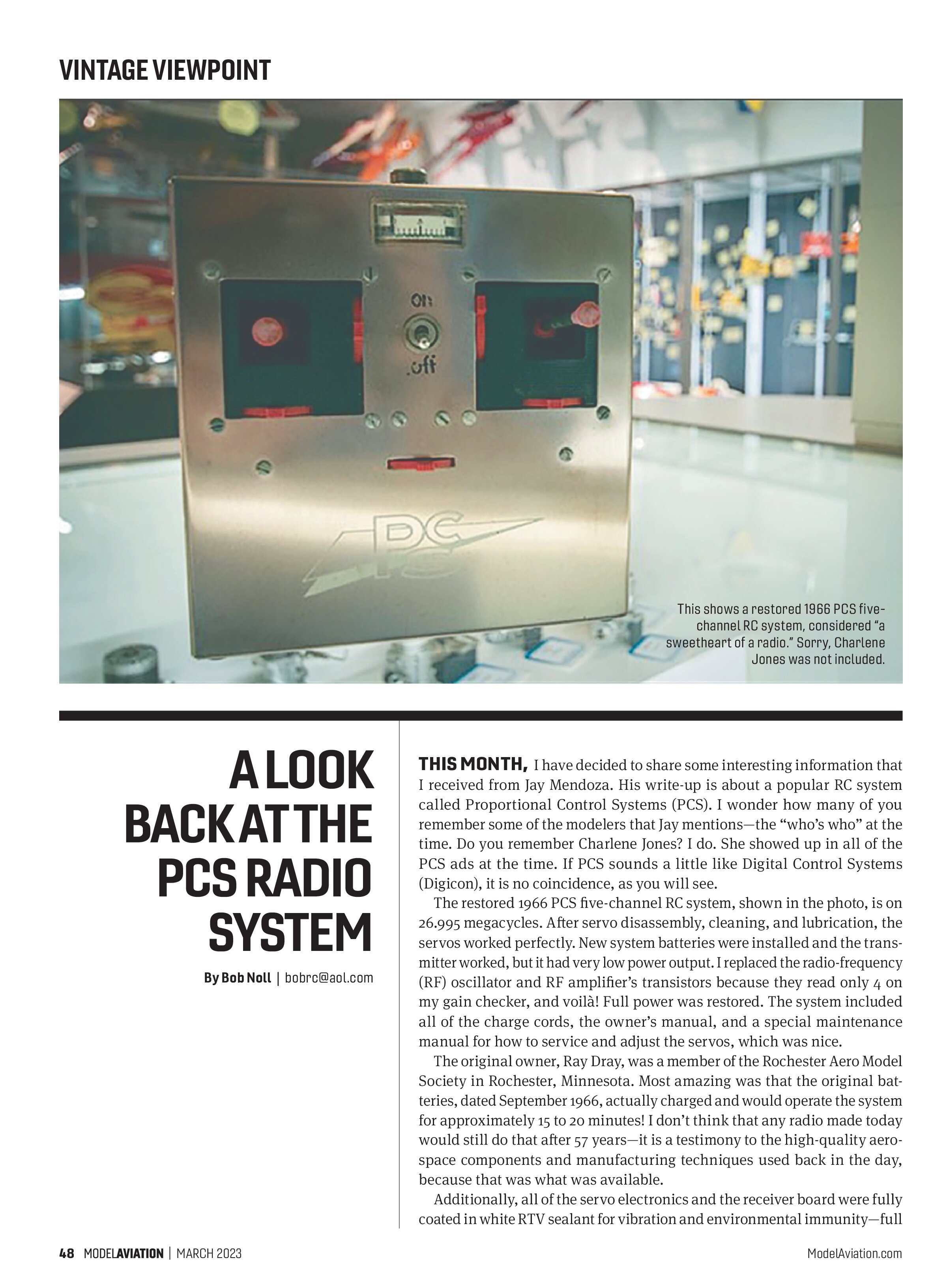
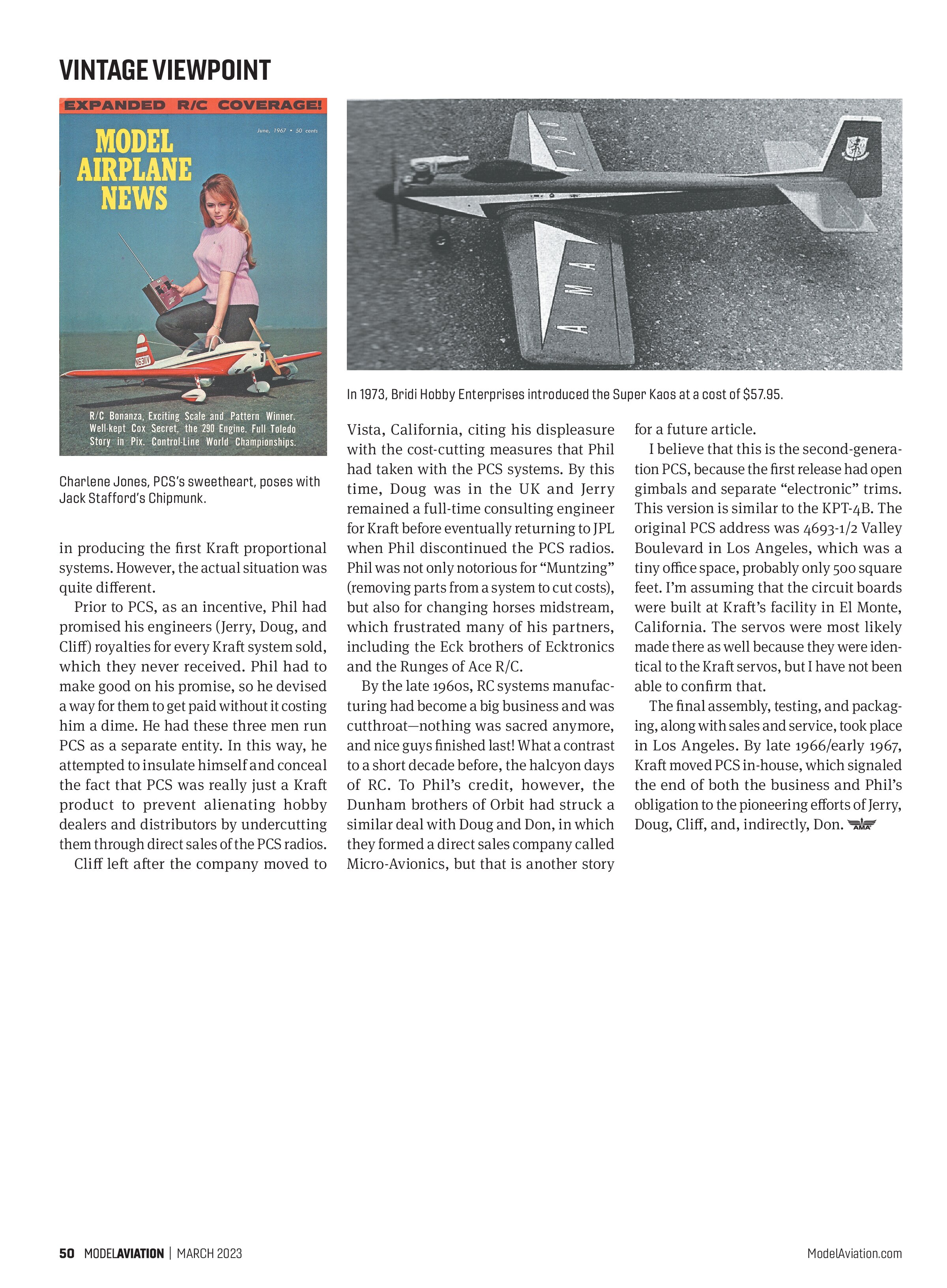
THIS MONTH, I have decided to share some interesting information that I received from Jay Mendoza. His write-up is about a popular RC system called Proportional Control Systems (PCS). I wonder how many of you remember some of the modelers that Jay mentions—the “who’s who” at the time. Do you remember Charlene Jones? I do. She showed up in all of the PCS ads at the time. If PCS sounds a little like Digital Control Systems (Digicon), it is no coincidence, as you will see.
The restored 1966 PCS five-channel RC system, shown in the photo, is on 26.995 megacycles. After servo disassembly, cleaning, and lubrication, the servos worked perfectly. New system batteries were installed and the transmitter worked, but it had very low power output. I replaced the radio-frequency (RF) oscillator and RF amplifier’s transistors because they read only 4 on my gain checker, and voilà! Full power was restored. The system included all of the charge cords, the owner’s manual, and a special maintenance manual for how to service and adjust the servos, which was nice.
The original owner, Ray Drav, was a member of the Rochester Aero Model Society in Rochester, Minnesota. Most amazing was that the original batteries, dated September 1966, actually charged and would operate the system for approximately 15 to 20 minutes! I don’t think that any radio made today would still do that after 57 years—it is a testimony to the high-quality aerospace components and manufacturing techniques used back in the day, because that was what was available.
Additionally, all of the servo electronics and the receiver board were fully coated in white RTV sealant for vibration and environmental immunity—full-
Mil-Spec conformal coating. For certain, they don’t make them like they used to—especially the rugged, metal cases. I know that today’s electronics are better, but when you consider nearly 60 years of progress, that should be a given. The quality


of the components, alongside the workmanship, are incredible for their era.
Originally priced at $299 (mail order only), it was a bargain because other full-house digital-proportional, four-channel radios at the time were approximately $400. If you correct the $299 price for inflation, it would be close to $2,900 (tax included) today. The only downside was that you could not check it out before buying one unless your buddy had one. Anyone today would be leery of buying a $2,900 item sight unseen, so the PCS was a little risky in that regard—especially because it was unproven and a supposed newcomer.
The insiders, however, secretly knew that it was a proven Kraft product. Kraft had a good reputation for quality and reliability. It had enlisted not only Jerry Pullen of JPL, but also Doug Spreng, who, along with Don Mathis, had introduced the first successful digital-proportional system, the Digicon, in 1963. By late 1965, Phil Kraft was selling his four-channel systems like hotcakes and was looking for a way to make bigger profits by reducing costs and increasing sales with lower retail pricing.
The PCS was Phil’s way of making more profits through direct sales, done by cutting out the distributor and hobby dealer. Some have said that it was Phil’s way of thanking Jerry, along with Doug and Cliff Weirick, for their tireless efforts


in producing the first Kraft proportional systems. However, the actual situation was quite different.
Prior to PCS, as an incentive, Phil had promised his engineers (Jerry, Doug, and Cliff) royalties for every Kraft system sold, which they never received. Phil had to make good on his promise, so he devised a way for them to get paid without it costing him a dime. He had these three men run PCS as a separate entity. In this way, he attempted to insulate and conceal the fact that PCS was really just a Kraft product to prevent alienating hobby dealers and distributors by undercutting them through direct sales of the PCS radios.
Cliff left after the company moved to Vista, California, citing his displeasure with the cost-cutting measures that Phil had taken with the PCS systems. By this time, Doug was in the UK and Jerry remained a full-time consulting engineer for Kraft before eventually returning to JPL when Phil discontinued the PCS radios. Phil was not only notorious for “Muntzing” (removing parts from a system to cut costs), but also for changing horses midstream, which frustrated many of his partners, including the Eck brothers of Ecktronics and the Runges of Ace R/C.
By the late 1960s, RC systems manufacturing had become a big business and was cutthroat—nothing was sacred anymore, and nice guys finished last! What a contrast to a short decade before, the halcyon days of RC. To Phil’s credit, however, the Dunham brothers of Orbit had struck a similar deal with Doug and Don, in which they formed a direct sales company called Micro-Avionics, but that is another story for a future article.
I believe that this is the second-generation PCS, because the first release had open gimbals and separate “electronic” trims. This version is similar to the KPT-4B. The original PCS address was 4693-1/2 Valley Boulevard in Los Angeles, which was a tiny office space, probably only 500 square feet. I’m assuming that the circuit boards were built at Kraft’s facility in El Monte, California. The servos were most likely made there as well because they were identical to the Kraft servos, but I have not been able to confirm that.
The final assembly, testing, and packaging, along with sales and service, took place in Los Angeles. By late 1966/early 1967, Kraft moved PCS in-house, which signaled the end of both the business and Phil’s obligation to the pioneering efforts of Jerry, Doug, Cliff, and, indirectly, Don.