Safety Comes First

HEED THE WARNING!
By Dave Gee | safetycolumn@cs.com
DO OUR MODELS
talk to us? Well, sometimes they send messages! Sam Brauer sent a story of how his model gave a hint of upcoming trouble. He wrote:
“I’ve been flying a Dash 25 electric Sport/Pattern design with a folding propeller. A couple of weeks ago, I gave the airplane a toss and was flying around quite enjoyably when I heard a strange noise. I cut the power, but the airplane still seemed to be flying okay, so I throttled up again. I should have heeded the warning and left the power off.
“Instead, when I throttled up, the whole firewall came unglued because the folder had thrown a blade! A wildly out-of-balance propeller can really do some damage. Amazingly, the motor and the ESC didn’t depart. I managed to land the airplane with the motor hanging by three wires.
“Moral of the story: Check the screws on your folders! I got pretty lucky. I just have to replace a blade, not a crashed airplane.”
Sam is right. If the motor had detached, the model would have been unmanageable. Even with heavy nose damage, he was able to save the airframe because the center of gravity remained within tolerance.
This was a case where there was a clear warning from the aircraft. If the pilot is paying attention, there might be a chance to save the model from heavier damage. Lots of RC stories include the line, “If I’d shut down and landed when that first twitch happened, the airplane would still be in one piece.”
Sharp pilots are alert for signs of trouble. They don’t hesitate to make a quick landing when something doesn’t look right. It’s always easier to fix a problem when the model is on the workbench instead of in the sky. Sam is likely to be extra sensitive to any irregularities in his model from now on!
Blown Away
In a recent column, I discussed the back-blast from model airplanes on starter stands and what steps might be taken to avoid spectators getting blown upon.
Tim Holly has some new information on the subject. He sent some photos from his recent trip to Fort Lauderdale, Florida.
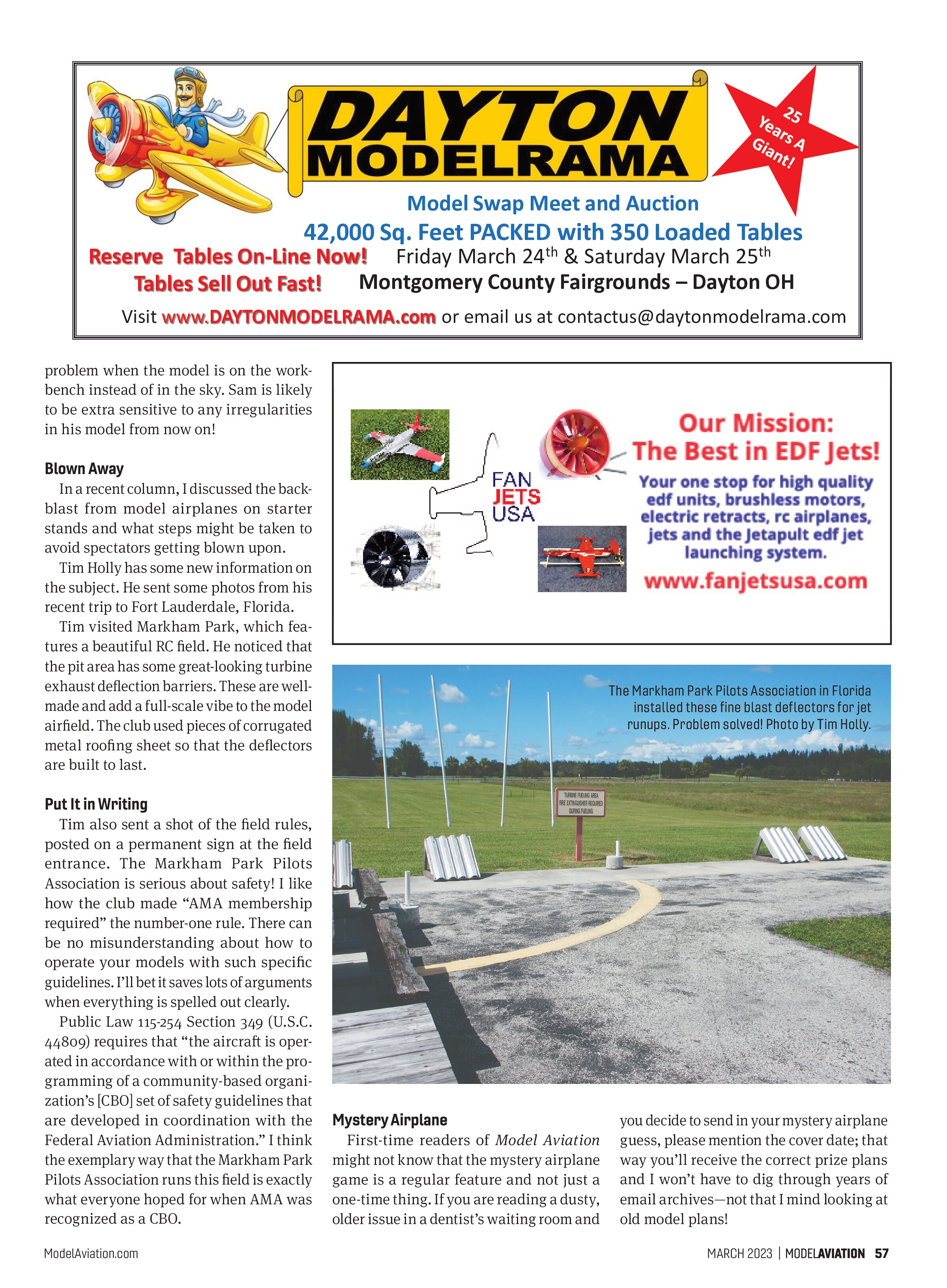
Tim visited Markham Park, which features a beautiful RC field. He noticed that the pit area has some great-looking turbine exhaust deflection barriers. These are well-made and add a full-scale vibe to the model airfield. The club used pieces of corrugated metal roofing sheet so that the deflectors are built to last.
Put It in Writing
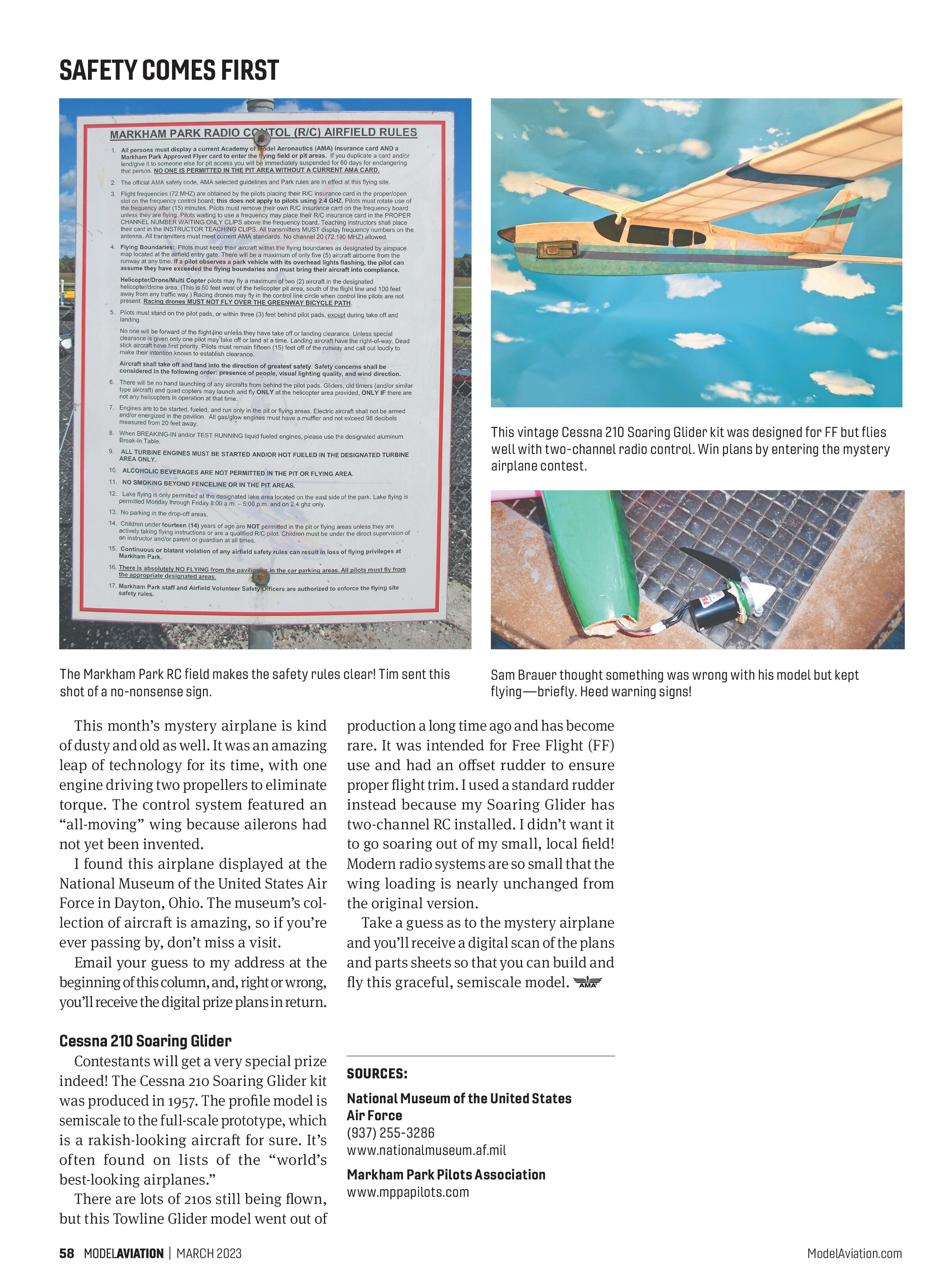
Tim also sent a shot of the field rules, posted on a permanent sign at the field entrance. The Markham Park Pilots Association is serious about safety! I like how the club made “AMA membership required” the number-one rule. There can be no misunderstanding about how to operate your models with such specific guidelines. I’ll bet it saves lots of arguments when everything is spelled out clearly.
Public Law 115-254 Section 349 (U.S.C. 44809) requires that “the aircraft is operated in accordance with or within the programming of a community-based organization’s [CBO] set of safety guidelines that are developed in coordination with the Federal Aviation Administration.” I think the exemplary way that the Markham Park Pilots Association runs this field is exactly what everyone hoped for when AMA was recognized as a CBO.

Mystery Airplane
First-time readers of Model Aviation might not know that the mystery airplane game is a regular feature and not just a one-time thing. If you are reading a dusty, older issue in a dentist’s waiting room and you decide to send in your mystery airplane guess, please mention the cover date; that way you’ll receive the correct prize plans and I won’t have to dig through years of email archives—not that I mind looking at old model plans!


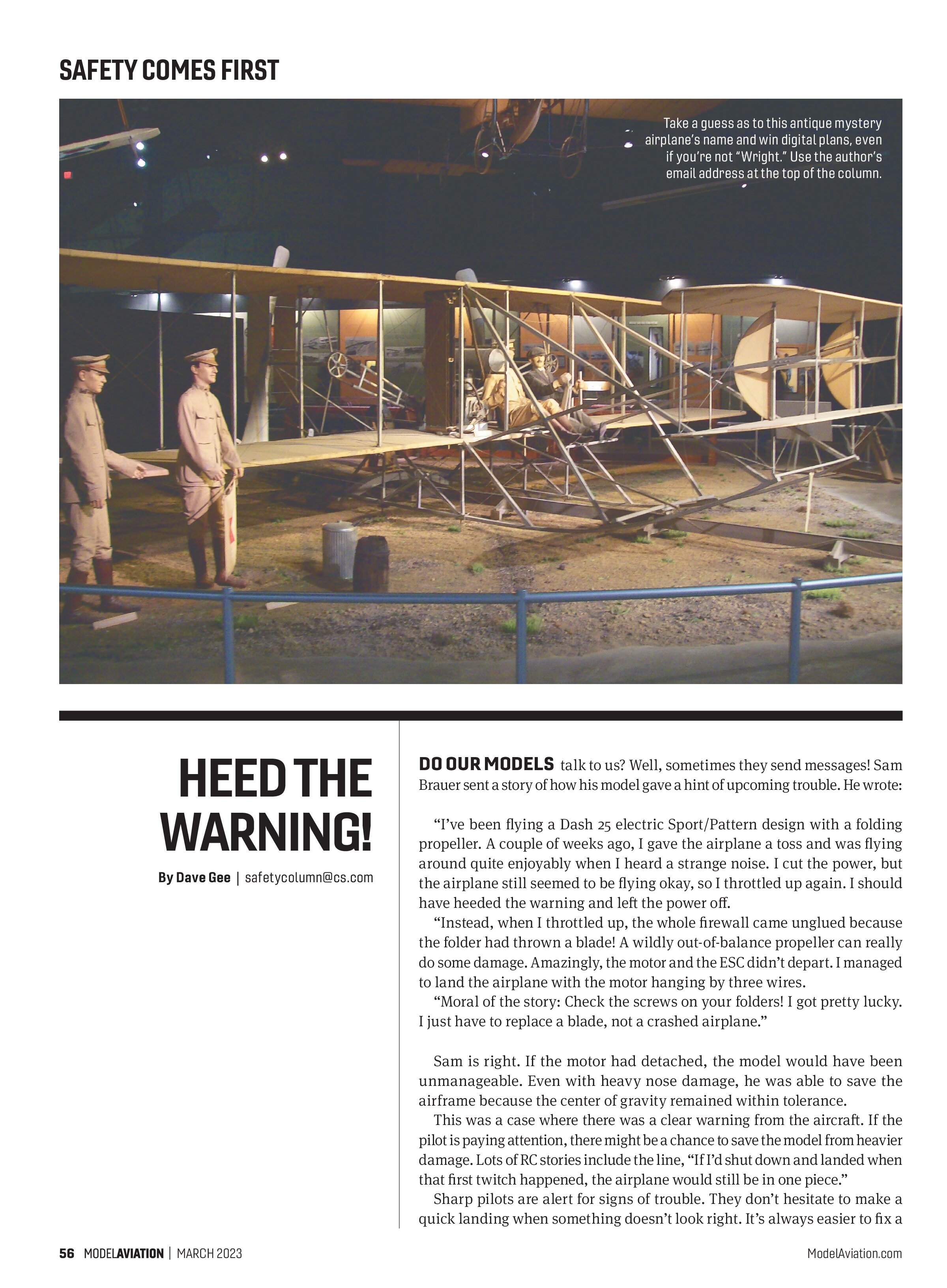
This month’s mystery airplane is kind of dusty and old as well. It was an amazing leap of technology for its time, with one engine driving two propellers to eliminate torque. The control system featured an “all-moving” wing because ailerons had not yet been invented.
I found this airplane displayed at the National Museum of the United States Air Force in Dayton, Ohio. The museum’s collection of aircraft is amazing, so if you’re ever passing by, don’t miss a visit.
Email your guess to my address at the beginning of this column, and, right or wrong, you’ll receive the digital prize plans in return.
Cessna 210 Soaring Glider
Contestants will get a very special prize indeed! The Cessna 210 Soaring Glider kit was produced in 1957. The profile model is semiscale to the full-scale prototype, which is a rakish-looking aircraft for sure. It’s often found on lists of the “world’s best-looking airplanes.”
There are lots of 210s still being flown, but this Towline Glider model went out of production a long time ago and has become rare. It was intended for Free Flight (FF) use and had an offset rudder to ensure proper flight trim. I used a standard rudder instead because my Soaring Glider has two-channel RC installed. I didn’t want it to go soaring out of my small, local field! Modern radio systems are so small that the wing loading is nearly unchanged from the original version.
Take a guess as to the mystery airplane and you’ll receive a digital scan of the plans and parts sheets so that you can build and fly this graceful, semiscale model.
SOURCES:
National Museum of the United States Air Force
(937) 255-3286
www.nationalmuseum.af.mil
Markham Park Pilots Association
www.mppapilots.com