RC SOARING

QUARTER-SCALE PROJECT OF THE FAMOUS RJ-5
By Gordon Buckland | gordon@gatorf3b.com
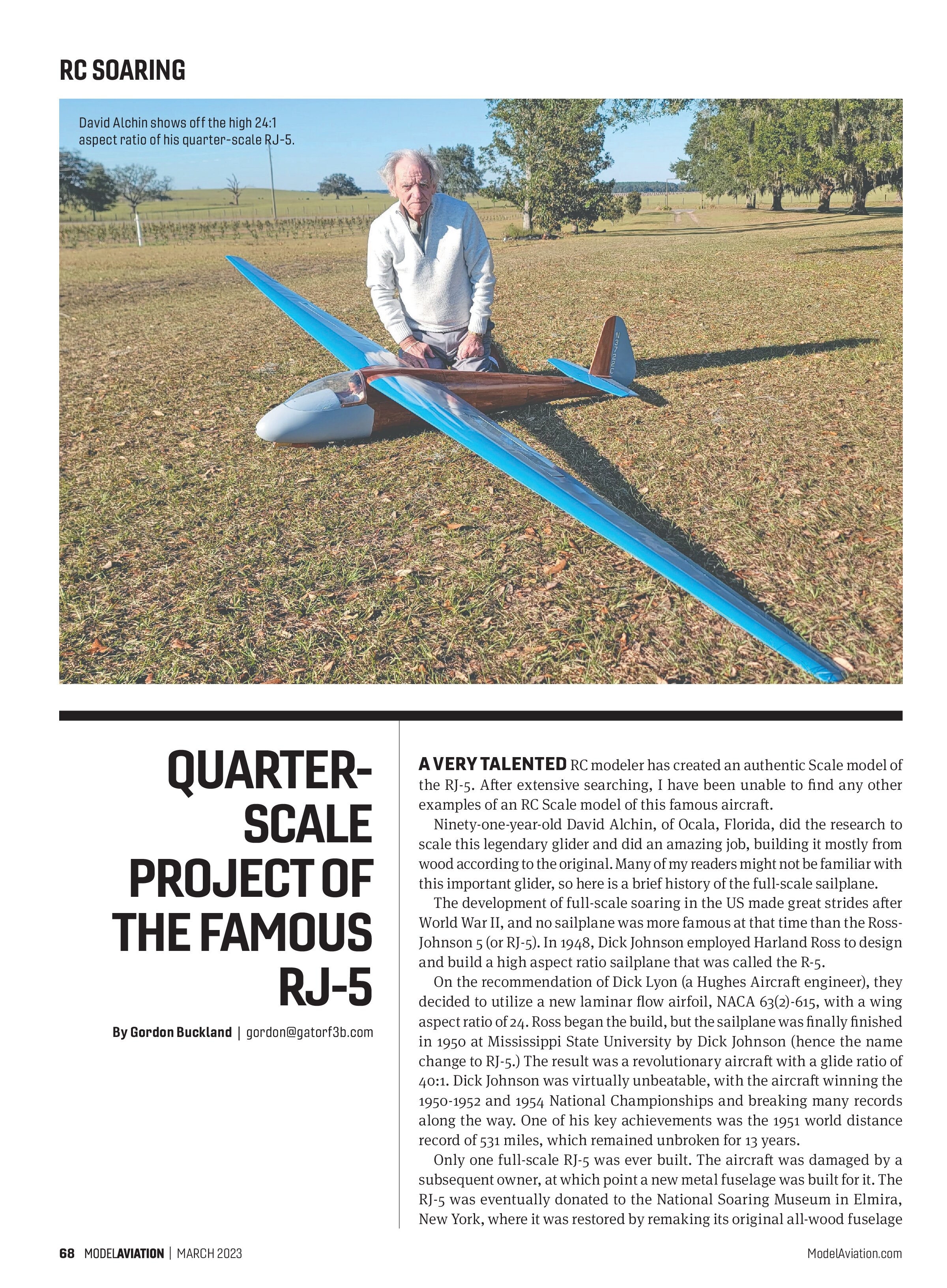
A VERY TALENTED RC modeler has created an authentic Scale model of the RJ-5. After extensive searching, I have been unable to find any other examples of an RC Scale model of this famous aircraft.
Ninety-one-year-old David Alchin, of Ocala, Florida, did the research to scale this legendary glider and did an amazing job, building it mostly from wood according to the original. Many of my readers might not be familiar with this important glider, so here is a brief history of the full-scale sailplane.
The development of full-scale soaring in the US made great strides after World War II, and no sailplane was more famous at that time than the Ross-Johnson 5 (or RJ-5). In 1948, Dick Johnson employed Harland Ross to design and build a high aspect ratio sailplane that was called the R-5.
On the recommendation of Dick Lyon (a Hughes Aircraft engineer), they decided to utilize a new laminar flow airfoil, NACA 63(2)-615, with a wing aspect ratio of 24. Ross began the build, but the sailplane was finally finished in 1950 at Mississippi State University by Dick Johnson (hence the name change to RJ-5.) The result was a revolutionary aircraft with a glide ratio of 40:1. Dick Johnson was virtually unbeatable, with the aircraft winning the 1950-1952 and 1954 National Championships and breaking many records along the way. One of his key achievements was the 1951 world distance record of 531 miles, which remained unbroken for 13 years.
Only one full-scale RJ-5 was ever built. The aircraft was damaged by a subsequent owner, at which point a new metal fuselage was built for it. The RJ-5 was eventually donated to the National Soaring Museum in Elmira, New York, where it was restored by remaking its original all-wood fuselage
and is now on display. To learn more about the aircraft, visit the links in “Sources,” including Dick Johnson’s personal story about the development of the RJ-5.
David started building models in 1943 at 13 years old, with a rubber-powered Frog Spitfire kit. In 1961, he built, entered, and flew a gull-wing sailplane in his first contest, but launched the model into a cloud and lost it. He has always been an avid builder of boats, cars, and airplanes, and has mostly built and flown sailplanes. He moved to California from England in 1980.

David has flown with the Modesto RC Club in Visalia, California, and with the South Bay Soaring Club in San Jose, California, for many years, competing with various Scale models, such as his Baby Albatross and Helios. He now lives in Ocala, Florida. After seeing a photo of the RJ-5 in the Vintage Sailplane Association’s Bungee Cord magazine, he was fascinated and set about creating a scale replica from scratch.
Three-views and many photos were obtained from Trafford Doherty of the National Soaring Museum, and David commissioned Pat Tritle to draw 1/4-scale plans
of the glider. After fully researching the original and gathering the materials together, David eventually constructed the model throughout the period of a year.
He brought the completed RJ-5 out to the Kennyworld flying site near Ocala during the annual Tangerine Soaring Contest, with a goal of having the model flown for its maiden flight. Unfortunately, radio installation issues prevented this, but it was awesome to talk to David in person about his build.
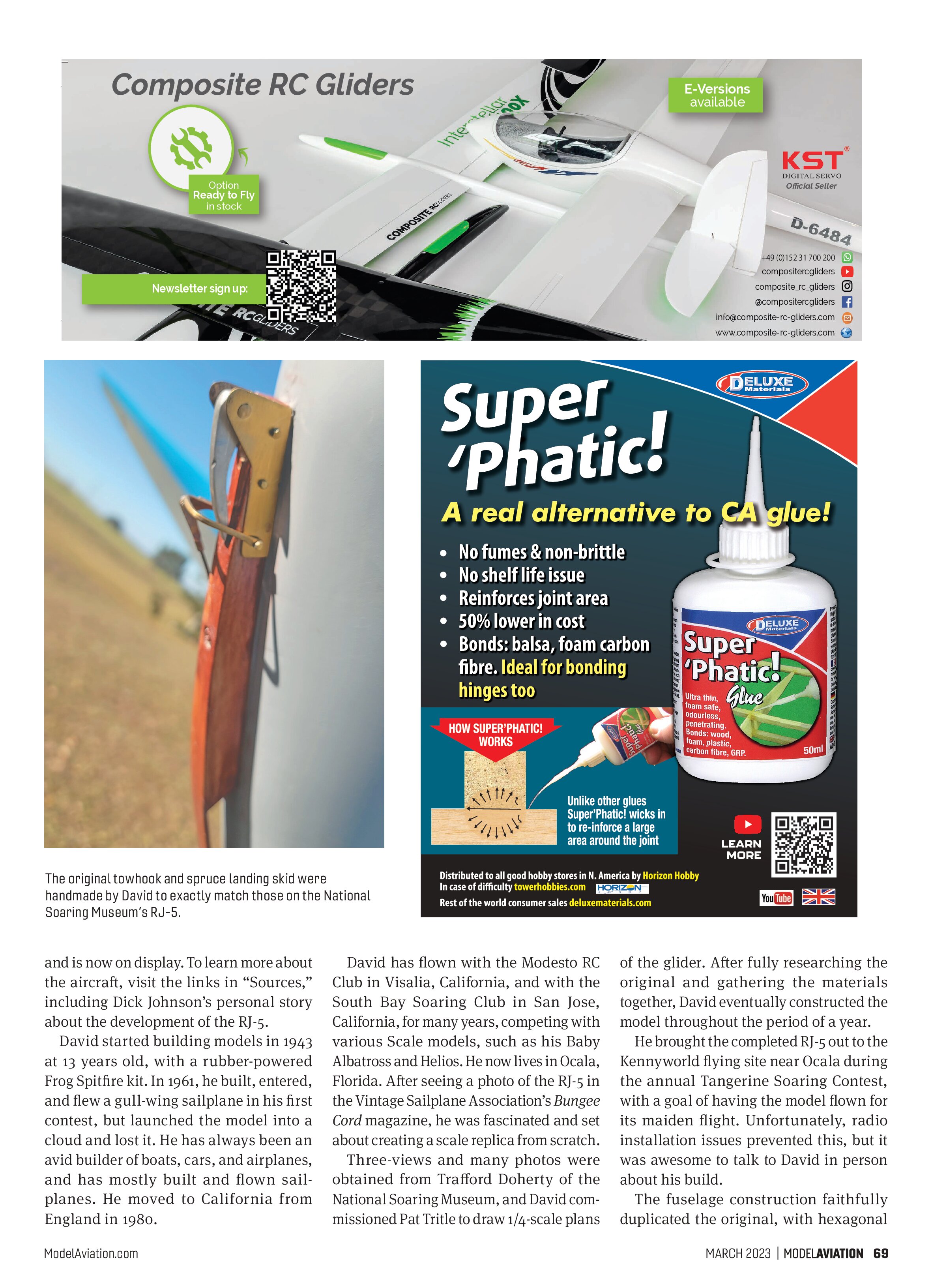
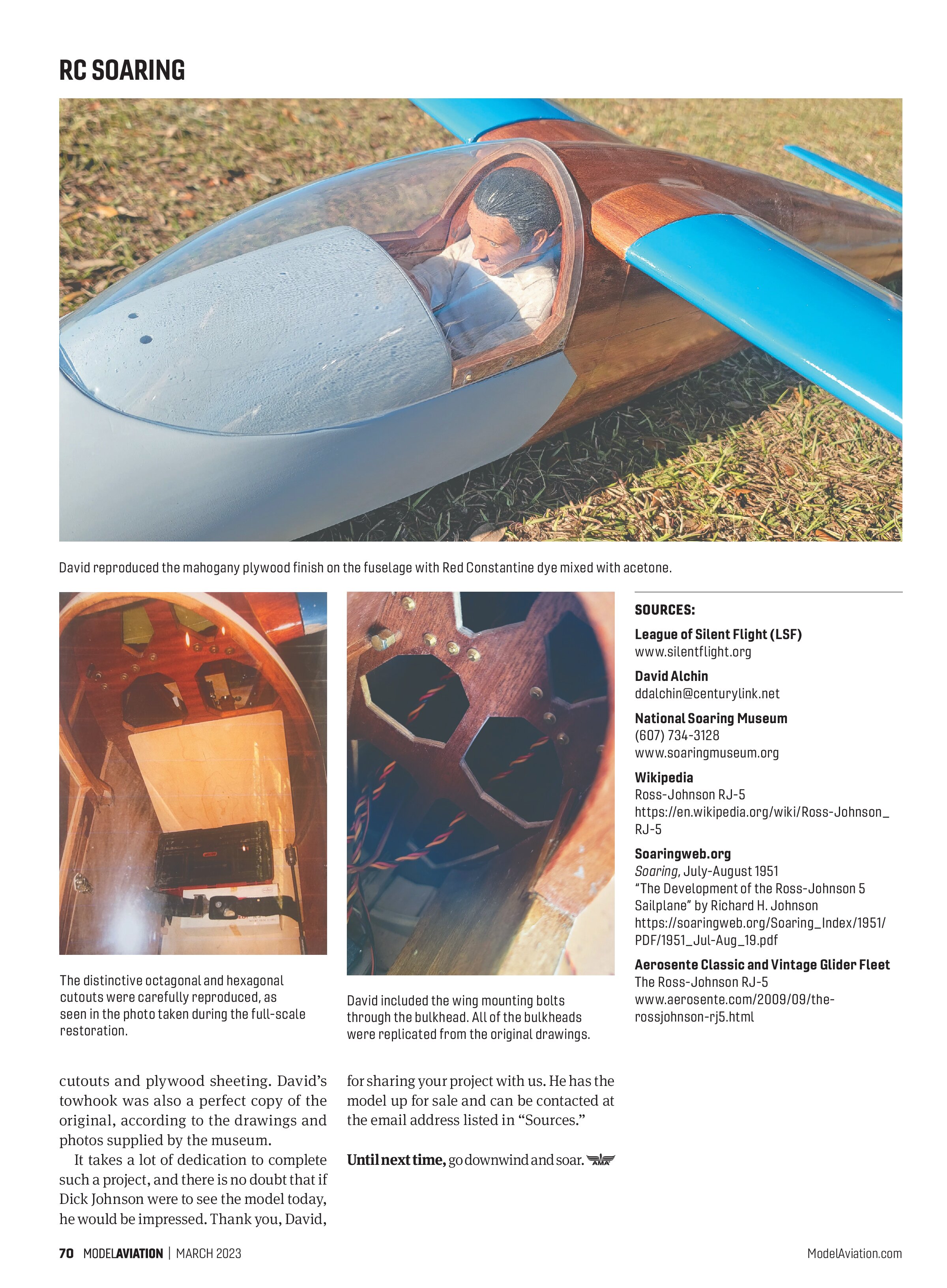
The fuselage construction faithfully duplicated the original, with hexagonal


cutouts and plywood sheeting. David’s tow hook was also a perfect copy of the original, according to the drawings and photos supplied by the museum.
It takes a lot of dedication to complete such a project, and there is no doubt that if Dick Johnson were to see the model today, he would be impressed. Thank you, David, for sharing your project with us. He has the model up for sale and can be contacted at the email address listed in “Sources.”
SOURCES:
League of Silent Flight (LSF)
www.silentflight.org
David Alchin
ddalchin@centurylink.net
National Soaring Museum
(607) 734-3128
www.soaringmuseum.org
Wikipedia
Ross-Johnson RJ-5
https://en.wikipedia.org/wiki/Ross-Johnson_RJ-5
Soaringweb.org
Soaring, July-August 1951
“The Development of the Ross-Johnson 5 Sailplane” by Richard H. Johnson
https://soaringweb.org/Soaring_Index/1951/PDF/1951_Jul-Aug_19.pdf
Aerosente Classic and Vintage Glider Fleet
The Ross-Johnson RJ-5
www.aerosente.com/2009/09/the-rossjohnson-rj5.html
Until next time, go downwind and soar.