RC PYLON RACING

TOM MELSHEIMER’S P.L.A.T.E.
By Tim Lampe | tim.lampe@hotmail.com
PYLON RACING happens because of Pylon Racing pilots who want to make it happen. Official positions in the National Miniature Pylon Racing Association (NMPRA) are not paid. Anything and everything—from writing rules to running the races—happens because volunteers do the work.
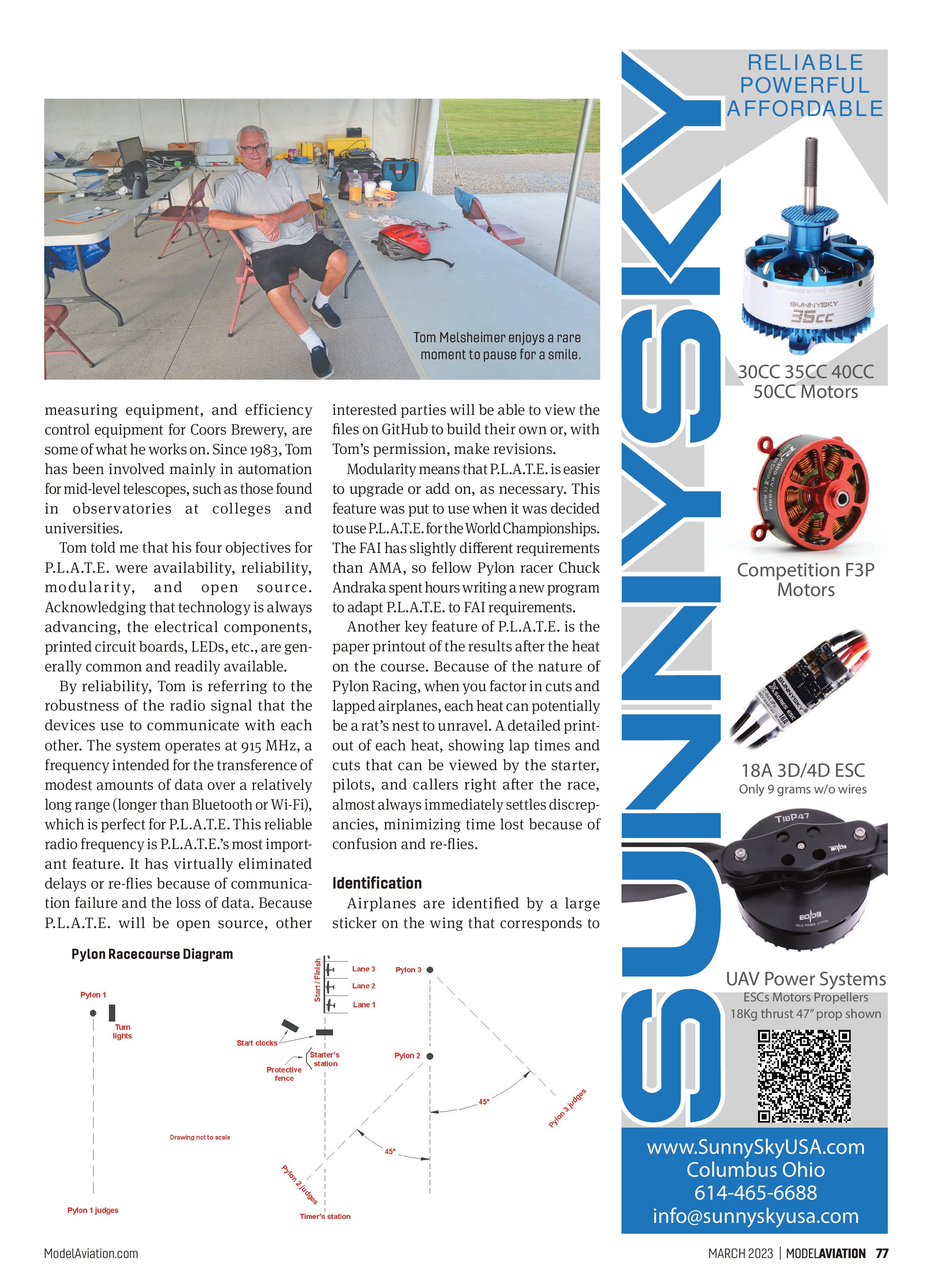
The quality of the components, alongside the workmanship, are incredible for their era. One of the standouts is Tom Melsheimer. Tom has used his technical experience and personal expenditure to develop and build Pylon Light and Timing Equipment (P.L.A.T.E.).
For those who are unfamiliar with RC three-pole Pylon Racing, it uses an extensive timing and light system composed of light boards, switches, electrical boxes, computers, cords, and wires. There are also workers who keep track of what is going on during a race, not only for scoring and results but for real-time, in-flight data that pilots and callers use to manage each individual heat race.
Inspired by the current Judgeman lighting/timing system that was developed by Hank Koffman, Tom’s P.L.A.T.E. has been used at races in Cincinnati and Muncie, Indiana, including the FAI F3D/F3E World Championships for Pylon Racing Model Aircraft. Tom credits Hank with the inspiration for P.L.A.T.E. by laying the groundwork with Judgeman, noting that advances in technology and the obsolesence or discontinuation of components were the impetus for P.L.A.T.E.
Tom has been involved in Pylon Racing on and off since 1969, and has flown RC since 1960. He’ll tell you that he’s a telescope engineer, but that’s shorthand for embedded systems designer—computer motion controls for devices, such as electronic check protection equipment, water quality measuring equipment, and efficiency control equipment for Coors Brewery, are some of what he works on. Since 1983, Tom has been involved mainly in automation for mid-level telescopes, such as those found in observatories at colleges and universities.
Tom told me that his four objectives for P.L.A.T.E. were availability, reliability, modularity, and open source. Acknowledging that technology is always advancing, the electrical components, printed circuit boards, LEDs, etc., are generally common and readily available.
By reliability, Tom is referring to the robustness of the radio signal that the devices use to communicate with each other. The system operates at 915 MHz, a frequency intended for the transference of modest amounts of data over a relatively long range (longer than Bluetooth or Wi-Fi), which is perfect for P.L.A.T.E. This reliable radio frequency is P.L.A.T.E.’s most important feature. It has virtually eliminated delays or re-flies because of communication failure and the loss of data. Because P.L.A.T.E. will be open source, other interested parties will be able to view the files on GitHub to build their own or, with Tom’s permission, make revisions.
Modularity means that P.L.A.T.E. is easier to upgrade or add on, as necessary. This feature was put to use when it was decided to use P.L.A.T.E. for the World Championships. The FAI has slightly different requirements than AMA, so fellow Pylon racer Chuck Andraka spent hours writing a new program to adapt P.L.A.T.E. to FAI requirements.
Another key feature of P.L.A.T.E. is the paper printout of the results after the heat on the course. Because of the nature of Pylon Racing, when you factor in cuts and lapped airplanes, each heat can potentially be a rat’s nest to unravel. A detailed printout of each heat, showing lap times and cuts that can be viewed by the starter, pilots, and callers right after the race, almost always immediately settles discrepancies, minimizing time lost because of confusion and re-flies.
Identification
Airplanes are identified by a large sticker on the wing that corresponds to


the “lane.” A red sticker on the right wing is said to be “high red” because that wingtip is up as the airplane is banked going around the course. Typically, high red is Lane One, low red is Lane Two, high green is Lane Three, and low green is Lane Four.
Lanes
The airplanes take off according to their lane. Once airborne, the race is on and pilots are free to maneuver their airplanes as necessary to get around the course as fast as they can.
Pylon Judges
Each of the three pylons has an observer (pylon judge) for each aircraft in a heat. Four airplanes in a heat requires four pylon judges at each pylon. Judges are assigned a lane; for example, the Lane One judge at each pylon will always be observing the airplane that has a sticker on the right wing (high red).
Cuts
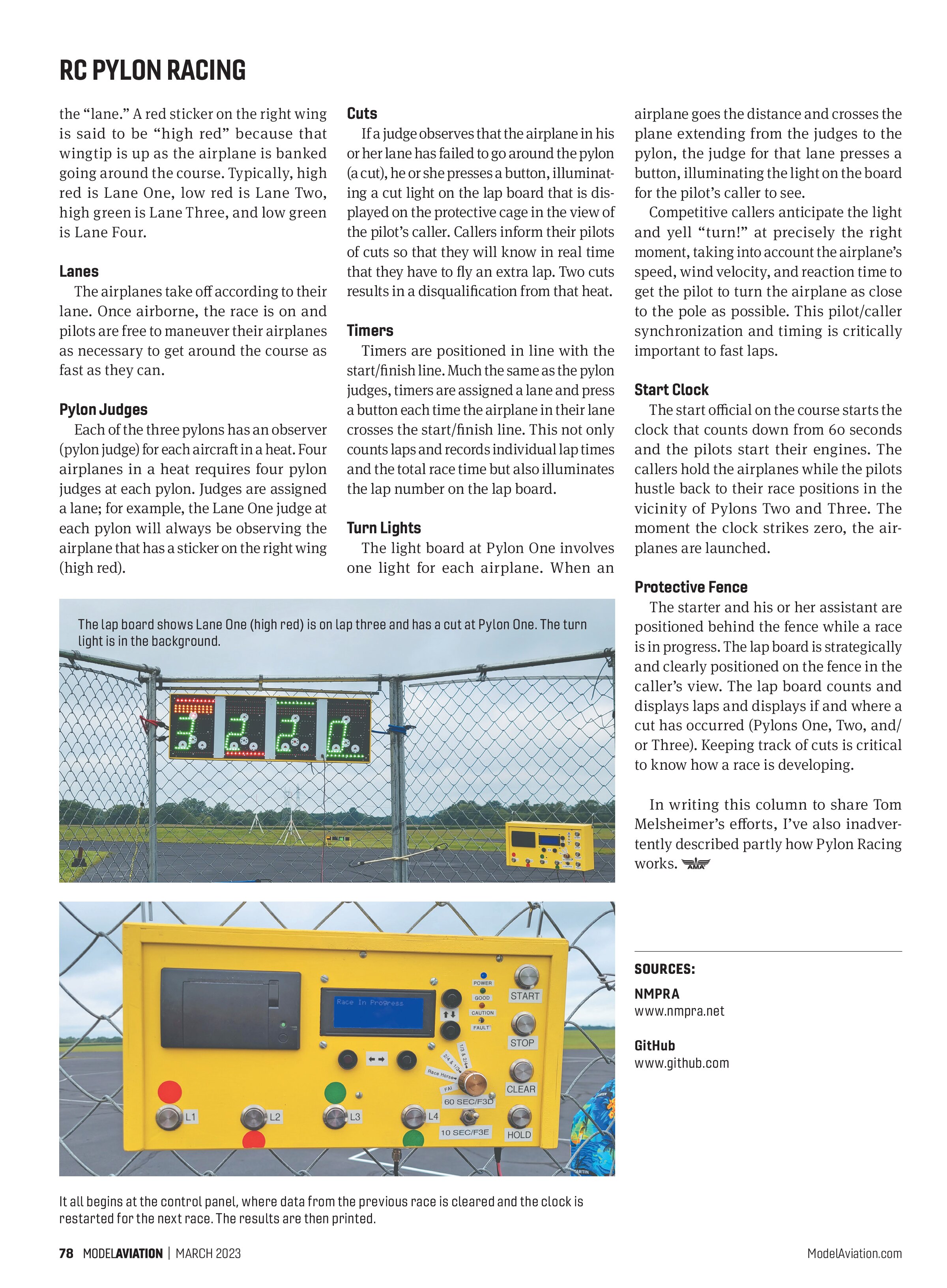
If a judge observes that the airplane in his or her lane has failed to go around the pylon (a cut), he or she presses a button, illuminating a cut light on the lap board that is displayed on the protective cage in the view of the pilot’s caller. Callers inform their pilots of cuts so that they will know in real time that they have to fly an extra lap. Two cuts results in a disqualification from that heat.
Timers
Timers are positioned in line with the start/finish line. Much the same as the pylon judges, timers are assigned a lane and press a button each time the airplane in their lane crosses the start/finish line. This not only counts laps and records individual lap times and the total race time but also illuminates the lap number on the lap board.
Turn Lights
The light board at Pylon One involves one light for each airplane. When an airplane goes the distance and crosses the plane extending from the judges to the pylon, the judge for that lane presses a button, illuminating the light on the board for the pilot’s caller to see.
Competitive callers anticipate the light and yell “turn!” at precisely the right moment, taking into account the airplane’s speed, wind velocity, and reaction time to get the pilot to turn the airplane as close to the pole as possible. This pilot/caller synchronization and timing is critically important to fast laps.
Start Clock
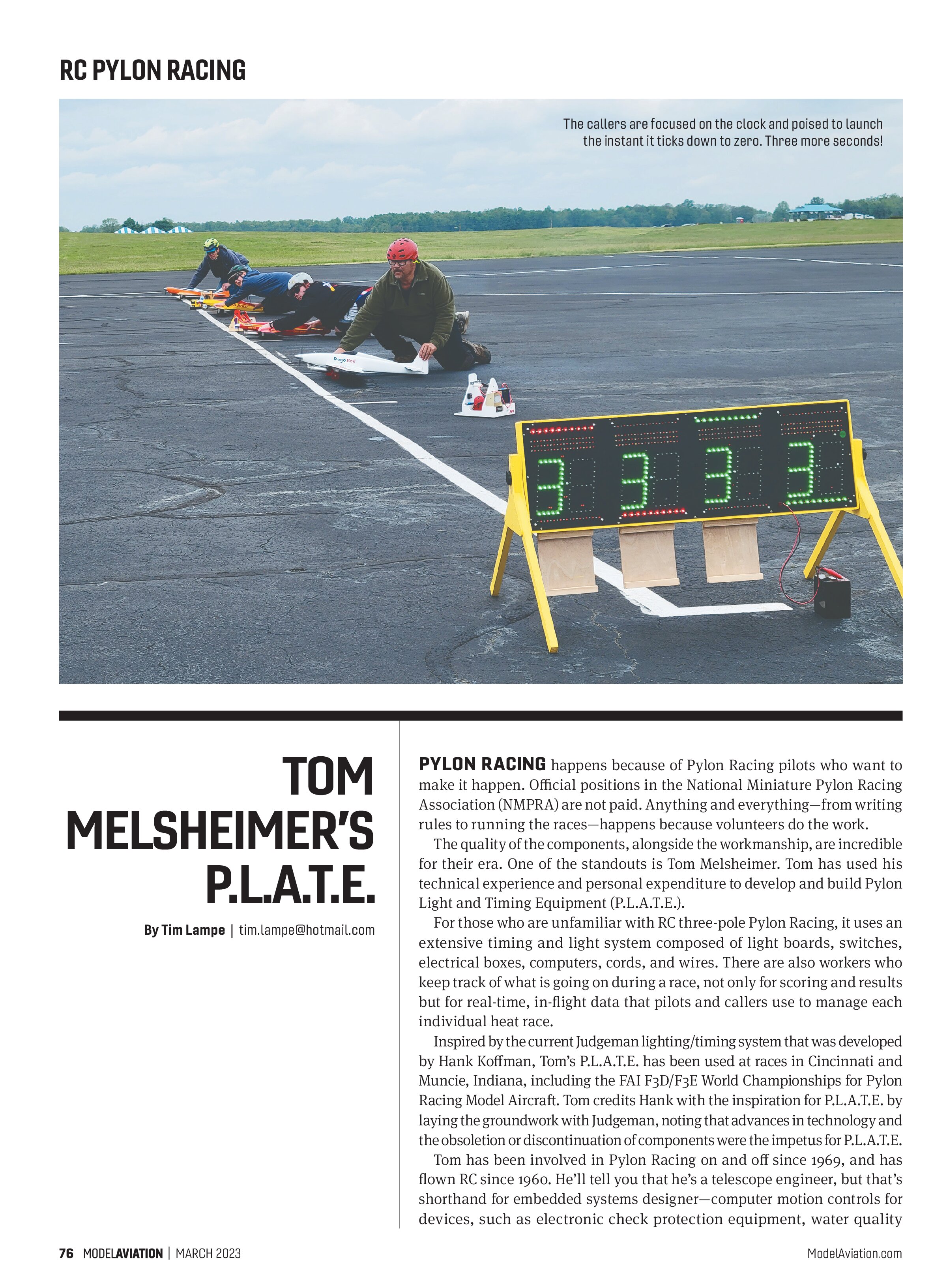
The start official on the course starts the clock that counts down from 60 seconds and the pilots start their engines. The callers hold the airplanes while the pilots hustle back to their race positions in the vicinity of Pylons Two and Three. The moment the clock strikes zero, the airplanes are launched.
Protective Fence
The starter and his or her assistant are positioned behind the fence while a race is in progress. The lap board is strategically and clearly positioned on the fence in the caller’s view. The lap board counts and displays laps and displays if and where a cut has occurred (Pylons One, Two, and/or Three). Keeping track of cuts is critical to know how a race is developing.


In writing this column to share Tom Melsheimer’s efforts, I’ve also inadvertently described partly how Pylon Racing works.
SOURCES:
NMPRA
www.nmpra.net
GitHub
www.github.com