RC AEROBATICS

SEQUENCE UPDATE: A CHANGE IS COMING
By Justin Wells | justinwells@mac.com
I WANT TO take a short break from our regularly scheduled programming to talk about a new development in the AMA RC Aerobatics sequences for 2024-2025. This is a big change for the National Society of Radio Controlled Aerobatics (NSRCA), and I want to help by putting it in front of a broader audience. I’ll pick up in my May column where I left off, but I will try to add an update to current events to further help everyone.
A Short History Lesson
The AMA RC Aerobatics patterns provided by all classes have always been developed by a sequence committee that is made up of dedicated NSRCA members. For years, this has provided fresh maneuvers for everyone by using a set of criteria. The sequence development committee is a thankless job, and they do a great service to those who fly RC Aerobatics.
The change for 2024-2025 involves the adoption of FAI sequences for the Advanced class and the Masters class. The AMA Advanced class will fly FAI A-25, and the Masters class will fly P-25. I assure you that the sequence development committee still plays a role in this portion to align K-Factors and scoring, but this also helps us measure up to the world stage.
Although I do enjoy flying a pattern that caters to me, I like the idea of flying patterns that are flown worldwide as well. This would ideally eliminate those who fly what is known as FAI Silver in some districts. The sequence development committee will still play a role in developing the Sportsman and Intermediate AMA classes; furthermore, they will assist with adopting A-25 and P-25, as necessary.
The next hurdle that will need to be taken on is the judging criteria. Unfortunately, I don’t know whether a direction has been decided on this, but I will offer some thoughts. It will require some judge training and the relearning of how things operate to adopt the FAI judging standards because they do differ from AMA standards.
I think, in the end, we will see a more coherent system by eliminating the differences. There can be much confusion at a contest when judging FAI vs. AMA classes.
I hope this direction improves our participation and we see an uptick in those who want to move to FAI after the Masters class.
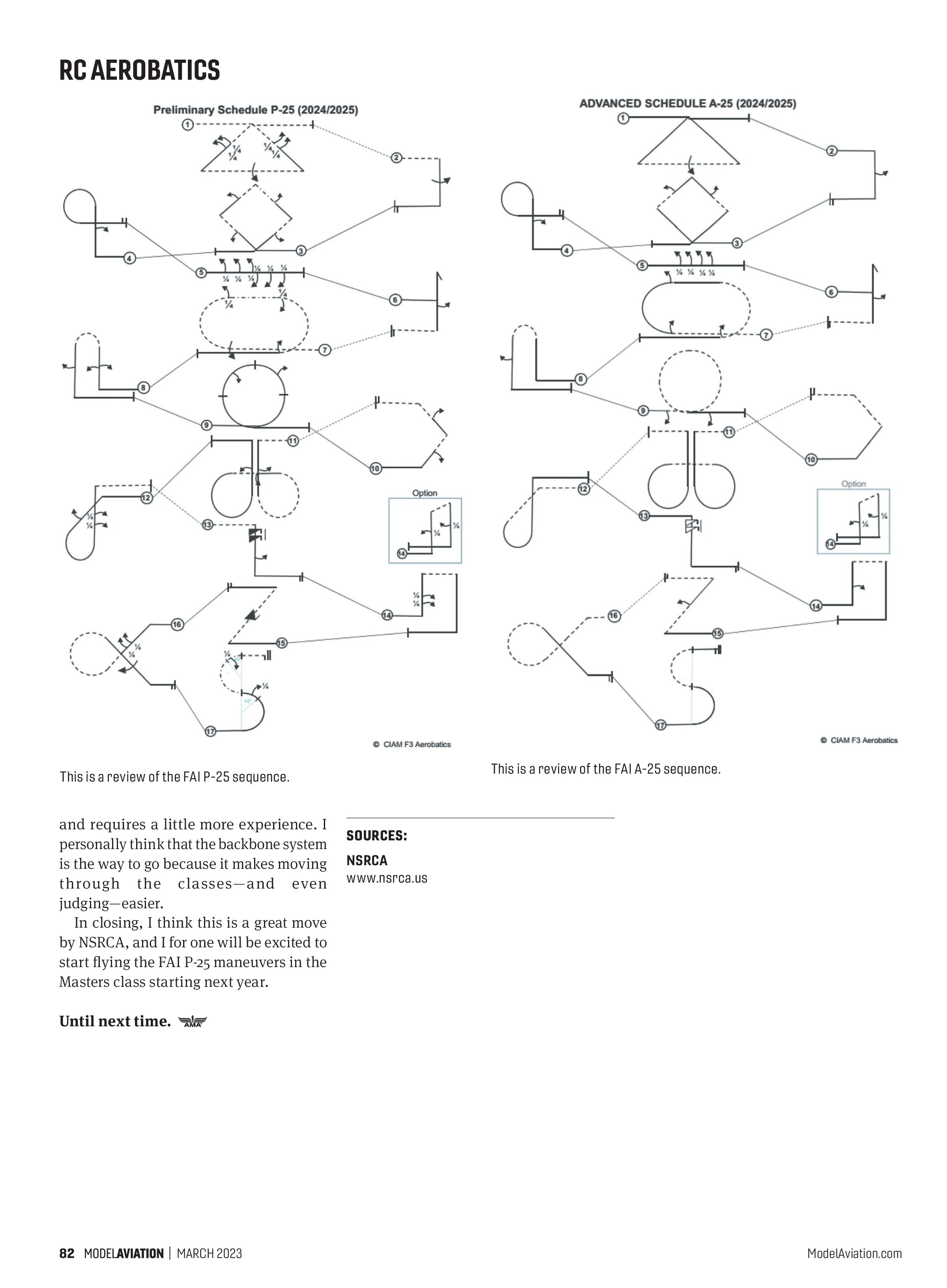
I’ve included the FAI A-25 and P-25 Aresti sheets for your review. If you carefully notice, they do look very similar because FAI is using the backbone maneuver approach. This helps when moving between the two classes. The P-25 Aresti obviously has more elements per maneuver


and requires a little more experience. I personally think that the backbone system is the way to go because it makes moving through the classes—and even judging—easier.
In closing, I think this is a great move by NSRCA, and I for one will be excited to start flying the FAI P-25 maneuvers in the Masters class starting next year.
Until next time.
SOURCES:
NSRCA
www.nsrca.us