DAVID LINDLEY
National Free Flight Society President
By Jay Smith | jays@modelaircraft.org
JAY SMITH: How did you become involved with model aviation?
DAVID LINDLEY: I got into modeling at an early age. I came to modeling the way a lot of us did, through my father, Don Lindley. My first Nats was Oshkosh 1973, at age 8, but I didn’t get to compete.
My dad was in charge of the RC Aerobatics [Pattern] line, so my first job was transmitter impound, back in the day when we had to impound every transmitter. Because my dad was an active contest director, I learned how to run a contest before I ever actually competed at a Nats.
Although I was competing in local/regional contests at age 7, as part of the Chicago Aeronauts, the first Nats I competed in was in 1976, in Dayton, Ohio. I flew Control Line (CL) Racing, Outdoor Free Flight (FF) and Indoor FF.
JS: How has model aviation impacted your life and/or career?
DL: Modeling has had a profound impact on my life and my career. It taught me from an early age the importance of keeping meticulous data, making incremental changes one variable at a time, attention to detail and, most importantly, persisting through adversity.
We have all faced adversity in modeling—when nothing seems to be going right. But you work through that process to find solutions. I made my career in software programming for the most part and working through problems in a logical order is the name of the game.
JS: What disciplines of modeling do you currently participate in?
DL: I have flown most disciplines throughout my life: RC Soaring and Pattern, CL Racing and Speed, and enough CL Aerobatics to be dangerous, but I really found my passion in FF.
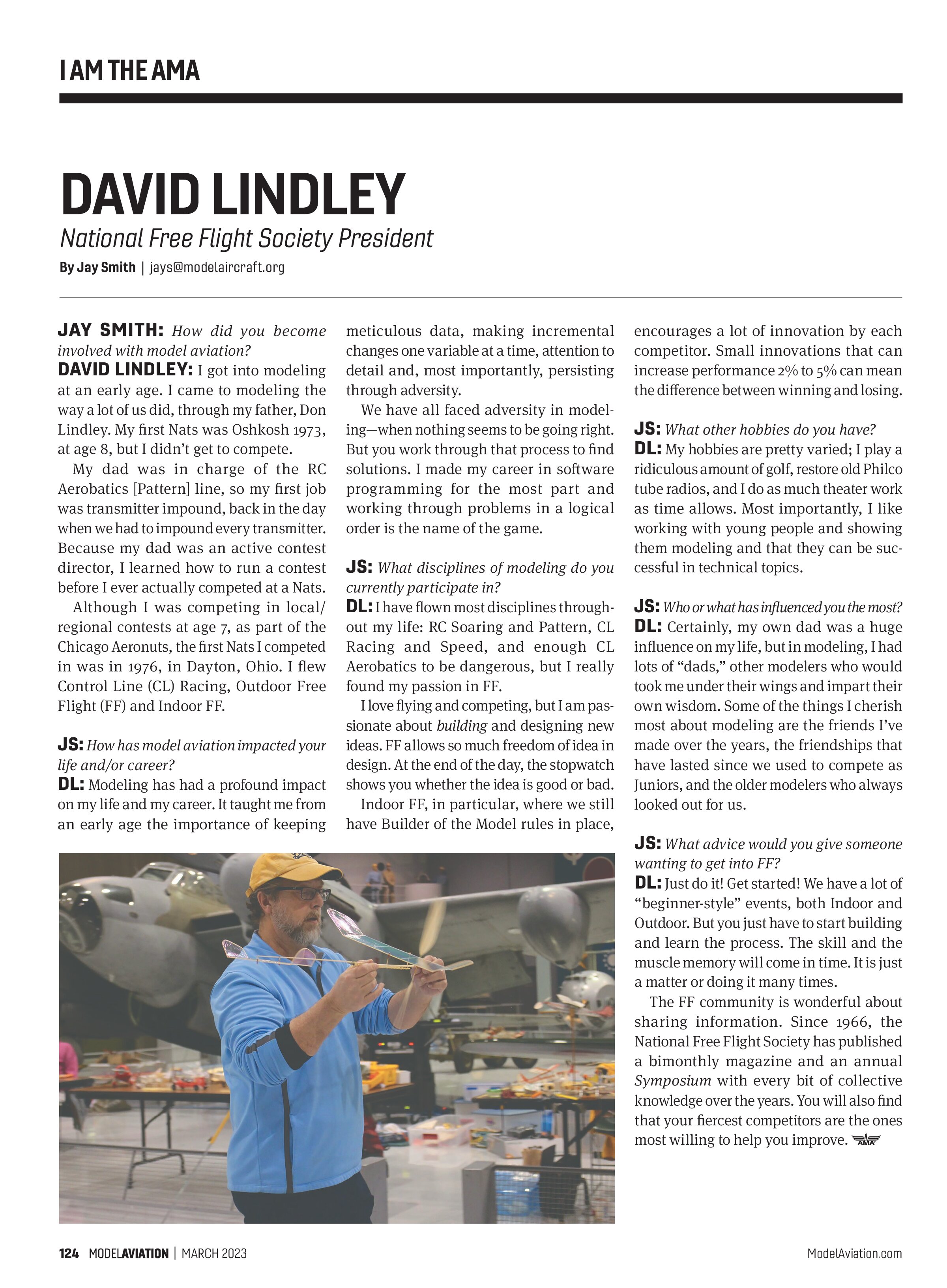
I love flying and competing, but I am passionate about building and designing new ideas. FF allows so much freedom of idea in design. At the end of the day, the stopwatch shows you whether the idea is good or bad.
Indoor FF, in particular, where we still have Builder of the Model rules in place,

encourages a lot of innovation by each competitor. Small innovations that can increase performance 2% to 5% can mean the difference between winning and losing.
JS: What other hobbies do you have?
DL: My hobbies are pretty varied; I play a ridiculous amount of golf, restore old Philco tube radios, and I do as much theater work as time allows. Most importantly, I like working with young people and showing them modeling and that they can be successful in technical topics.
JS: Who or what has influenced you the most?
DL: Certainly, my own dad was a huge influence on my life, but in modeling, I had lots of “dads,” other modelers who would took me under their wings and impart their own wisdom. Some of the things I cherish most about modeling are the friends I’ve made over the years, the friendships that have lasted since we used to compete as Juniors, and the older modelers who always looked out for us.
JS: What advice would you give someone wanting to get into FF?
DL: Just do it! Get started! We have a lot of “beginner-style” events, both Indoor and Outdoor. But you just have to start building and learn the process. The skill and the muscle memory will come in time. It is just a matter or doing it many times.
The FF community is wonderful about sharing information. Since 1966, the National Free Flight Society has published a bimonthly magazine and an annual Symposium with every bit of collective knowledge over the years. You will also find that your fiercest competitors are the ones most willing to help you improve.