REMEMBERING DON SRULL

By Thayer Syme | thayer@flying-models.com
UNFORTUNATELY, or so it seems at times like these, the great reality of life is that it doesn’t last forever.
Word spread through the hobby channels just before the 2022 holiday season that we had lost yet another one of the greats. We all have our own memories when someone important to our lives passes, and the telling of these personal stories keeps their memories and achievements alive for the rest of us.
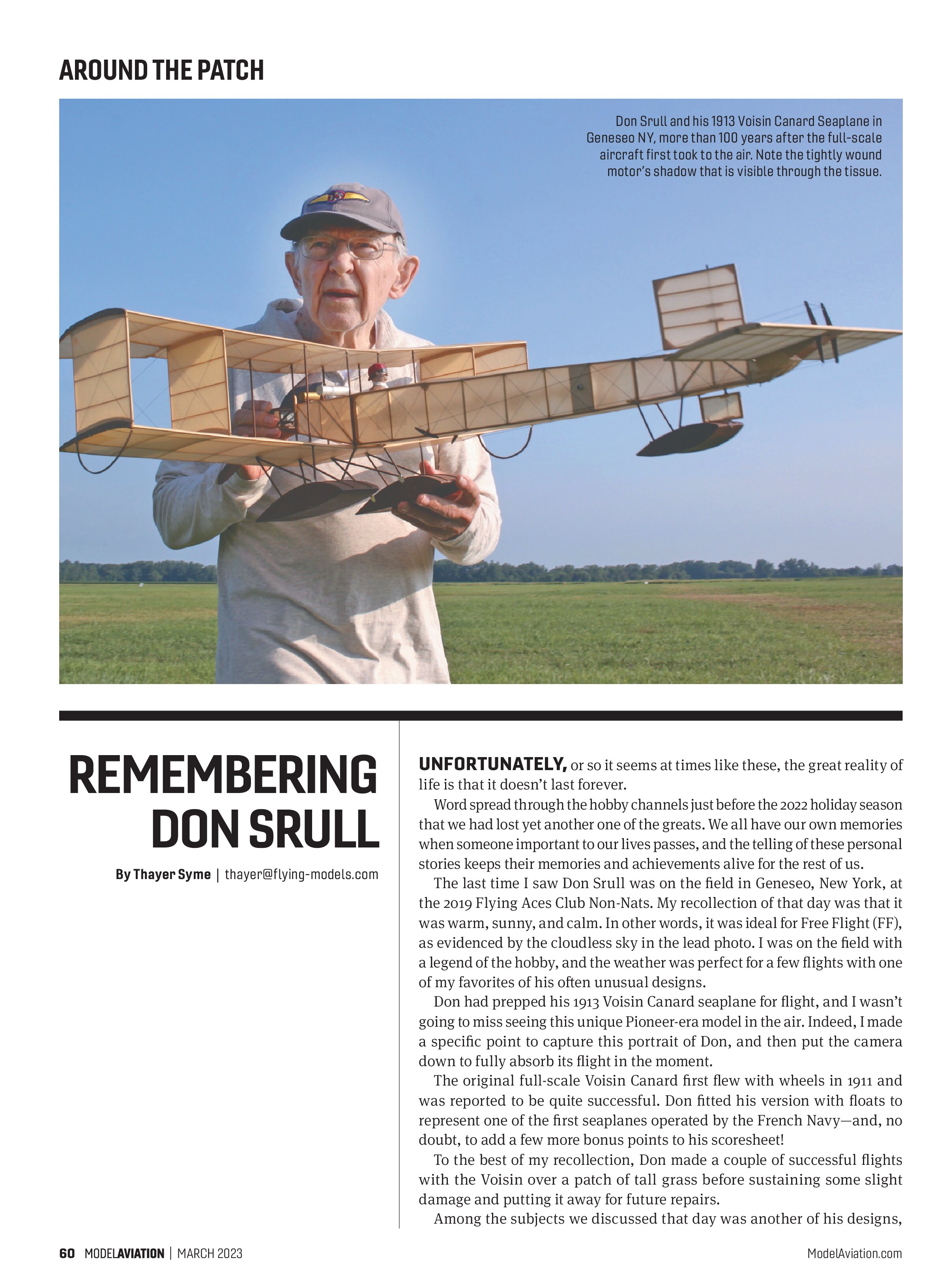
The last time I saw Don Srull was on the field in Geneseo, New York, at the 2019 Flying Aces Club Non-Nats. My recollection of that day was that it was warm, sunny, and calm. In other words, it was ideal for Free Flight (FF), as evidenced by the cloudless sky in the lead photo. I was on the field with a legend of the hobby, and the weather was perfect for a few flights with one of my favorites of his often unusual designs.
Don had prepped his 1913 Voisin Canard seaplane for flight, and I wasn’t going to miss seeing this unique Pioneer-era model in the air. Indeed, I made a specific point to capture this portrait of Don, and then put the camera down to fully absorb its flight in the moment.
The original full-scale Voisin Canard first flew with wheels in 1911 and was reported to be quite successful. Don fitted his version with floats to represent one of the first seaplanes operated by the French Navy—and, no doubt, to add a few more bonus points to his scoresheet!
To the best of my recollection, Don made a couple of successful flights with the Voisin over a patch of tall grass before sustaining some slight damage and putting it away for future repairs.
Among the subjects we discussed that day was another of his designs, a 72-inch Spitfire. Although that might sound a bit mainstream, it did come with a twist. His sport Spitfire, The Spirit of Biggen Hill, first came to my attention when it appeared in the October 1981 issue of Model Aviation. Continuing the spirit of lightweight flying, that issue also featured Paul MacCready’s Solar Challenger on the cover.
The story mentions his son’s desire to fly a large Spitfire, having learned the basics with simple sport models. Ever an innovator, Don figured out an approach that was appropriate to his son’s limited experience. He based his model on Earl Stahl’s classic FF design. The result was a unique melding of FF and RC design, resulting in a 6-foot warbird that weighed only 5-1/2 pounds with its .23-size glow engine. This three-channel model proved perfect for the desired mission and it was successfully flown for a few years before being hung up to make room for other projects.
It turns out that Bill Winter was captivated by the Spitfire, and during one of his many visits, Don suggested trying out the new Astro Flight geared 15 motor in the idle airframe. The electric conversion was a complete success and was featured in Model Aviation.
Don remarked to me that the Spitfire flew great and that he had built another more recently, this time with ailerons. This more complex version was of a similar weight and just as successful. When he asked whether I had built one, I confessed that I had not built it as drawn, although I did use it as inspiration for another project.
Following Don’s Lead
The original Spitfire article was intriguing because the story paralleled my own limited experience at that time. I immediately ordered the plans and I hung them on my wall to study before tackling the build. As is often the case, the rest of life distracted me, and it was another 20 years before I got started on my own version.
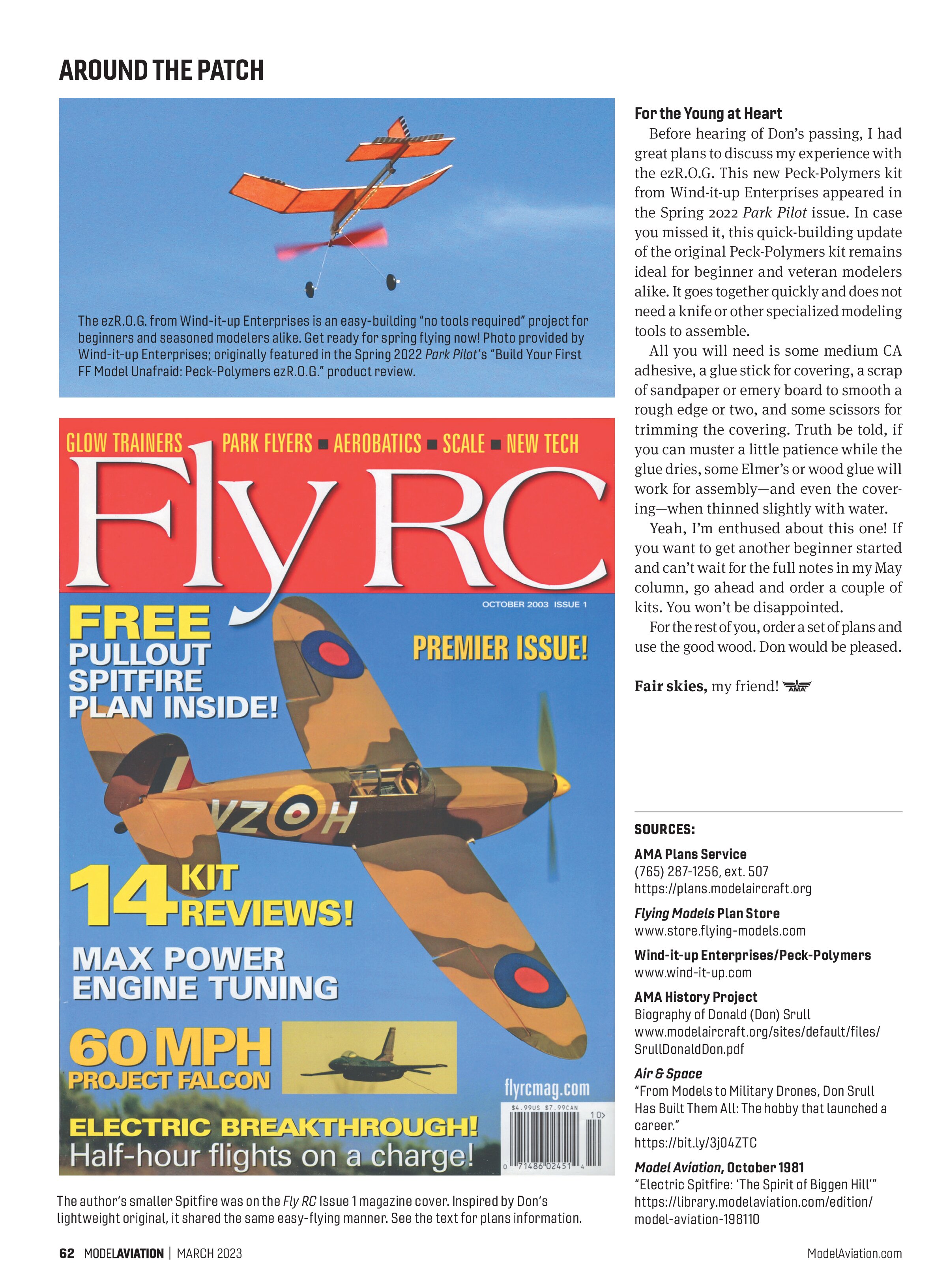
Early in 2003, Tom Atwood and I were discussing the upcoming first issue of Fly RC magazine, specifically what might make a suitable construction article. We bounced around a few ideas before I mentioned always wanting to do something like Don’s Spitfire.
I thought that a scaled-down version might be more approachable for the readers, and would also tie in well with the growing interest in small electric models. Tom gave the thumbs up, and I immediately got started.
Step one was to get the original plans into my computer so that I could start sketching my version. I determined that the easiest “scanning” option would be to unroll the plans on our San Francisco patio, and then climb to our second-floor balcony to rephotograph it with my digital camera.
To speed up the build, I opted for sheet-balsa sides for the fuselage, with a few formers to fill in the outline. NiMH batteries were the order of the day back then and easily offset the full-sheet tail surfaces.
One big stumbling block has always been developing ribs for the Spitfire’s elliptical wing planform. I borrowed Tom Hunt’s “cap strips only” concept and the wing came together very quickly.
The AMA Plans Service offers Don’s Spitfire for sale, and I still believe it would be a blast to fly. A modern power system could allow a light and slow “ghost ship” for an otherworldly flight experience. I can think of nothing more fun than shooting endless touch-and-gos with a Spitfire that is still flying at walking speed!
Do you need more convincing? Visit the Model Aviation Archive/Library and read Don’s original Spitfire article before you order the plans.
Those who are inclined to build smaller models might be interested in my own version. I’ve recently redrawn the nose to accept a modern outrunner motor and added it to the Flying Models Plan Store collection. My original model had a small, geared, brushed motor, and while sufficient for flight, most will prefer the extra power today.
For a more objective look at Don’s achievements and contributions to our lives, see the links in “Sources” to his biography and an interview that appeared in the Smithsonian’s Air & Space magazine. He has left a great challenge to the rest of us.


For the Young at Heart
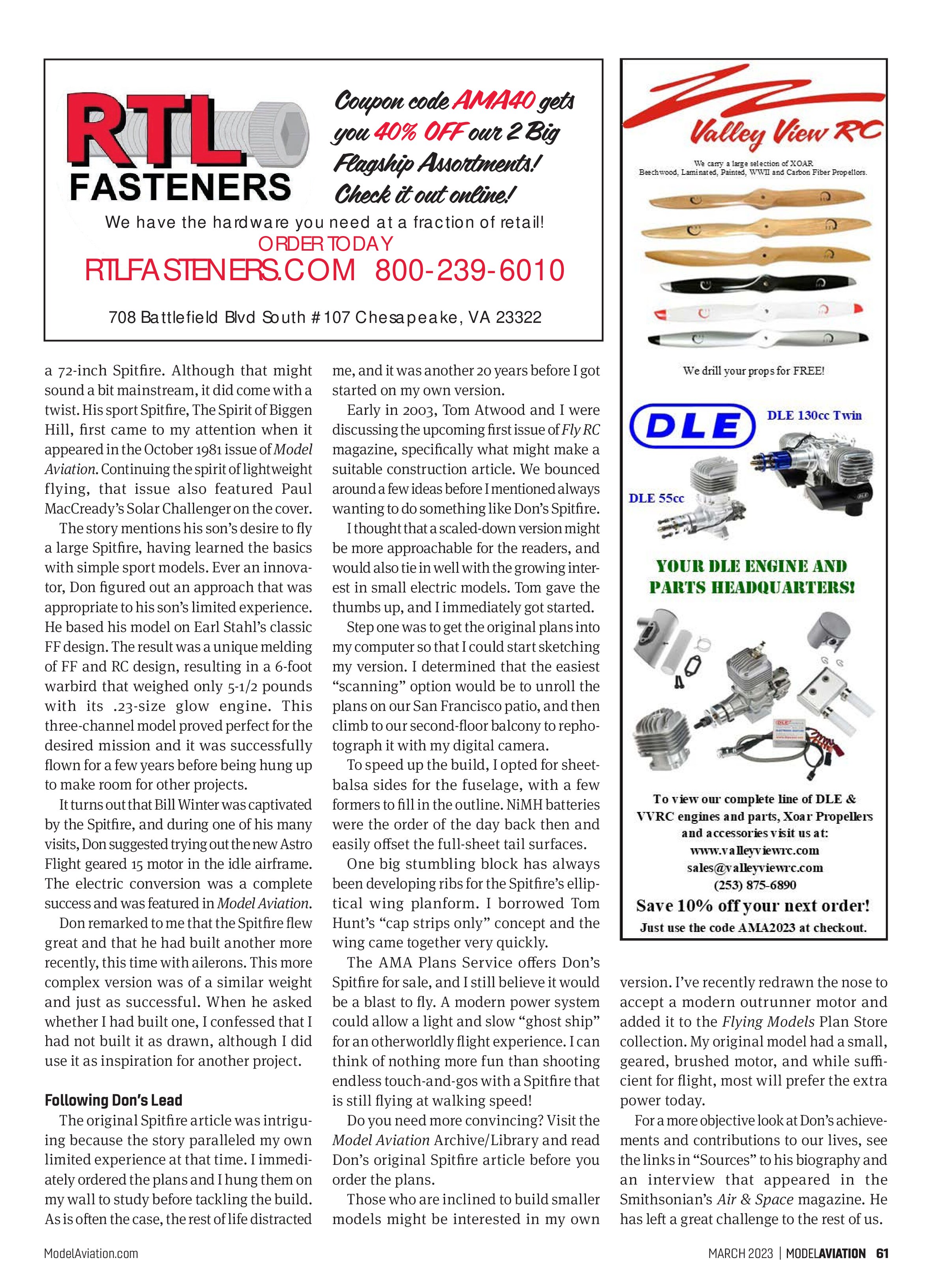
Before hearing of Don’s passing, I had great plans to discuss my experience with the ezR.O.G. This new Peck-Polymers kit from Wind-it-up Enterprises appeared in the Spring 2022 Park Pilot issue. In case you missed it, this quick-building update of the original Peck-Polymers kit remains ideal for beginner and veteran modelers alike. It goes together quickly and does not need a knife or other specialized modeling tools to assemble.
All you will need is some medium CA adhesive, a glue stick for covering, a scrap of sandpaper or emery board to smooth a rough edge or two, and some scissors for trimming the covering. Truth be told, if you can muster a little patience while the glue dries, some Elmer’s or wood glue will work for assembly—and even the covering—when thinned slightly with water.
Yeah, I’m enthused about this one! If you want to get another beginner started and can’t wait for the full notes in my May column, go ahead and order a couple of kits. You won’t be disappointed.
For the rest of you, order a set of plans and use the good wood. Don would be pleased.
Fair skies, my friend!
SOURCES:
AMA Plans Service
(765) 287-1256, ext. 507
https://plans.modelaircraft.org
Flying Models Plan Store
www.store.flying-models.com
Wind-it-up Enterprises/Peck-Polymers
www.wind-it-up.com
AMA History Project
Biography of Donald (Don) Srull
www.modelaircraft.org/sites/default/files/SrullDonaldDon.pdf
Air & Space
“From Models to Military Drones, Don Srull Has Built Them All: The hobby that launched a career.”
https://bit.ly/3j04ZTC
Model Aviation, October 1981
“Electric Spitfire: ‘The Spirit of Biggen Hill’”
https://library.modelaviation.com/edition/model-aviation-198110