
Vapor Bash
Turn your old Vapor into something unexpected
By Tim Bailiff
casurffish@aol.com
Photos by Maggie Madril
Model bashing is something that I have always had fun with. It’s not that I don’t appreciate aircraft as they were originally designed. On the contrary, I love them. The truth is, all of the airplanes that I choose to modify are wonderfully stable flyers and have proven designs. In essence, I’m embracing each model and then using that platform to experiment.
I really enjoy trying different aerodynamic designs and ideas. In the end, if successful, seeing them fly feels amazing! And you know what? You can experience that same feeling too!

What’s the Point?

This article was written to encourage and challenge you to think beyond standard conventions. In fact, I’ll say it: “I dare you!” Go ahead. Try something different—perhaps even outrageous. With that stated, the four airplanes shared in this article, and the ideas behind them, are intended to inspire. Sound intriguing? If so, please join me in “bashing” a terrific little indoor flyer that many pilots love.
The Vapor
The E-flite Vapor has been around for years and has proven to be a popular design. The Vapor line has included the original Vapor, Night Vapor, Mini Vapor, Vapor Lite, and UMX Night Vapor. All are slightly different in their appearance and in the way that they fly. However, when their individual flight characteristics are learned and understood, all are wonderful flyers.
Some of the following modifications were brought about simply because of my desire to experiment, while other designs began with some misfortune. In other words, if I were given the opportunity to harvest some materials or electronics from a grounded Vapor, I did so and appreciated it.
The Vapor Wing
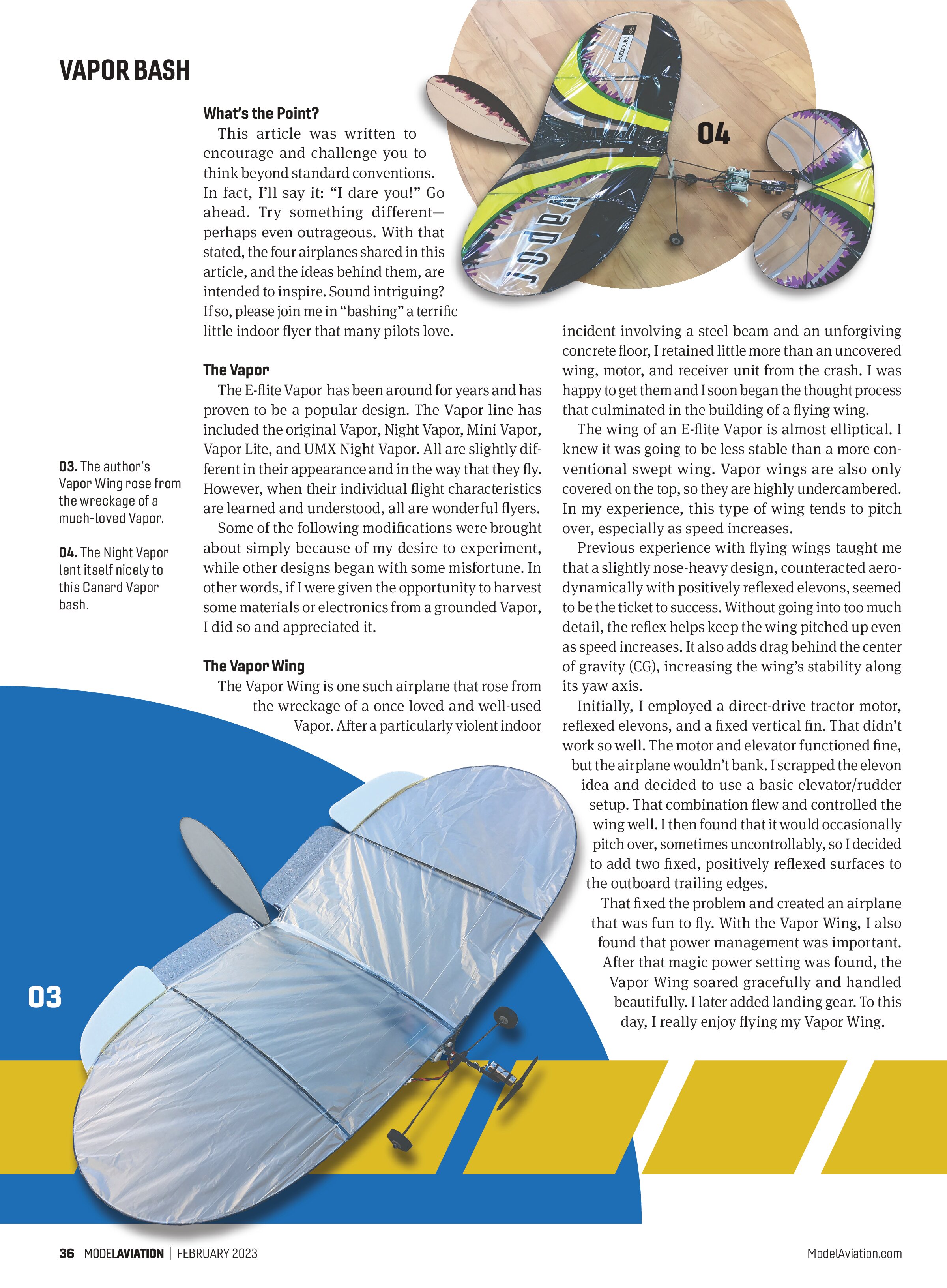
The Vapor Wing is one such airplane that rose from the wreckage of a once loved and well-used Vapor. After a particularly violent indoor

incident involving a steel beam and an unforgiving concrete floor, I retained little more than an uncovered wing, motor, and receiver unit from the crash. I was happy to get them and I soon began the thought process that culminated in the building of a flying wing.
The wing of an E-flite Vapor is almost elliptical. I knew it was going to be less stable than a more conventional swept wing. Vapor wings are also only covered on the top, so they are highly undercambered. In my experience, this type of wing tends to pitch over, especially as speed increases.
Previous experience with flying wings taught me that a slightly nose-heavy design, counteracted aerodynamically with positively reflexed elevons, seemed to be the ticket to success. Without going into too much detail, the reflex helps keep the wing pitched up even as speed increases. It also adds drag behind the center of gravity (CG), increasing the wing’s stability along its yaw axis.
Initially, I employed a direct-drive tractor motor, reflexed elevons, and a fixed vertical fin. That didn’t work so well. The motor and elevator functioned fine, but the airplane wouldn’t bank. I scrapped the elevon idea and decided to use a basic elevator/rudder setup. That combination flew and controlled the wing well. I then found that it would occasionally pitch over, sometimes uncontrollably, so I decided to add two fixed, positively reflexed surfaces to the outboard trailing edges.
That fixed the problem and created an airplane that was fun to fly. With the Vapor Wing, I also found that power management was important. After that magic power setting was found, the Vapor Wing soared gracefully and handled beautifully. I later added landing gear. To this day, I really enjoy flying my Vapor Wing.
The Canard Vapor
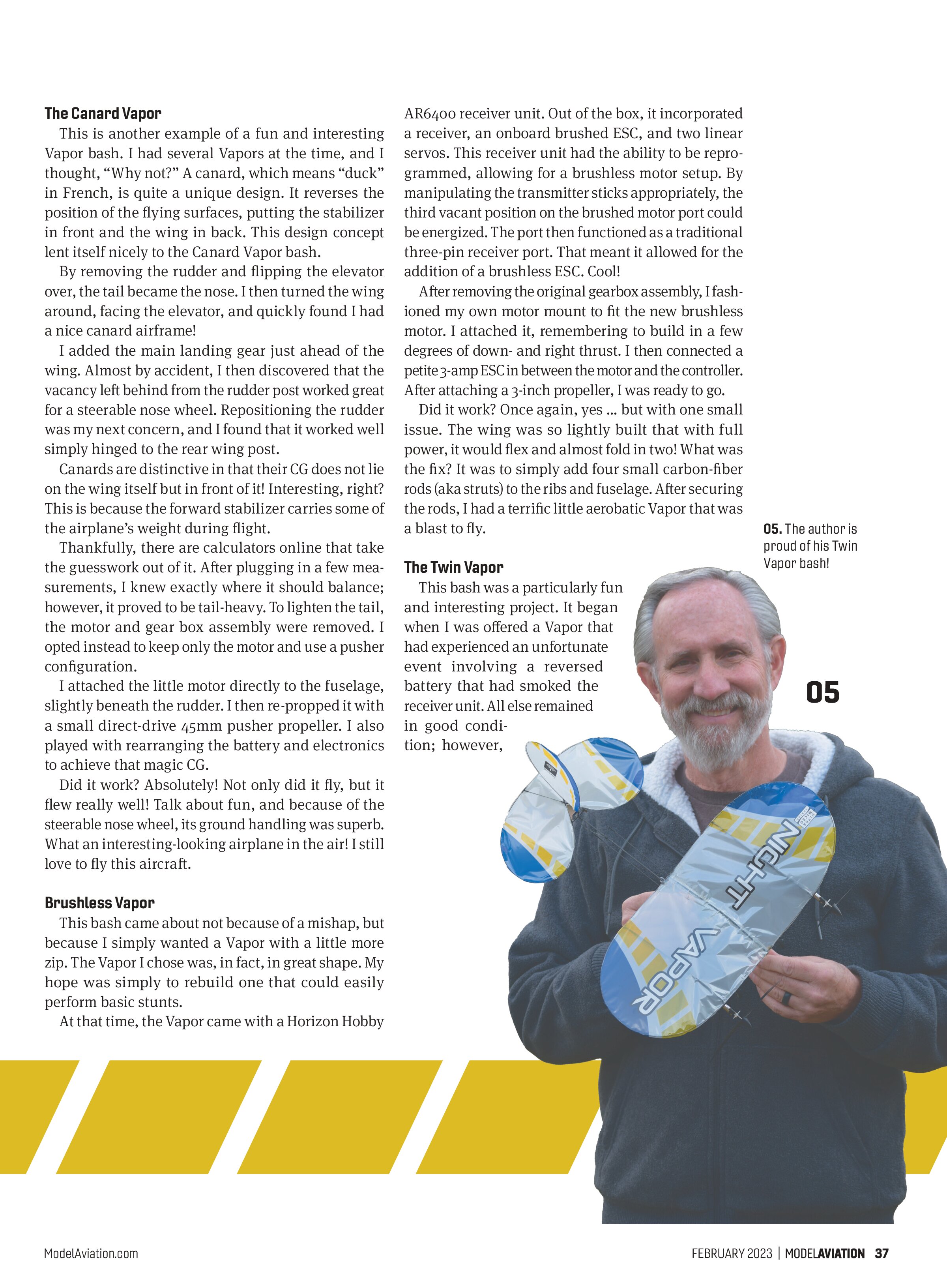
This is another example of a fun and interesting Vapor bash. I had several Vapors at the time, and I thought, “Why not?” A canard, which means “duck” in French, is quite a unique design. It reverses the position of the flying surfaces, putting the stabilizer in front and the wing in back. This design concept lent itself nicely to the Canard Vapor bash.
By removing the rudder and flipping the elevator over, the tail became the nose. I then turned the wing around, facing the elevator, and quickly found I had a nice canard airframe!
I added the main landing gear just ahead of the wing. Almost by accident, I then discovered that the vacancy left behind from the rudder post worked great for a steerable nose wheel. Repositioning the rudder was my next concern, and I found that it worked well simply hinged to the rear wing post.
Canards are distinctive in that their CG does not lie on the wing itself but in front of it! Interesting, right? This is because the forward stabilizer carries some of the airplane’s weight during flight.
Thankfully, there are calculators online that take the guesswork out of it. After plugging in a few measurements, I knew exactly where it should balance; however, it proved to be tail-heavy. To lighten the tail, the motor and gear box assembly were removed. I opted instead to keep only the motor and use a pusher configuration.
I attached the little motor directly to the fuselage, slightly beneath the rudder. I then re-propped it with a small direct-drive 45mm pusher propeller. I also played with rearranging the battery and electronics to achieve that magic CG.
Did it work? Absolutely! Not only did it fly, but it flew really well! Talk about fun, and because of the steerable nose wheel, its ground handling was superb. What an interesting-looking airplane in the air! I still love to fly this aircraft.
Brushless Vapor
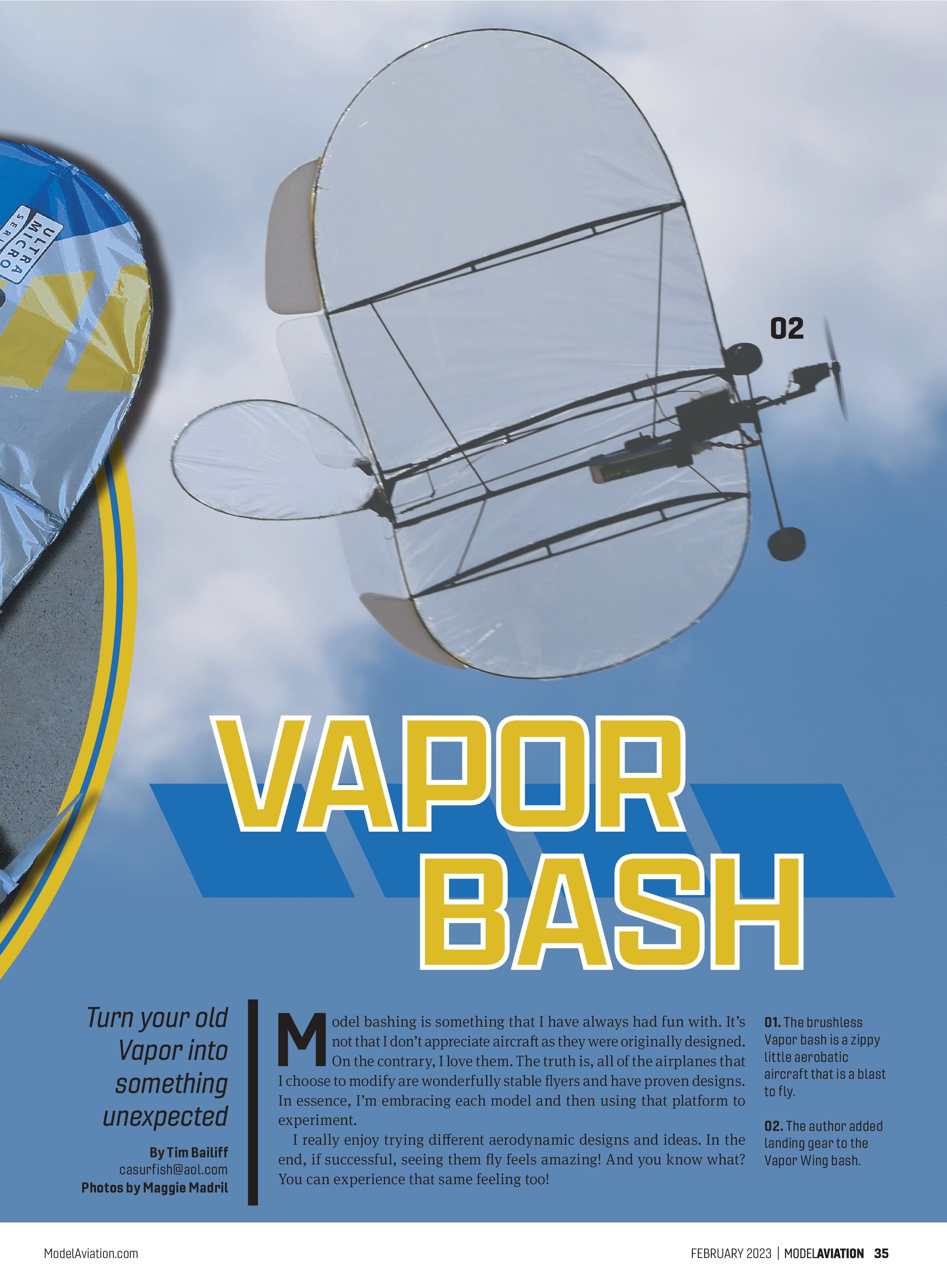
This bash came about not because of a mishap, but because I simply wanted a Vapor with a little more zip. The Vapor I chose was, in fact, in great shape. My hope was simply to rebuild one that could easily perform basic stunts.
At that time, the Vapor came with a Horizon Hobby AR6400 receiver unit. Out of the box, it incorporated a receiver, an onboard brushed ESC, and two linear servos. This receiver unit had the ability to be reprogrammed, allowing for a brushless motor setup. By manipulating the transmitter sticks appropriately, the third vacant position on the brushed motor port could be energized. The port then functioned as a traditional three-pin receiver port. That meant it allowed for the addition of a brushless ESC. Cool!
After removing the original gearbox assembly, I fashioned my own motor mount to fit the new brushless motor. I attached it, remembering to build in a few degrees of down- and right thrust. I then connected a petite 3-amp ESC in between the motor and the controller. After attaching a 3-inch propeller, I was ready to go.
Did it work? Once again, yes ... but with one small issue. The wing was so lightly built that with full power, it would flex and almost fold in two! What was the fix? It was to simply add four small carbon-fiber rods (aka struts) to the ribs and fuselage. After securing the rods, I had a terrific little aerobatic Vapor that was a blast to fly.
The Twin Vapor

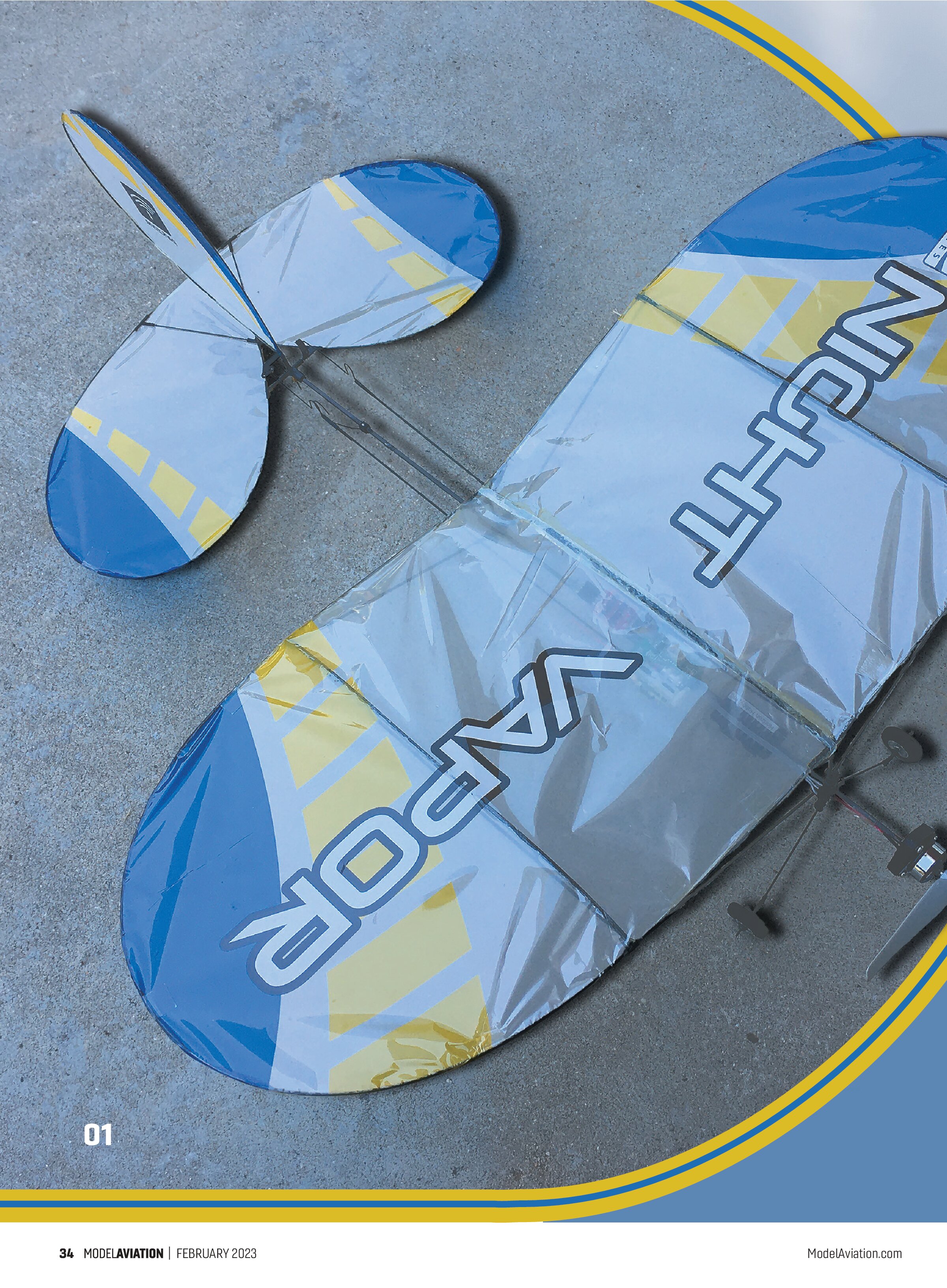
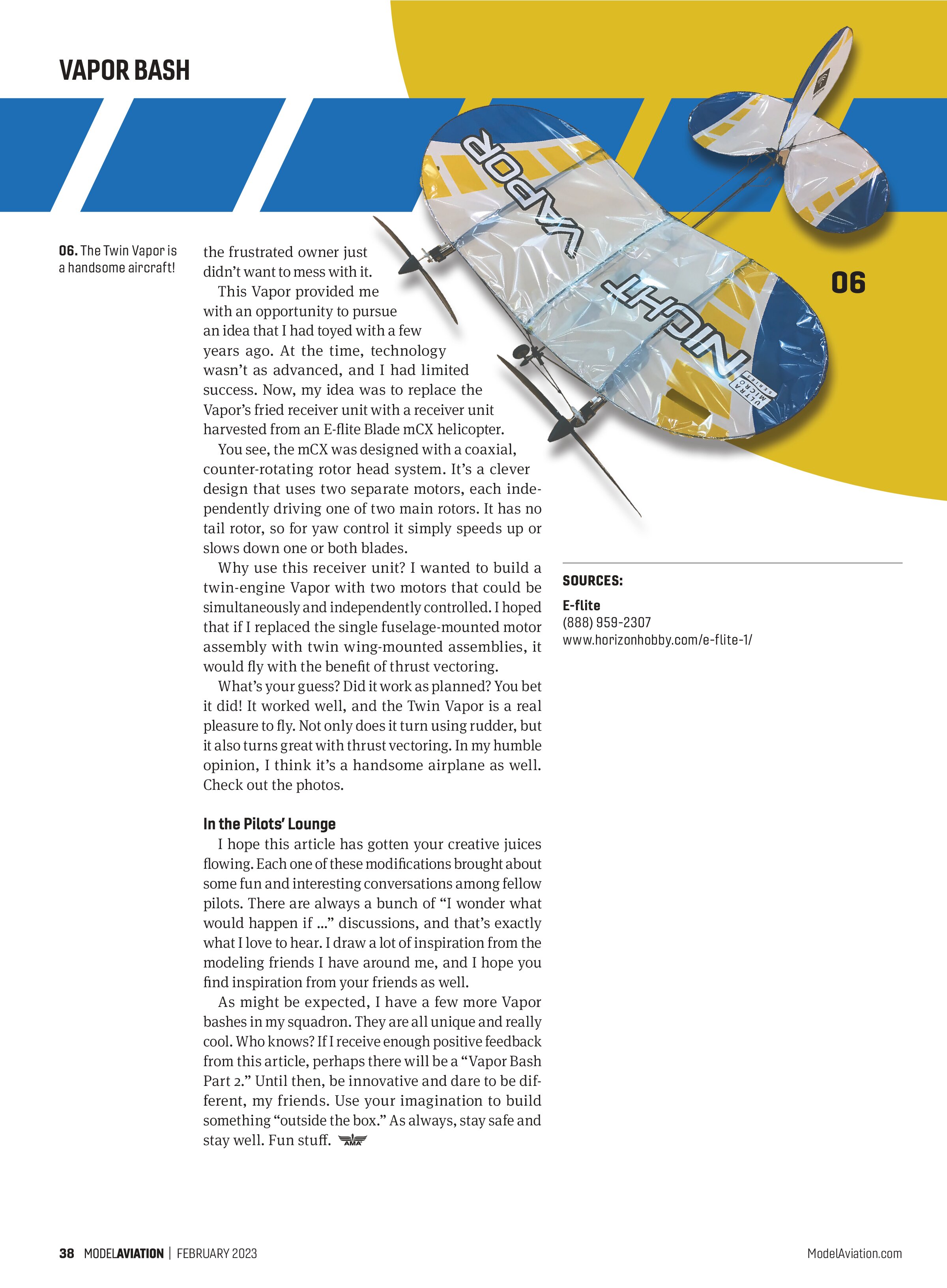
This bash was a particularly fun and interesting project. It began when I was offered a Vapor that had experienced an unfortunate event involving a reversed battery that had smoked the receiver unit. All else remained in good condition; however,

The frustrated owner just didn’t want to mess with it. This Vapor provided me with an opportunity to pursue an idea that I had toyed with a few years ago. At the time, technology wasn’t as advanced, and I had limited success. Now, my idea was to replace the Vapor’s fried receiver unit with a receiver unit harvested from an E-flite Blade mCX helicopter.
You see, the mCX was designed with a coaxial, counter-rotating rotor head system. It’s a clever design that uses two separate motors, each independently driving one of two main rotors. It has no tail rotor, so for yaw control it simply speeds up or slows down one or both blades.
Why use this receiver unit? I wanted to build a twin-engine Vapor with two motors that could be simultaneously and independently controlled. I hoped that if I replaced the single fuselage-mounted motor assembly with twin wing-mounted assemblies, it would fly with the benefit of thrust vectoring.
What’s your guess? Did it work as planned? You bet it did! It worked well, and the Twin Vapor is a real pleasure to fly. Not only does it turn using rudder, but it also turns great with thrust vectoring. In my humble opinion, I think it’s a handsome airplane as well. Check out the photos.
In the Pilots’ Lounge
I hope this article has gotten your creative juices flowing. Each one of these modifications brought about some fun and interesting conversations among fellow pilots. There are always a bunch of “I wonder what would happen if …” discussions, and that’s exactly what I love to hear. I draw a lot of inspiration from the modeling friends I have around me, and I hope you find inspiration from your friends as well.
As might be expected, I have a few more Vapor bashes in my squadron. They are all unique and really cool. Who knows? If I receive enough positive feedback from this article, perhaps there will be a “Vapor Bash Part 2.” Until then, be innovative and dare to be different, my friends. Use your imagination to build something “outside the box.” As always, stay safe and stay well. Fun stuff.
SOURCES:
E-flite
(888) 959-2307
www.horizonhobby.com/e-flite-1/