RC SLOPE SOARING

MYSTICAL QUESTIONS
By Greg Schutte | gshooty@yahoo.com
I’VE ALWAYS BEEN PUZZLED by how few Slope Soaring pilots there are. I work in North Dakota, where the wind never really stops blowing. Last winter, the wind was so strong that it snapped more than 30 power poles in half throughout one storm.
There is an RC airfield approximately 45 minutes from where I live, but I never see anyone flying there. I visited a couple of local hobby shops. One only had car stuff and the other had rockets and trains. I asked both owners about the local RC airplane scene, and they informed me that there are few RC airplane pilots in the area because of the large amount of wind. There are flyable slopes less than 15 minutes from each of these hobby shops. Apparently the local pilots become frustrated while waiting for the wind to calm down.
I’ve recently received feedback from powered RC pilots who don’t fly Slope Soaring and are interested in trying it, so I thought I would answer some of those mystical questions. The questions are usually: Where do I fly? How do I fly? What do I fly? How can I meet some local pilots? So, here goes.
Where Do I Slope Soar?
You basically only need two conditions. The first is wind. I like the wind to blow between 10 and 20 mph. I don’t complain if it blows harder, but I generally plan on the wind being in that range.
The second is a slope. A slope, in my mind, is just a long, horizontal space that has a steep, vertical rise. A hill, overpass, shoreline, sand dune, dam, or railroad track all fall into meeting this condition. The wind blows into these objects and deflects up and over them. When this happens, the air in
front of the object blows up, creating a pocket of lift. Depending on the object’s size and the strength of the wind, this lift area/band will vary in size.
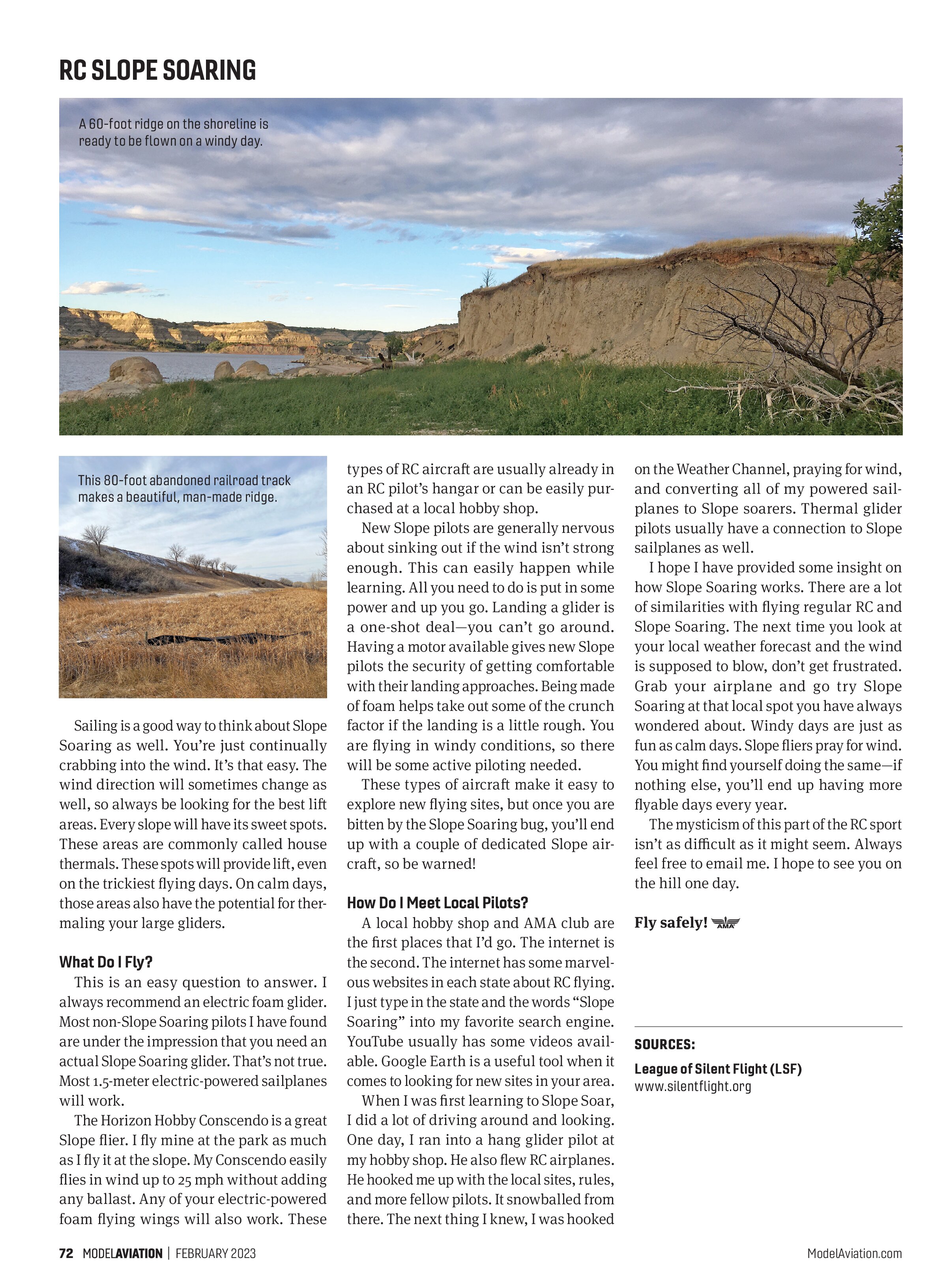
The object generally needs to be at least 50 feet tall and a couple hundred feet long to create a decent-size lift area. Your average, commercially bought, foam Slope glider in the 10 to 20 mph wind range will easily fly there. The taller the object, the more lift will be created. Places to start looking for a slope would be shorelines if you are near a lake, and high spots if you’re inland. Mountains are kind of a no-brainer.

How Do I Fly a Slope Sailplane?
For a beginner, one of the easy things about flying a Slope Soaring sailplane is that the airplane flies pointed away from you most of the time. Flying straight at yourself isn’t common, and reversing the controls usually isn’t an issue. You fly a pattern from left to right just like you would at a regular airfield, but the nose is pointed away from you when you do this. The wind blowing into the hill is always pushing your glider toward you.
The wind doesn’t always blow straight into the hill, so there will be what is called a downwind leg and an upwind leg. With the downwind leg, your glider will fly really fast. The upwind leg is the opposite, and the glider will move slowly. This will tell you which direction you will generally land. This might sound familiar, because that’s how it works at an airport.
Sailing is a good way to think about Slope Soaring as well. You’re just continually crabbing into the wind. It’s that easy. The wind direction will sometimes change as well, so always be looking for the best lift areas. Every slope will have its sweet spots. These areas are commonly called house thermals. These spots will provide lift, even on the trickiest flying days. On calm days, those areas also have the potential for thermaling your large gliders.
What Do I Fly?
This is an easy question to answer. I always recommend an electric foam glider. Most non-Slope Soaring pilots I have found are under the impression that you need an actual Slope Soaring glider. That’s not true. Most 1.5-meter electric-powered sailplanes will work.
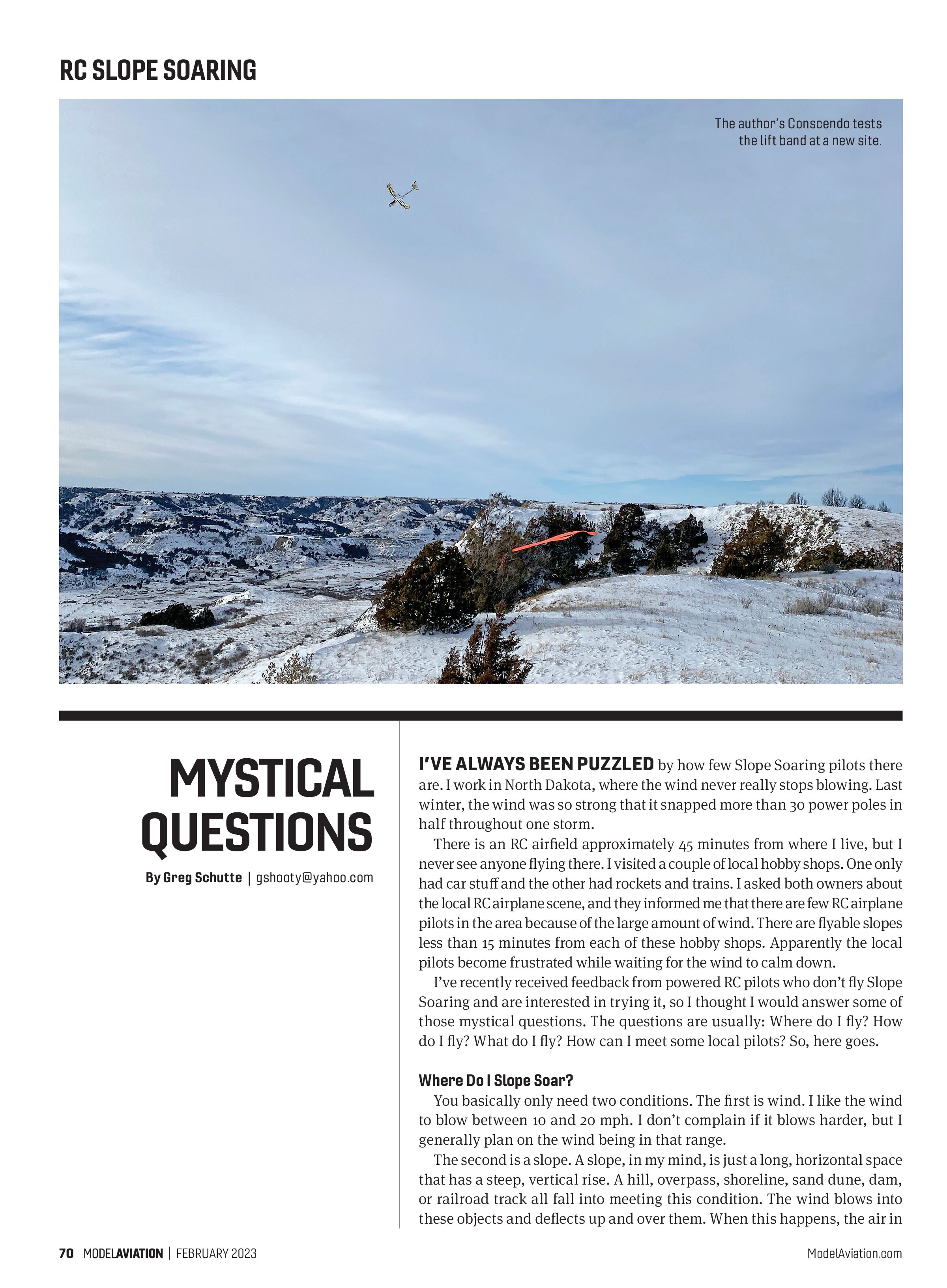
The Horizon Hobby Conscendo is a great Slope flier. I fly mine at the park as much as I fly it at the slope. My Conscendo easily flies in wind up to 25 mph without adding any ballast. Any of your electric-powered foam flying wings will also work. These

types of RC aircraft are usually already in an RC pilot’s hangar or can be easily purchased at a local hobby shop.
New Slope pilots are generally nervous about sinking out if the wind isn’t strong enough. This can easily happen while learning. All you need to do is put in some power and up you go. Landing a glider is a one-shot deal—you can’t go around. Having a motor available gives new Slope pilots the security of getting comfortable with their landing approaches. Being made of foam helps take out some of the crunch factor if the landing is a little rough. You are flying in windy conditions, so there will be some active piloting needed.
These types of aircraft make it easy to explore new flying sites, but once you are bitten by the Slope Soaring bug, you’ll end up with a couple of dedicated Slope aircraft, so be warned!
How Do I Meet Local Pilots?
A local hobby shop and AMA club are the first places that I’d go. The internet is the second. The internet has some marvelous websites in each state about RC flying. I just type in the state and the words “Slope Soaring” into my favorite search engine. YouTube usually has some videos available. Google Earth is a useful tool when it comes to looking for new sites in your area.
When I was first learning to Slope Soar, I did a lot of driving around and looking. One day, I ran into a hang glider pilot at my hobby shop. He also flew RC airplanes. He hooked me up with the local sites, rules, and more fellow pilots. It snowballed from there. The next thing I knew, I was hooked
on the Weather Channel, praying for wind, and converting all of my powered sailplanes to Slope soarers. Thermal glider pilots usually have a connection to Slope sailplanes as well.
I hope I have provided some insight on how Slope Soaring works. There are a lot of similarities with flying regular RC and Slope Soaring. The next time you look at your local weather forecast and the wind is supposed to blow, don’t get frustrated. Grab your airplane and go try Slope Soaring at that local spot you have always wondered about. Windy days are just as fun as calm days. Slope fliers pray for wind. You might find yourself doing the same—if nothing else, you’ll end up having more flyable days every year.
The mysticism of this part of the RC sport isn’t as difficult as it might seem. Always feel free to email me. I hope to see you on the hill one day.
Fly safely!
SOURCES:
League of Silent Flight (LSF)
www.silentflight.org