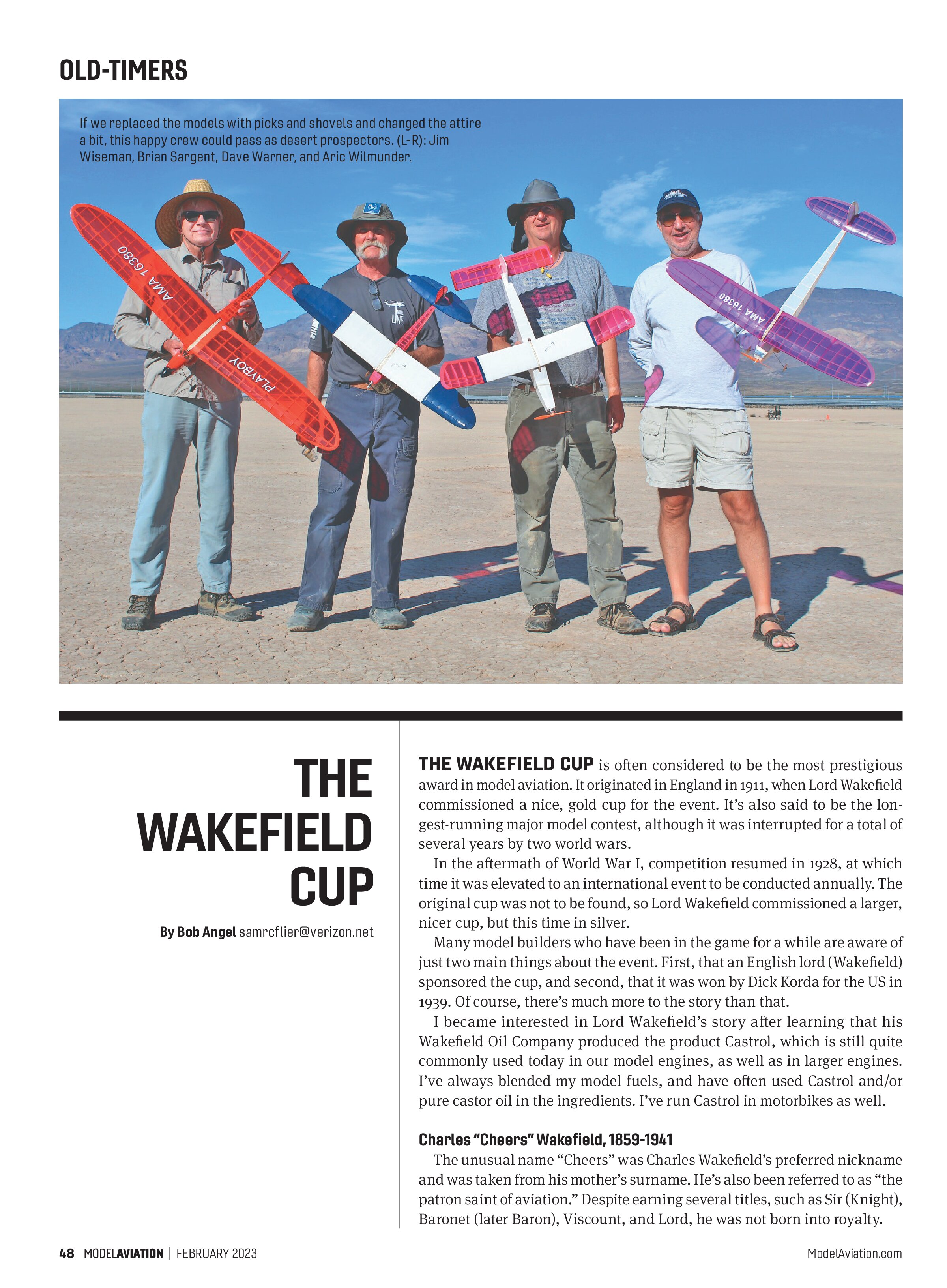
OLD-TIMERS
By Bob Angel samrcflier@verizon.net

THE WAKEFIELD CUP is often considered to be the most prestigious award in model aviation. It originated in England in 1911, when Lord Wakefield commissioned a nice, gold cup for the event. It’s also said to be the longest-running major model contest, although it was interrupted for a total of several years by two world wars.
In the aftermath of World War I, competition resumed in 1928, at which time it was elevated to an international event to be conducted annually. The original cup was not to be found, so Lord Wakefield commissioned a larger, nicer cup, but this time in silver.
Many model builders who have been in the game for a while are aware of just two main things about the event. First, that an English lord (Wakefield) sponsored the cup, and second, that it was won by Dick Korda for the US in 1939. Of course, there’s much more to the story than that.
I became interested in Lord Wakefield’s story after learning that his Wakefield Oil Company produced the product Castrol, which is still quite commonly used today in our model engines, as well as in larger engines. I’ve always blended my model fuels, and have often used Castrol and/or pure castor oil in the ingredients. I’ve run Castrol in motorbikes as well.
Charles “Cheers” Wakefield, 1859–1941
The unusual name “Cheers” was Charles Wakefield’s preferred nickname and was taken from his mother’s surname. He’s also been referred to as “the patron saint of aviation.” Despite earning several titles, such as Sir (Knight), Baronet (later Baron), Viscount, and Lord, he was not born into royalty.
Charles began working in the oil industry and, by approximately age 40, he had amassed a sizable fortune. He made many improvements and had patents in the areas of lubrication and its application. He applied this to locomotives, automobiles, motorcycles, airplanes, speedboats, etc. He improved the manufacture of acetylene, including a patent applicable to the acetylene headlamps that were used in early 1900s automobiles.
He led a relatively simple life, while donating much of his wealth to trophies, expenses, and prizes for a variety of mostly motorized competitions and speed record attempts. He drove an older Rolls-Royce, no doubt kept in good running condition with his own products. He founded scholarships for the Royal Air Force Cadet College, and provided prize money for the international Schneider Trophy seaplane races.
Charles founded the Wakefield Oil Company in 1899. The company first introduced that new motor oil, Castrol, in 1909. The name was chosen because castor oil was part of the blend. It was considered premium oil, often used in motorized competitions, such as the Isle of Man TT motorcycle races, where those air-cooled engines were given an extremely demanding workout. Castrol is still being produced today, but now in several different formulations, including synthetics, and it has seen good service in our model engines.
The Wakefield Event
The original event lasted only four years, from 1911 through 1914, before WW I interrupted it. The war ended in 1918, but the event did not resume until years later, likely because of the war’s aftermath.
Charles Lindbergh made his famous transatlantic flight in 1927, which gave model building its most significant boost ever. That probably served as a catalyst for resuming the Wakefield event in 1928.
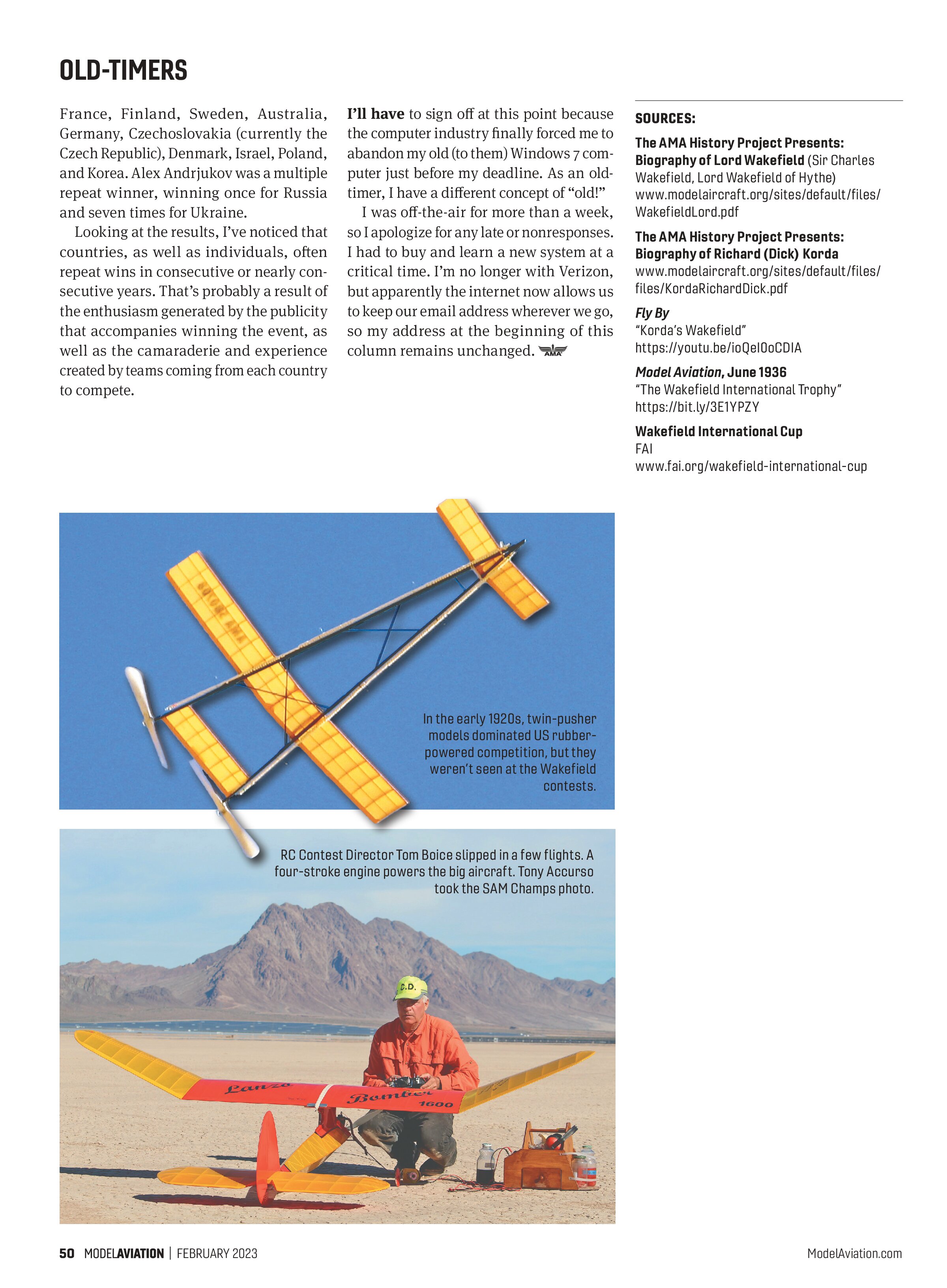
I wondered why I’d never noticed any twin-pusher airplanes pictured in Wakefield competition, although pushers were quite popular in US contests during those early years. I recently read the rules, and the reason was simple. Early Wakefield rules required rise-off-ground (ROG), while twin-pusher designs never included takeoff and landing gear for practical reasons.
The British, and most of the European countries, appear to have taken aircraft modeling much more seriously than the US, especially in those early days. You can notice in early photographs that the European participants consisted of mainly adults. By contrast, US events often consisted of more youthful participants, often being attended and encouraged by their parents.
Dick Korda, 1915–2001
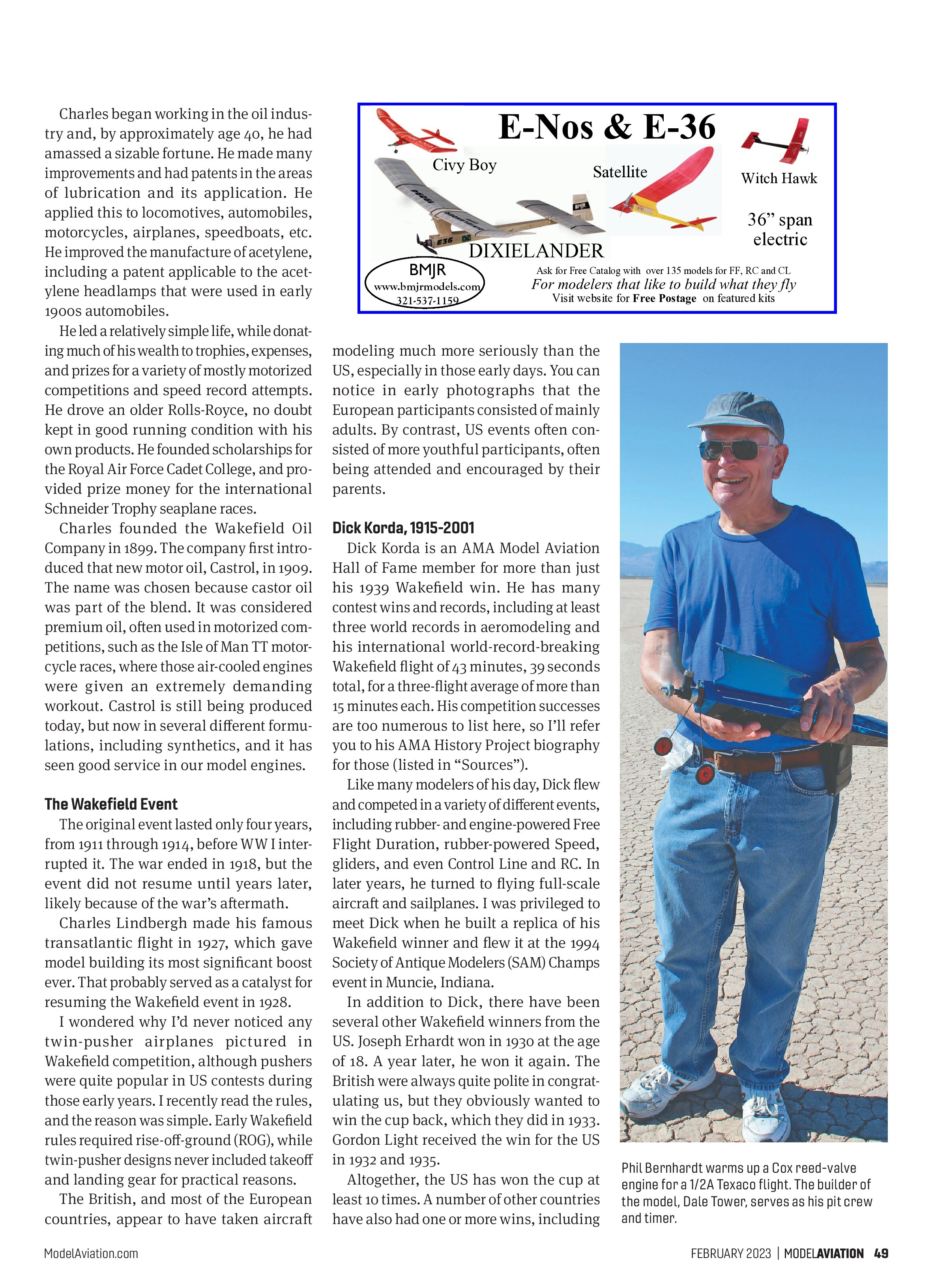
Dick Korda is an AMA Model Aviation Hall of Fame member for more than just his 1939 Wakefield win. He has many contest wins and records, including at least three world records in aeromodeling and his international world-record-breaking Wakefield flight of 43 minutes, 39 seconds total, for a three-flight average of more than 15 minutes each. His competition successes are too numerous to list here, so I’ll refer you to his AMA History Project biography for those (listed in “Sources”).
Like many modelers of his day, Dick flew and competed in a variety of different events, including rubber- and engine-powered Free Flight Duration, rubber-powered Speed, gliders, and even Control Line and RC. In later years, he turned to flying full-scale aircraft and sailplanes. I was privileged to meet Dick when he built a replica of his Wakefield winner and flew it at the 1994 Society of Antique Modelers (SAM) Champs event in Muncie, Indiana.
In addition to Dick, there have been several other Wakefield winners from the US. Joseph Earhart won in 1930 at the age of 18. A year later, he won it again. The British were always quite polite in congratulating us, but they obviously wanted to win the cup back, which they did in 1933. Gordon Light received the win for the US in 1932 and 1935.
Altogether, the US has won the cup at least 10 times. A number of other countries have also had one or more wins, including

France, Finland, Sweden, Australia, Germany, Czechoslovakia (currently the Czech Republic), Denmark, Israel, Poland, and Korea. Alex Andrjukov was a multiple repeat winner, winning once for Russia and seven times for Ukraine.
Looking at the results, I’ve noticed that countries, as well as individuals, often repeat wins in consecutive or nearly consecutive years. That’s probably a result of the enthusiasm generated by the publicity that accompanies winning the event, as well as the camaraderie and experience created by teams coming from each country to compete.
I’ll have to sign off at this point because the computer industry finally forced me to abandon my old (to them) Windows 7 computer just before my deadline. As an old-timer, I have a different concept of “old!”
I was off-the-air for more than a week, so I apologize for any late or nonresponses. I had to buy and learn a new system at a critical time. I’m no longer with Verizon, but apparently the internet now allows us to keep our email address wherever we go, so my address at the beginning of this column remains unchanged.
SOURCES:
The AMA History Project Presents:
Biography of Lord Wakefield (Sir Charles Wakefield, Lord Wakefield of Hythe)
www.modelaircraft.org/sites/default/files/WakefieldLord.pdf
The AMA History Project Presents:
Biography of Richard (Dick) Korda
www.modelaircraft.org/sites/default/files/files/KordaRichardDick.pdf
Fly By
“Korda’s Wakefield”
https://youtu.be/ioQel0oCDIA
Model Aviation, June 1936
“The Wakefield International Trophy”
https://bit.ly/3E1YPZY
Wakefield International Cup
FAI
www.fai.org/wakefield-international-cup