FOCAL POINT
Interested in sharing your handiwork? Visit www.ModelAviation.com for submission guidelines.
Old School Model Works Javelin
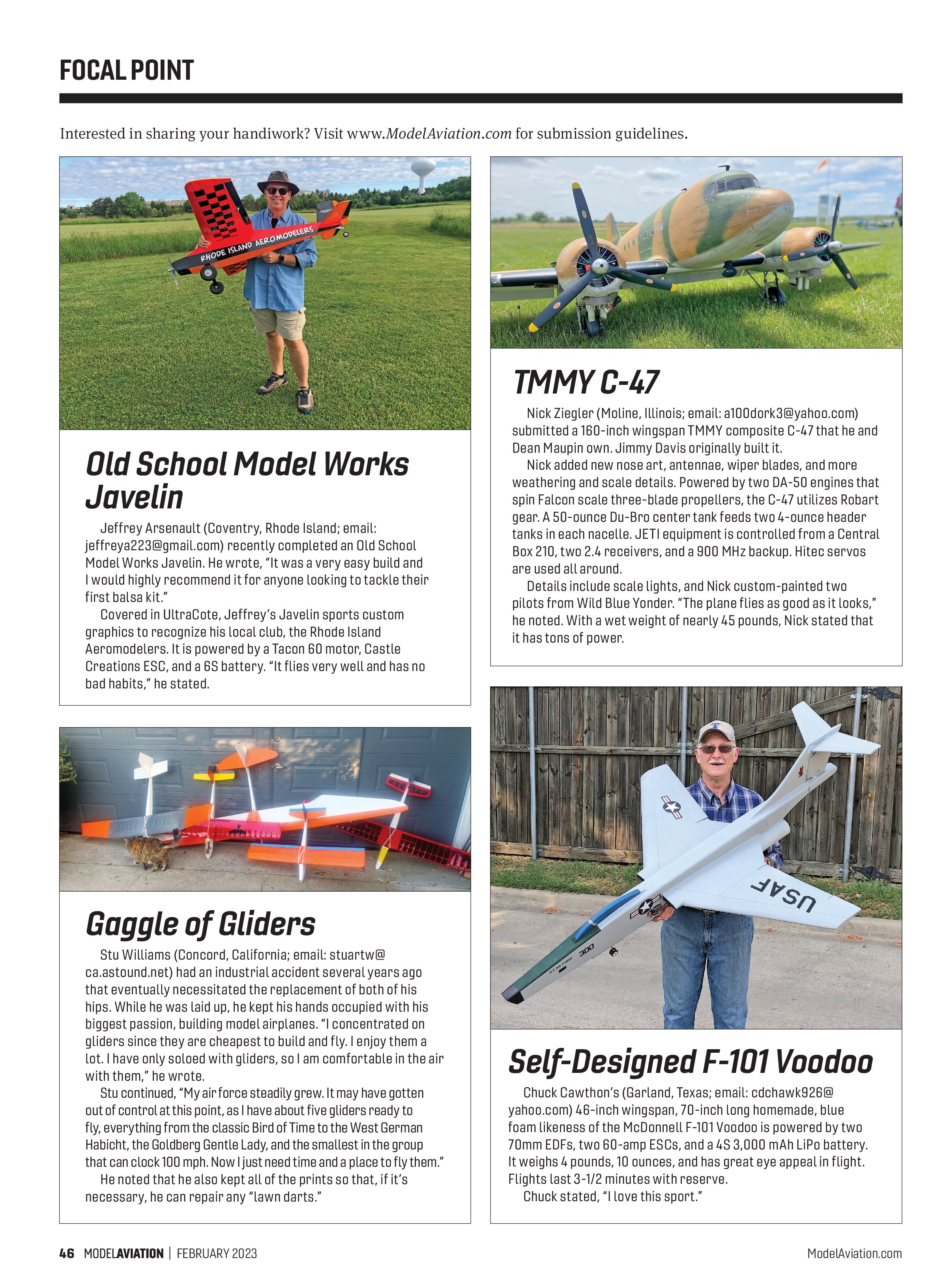
Jeffrey Arsenault (Coventry, Rhode Island; email: jeffreya223@gmail.com) recently completed an Old School Model Works Javelin. He wrote, “It was a very easy build and I would highly recommend it for anyone looking to tackle their first balsa kit.”
Covered in UltraCote, Jeffrey’s Javelin sports custom graphics to recognize his local club, the Rhode Island Aeromodelers. It is powered by a Tacon 60 motor, Castle Creations ESC, and a 6S battery. “It flies very well and has no bad habits,” he stated.

TMNY C-47
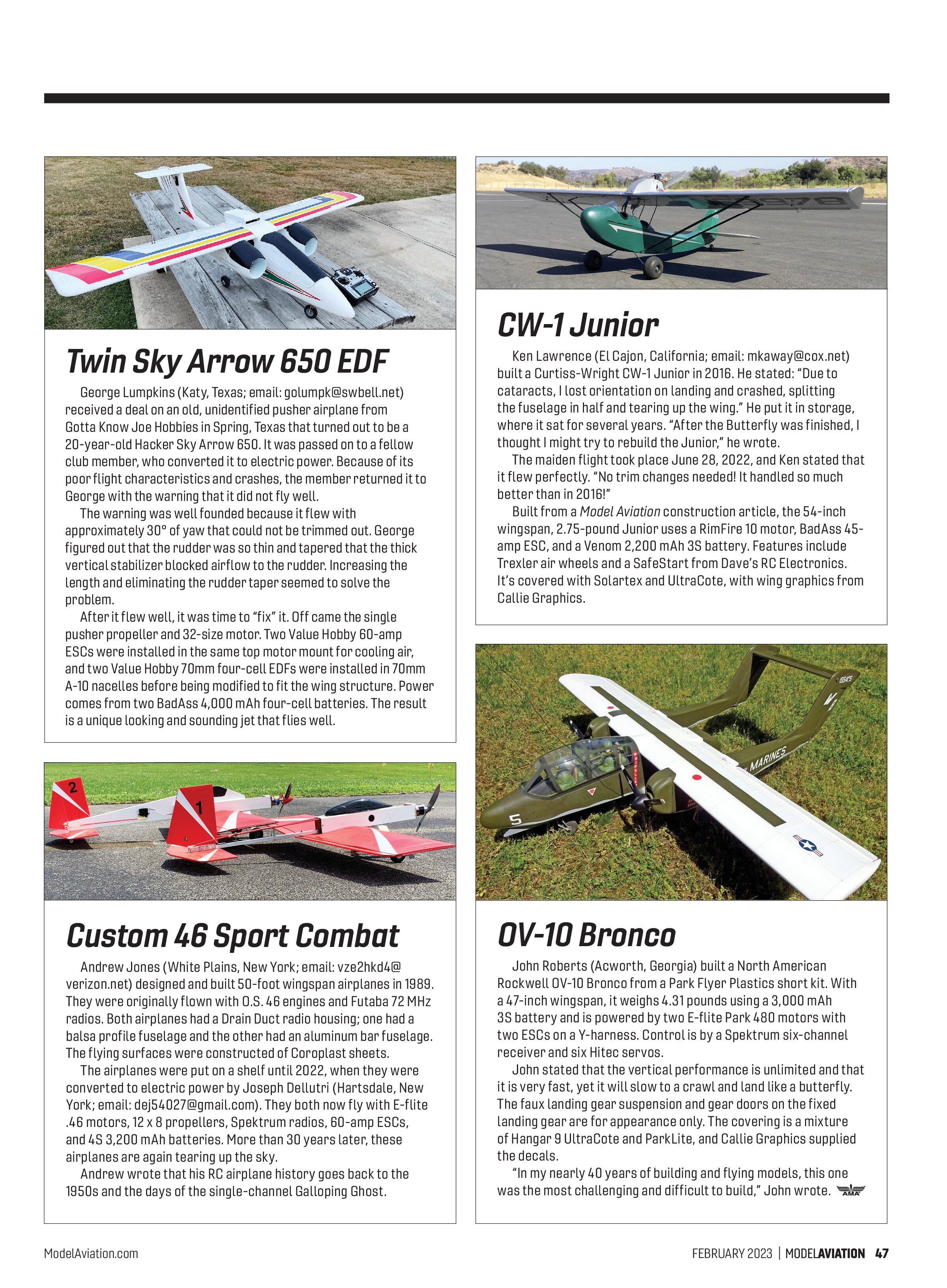
Nick Ziegler (Moline, Illinois; email: a100dork3@yahoo.com) submitted a 160-inch wingspan TMNY composite C-47 that he and Dean Maupin own. Jimmy Davis originally built it.
Nick added new nose art, antennae, wiper blades, and more weathering and scale details. Powered by two DA-50 engines that spin Falcon scale three-blade propellers, the C-47 utilizes Robart gear. A 50-ounce Du-Bro center tank feeds two 4-ounce header tanks in each nacelle. JETI equipment is controlled from a Central Box 210, two 2.4 receivers, and a 900 MHz backup. Hitec servos are used all around.
Details include scale lights, and Nick custom-painted two pilots from Wild Blue Yonder. “The plane flies as good as it looks,” he noted. With a wet weight of nearly 45 pounds, Nick stated that it has tons of power.

Gaggle of Gliders
Stu Williams (Concord, California; email: stuartw@ca.astound.net) had an industrial accident several years ago that eventually necessitated the replacement of both of his hips. While he was laid up, he kept his hands occupied with his biggest passion, building model airplanes. “I concentrated on gliders since they are cheapest to build and fly. I enjoy them a lot. I have only soloed with gliders, so I am comfortable in the air with them,” he wrote.
Stu continued, “My air force steadily grew. It may have gotten out of control at this point, as I have about five gliders ready to fly, everything from the classic Bird of Time to the West German Habicht, the Goldberg Gentle Lady, and the smallest in the group that can clock 100 mph. Now I just need time and a place to fly them.”
He noted that he also kept all of the prints so that, if it’s necessary, he can repair any “lawn darts.”

Self-Designed F-101 Voodoo
Chuck Cawthon’s (Garland, Texas; email: cdchawk926@yahoo.com) 46-inch wingspan, 70-inch long homemade, blue foam likeness of the McDonnell F-101 Voodoo is powered by two 70mm EDFs, two 60-amp ESCs, and a 4S 3,000 mAh LiPo battery. It weighs 4 pounds, 10 ounces, and has great eye appeal in flight. Flights last 3-1/2 minutes with reserve.
Chuck stated, “I love this sport.”

Twin Sky Arrow 650 EDF
George Lumpkins (Katy, Texas; email: golumpk@swbell.net) received a deal on an old, unidentified pusher airplane from Gotta Know Joe Hobbies in Spring, Texas that turned out to be a 20-year-old Hacker Sky Arrow 650. It was passed on to a fellow club member, who converted it to electric power. Because of its poor flight characteristics and crashes, the member returned it to George with the warning that it did not fly well.
The warning was well founded because it flew with approximately 30° of yaw that could not be trimmed out. George figured out that the rudder was so thin and tapered that the thick vertical stabilizer blocked airflow to the rudder. Increasing the length and eliminating the rudder taper seemed to solve the problem.
After it flew well, it was time to “fix” it. Off came the single pusher propeller and 32-size motor. Two Value Hobby 60-amp ESCs were installed in the same top motor mount for cooling air, and two Value Hobby 70mm four-cell EDFs were installed in 70mm A-10 nacelles before being modified to fit the wing structure. Power comes from two BadAss 4,000 mAh four-cell batteries. The result is a unique looking and sounding jet that flies well.

CW-1 Junior
Ken Lawrence (El Cajon, California; email: mkaway@cox.net) built a Curtiss-Wright CW-1 Junior in 2016. He stated: “Due to cataracts, I lost orientation on landing and crashed, splitting the fuselage in half and tearing up the wing.” He put it in storage, where it sat for several years. “After the Butterfly was finished, I thought I might try to rebuild the Junior,” he wrote.
The maiden flight took place June 28, 2022, and Ken stated that it flew perfectly. “No trim changes needed! It handled so much better than in 2016!”
Built from a Model Aviation construction article, the 54-inch wingspan, 2.75-pound Junior uses a RimFire 10 motor, BadAss 45-amp ESC, and a Venom 2,200 mAh 3S battery. Features include Trexler air wheels and a SafeStart from Dave’s RC Electronics. It’s covered with Solartеx and UltraCote, with wing graphics from Callie Graphics.

Custom 46 Sport Combat
Andrew Jones (White Plains, New York; email: vze2hk4u@verizon.net) designed and built 50-foot wingspan airplanes in 1989. They were originally flown with O.S. 46 engines and Futaba 72 MHz radios. Both airplanes had a Drain Duct radio housing; one had a balsa profile fuselage and the other had an aluminum bar fuselage. The flying surfaces were constructed of Coroplast sheets.
The airplanes were put on a shelf until 2022, when they were converted to electric power by Joseph Dellutti (Hartsdale, New York; email: dej54027@gmail.com). They both now fly with E-flite .46 motors, 12 x 8 propellers, Spektrum radios, 60-amp ESCs, and 4S 3,200 mAh batteries. More than 30 years later, these airplanes are again tearing up the sky.
Andrew wrote that his RC airplane history goes back to the 1950s and the days of the single-channel Galloping Ghost.

OV-10 Bronco
John Roberts (Acworth, Georgia) built a North American Rockwell OV-10 Bronco from a Park Flyer Plastics short kit. With a 47-inch wingspan, it weighs 4.31 pounds using a 3,000 mAh 3S battery and is powered by two E-flite Park 480 motors with two ESCs on a Y-harness. Control is by a Spektrum six-channel receiver and six Hitec servos.
John stated that the vertical performance is unlimited and that it is very fast, yet it will slow to a crawl and land like a butterfly. The faux landing gear suspension and gear doors on the fixed landing gear are for appearance only. The covering is a mixture of Hangar 9 UltraCote and ParkLite, and Callie Graphics supplied the decals.
“In my nearly 40 years of building and flying models, this one was the most challenging and difficult to build,” John wrote.