The Deal with Drones

BIG LEAPS
FORWARD
FOR THE
SMALLEST
DRONES
By Susan Smith | susankaysmith@gmail.com
IMAGINE AN FPV DRONE that is great for beginners and experts. It’s safe, inexpensive, and simple to build or buy. Enter the Tiny Whoop.
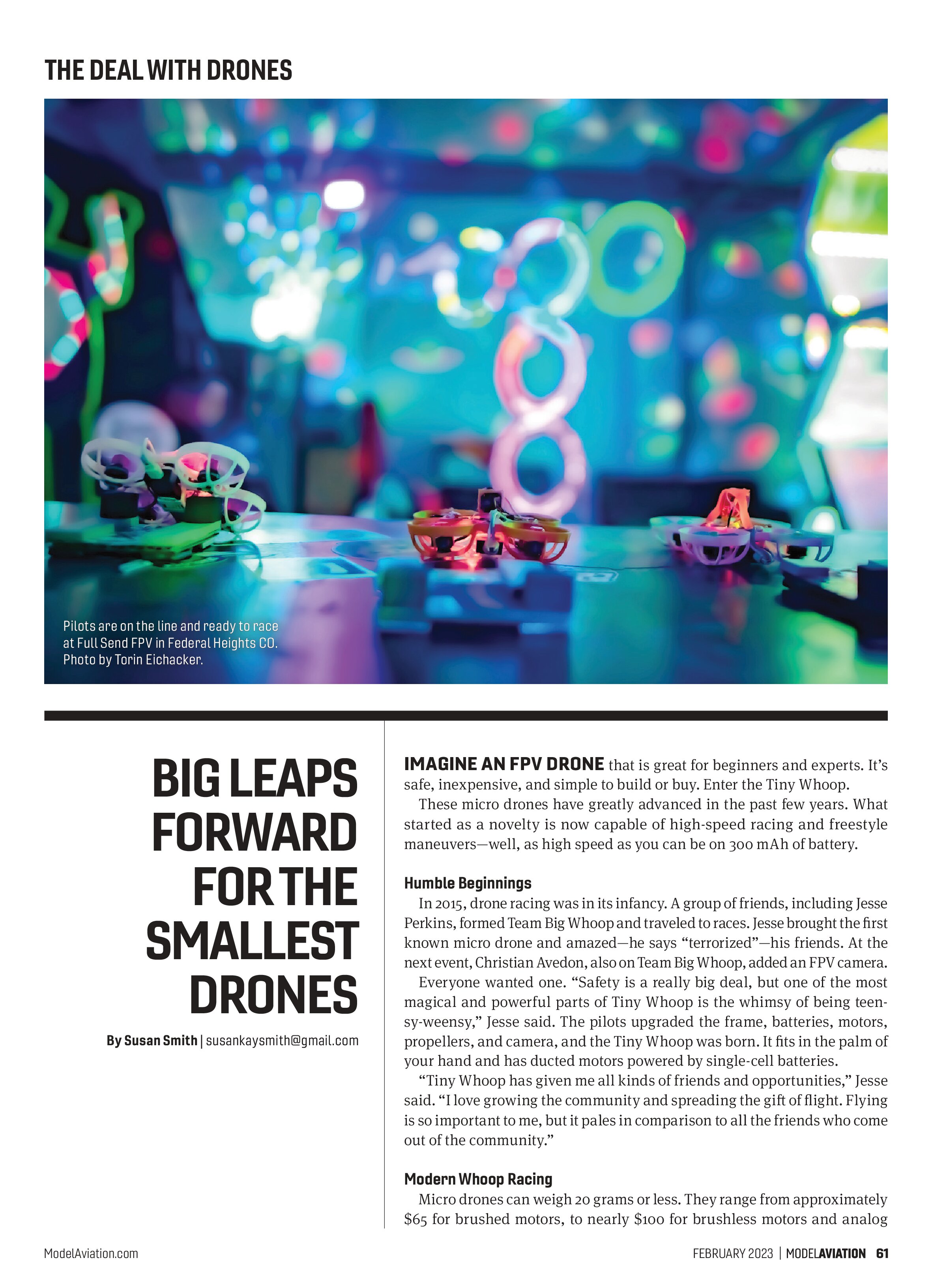
These micro drones have greatly advanced in the past few years. What started as a novelty is now capable of high-speed racing and freestyle maneuvers—well, as high speed as you can be on 300 mAh of battery.
Humble Beginnings
In 2015, drone racing was in its infancy. A group of friends, including Jesse Perkins, formed Team Big Whoop and traveled to races. Jesse brought the first known micro drone and amazed—he says “terrorized”—his friends. At the next event, Christian Avedon, also on Team Big Whoop, added an FPV camera.
Everyone wanted one. “Safety is a really big deal, but one of the most magical and powerful parts of Tiny Whoop is the whimsy of being teen-sy-weensy,” Jesse said. The pilots upgraded the frame, batteries, motors, propellers, and camera, and the Tiny Whoop was born. It fits in the palm of your hand and has ducted motors powered by single-cell batteries.
“Tiny Whoop has given me all kinds of friends and opportunities,” Jesse said. “I love growing the community and spreading the gift of flight. Flying is so important to me, but it pales in comparison to all the friends who come out of the community.”
Modern Whoop Racing
Micro drones can weigh 20 grams or less. They range from approximately $65 for brushed motors, to nearly $100 for brushless motors and analog

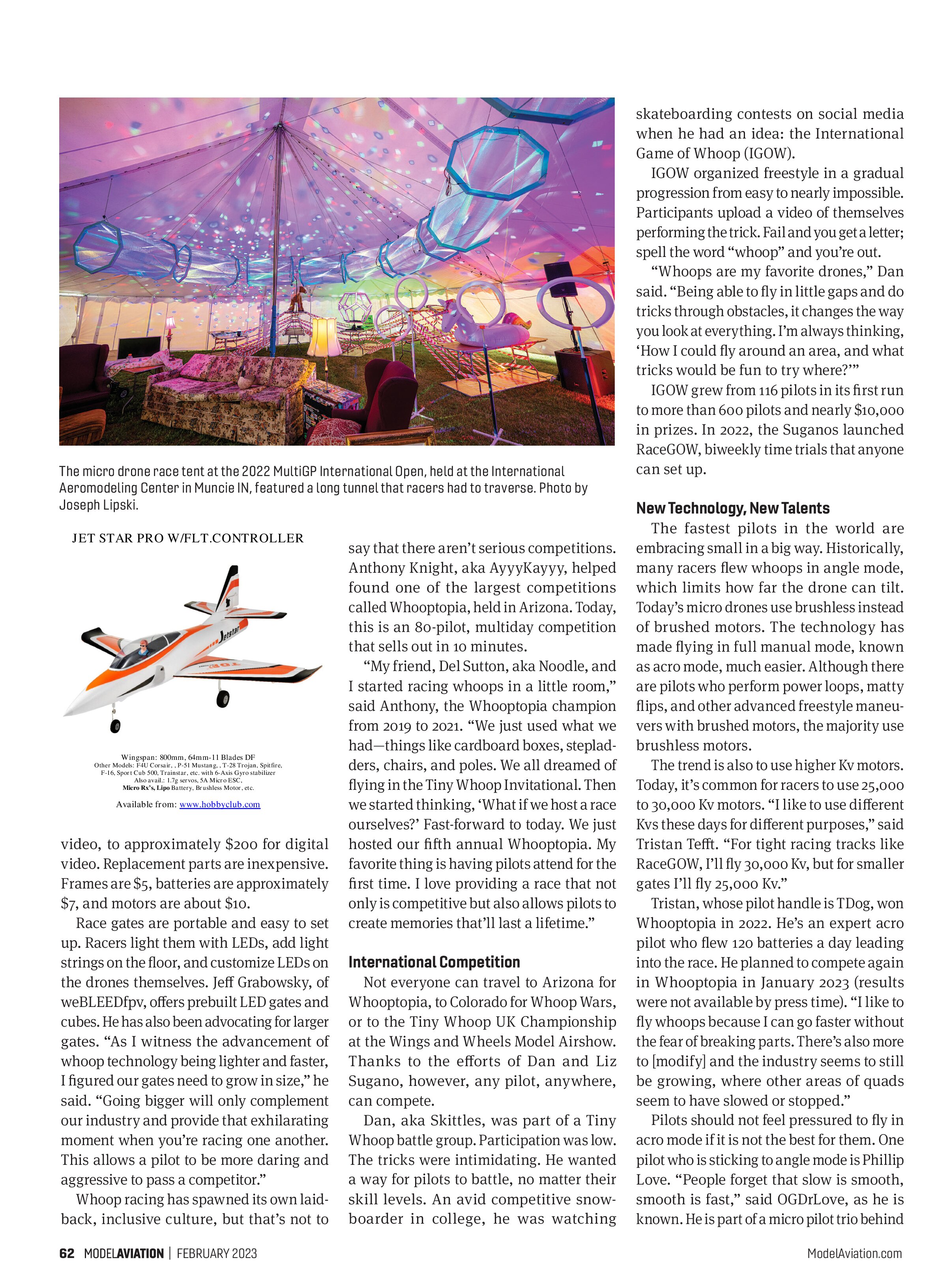
The micro drone race tent at the 2022 MultiGP International Open, held at the International Aeromodeling Center in Muncie IN, featured a long tunnel that racers had to traverse.
video, to approximately $200 for digital video. Replacement parts are inexpensive. Frames are $5, batteries are approximately $7, and motors are about $10.
Race gates are portable and easy to set up. Racers light them with LEDs, add light strings on the floor, and customize LEDs on the drones themselves. Jeff Grabowsky, of weBLEEDfpv, offers prebuilt LED gates and cubes. He has also been advocating for larger gates. “As I witness the advancement of whoop technology being lighter and faster, I figured our gates need to grow in size,” he said. “Going bigger will only complement our industry and provide that exhilarating moment when you’re racing one another. This allows a pilot to be more daring and aggressive to pass a competitor.”
Whoop racing has spawned its own laid-back, inclusive culture, but that’s not to say that there aren’t serious competitions.
Anthony Knight, aka AyyyKayyy, helped found one of the largest competitions called Whooptopia, held in Arizona. Today, this is an 80-pilot, multiday competition that sells out in 10 minutes.
“My friend, Del Sutton, aka Noodle, and I started racing whoops in a little room,” said Anthony, the Whooptopia champion from 2019 to 2021. “We just used what we had—things like cardboard boxes, stepladders, chairs, and poles. We all dreamed of flying in the Tiny Whoop Invitational. Then we started thinking, ‘What if we host a race ourselves?’ Fast-forward to today. We just hosted our fifth annual Whooptopia. My favorite thing is having pilots attend for the first time. I love providing a race that not only is competitive but also allows pilots to create memories that’ll last a lifetime.”
International Competition
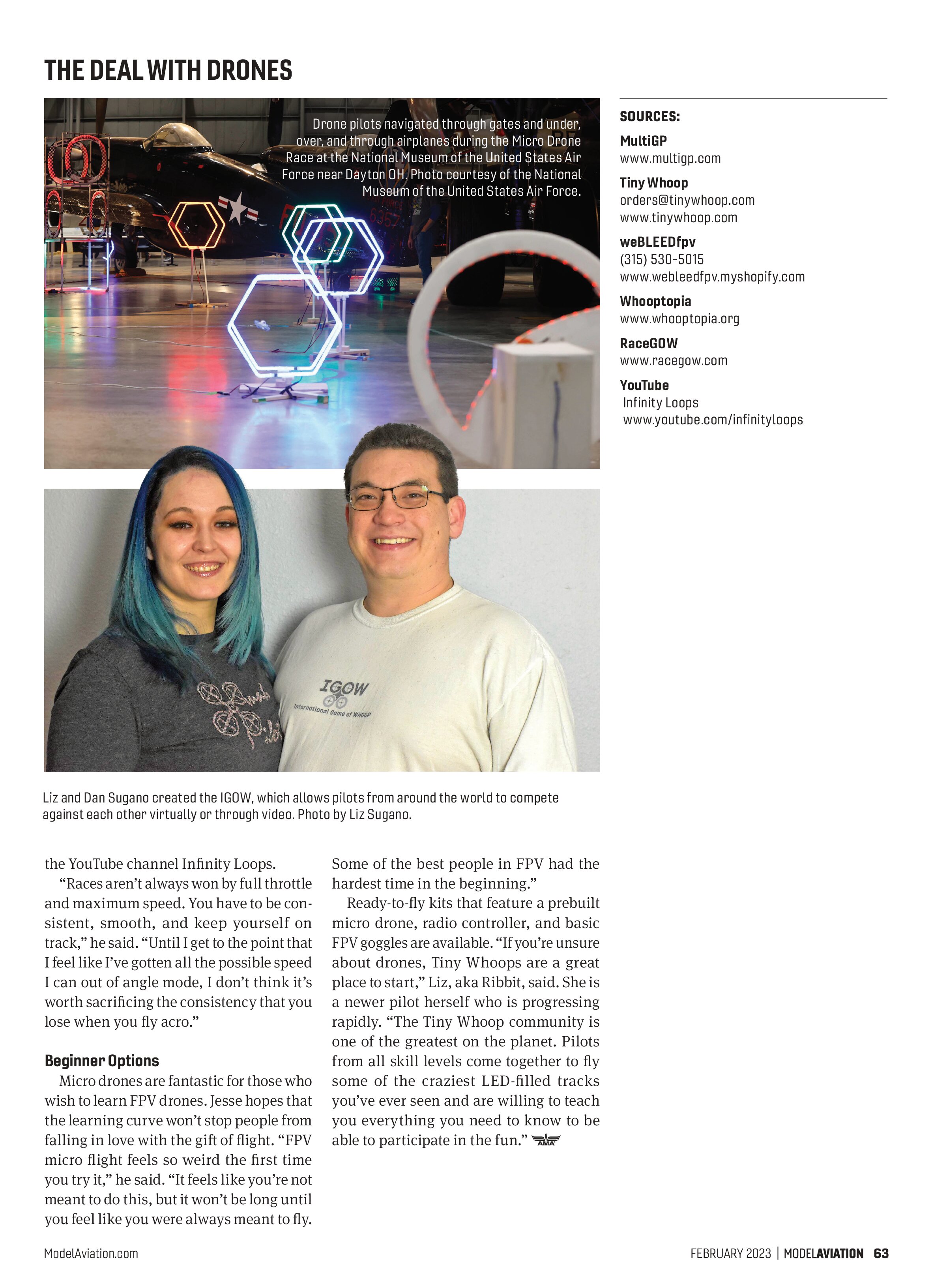
Not everyone can travel to Arizona for Whooptopia, to Colorado for Whoop Wars, or to the Tiny Whoop UK Championship at the Wings and Wheels Model Airshow. Thanks to the efforts of Dan and Liz Sugano, however, any pilot, anywhere, can compete.
Dan, aka Skittles, was part of a Tiny Whoop battle group. Participation was low. The tricks were intimidating. He wanted a way for pilots to battle, no matter their skill levels. An avid competitive snowboarder in college, he was watching skateboarding contests on social media when he had an idea: the International Game of Whoop (IGOW).
IGOW organized freestyle in a gradual progression from easy to nearly impossible. Participants upload a video of themselves performing the trick. Fail and you get a letter; spell the word “whoop” and you’re out.
“Whoops are my favorite drones,” Dan said. “Being able to fly in little gaps and do tricks through obstacles, it changes the way you look at everything. I’m always thinking, ‘How I could fly around an area, and what tricks would be fun to try where?’”
IGOW grew from 116 pilots in its first run to more than 600 pilots and nearly $10,000 in prizes. In 2022, the Suganos launched RaceGOW, biweekly time trials that anyone can set up.
New Technology, New Talents
The fastest pilots in the world are embracing small in a big way. Historically, many racers flew whoops in angle mode, which limits how far the drone can tilt. Today’s micro drones use brushless instead of brushed motors. The technology has made flying in full manual mode, known as acro mode, much easier. Although there are pilots who perform power loops, matty flips, and other advanced freestyle maneuvers with brushed motors, the majority use brushless motors.
The trend is also to use higher Kv motors. Today, it’s common for racers to use 25,000 to 30,000 Kv motors. “I like to use different Kvs these days for different purposes,” said Tristan Tefft. “For tight racing tracks like RaceGOW, I’ll fly 30,000 Kv, but for smaller gates I’ll fly 25,000 Kv.”
Tristan, whose pilot handle is TDog, won Whooptopia in 2022. He’s an expert acro pilot who flew 120 batteries a day leading into the race. He planned to compete again in Whooptopia in January 2023 (results were not available by press time). “I like to fly whoops because I can go faster without the fear of breaking parts. There’s also more to [modify] and the industry seems to still be growing, where other areas of quads seem to have slowed or stopped.”
Pilots should not feel pressured to fly in acro mode if it is not the best for them. One pilot who is sticking to angle mode is Phillip Love. “People forget that slow is smooth, smooth is fast,” said O G D rLove, as he is known. He is part of a micro pilot trio behind the YouTube channel Infinity Loops.
“Races aren’t always won by full throttle and maximum speed. You have to be consistent, smooth, and keep yourself on track,” he said. “Until I get to the point that I feel like I’ve gotten all the possible speed I can out of angle mode, I don’t think it’s worth sacrificing the consistency that you lose when you fly acro.”
Beginner Options
Micro drones are fantastic for those who wish to learn FPV drones. Jesse hopes that the learning curve won’t stop people from falling in love with the gift of flight. “FPV micro flight feels so weird the first time you try it,” he said. “It feels like you’re not meant to do this, but it won’t be long until you feel like you were always meant to fly.
Some of the best people in FPV had the hardest time in the beginning.”
Ready-to-fly kits that feature a prebuilt micro drone, radio controller, and basic FPV goggles are available. “If you’re unsure about drones, Tiny Whoops are a great place to start,” Liz, aka Ribbit, said. She is a newer pilot herself who is progressing rapidly. “The Tiny Whoop community is one of the greatest on the planet. Pilots from all skill levels come together to fly some of the craziest LED-filled tracks you’ve ever seen and are willing to teach you everything you need to know to be able to participate in the fun.”


SOURCES:
MultiGP
www.multigp.com
Tiny Whoop
orders@tinywhoop.com
www.tinywhoop.com
weBLEEDfpv
(315) 530-5015
www.webleedfpv.myshopify.com
Whooptopia
www.whooptopia.org
RaceGOW
www.racegow.com
YouTube
Infinity Loops
www.youtube.com/infinityloops