
BETAFPV CETUS X
The next step in multirotors for beginners
By Matt Ruddick | mattr@modelaircraft.org
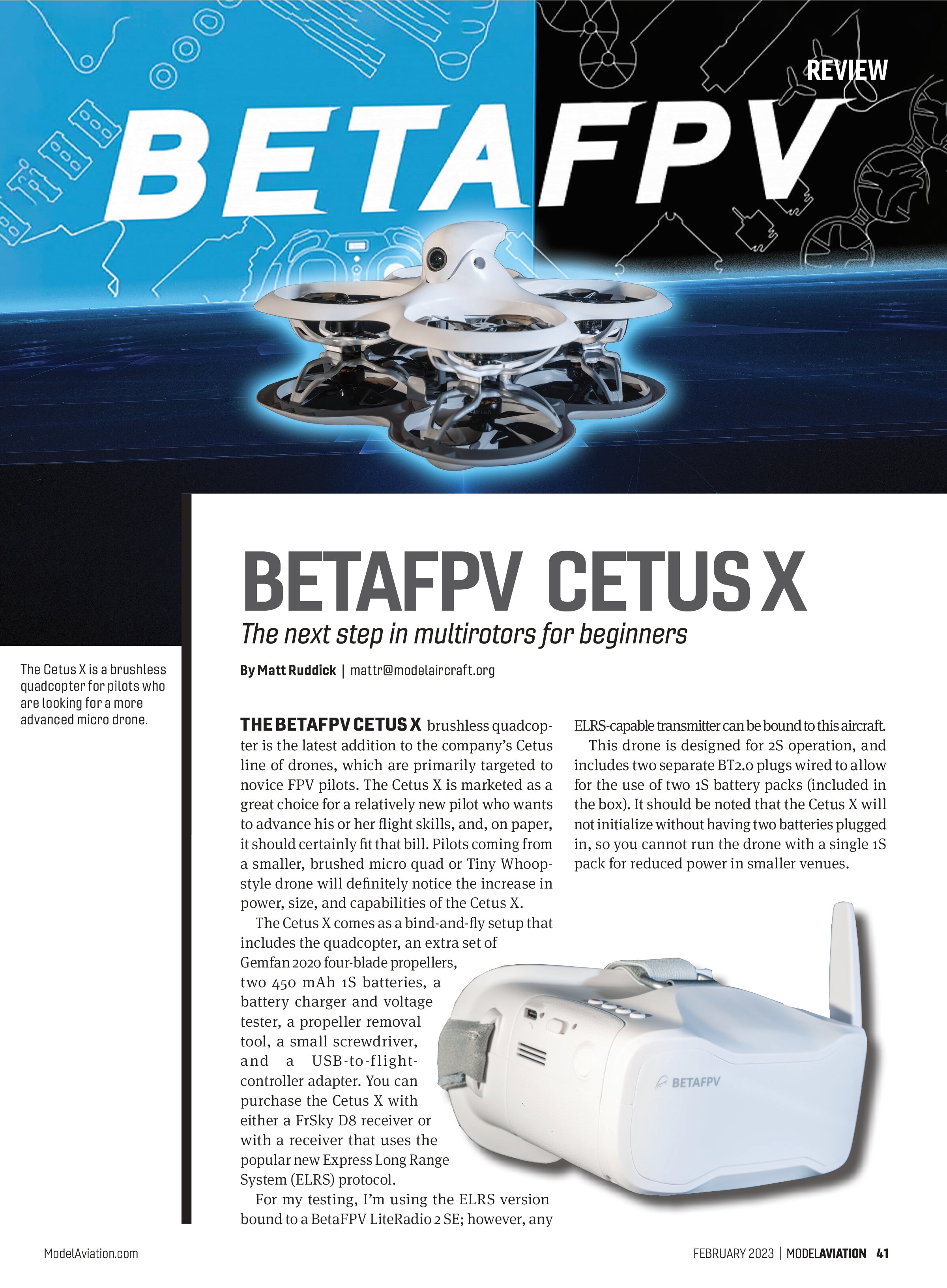
THE BETAFPV CETUS X brushless quadcopter is the latest addition to the company’s Cetus line of drones, which are primarily targeted to novice FPV pilots. The Cetus X is marketed as a great choice for a relatively new pilot who wants to advance his or her flight skills, and, on paper, it should certainly fit that bill. Pilots coming from a smaller, brushed micro quad or Tiny Whoop-style drone will definitely notice the increase in power, size, and capabilities of the Cetus X.
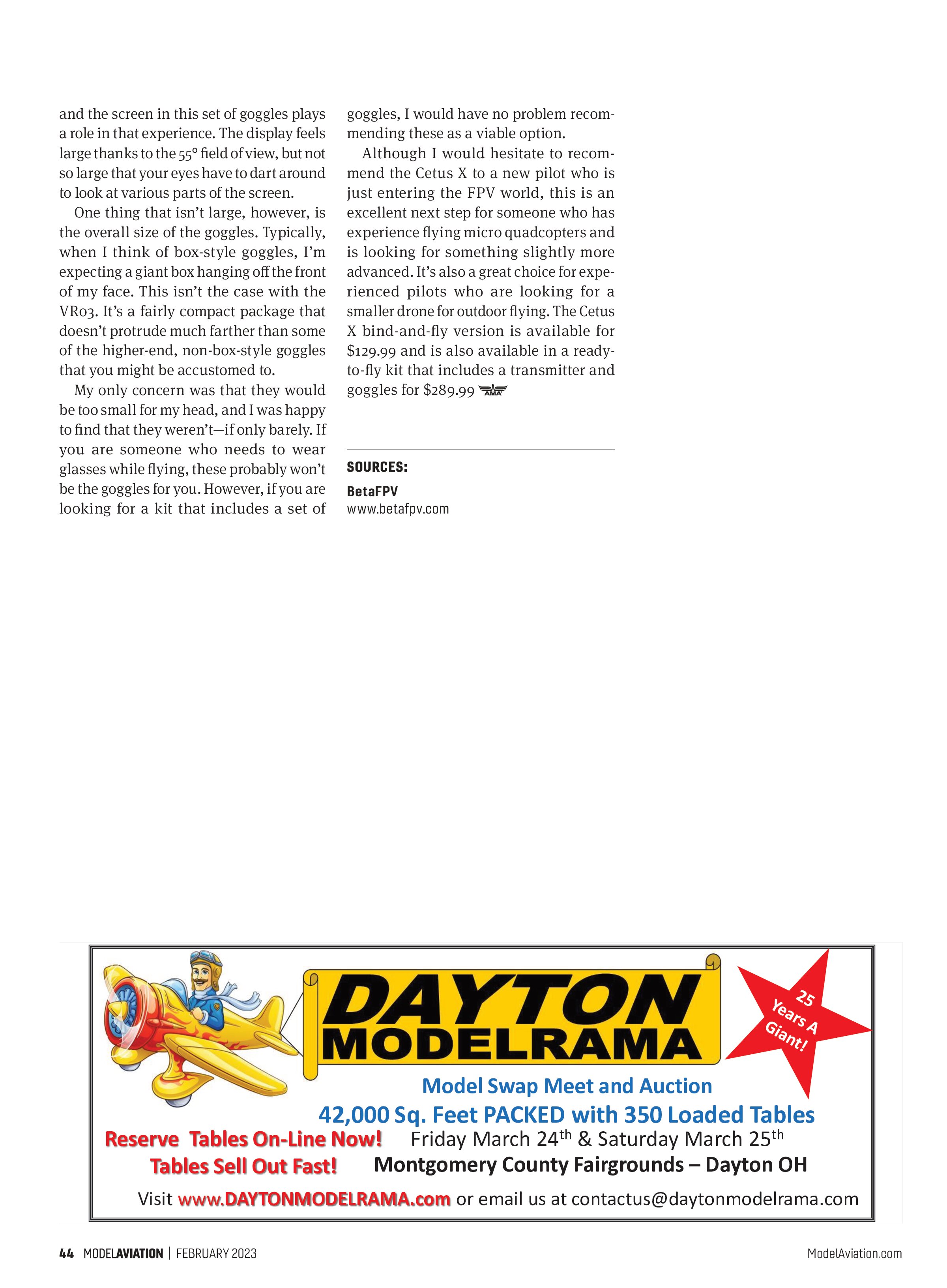
The Cetus X comes as a bind-and-fly setup that includes the quadcopter, an extra set of Gemfan 2020 four-blade propellers, two 450 mAh 1S batteries, a battery charger and voltage tester, a propeller removal tool, a small screwdriver, and a USB-to-flight-controller adapter. You can purchase the Cetus X with either a FrSky D8 receiver or with a receiver that uses the popular new Express Long Range System (ELRS) protocol. For my testing, I’m using the ELRS version bound to a BetaFPV LiteRadio 2 SE; however, any ELRS-capable transmitter can be bound to this aircraft.
This drone is designed for 2S operation, and includes two separate BT2.0 plugs wired to allow for the use of two 1S battery packs (included in the box). It should be noted that the Cetus X will not initialize without having two batteries plugged in, so you cannot run the drone with a single 1S pack for reduced power in smaller venues.

At a Glance
Specifications
Weight: 55 grams
Size: 95mm
Battery: Two 450 mAh
Motors: 1103 11,000 Kv
Electronics: Built-in ExpressLRS 2.4 GHz or FrSky D8 receiver; F4 12A flight controller with Betaflight; Caddx Nano Ant/Runcam Nano 4-based camera with adjustable angle; 25 to 400 mW video transmitter
Flight duration: Up to 5 minutes
Pluses
- Plenty of power.
- Betaflight-based flight controller.
- Great camera clarity.
- Configurable with Betaflight.
- Durable frame.
Minuses
- Narrow camera field of view.
- Can’t run on 1S for indoor flight.
- Requires an extra (included) adapter for USB connection.


Upon powering up the Cetus X, my first observation was the clarity of the camera feed. The C04 FPV camera, which claims to be based on the highly regarded Caddx Nano Ant and Runcam Nano 4, provides a crisp, clear image that lives up to those claims. It’s common to see cameras in this class be a little soft in focus, but this camera showed none of the negative traits that I’ve often experienced when using micro quadcopters.
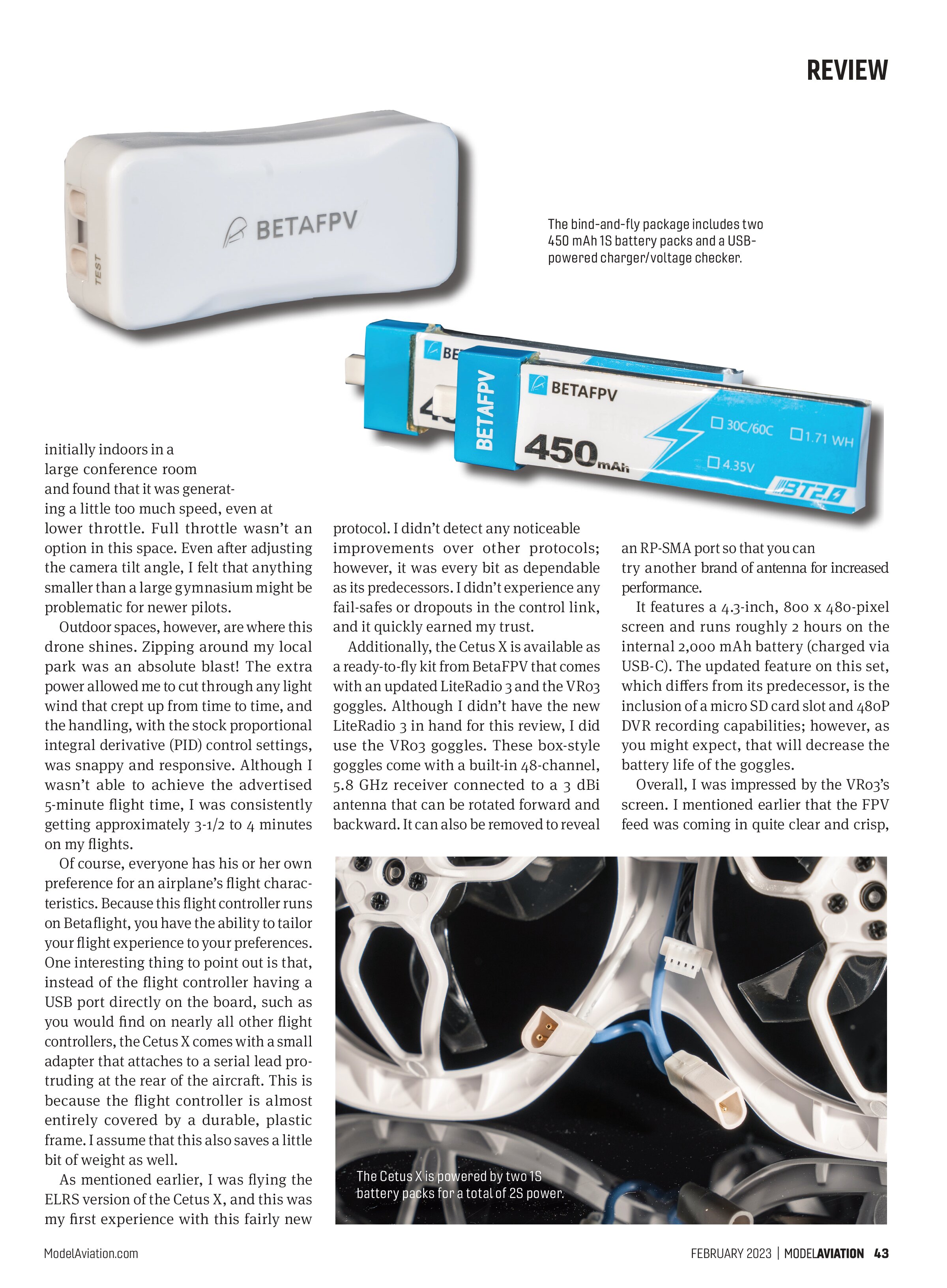
Of course, a great camera can only be as great as the video transmitter sending those signals back to the goggles. The VTX included on the Cetus X ranges in power from 25 mW to 400 mW and, in my tests, I stuck to the minimum power of 25 mW with outstanding results. Although not a complaint, I would love for the field of view to be slightly wider than it is. Navigating through narrow pathways and around obstacles is a bit more challenging in its stock configuration.
For beginners who have only flown brushed micros or even 1S brushless micro quadcopters, the extra power generated by this 2S machine might come as a surprise. Although I am experienced with quads of all types, I was caught off guard by the thrust of the Cetus X.
Even with the larger body and extra weight of the two batteries, it had no trouble leaping off the ground at 30% to 40% throttle. I was running my flight tests initially indoors in a large conference room and found that it was generating a little too much speed, even at lower throttle. Full throttle wasn’t an option in this space. Even after adjusting the camera tilt angle, I felt that anything smaller than a large gymnasium might be problematic for newer pilots.
Outdoor spaces, however, are where this drone shines. Zipping around my local park was an absolute blast! The extra power allowed me to cut through any light wind that crept up from time to time, and the handling, with the stock proportional integral derivative (PID) control settings, was snappy and responsive. Although I wasn’t able to achieve the advertised 5-minute flight time, I was consistently getting approximately 3-1/2 to 4 minutes on my flights.
Of course, everyone has his or her own preference for an airplane’s flight characteristics. Because this flight controller runs on Betaflight, you have the ability to tailor your flight experience to your preferences. One interesting thing to point out is that, instead of the flight controller having a USB port directly on the board, such as you would find on nearly all other flight controllers, the Cetus X comes with a small adapter that attaches to a serial lead protruding at the rear of the aircraft. This is because the flight controller is almost entirely covered by a durable, plastic frame. I assume that this also saves a little bit of weight as well.
As mentioned earlier, I was flying the ELRS version of the Cetus X, and this was my first experience with this fairly new protocol. I didn’t detect any noticeable improvements over other protocols; however, it was every bit as dependable as its predecessors. I didn’t experience any fail-safes or dropouts in the control link, and it quickly earned my trust.
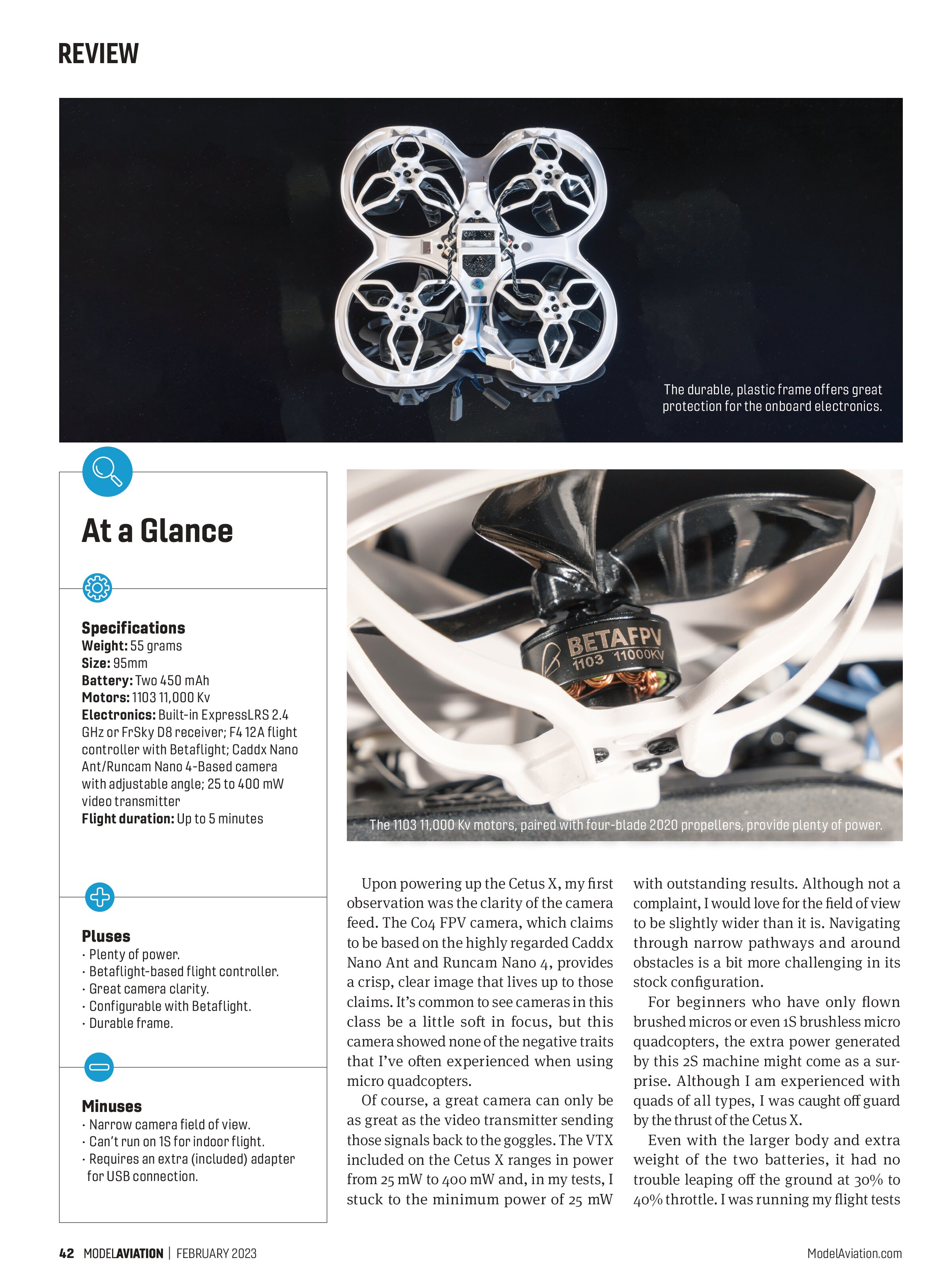
Additionally, the Cetus X is available as a ready-to-fly kit from BetaFPV that comes with an updated LiteRadio 3 and the VR03 goggles. Although I didn’t have the new LiteRadio 3 in hand for this review, I did use the VR03 goggles. These box-style goggles come with a built-in 48-channel, 5.8 GHz receiver connected to a 3 dBi antenna that can be rotated forward and backward. It can also be removed to reveal an RP-SMA port so that you can try another brand of antenna for increased performance.
It features a 4.3-inch, 800 x 480-pixel screen and runs roughly 2 hours on the internal 2,000 mAh battery (charged via USB-C). The updated feature on this set, which differs from its predecessor, is the inclusion of a micro SD card slot and 480p DVR recording capabilities; however, as you might expect, that will decrease the battery life of the goggles.
Overall, I was impressed by the VR03’s screen. I mentioned earlier that the FPV feed was coming in quite clear and crisp,


and the screen in this set of goggles plays a role in that experience. The display feels large thanks to the 55° field of view, but not so large that your eyes have to dart around to look at various parts of the screen.
One thing that isn’t large, however, is the overall size of the goggles. Typically, when I think of box-style goggles, I’m expecting a giant box hanging off the front of my face. This isn’t the case with the VR03. It’s a fairly compact package that doesn’t protrude much farther than some of the higher-end, non-box-style goggles that you might be accustomed to.
My only concern was that they would be too small for my head, and I was happy to find that they weren’t—if only barely. If you are someone who needs to wear glasses while flying, these probably won’t be the goggles for you. However, if you are looking for a kit that includes a set of goggles, I would have no problem recommending these as a viable option.
Although I would hesitate to recommend the Cetus X to a new pilot who is just entering the FPV world, this is an excellent next step for someone who has experience flying micro quadcopters and is looking for something slightly more advanced. It’s also a great choice for experienced pilots who are looking for a smaller drone for outdoor flying. The Cetus X bind-and-fly version is available for $129.99 and is also available in a ready-to-fly kit that includes a transmitter and goggles for $289.99.
SOURCES:
BetaFPV
www.betafpv.com