VINTAGE VIEWPOINT
50 YEARS AGO, IN JANUARY
By Bob Noll | bobrc@aol.com

I WENT TO MY MAGAZINE COLLECTION and found four magazines dated January 1973. Yes, that is 50 years ago, and so I will continue with my theme of looking back at what was being published about our RC hobby.
Radio Control Modeler’s (RCM) cover page had the heading, “Special Issue for Scale Enthusiasts!” The airplane on the cover was of Josh Titus’ Ansaldo, taken at Old Rhinebeck Aerodrome in Rhinebeck, New York, in 1972. An article about the 1972 Rhinebeck gathering covered this large World War I RC Jamboree. There were 126 entries that year—a significant growth from 17 entries merely six years earlier.
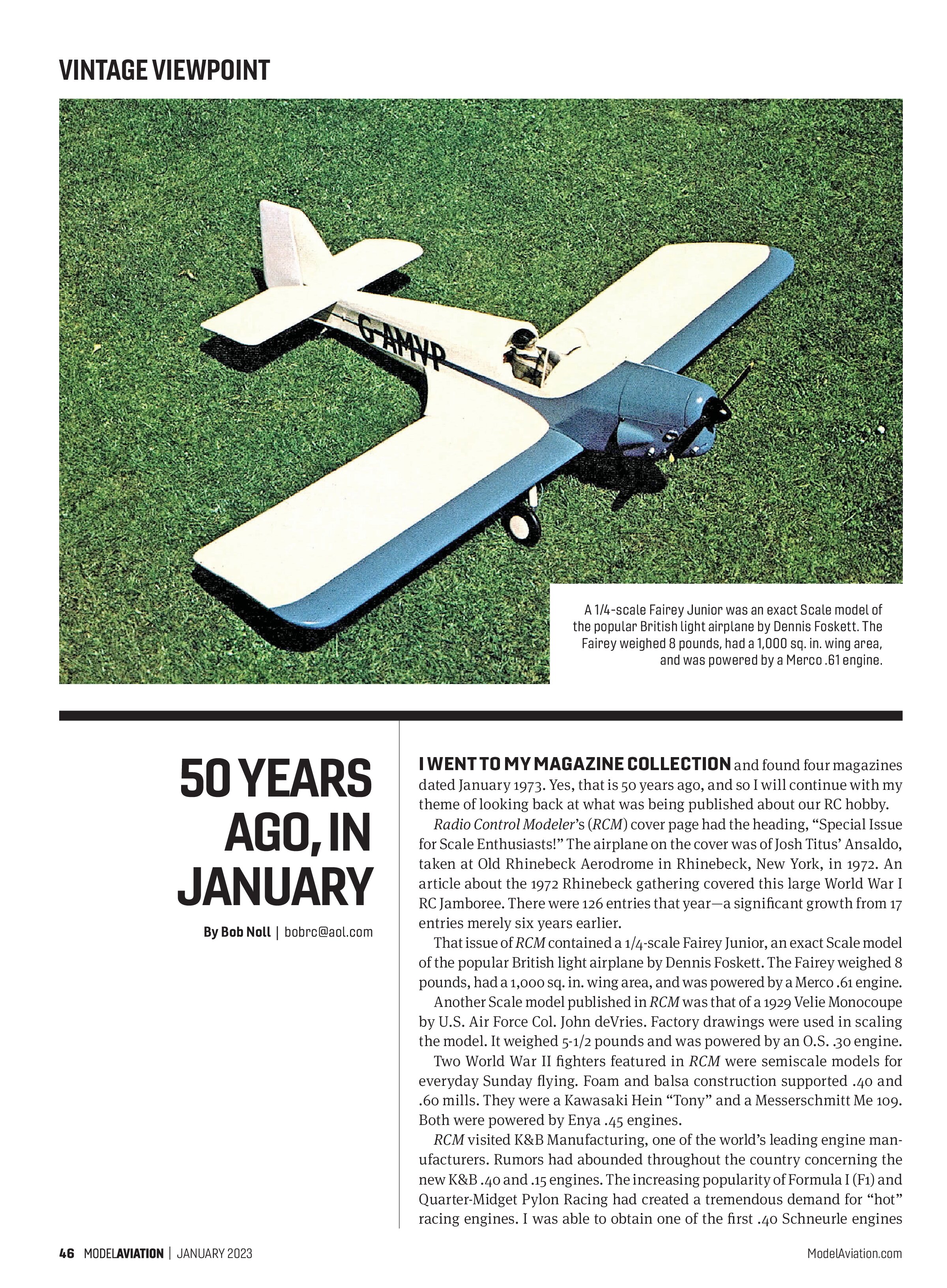
That issue of RCM contained a 1/4-scale Fairey Junior, an exact Scale model of the popular British light airplane by Dennis Foskett. The Fairey weighed 8 pounds, had a 1,000 sq. in. wing area, and was powered by a Merco .61 engine.
Another Scale model published in RCM was that of a 1929 Velie Monocoupe by U.S. Air Force Col. John deVries. Factory drawings were used in scaling the model. It weighed 5-1/2 pounds and was powered by an O.S. .30 engine.
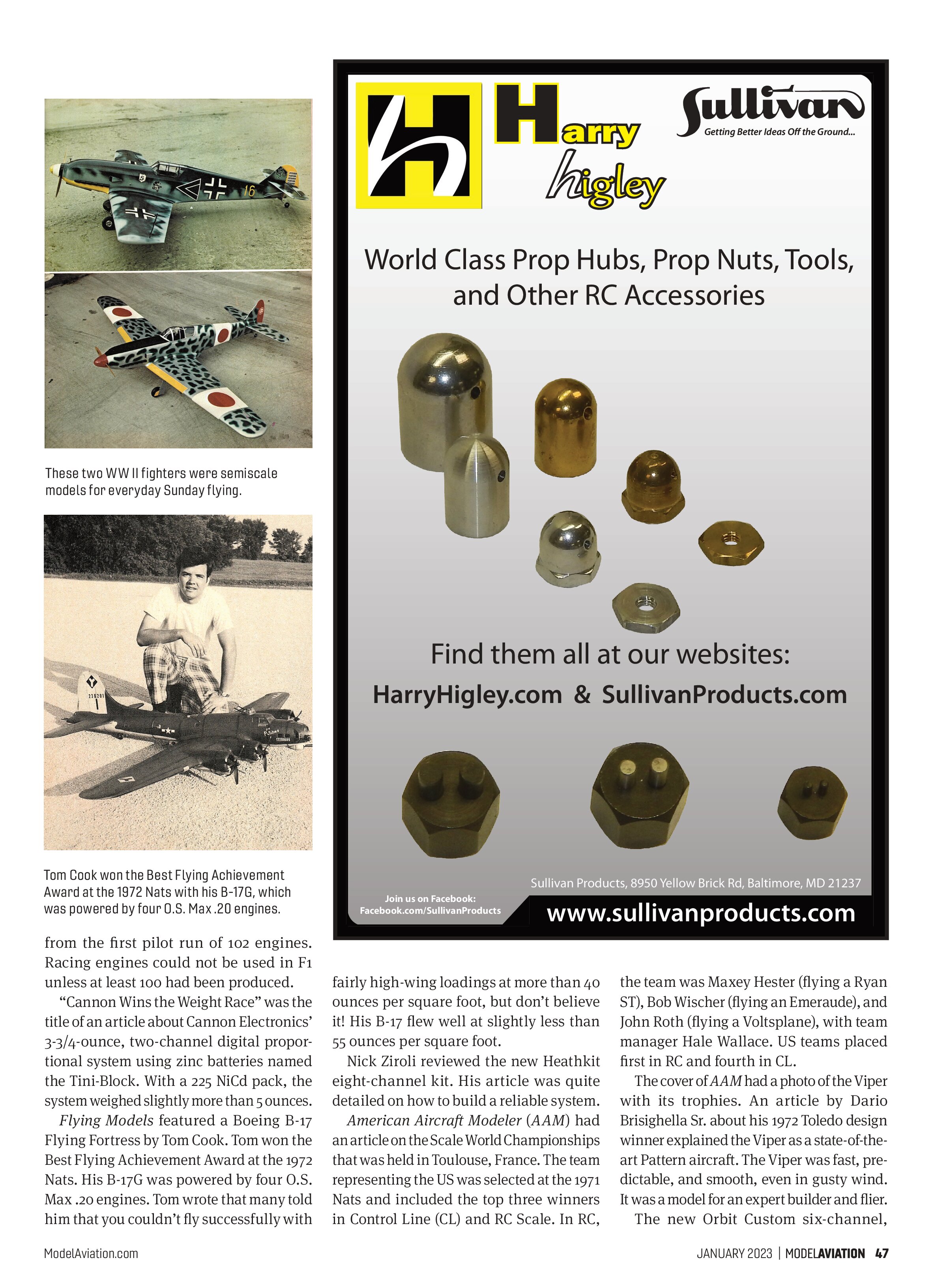
Two World War II fighters featured in RCM were semiscale models for everyday Sunday flying. Foam and balsa construction supported .40 and .60 mills. They were a Kawasaki Hein “Tony” and a Messerschmitt Me 109. Both were powered by Enya .45 engines.
RCM visited K&B Manufacturing, one of the world’s leading engine manufacturers. Rumors had abounded throughout the country concerning the new K&B .40 and .15 engines. The increasing popularity of Formula I (F1) and Quarter-Midget Pylon Racing had created a tremendous demand for “hot” racing engines. I was able to obtain one of the first .40 Schneurle engines from the first pilot run of 102 engines. Racing engines could not be used in F1 unless at least 100 had been produced.


“Cannon Wins the Weight Race” was the title of an article about Cannon Electronics’ 3-3/4-ounce, two-channel digital proportional system using zinc batteries named the Tini-Block. With a 225 NiCd pack, the system weighed slightly more than 5 ounces.
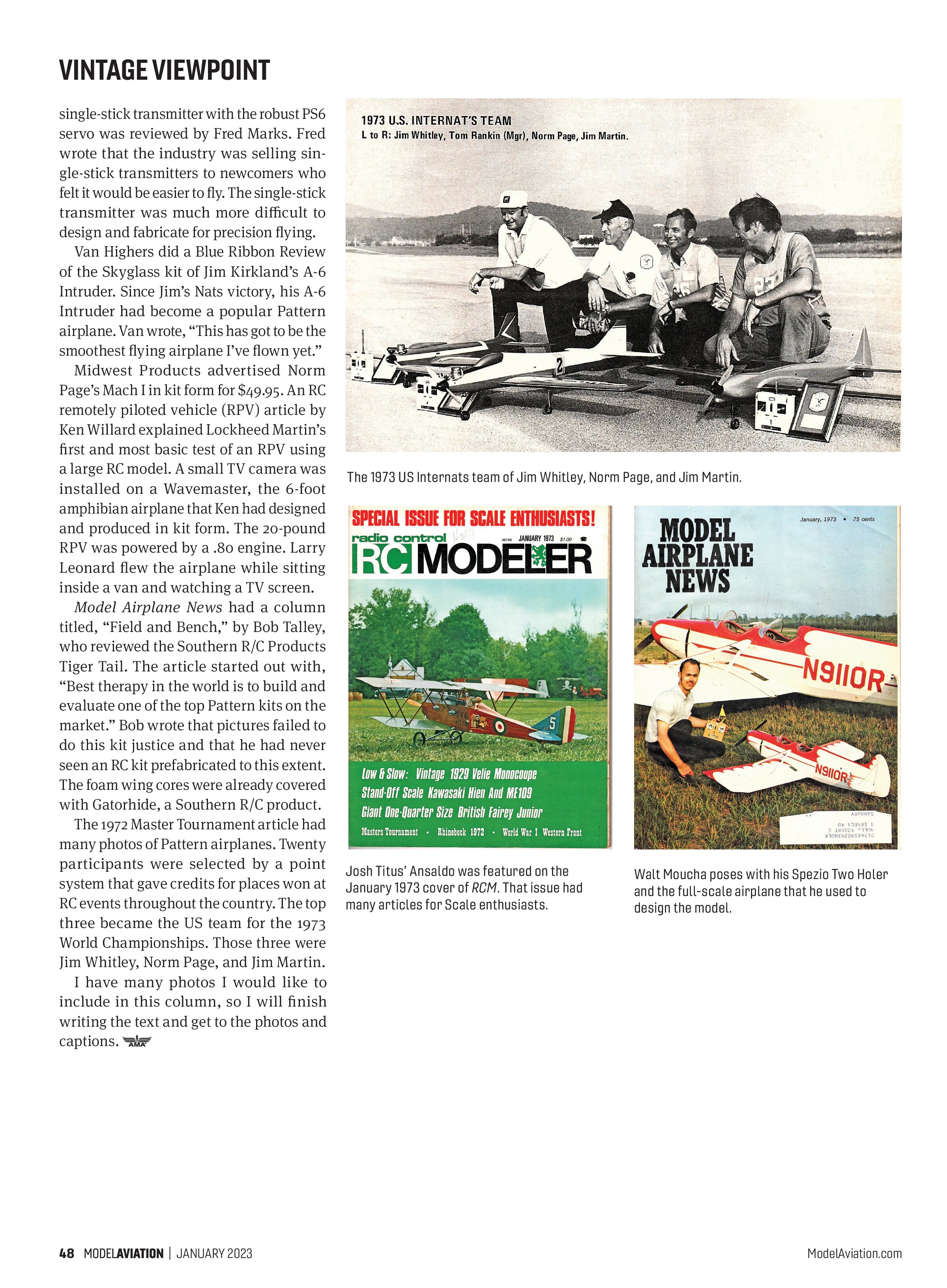
Flying Models featured a Boeing B-17 Flying Fortress by Tom Cook. Tom won the Best Flying Achievement Award at the 1972 Nats. His B-17G was powered by four O.S. Max .20 engines. Tom wrote that many told him that you couldn’t fly successfully with fairly high-wing loadings at more than 40 ounces per square foot, but don’t believe it! His B-17 flew well at slightly less than 55 ounces per square foot.
Nick Ziroli reviewed the new Heathkit eight-channel kit. His article was quite detailed on how to build a reliable system.
American Aircraft Modeler (AAM) had an article on the Scale World Championships that was held in Toulouse, France. The team representing the US was selected at the 1971 Nats and included the top three winners in Control Line (CL) and RC Scale. In RC, the team was Maxey Hester (flying a Ryan ST), Bob Wischer (flying an Emaeraude), and John Roth (flying a Voltspan), with team manager Hale Wallace. US teams placed first in RC and fourth in CL.
The cover of AAM had a photo of the Viper with its trophies. An article by Dario Brisighella Sr. about his 1972 Toledo design winner explained the Viper as a state-of-the-art Pattern aircraft. The Viper was fast, predictable, and smooth, even in gusty wind. It was a model for an expert builder and flier.
The new Orbit Custom six-channel,
single-stick transmitter with the robust PS6 servo was reviewed by Fred Marks. Fred wrote that the industry was selling single-stick transmitters to newcomers who felt it would be easier to fly. The single-stick transmitter was much more difficult to design and fabricate for precision flying.
Van Highers did a Blue Ribbon Review of the Skyglass kit of Jim Kirkland’s A-6 Intruder. Since Jim’s Nats victory, his A-6 Intruder had become a popular Pattern airplane. Van wrote, “This has got to be the smoothest flying airplane I’ve flown yet.”
Midwest Products advertised Norm Page’s Mach I in kit form for $49.95. An RC remotely piloted vehicle (RPV) article by Ken Willard explained Lockheed Martin’s first and most basic test of an RPV using a large RC model. A small TV camera was installed on a Wavemaster, the 6-foot amphibian airplane that Ken had designed and produced in kit form. The 20-pound RPV was powered by a .80 engine. Larry Leonard flew the airplane while sitting inside a van and watching a TV screen.
Model Airplane News had a column titled, “Field and Bench,” by Bob Talley, who reviewed the Southern R/C Products Tiger Tail. The article started out with, “Best therapy in the world is to build and evaluate one of the top Pattern kits on the market.” Bob wrote that pictures failed to do this kit justice and that he had never seen an RC kit prefabricated to this extent. The foam wing cores were already covered with Gatorhide, a Southern R/C product.
The 1972 Master Tournament article had many photos of Pattern airplanes. Twenty participants were selected by a point system that gave credits for places won at RC events throughout the country. The top three became the US team for the 1973 World Championships. Those three were Jim Whitley, Norm Page, and Jim Martin.
I have many photos I would like to include in this column, so I will finish writing the text and get to the photos and captions.