NEVER TOO
OLD TO RACE
By Walt Wilson | rallyx@charter.net
Photos by the author
IN 1947, Walt Wilson (St. Charles, Missouri) started racing tether cars with his dad, Walter Wilson Sr., who had been involved with full-scale automobile racing since before World War II. At first, they joined a club that raced in a converted wading pool in St. Louis. Soon, they helped build a better track in Belleville, Illinois, and traveled throughout the Midwest, running at several different tracks.
In 1954, Walt set a world record for tether cars at 151.77 mph, which stood for 15 months. In the early 1960s, Walt and his dad moved on to other types of full-scale automobile racing and got away from tether cars.
After Walt’s beloved wife passed away in 2014, a friend, John Ellis, loaned Walt a car to run on a bucket list trip to Anderson, Indiana. He turned the fastest speed of the day and was soon back into tether cars in a big way. He had flown both glow- and electric-powered RC airplanes for several years.
While the rest of his cars were powered by .60-size glow engines, he decided to try something different, so he designed and built an electric-powered tether car. Others had built very successful electric tether cars, but they were more sophisticated and didn’t attract many new electric enthusiasts.
Walt has designed and scratch-built two electric-powered tether cars using adapted RC car electrical components and gears. They’re powered by Castle Creations motors and ESCs. The KISS Special uses nine LiPo battery cells and an electronic throttle controller designed by an engineer friend. It holds two American Miniature Racing Car Association (AMRCA; www.amrca.com) Class 9A-E and Class 9B-E records at 161 and 164 mph, respectively, and has been clocked at 166 mph.
The Mite Bandit uses a single five-cell battery, RC throttle management, and has set an AMRCA Class 6E record of 141 mph, bettering the previous record set the week before by 51 mph.
Both cars have reinforced sheet-aluminum chassis and balsa bodies designed and built by Walt. The Bandit weighs 4 pounds and the KISS Special weighs a little more than 6 pounds.
According to Walt, most tether cars are powered by internal combustion engines, but some racers are now experimenting with electric power because of the readily available RC cars and components and relatively lower costs. “Electric tether cars don’t emit the awesome sounds of reciprocal engines turning 25,000 to more than 30,000 rpm, but they go fast and are attracting new racers,” he stated.
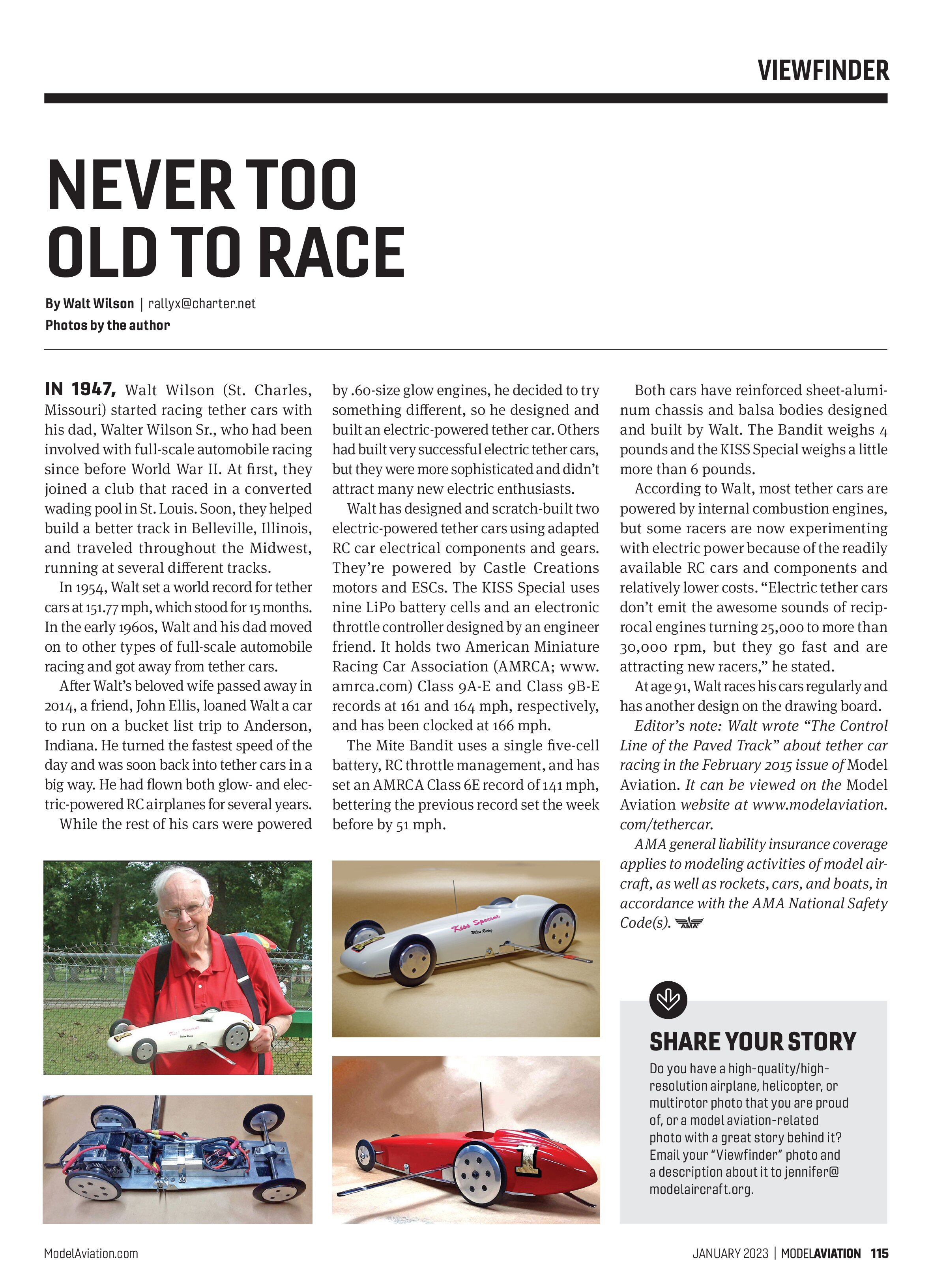
At age 91, Walt races his cars regularly and has another design on the drawing board.
Editor’s note: Walt wrote “The Control Line of the Paved Track” about tether car racing in the February 2015 issue of Model Aviation. It can be viewed on the Model Aviation website at www.modelaviation.com/tethercar.
AMA general liability insurance coverage applies to modeling activities of model aircraft, as well as rockets, cars, and boats, in accordance with the AMA National Safety Code(s).