READING AIR: WHERE SHOULD I GO?
By Gordon Buckland | gordon@gatorf3b.com

A THERMAL DURATION (TD) Soaring pilot is always asking this question. It’s what is on our minds before flying, while helping teammates, and constantly during flights. If you are a dedicated TD competition pilot, you might find yourself continually reading air, even when you are outdoors doing other activities. It’s part of what expands your skills and hones your awareness of what the air around you is doing. Eventually, it is almost intuitive because you are reading air subconsciously all the time.
I remember a moment with Joe Wurts. He was holding a Ceres F3B model and a transmitter and suddenly took off running to hurl the sailplane into the air. He cried out “wind shift” and although he didn’t catch the lift that time, it illustrated to me that he was always “sensing” for thermal indicators, even while doing other things. (For your enjoyment, I have included a link to this video in the “Sources” section.)
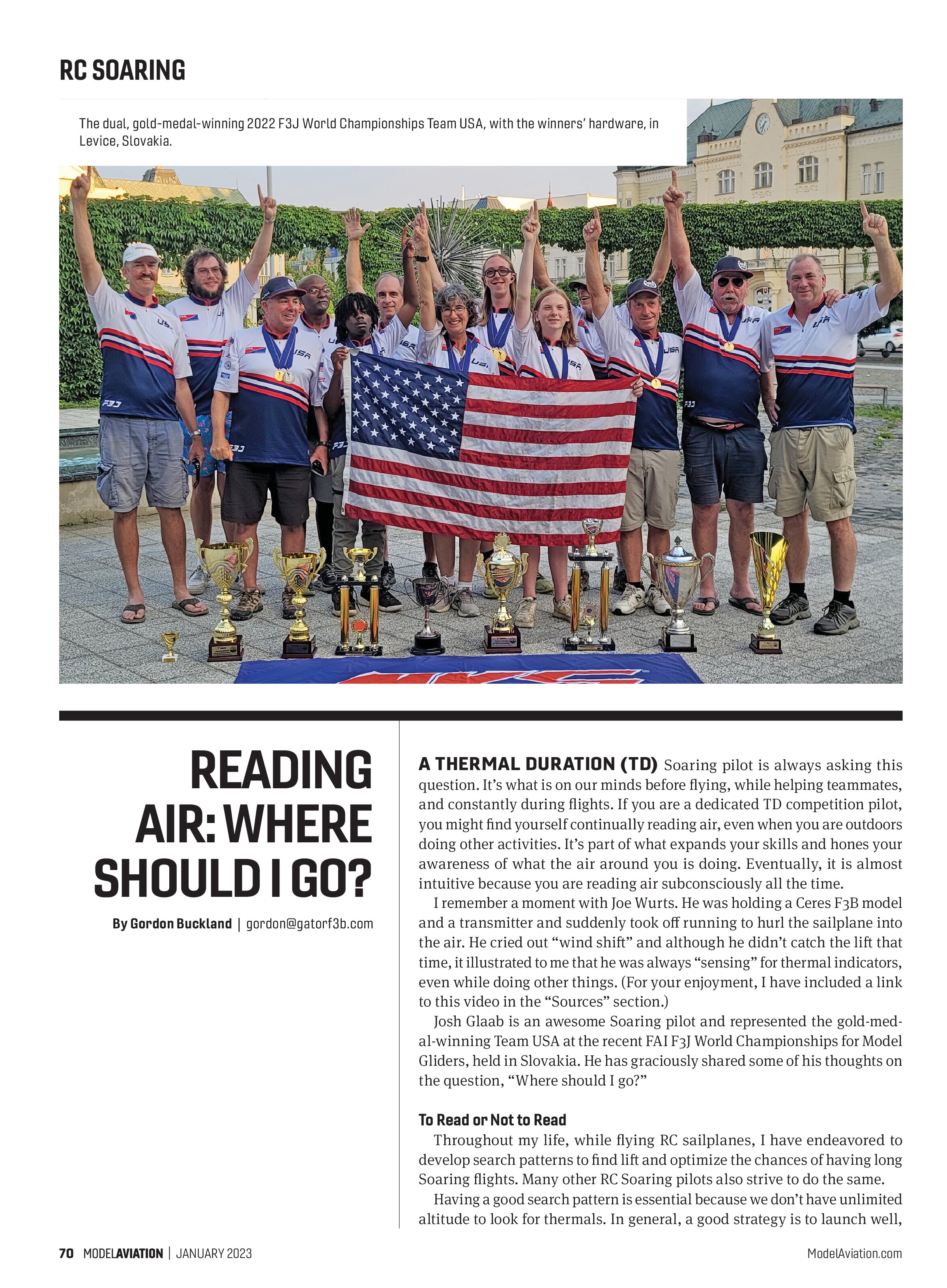
Josh Glaab is an awesome Soaring pilot and represented the gold-medal-winning Team USA at the recent FAI F3J World Championships for Model Gliders, held in Slovakia. He has graciously shared some of his thoughts on the question, “Where should I go?”
To Read or Not to Read
Throughout my life, while flying RC sailplanes, I have endeavored to develop search patterns to find lift and optimize the chances of having long Soaring flights. Many other RC Soaring pilots also strive to do the same.
Having a good search pattern is essential because we don’t have unlimited altitude to look for thermals. In general, a good strategy is to launch well, choose a general area to search, and execute speeds to fly until contacting lift. Speeds to fly implies that if you are in sink, you need to accelerate and slow down in lift of zero sink. If you are going upwind, this speed increases, and going downwind, it decreases. If you are not continually changing speeds and flying rapidly through sink, you are leaving a ton of sailplane performance on the table.
Another “rule” is to not fly through the same sink more than once, but a couple of others will be flying toward aircraft in lift and away from those in sink. Pretty simple, right? This column will discuss two approaches to figuring out where to search for lift, and I’ll offer my approach for consideration.
Thermal Read
The approach of some pilots is to carefully look at the wind, as indicated by several surface wind sensors, such as flags, streamers, windsocks, etc. The basic theory is that a rising air current (or thermal) would need to suck in air to replace the air that is rising. The surface air that fills in influences wind sensors on the ground. These pilots attempt to visualize where a thermal might be and where it is going.
In some ways, ground wind sensors could point to where the thermal is at a given instant. If you have two ground wind sensors and they are pointing at each other (two streamers extended toward each other at 100 meters apart), odds are that there is a thermal between them. The approach, or “read,” is to search the area where the thermal is thought to be when they get there. The primary benefit is entering lift quickly—if the read is correct.
How far can you take this? As an example, very light lift at the edge of our sailplanes’ performance would certainly not induce wind changes where we see or feel them. A weakness is that a strong run to a specific spot after launch could limit Plan B or what happens if Plan A doesn’t work out.
What Worked 10 Minutes Ago
In this approach, pilots study what the winning flights were and the strategies in the several previous flight groups and use this as Plan A. This leverages the history of the last 30 minutes to an hour and also indicates lift at distances that could be far away. A weakness is that a pilot could be exposed to struggling with significantly changing conditions; however, if the wind/conditions are the same as before, odds are that what just worked will work again.
Plan B is then an inflight adjustment of Plan A. Plan B is an art and requires the ability to observe the entire field as much as possible. Some pilots are awesome at not looking at their own sailplanes and seeing what others are doing. Some lose track of their aircraft and crash. Others need the help of callers or strategists. Callers or spotters provide information about what the pilot can’t see and also offer strategy to the pilot to make decisions.
It is essential to have a caller who thinks and flies as you do. It is also vital to trust your caller and execute when needed. In Man-on-Man (MoM) Soaring, it is important to have a good strategist who can assist with exploiting the other pilots. Remember, in MoM, you don’t need to make the maximum time—just outfly the others. Great callers can immediately read the energy of an aircraft or a bird, even when they are not circling. Other callers need more time to read the air by seeing aircraft climbing significantly.
Sometimes, when the chips are down,
callers might imagine lift to try to help their pilots. This can be very risky, and it is much better to tell your pilot that you have nothing to allow him or her to realize that everyone is getting hammered and to limit the damage and out-retreat them.
One approach I have recently developed for calling for pilots who are looking to develop their skills involves providing lift inputs each minute on the minute if they want just the basic information. I provide who and where the high guy is, whether a max flight is obvious, and the status of all other aircraft—then I shut up.
Knowing whether someone is making his or her flight time is important for responding to tough situations. The pilot can then act on this information. Sometimes this works; sometimes much higher frequency inputs are needed. This was not often used at the World Championships, except sometimes during low-stress flights.
At the FAI F3J World Championships for Model Gliders, the lift conditions in Levice, Slovakia, were challenging—much more challenging than what was expected from the prevailing wind/sunshine.
Levice is several hundred miles inland and was somewhat dry but definitely not like California. It had a large hayfield to the southwest and woods to the northeast. The wind usually paralleled the northwest/southeast tree line. Lift cycles would move through, and sometimes during the tail end of a lift cycle, it would be very short lived (in the order of 30 seconds), pop up, and fade rapidly over a large area. Decisions were made quickly and repeatedly.
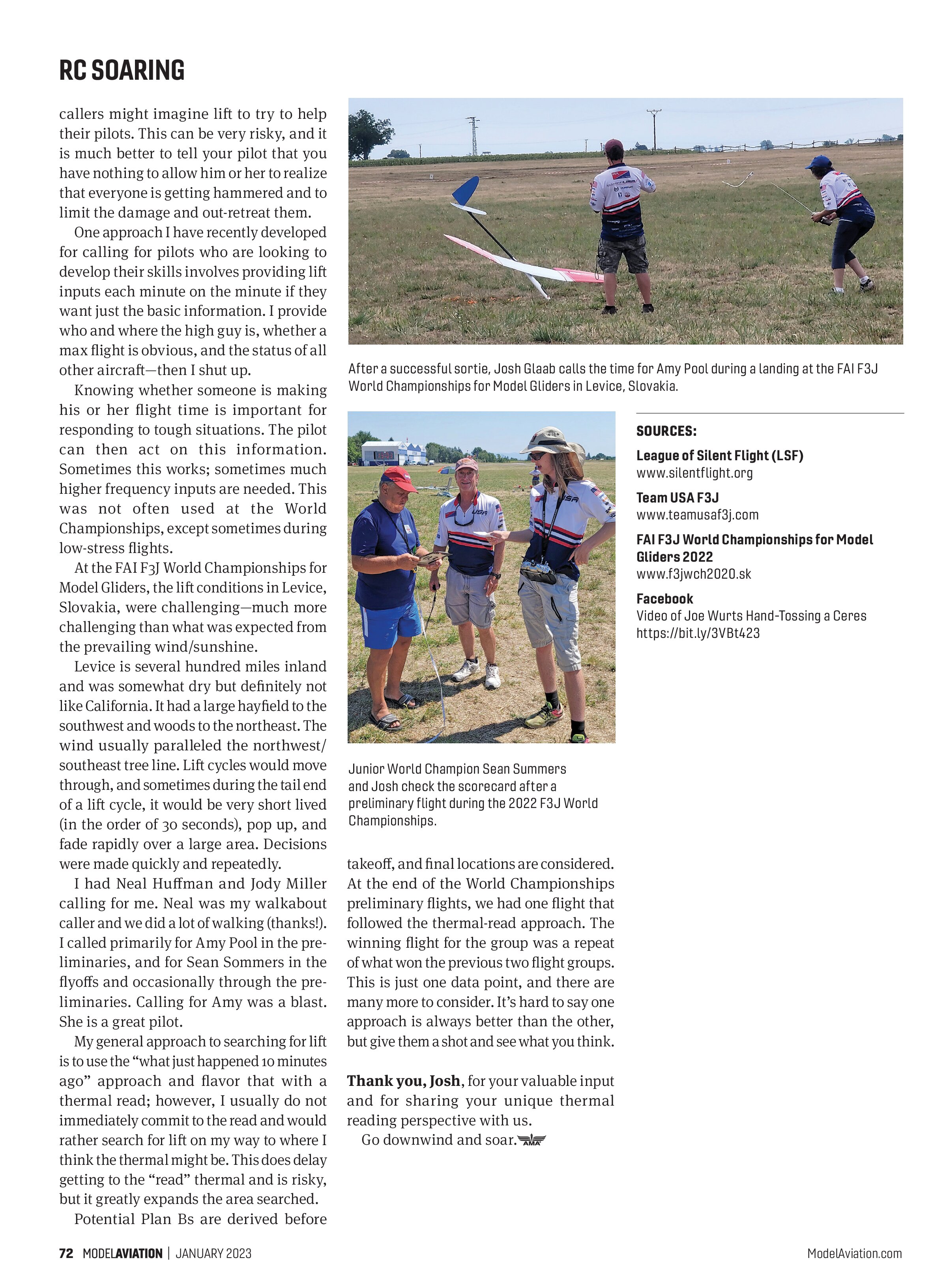
I had Neal Huffman and Jody Miller calling for me. Neal was my walkabout caller and we did a lot of walking (thanks!). I called primarily for Amy Pool in the preliminaries, and for Sean Summers in the flyoffs and occasionally through the preliminaries. Calling for Amy was a blast. She is a great pilot.
My general approach to searching for lift is to use the “what just happened 10 minutes ago” approach and flavor that with a thermal read; however, I usually do not immediately commit to the read and would rather search for lift on my way to where I think the thermal might be. This does delay getting to the “read” thermal and is risky, but it greatly expands the area searched.
Potential Plan Bs are derived before

takeoff, and final locations are considered. At the end of the World Championships preliminary flights, we had one flight that followed the thermal-read approach. The winning flight for the group was a repeat of what won the previous two flight groups. This is just one data point, and there are many more to consider. It’s hard to say one approach is always better than the other, but give them a shot and see what you think.
Thank you, Josh, for your valuable input and for sharing your unique thermal reading perspective with us.
Go downwind and soar.
SOURCES:
League of Silent Flight (LSF)
www.silentflight.org
Team USA F3J
www.teamusaf3j.com
FAI F3J World Championships for Model Gliders 2022
www.f3jwch2020.sk
Facebook
Video of Joe Wurts Hand-Tossing a Ceres
https://bit.ly/3VBt423