THE NEW LINDY FLYING GAME—NEW YORK TO PARIS
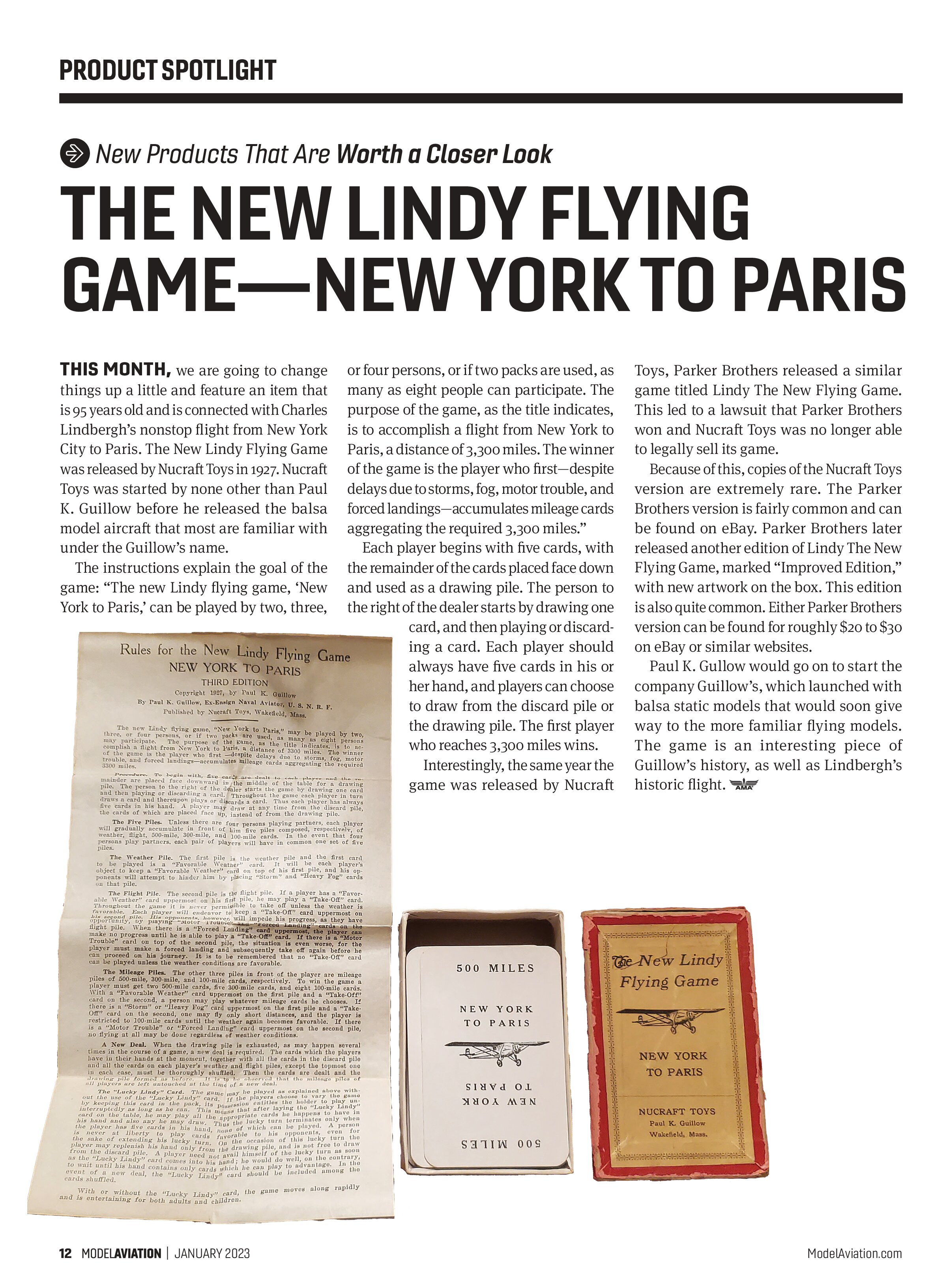
THIS MONTH, we are going to change things up a little and feature an item that is 95 years old and is connected with Charles Lindbergh’s nonstop flight from New York City to Paris. The New Lindy Flying Game was released by NuCraft Toys in 1927. NuCraft Toys was started by none other than Paul K. Guilllow before he released the balsa model aircraft that most are familiar with under the Guilllow’s name.
The instructions explain the goal of the game: “The new Lindy flying game, ‘New York to Paris,’ can be played by two, three, or four persons, or if two packs are used, as many as eight people can participate. The purpose of the game, as the title indicates, is to accomplish a flight from New York to Paris, a distance of 3,300 miles. The winner of the game is the player who first—despite delays due to storms, fog, motor trouble, and forced landings—accumulates mileage cards aggregating the required 3,300 miles.”
Each player begins with five cards, with the remainder of the cards placed face down and used as a drawing pile. The person to the right of the dealer starts by drawing one card, and then playing or discarding a card. Each player should always have five cards in his or her hand, and players can choose to draw from the discard pile or the drawing pile. The first player who reaches 3,300 miles wins.
Interestingly, the same year the game was released by NuCraft Toys, Parker Brothers released a similar game titled Lindy The New Flying Game. This led to a lawsuit that Parker Brothers won and NuCraft Toys was no longer able to legally sell its game.
Because of this, copies of the NuCraft Toys version are extremely rare. The Parker Brothers version is fairly common and can be found on eBay. Parker Brothers later released another edition of Lindy The New Flying Game, marked “Improved Edition,” with new artwork on the box. This edition is also quite common. Either Parker Brothers version can be found for roughly $20 to $30 on eBay or similar websites.
Paul K. Guilllow would go on to start the company Guilllow’s, which launched with balsa static models that would soon give way to the more familiar flying models. The game is an interesting piece of Guilllow’s history, as well as Lindbergh’s historic flight.

New Products from the Modeler’s Mall
Classic II Floor Model Stand @ $389 + S&H from RC Plane Stands
Tel.: (949) 633-3420; website: www.rcplanestands.com
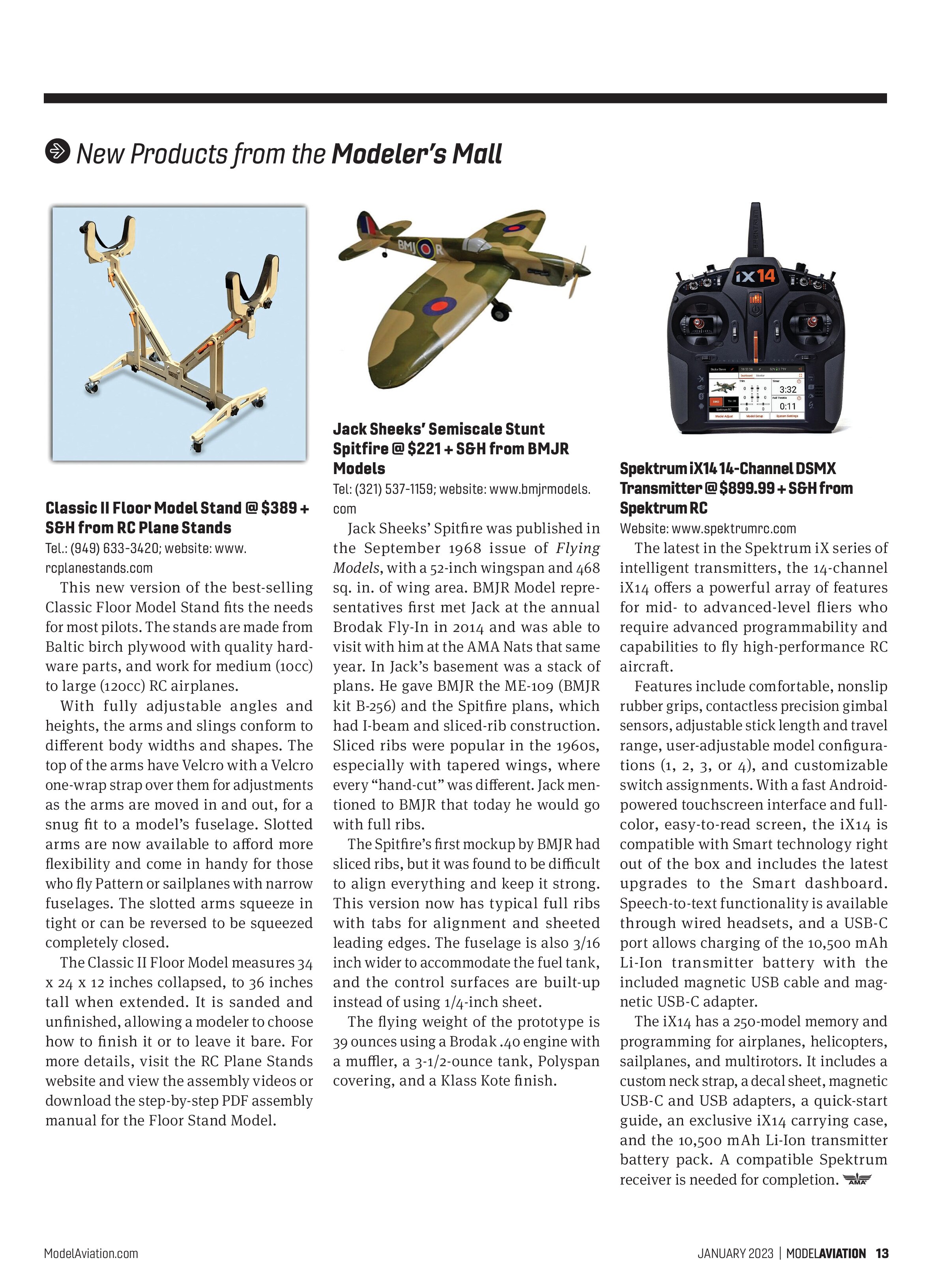
This new version of the best-selling Classic Floor Model Stand fits the needs for most pilots. The stands are made from Baltic birch plywood with quality hardware parts, and work for medium (10cc) to large (120cc) RC airplanes.
With fully adjustable angles and heights, the arms and slings conform to different body widths and shapes. The top of the arms have Velcro with a Velcro one-wrap strap over them for adjustments as the arms are moved in and out, for a snug fit to a model’s fuselage. Slotted arms are now available to afford more flexibility and come in handy for those who fly Pattern or sailplanes with narrow fuselages. The slotted arms squeeze in tight or can be reversed to be squeezed completely closed.
The Classic II Floor Model measures ¾ x 24 x 12 inches collapsed, to 36 inches tall when extended. It is sanded and unfinished, allowing a modeler to choose how to finish it or to leave it bare. For more details, visit the RC Plane Stands website and view the assembly videos or download the step-by-step PDF assembly manual for the Floor Stand Model.

Jack Sheeks’ Semiscale Stunt Spitfire @ $221 + S&H from BMJR Models
Tel: (321) 537-1159; website: www.bjmrmodels.com
Jack Sheeks’ Spitfire was published in the September 1968 issue of Flying Models, with a 52-inch wingspan and 468 sq. in. of wing area. BMJR Model representatives first met Jack at the annual Brodak Fly-In in 2014 and was able to visit with him at the AMA Nats that same year. In Jack’s basement was a stack of plans. He gave BMJR the ME-109 (BMJR kit B-256) and the Spitfire plans, which had I-beam and sliced-rib construction. Sliced ribs were popular in the 1960s, especially with tapered wings, where every “hand-cut” was different. Jack mentioned to BMJR that today he would go with full ribs.
The Spitfire’s first mockup by BMJR had sliced ribs, but it was found to be difficult to align everything and keep it strong. This version now has typical full ribs with tabs for alignment and sheeted leading edges. The fuselage is also 3/16 inch wider to accommodate the fuel tank, and the control surfaces are built-up instead of using 1/4-inch sheet.
The flying weight of the prototype is 39 ounces using a Brodak .40 engine with a muffler, a 3-1/2-ounce tank, Polyspan covering, and a Klass Kote finish.

Spektrum iX14 14-Channel DSMX Transmitter @ $899.99 + S&H from Spektrum RC
Website: www.spektrumrc.com
The latest in the Spektrum iX series of intelligent transmitters, the 14-channel iX14 offers a powerful array of features for mid- to advanced-level fliers who require advanced programmability and capabilities to fly high-performance RC aircraft.
Features include comfortable, nonslip rubber grips, contactless precision gimbal sensors, adjustable stick length and travel range, user-adjustable model configurations (1, 2, 3, or 4), and customizable switch assignments. With a fast Android-powered touchscreen interface and full-color, easy-to-read screen, the iX14 is compatible with Smart technology right out of the box and includes the latest upgrades to the Smart dashboard. Speech-to-text functionality is available through wired headsets, and a USB-C port allows charging of the 10,500 mAh Li-Ion transmitter battery with the included magnetic USB cable and magnetic USB-C adapter.
The iX14 has a 250-model memory and programming for airplanes, helicopters, sailplanes, and multirotors. It includes a custom neck strap, a decal sheet, magnetic USB-C and USB adapters, a quick-start guide, an exclusive iX14 carrying case, and the 10,500 mAh Li-Ion transmitter battery pack. A compatible Spektrum receiver is needed for completion.