FOCAL POINT
Interested in sharing your handiwork? Visit www.ModelAviation.com for submission guidelines.
CL Antics
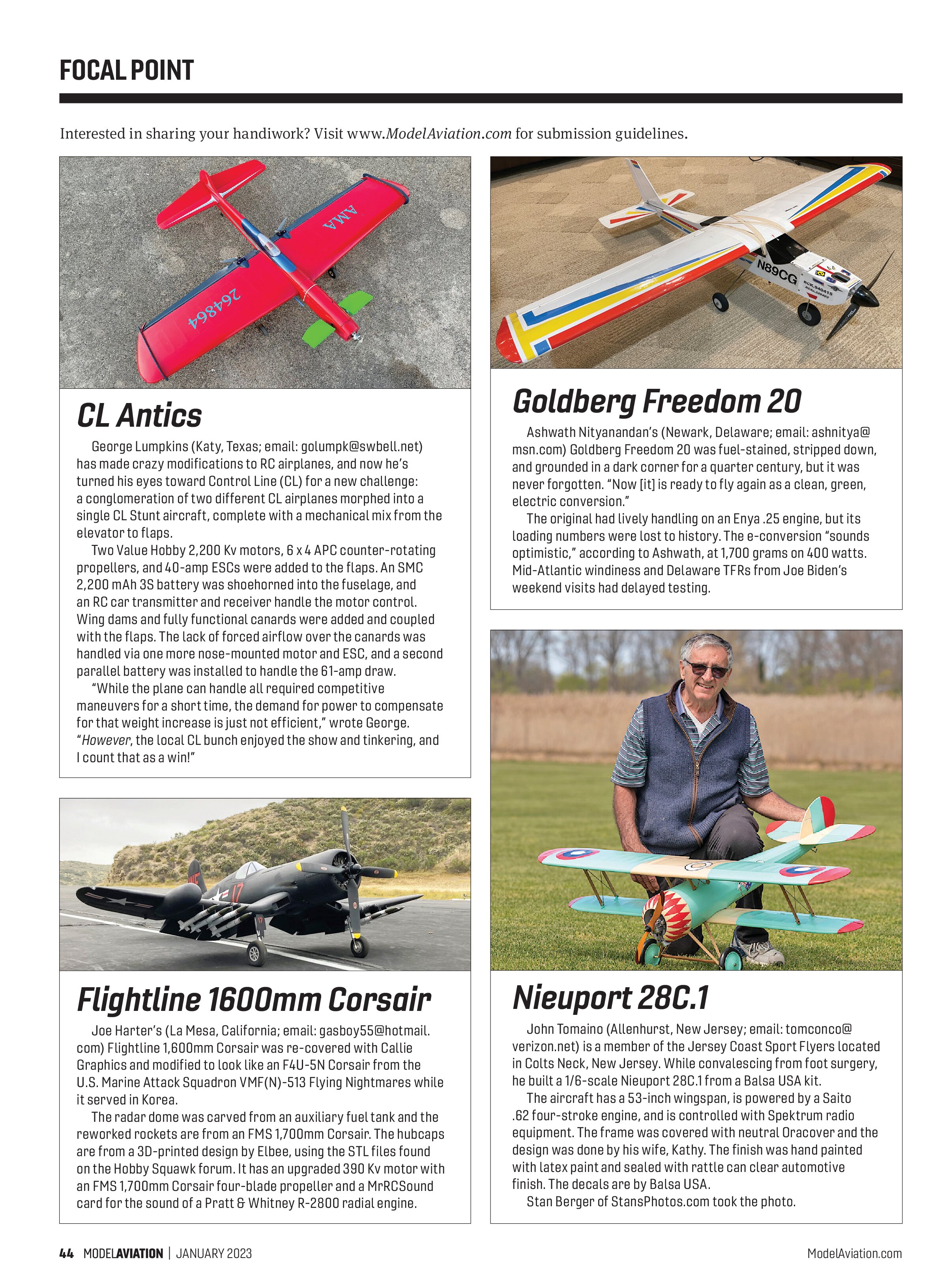
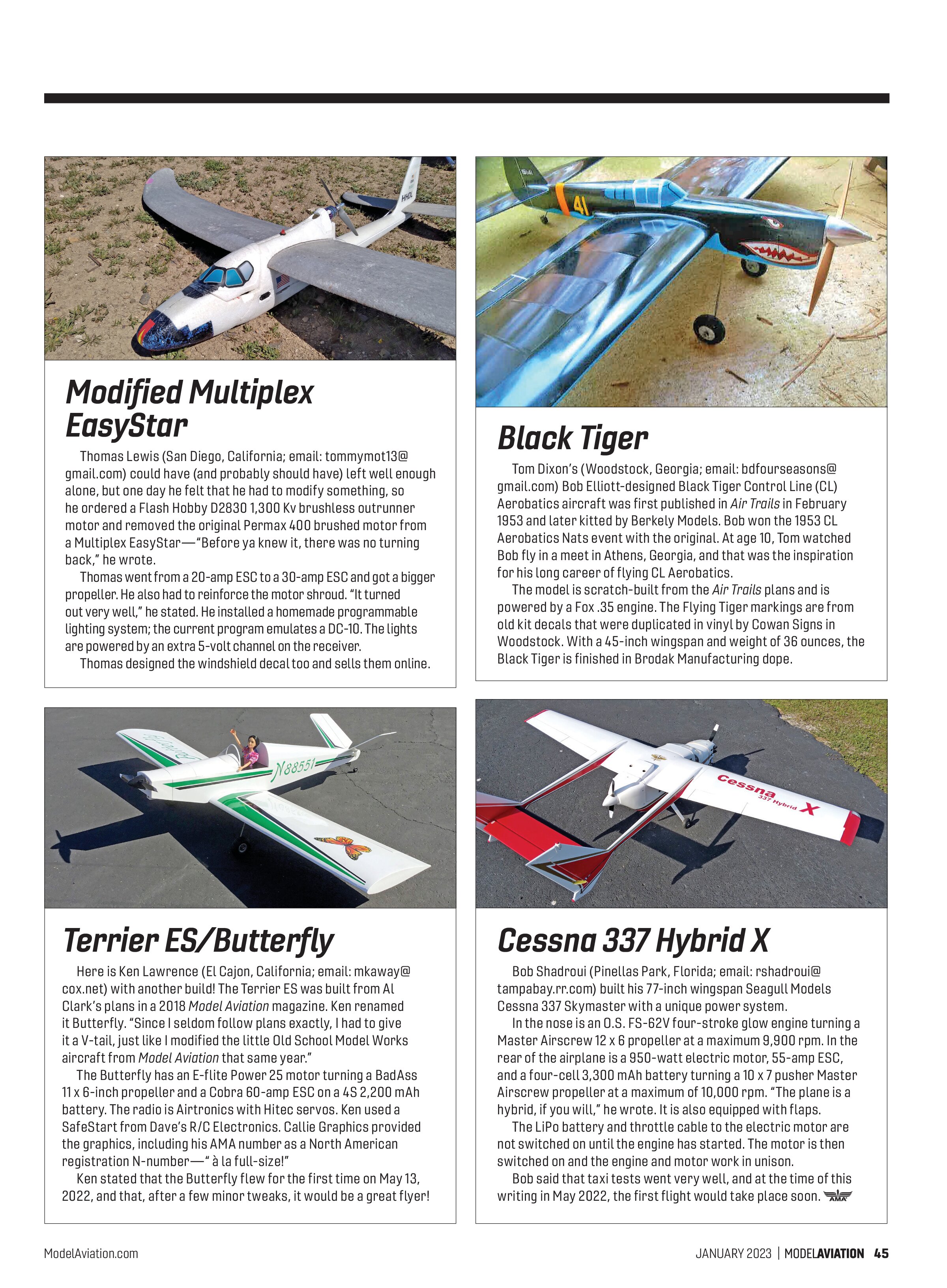
George Lumpkins (Katy, Texas; email: golumpkl@swbell.net) has made crazy modifications to RC airplanes, and now he’s turned his eyes toward Control Line (CL) for a new challenge: a conglomeration of two different CL airplanes morphed into a single CL Stunt aircraft, complete with a mechanical mix from the elevator to flaps.
Two Value Hobby 2,200 Kv motors, 6 x 4 APC counter-rotating propellers, and 40-amp ESCs were added to the flaps. An SMC 2,200 mAh 3S battery was shoehorned into the fuselage, and an RC car transmitter and receiver handle the motor control. Wing dams and fully functional canards were added and coupled with the flaps. The lack of forced airflow over the canards was handled via one more nose-mounted motor and ESC, and a second parallel battery was installed to handle the 61-amp draw.
“While the plane can handle all required competitive maneuvers for a short time, the demand for power to compensate for that weight increase is just not efficient,” wrote George. “However, the local CL bunch enjoyed the show and tinkering, and I count that as a win!”

Flightline 1600mm Corsair
Joe Harter’s (La Mesa, California; email: gasboy55@hotmail.com) Flightline 1,600mm Corsair was re-covered with Callie Graphics and modified to look like an F4U-5N Corsair from the U.S. Marine Attack Squadron VMF(N)-513 Flying Nightmares while it served in Korea.
The radar dome was carved from an auxiliary fuel tank and the reworked rockets are from an FMS 1,700mm Corsair. The hubcaps are from a 3D-printed design by Elbee, using the STL files found on the Hobby Squawk forum. It has an upgraded 390 Kv motor with an FMS 1,700mm Corsair four-blade propeller and a MRCsound card for the sound of a Pratt & Whitney R-2800 radial engine.

Goldberg Freedom 20
Ashwath Nityanandan’s (Newark, Delaware; email: ashnitya@msn.com) Goldberg Freedom 20 was fuel-stained, stripped down, and grounded in a dark corner for a quarter century, but it was never forgotten. “Now [it] is ready to fly again as a clean, green, electric conversion.”
The original had lively handling on an Enya .25 engine, but its loading numbers were lost to history. The e-conversion “sounds optimistic,” according to Ashwath, at 1,700 grams on 400 watts. Mid-Atlantic windiness and Delaware TFRs from Joe Biden’s weekend visits had delayed testing.

Nieuport 28C.1
John Tomaino (Allenhurst, New Jersey; email: tomconco@verizon.net) is a member of the Jersey Coast Sport Flyers located in Colts Neck, New Jersey. While convalescing from foot surgery, he built a 1/6-scale Nieuport 28C.1 from a Balsa USA kit.
The aircraft has a 53-inch wingspan, is powered by a Saito .62 four-stroke engine, and is controlled with Spektrum radio equipment. The frame was covered with neutral Oracover and the design was done by his wife, Kathy. The finish was hand painted with latex paint and sealed with rattle can clear automotive finish. The decals are by Balsa USA.
Stan Berger of StansPhotos.com took the photo.

Modified Multiplex EasyStar
Thomas Lewis (San Diego, California; email: tommymot13@gmail.com) could have (and probably should have) left well enough alone, but one day he felt that he had to modify something, so he ordered a Flash Hobby D2830 1,300 Kv brushless outrunner motor and removed the original Permax 400 brushed motor from a Multiplex EasyStar—“Before ya knew it, there was no tunning back,” he wrote.
Thomas went from a 20-amp ESC to a 30-amp ESC and got a bigger propeller. He also had to reinforce the motor shroud. “It turned out very well,” he stated. He installed a homemade programmable lighting system; the current program emulates a DC-10. The lights are powered by an extra 5-volt channel on the receiver.
Thomas designed the windshield decal too and sells them online.

Black Tiger
Tom Dixon’s (Woodstock, Georgia; email: bdfourseasons@gmail.com) Bob Elliott-designed Black Tiger Control Line (CL) Aerobatics aircraft was first published in Air Trails in February 1953 and later kitted by Berkley Models. Bob won the 1953 CL Aerobatics Nats event with the original. At age 10, Tom watched Bob fly in a meet in Athens, Georgia, and that was the inspiration for his long career of flying CL Aerobatics.
The model is scratch-built from the Air Trails plans and is powered by a Fox .35 engine. The Flying Tiger markings are from old kit decals that were duplicated in vinyl by Cowan Signs in Woodstock. With a 45-inch wingspan and weight of 36 ounces, the Black Tiger is finished in Brodak Manufacturing dope.

Terrier ES/Butterfly
Here is Ken Lawrence (El Cajon, California; email: mkaway@cox.net) with another build! The Terrier ES was built from Al Clark’s plans in a 2018 Model Aviation magazine. Ken renamed it Butterfly. “Since I seldom follow plans exactly, I had to give it a V-tail, just like I modified the little Old School Model Works aircraft from Model Aviation that same year.”
The Butterfly has an E-flite Power 25 motor turning a BadAss 11 x 6-inch propeller and a Cobra 60-amp ESC on a 4S 2,200 mAh battery. The radio is Airtronics with Hitec servos. Ken used a SafeStart from Dave’s R/C Electronics. Callie Graphics provided the graphics, including his AMA number as a North American registration N-number—“à la full-size!”
Ken stated that the Butterfly flew for the first time on May 13, 2022, and that, after a few minor tweaks, it would be a great flyer!

Cessna 337 Hybrid X
Bob Shadroui (Pinellas Park, Florida; email: rshadroui@tampabay.rr.com) built his 77-inch wingspan Seagull Models Cessna 337 Skymaster with a unique power system.
In the nose is an O.S. FS-62V four-stroke glow engine turning a Master Airscrew 12 x 6 propeller at a maximum 9,900 rpm. In the rear of the airplane is a 950-watt electric motor, 55-amp ESC, and a four-cell 3,300 mAh battery turning a 10 x 7 pusher Master Airscrew propeller at a maximum of 10,000 rpm. “The plane is a hybrid, if you will,” he wrote. It is also equipped with flaps.
The LiPo battery and throttle cable to the electric motor are not switched on until the engine has started. The motor is then switched on and the engine and motor work in unison.
Bob said that taxi tests went very well, and at the time of this writing in May 2022, the first flight would take place soon.