WHAT IS CRAFTSMANSHIP?
By Thayer Syme | thayer@flying-models.com

BEFORE ADDRESSING this leading question, let’s agree to not actually define the term but instead simply consider how our own personal relationship with craftsmanship has changed over time, and will likely continue to do so.
In the simplest terms, I believe that most people who make things—or pay attention to those who do—consider craftsmanship to be something close to the skills and refinement that are exhibited within the objects that are made. It might also be fair to say that there is a general assumption that craftsmanship requires an above-average level of skill to make things that are pleasing to the eye and hand.
I would offer that the refinement of skill is not a requirement because ours is primarily a pursuit of personal growth and expression. Instead, I believe that the only measure that matters is our own. Does our current effort reward us with a more refined outcome than the last, and have we learned something along the way? If so, that should be enough to satisfy us.
Following are a couple of examples of craftsmanship within our hobby that I hope will inspire your next project to new heights.
Mystery Formers
A friend of mine from Virginia spent a fair amount of time during the last summer volunteering to help another modeling friend’s widow disburse her late husband’s workshop contents. As is often typical in such instances, there was a wide range of contents—from treasure to trash—that was accumulated throughout the years.
The fellow who had passed away was no stranger to building and had left many examples of his craftsmanship for others to enjoy. For every finished and flying project, however, there are often more than a few that are “waiting for someday” before completion.
Mixed in and among everything else was a unique example of a modeling technique that I wanted to share as soon as I saw it.
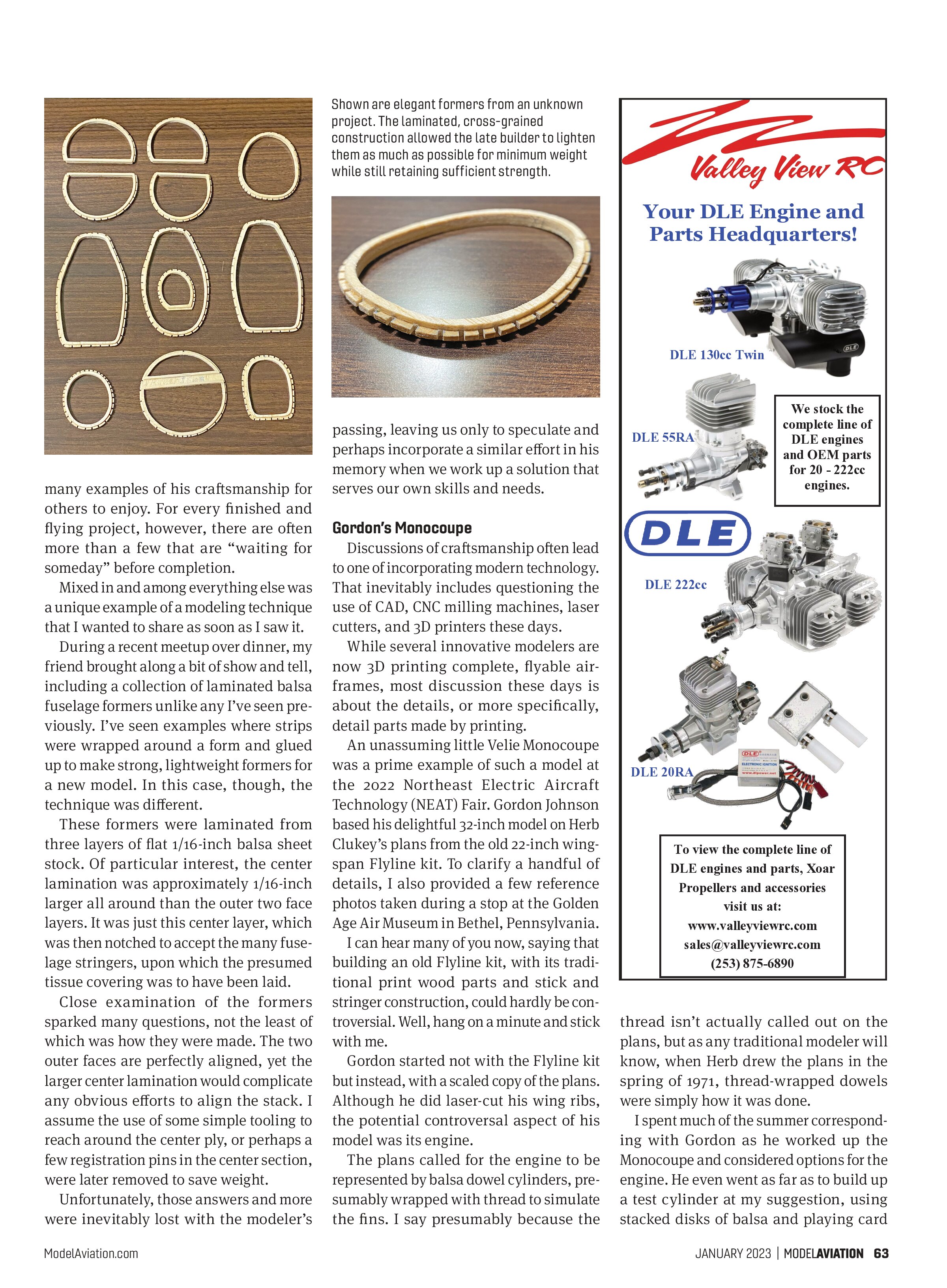
During a recent meetup over dinner, my friend brought along a bit of show and tell, including a collection of laminated balsa fuselage formers unlike any I’ve seen previously. I’ve seen examples where strips were wrapped around a form and glued up to make strong, lightweight formers for a new model. In this case, though, the technique was different.

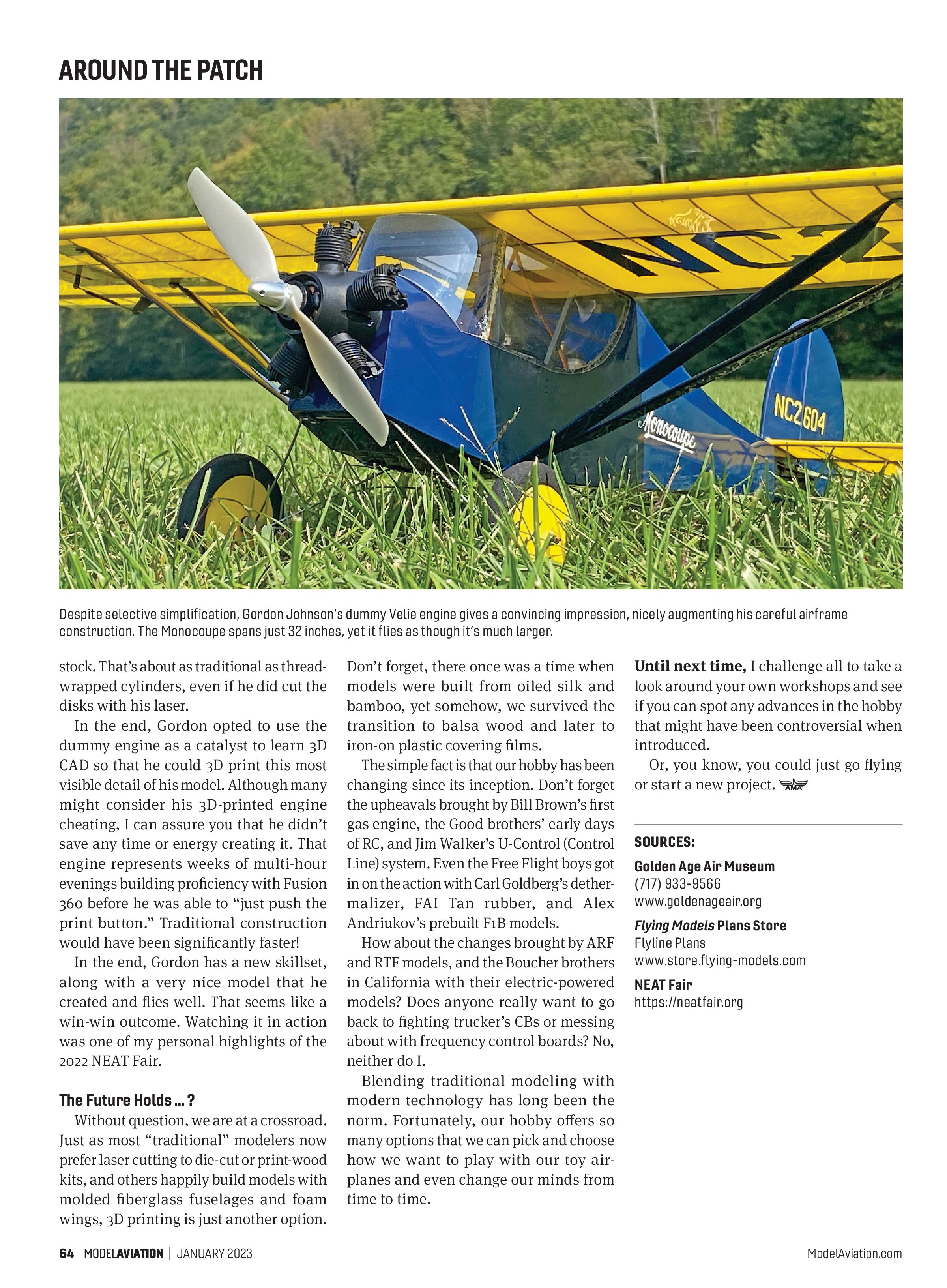
These formers were laminated from three layers of flat 1/16-inch balsa sheet stock. Of particular interest, the center lamination was approximately 1/16-inch larger all around than the outer two face layers. It was just this center layer, which was then notched to accept the many fuselage stringers, upon which the presumed tissue covering was to have been laid.
Close examination of the formers sparked many questions, not the least of which was how they were made. The two outer faces are perfectly aligned, yet the larger center lamination would complicate any obvious efforts to align the stack. I assume the use of some simple tooling to reach around the center ply, or perhaps a few registration pins in the center section, were later removed to save weight.
Unfortunately, those answers and more were inevitably lost with the modeler’s passing, leaving us only to speculate and perhaps incorporate a similar effort in his memory when we work up a solution that serves our own skills and needs.

Gordon’s Monocoupe
Discussions of craftsmanship often lead to one of incorporating modern technology. That inevitably includes questioning the use of CAD, CNC milling machines, laser cutters, and 3D printers these days.
While several innovative modelers are now 3D printing complete, flyable airframes, most discussion these days is about the details, or more specifically, detail parts made by printing.
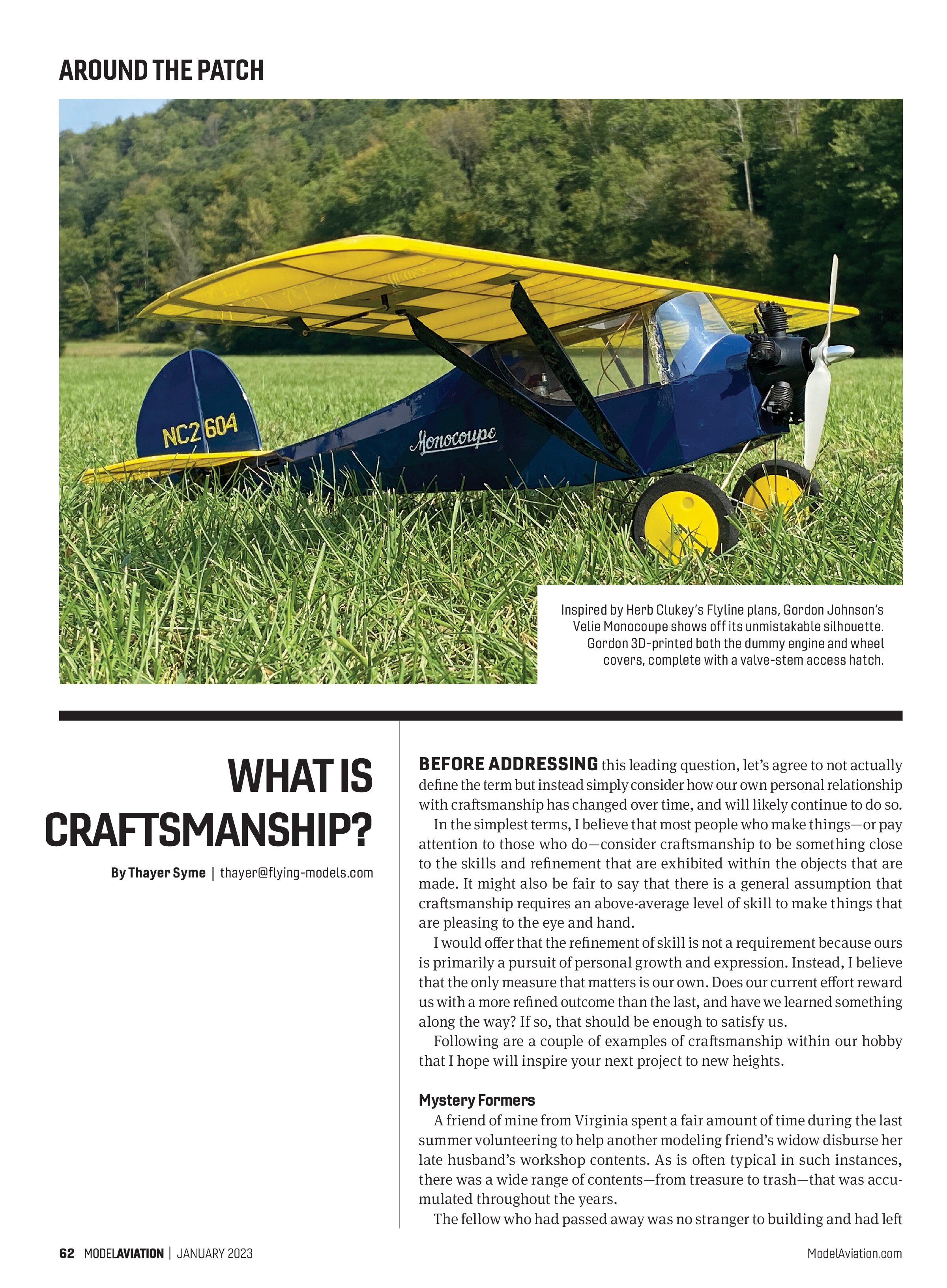
An unassuming little Velie Monocoupe was a prime example of such a model at the 2022 Northeast Electric Aircraft Technology (NEAT) Fair. Gordon Johnson based his delightful 32-inch model on Herb Clukey’s plans from the old 22-inch wingspan Flyline kit. To clarify a handful of details, I also provided a few reference photos taken during a stop at the Golden Age Air Museum in Bethel, Pennsylvania.
I can hear many of you now, saying that building an old Flyline kit, with its traditional print wood parts and stick and stringer construction, could hardly be controversial. Well, hang on a minute and stick with me.
Gordon started not with the Flyline kit but instead, with a scaled copy of the plans. Although he did laser-cut his wing ribs, the potential controversial aspect of his model was its engine.
The plans called for the engine to be represented by balsa dowel cylinders, presumably wrapped with thread to simulate the fins. I say presumably because the thread isn’t actually called out on the plans, but as any traditional modeler will know, when Herb drew the plans in the spring of 1971, thread-wrapped dowels were simply how it was done.
I spent much of the summer corresponding with Gordon as he worked up the Monocoupe and considered options for the engine. He even went as far as to build up a test cylinder at my suggestion, using stacked disks of balsa and playing card

stock. That’s about as traditional as thread-wrapped cylinders, even if he did cut the disks with his laser.
In the end, Gordon opted to use the dummy engine as a catalyst to learn 3D CAD so that he could 3D print this most visible detail of his model. Although many might consider his 3D-printed engine cheating, I can assure you that he didn’t save any time or energy creating it. That engine represents weeks of multi-hour evenings building proficiency with Fusion 360 before he was able to “just push the print button.” Traditional construction would have been significantly faster!
In the end, Gordon has a new skillset, along with a very nice model that he created and flies well. That seems like a win-win outcome. Watching it in action was one of my personal highlights of the 2022 NEAT Fair.
The Future Holds...?
Without question, we are at a crossroads. Just as most “traditional” modelers now prefer laser cutting to die-cut or print-wood kits, and others happily build models with molded fiberglass fuselages and foam wings, 3D printing is just another option.
Don’t forget, there once was a time when models were built from oiled silk and bamboo, yet somehow, we survived the transition to balsa wood and later to iron-on plastic covering films.
The simple fact is that our hobby has been changing since its inception. Don’t forget the upheavals brought by Bill Brown’s first gas engine, the Good brothers’ early days of RC, and Jim Walker’s U-Control (Control Line) system. Even the Free Flight boys got in on the action with Carl Goldberg’s dethermalizer, FAI Tan rubber, and Alex Andriukov’s prebuilt F1B models.
How about the changes brought by ARF and RTF models, and the Boucher brothers in California with their electric-powered models? Does anyone really want to go back to fighting trucker’s CBs or messing about with frequency control boards? No, neither do I.
Blending traditional modeling with modern technology has long been the norm. Fortunately, our hobby offers so many options that we can pick and choose how we want to play with our toy airplanes and even change our minds from time to time.
Until next time, I challenge all to take a look around your own workshops and see if you can spot any advances in the hobby that might have been controversial when introduced.
Or, you know, you could just go flying or start a new project.
SOURCES:
Golden Age Air Museum
(717) 933-9566
www.goldenageair.org
Flying Models Plans Store
Flyline Plans
www.store.flying-models.com
NEAT Fair
https://neatfair.org