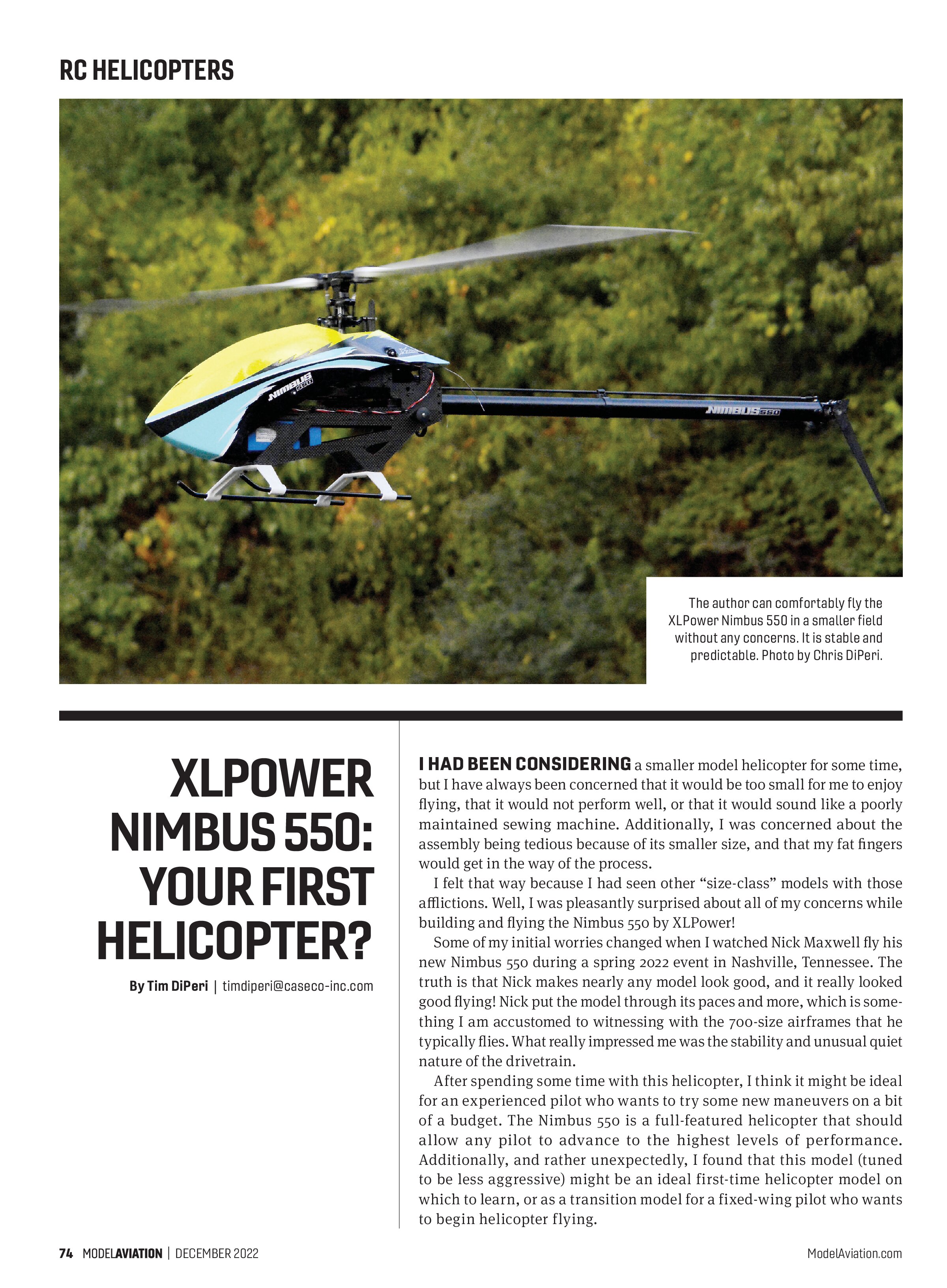
XLPOWER NIMBUS 550: YOUR FIRST HELICOPTER?
By Tim DiPeri | timdiper i@caseco-inc.com

I HAD BEEN CONSIDERING a smaller model helicopter for some time, but I have always been concerned that it would be too small for me to enjoy flying, that it would not perform well, or that it would sound like a poorly maintained sewing machine. Additionally, I was concerned about the assembly being tedious because of its smaller size, and that my fat fingers would get in the way of the process.
I felt that way because I had seen other “size-class” models with those afflictions. Well, I was pleasantly surprised about all of my concerns while building and flying the Nimbus 550 by XLPower!
Some of my initial worries changed when I watched Nick Maxwell fly his new Nimbus 550 during a spring 2022 event in Nashville, Tennessee. The truth is that Nick makes nearly any model look good, and it really looked good flying! Nick put the model through its paces and more, which is something I am accustomed to witnessing with the 700-size airframes that he typically flies. What really impressed me was the stability and unusual quiet nature of the drivetrain.
After spending some time with this helicopter, I think it might be ideal for an experienced pilot who wants to try some new maneuvers on a bit of a budget. The Nimbus 550 is a full-featured helicopter that should allow any pilot to advance to the highest levels of performance. Additionally, and rather unexpectedly, I found that this model (tuned to be less aggressive) might be an ideal first-time helicopter model on which to learn, or as a transition model for a fixed-wing pilot who wants to begin helicopter flying.


Building
The model started as a bit of a “team” build at the International Radio Controlled Helicopter Association (IRCHA) 2022 Jamboree, held in August at the International Aeromodeling Center in Muncie, Indiana. Nob Muraki helped greatly in its assembly, as well as with the photographs.
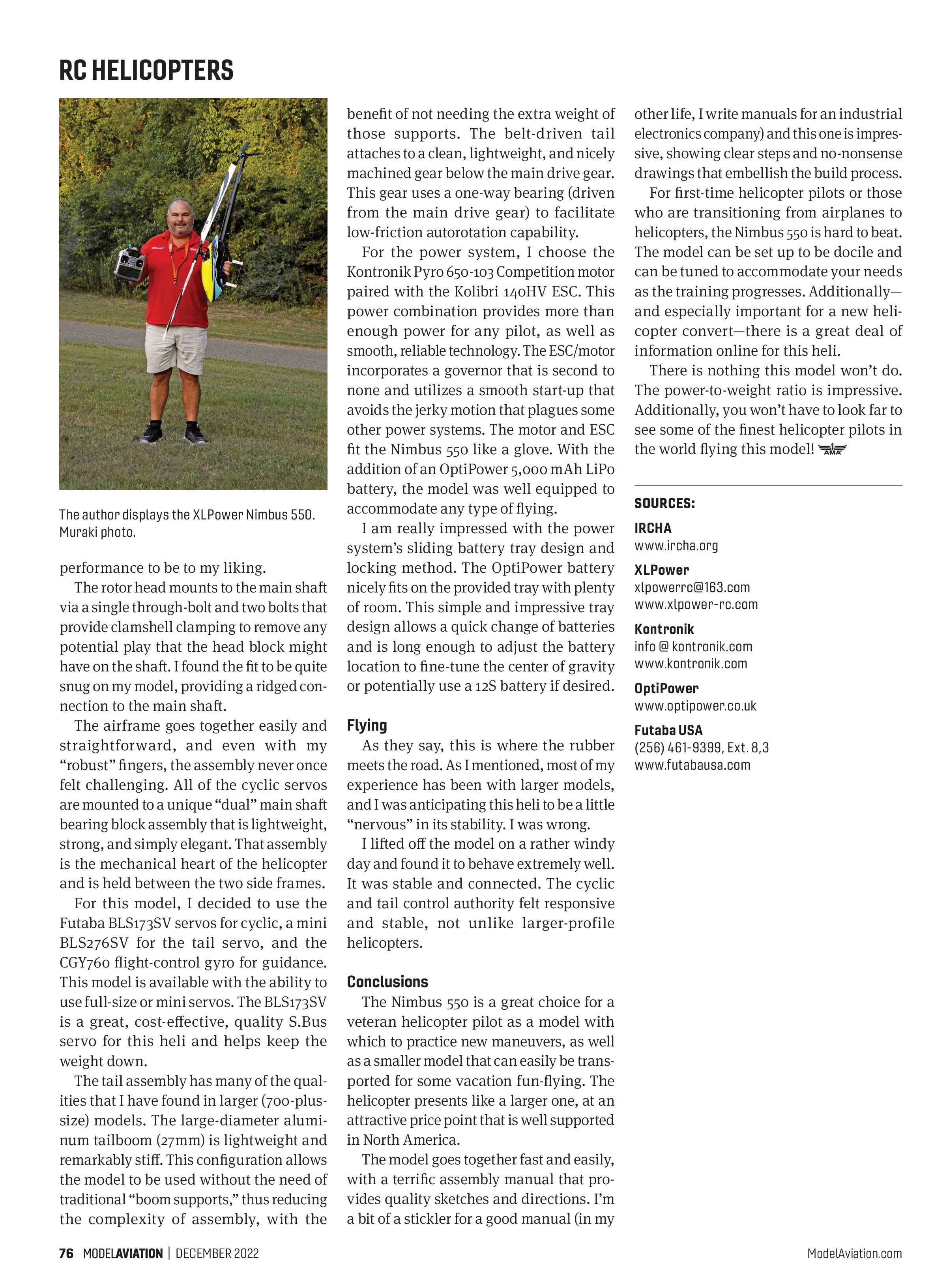
We had a slight mishap during the maiden flight that required a pause and some repair (the gyro cyclic was reversed). Although I did not plan it, it gave me a good feeling about how durable this model is and how reasonable repair parts are for the helicopter, as well as just how quick and easy it was to repair. The main shaft (again because of a cyclic gyro being reversed) popped out and a new one was back in place in a matter of minutes!
The mechanics are a straightforward pod-and-boom configuration, beginning with the main rotor assembly. The black, anodized rotor head is quite attractive. The pitch arms allow for two flight-performance configurations: stable and agile. Mine is set up for stable and I found the

performance to be to my liking.
The rotor head mounts to the main shaft via a single through-bolt and two bolts that provide clamshell clamping to remove any potential play that the head block might have on the shaft. I found the fit to be quite snug on my model, providing a ridged connection to the main shaft.
The airframe goes together easily and straightforward, and even with my “robust” fingers, the assembly never once felt challenging. All of the cyclic servos are mounted to a unique “dual” main shaft bearing block assembly that is lightweight, strong, and simply elegant. That assembly is the mechanical heart of the helicopter and is held between the two side frames.
For this model, I decided to use the Futaba BLS173SV servos for cyclic, a mini BLS276SV for the tail servo, and the CGY760 flight-control gyro for guidance. This model is available with the ability to use full-size or mini servos. The BLS173SV is a great, cost-effective, quality S.Bus servo for this heli and helps keep the weight down.
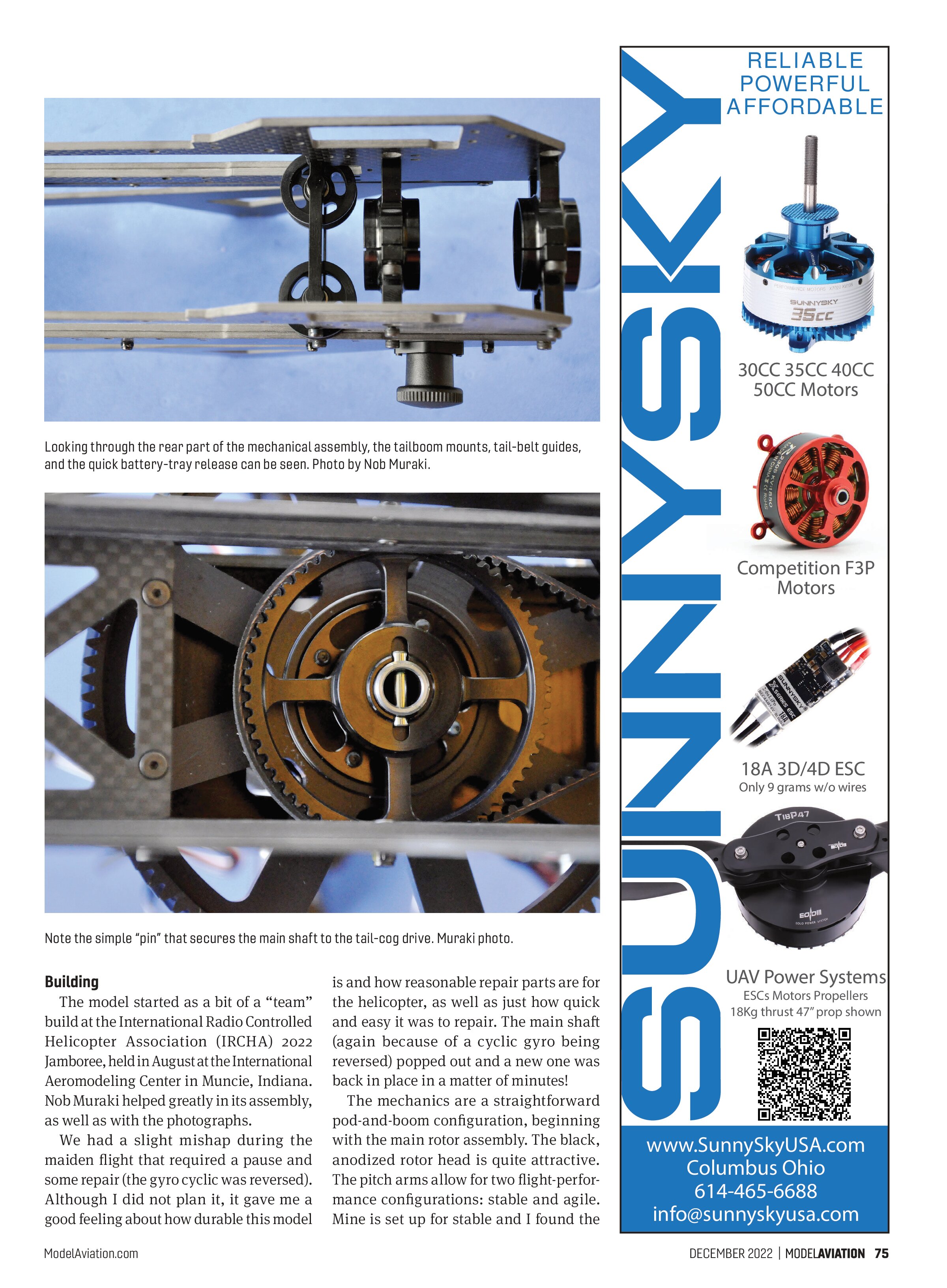
The tail assembly has many of the qualities that I have found in larger (700-plus-size) models. The large-diameter aluminum tailboom (27mm) is lightweight and remarkably stiff. This configuration allows the model to be used without the need of traditional “boom supports,” thus reducing the complexity of assembly, with the benefit of not needing the extra weight of those supports. The belt-driven tail attaches to a clean, lightweight, and nicely machined gear below the main drive gear. This gear uses a one-way bearing (driven from the main drive gear) to facilitate low-friction autorotation capability.
For the power system, I choose the Kontronik Pyro 650-103 Competition motor paired with the Kolibri 140HV ESC. This power combination provides more than enough power for any pilot, as well as smooth, reliable technology. The ESC/motor incorporates a governor that is second to none and utilizes a smooth start-up that avoids the jerky motion that plagues some other power systems. The motor and ESC fit the Nimbus 550 like a glove. With the addition of an OptiPower 5,000 mAh LiPo battery, the model was well equipped to accommodate any type of flying.
I am really impressed with the power system’s sliding battery tray design and locking method. The OptiPower battery nicely fits on the provided tray with plenty of room. This simple and impressive tray design allows a quick change of batteries and is long enough to adjust the battery location to fine-tune the center of gravity or potentially use a 12S battery if desired.
Flying
As they say, this is where the rubber meets the road. As I mentioned, most of my experience has been with larger models, and I was anticipating this heli to be a little “nervous” in its stability. I was wrong.
I lifted off the model on a rather windy day and found it to behave extremely well. It was stable and connected. The cyclic and tail control authority felt responsive and stable, not unlike larger-profile helicopters.
Conclusions
The Nimbus 550 is a great choice for a veteran helicopter pilot as a model with which to practice new maneuvers, as well as a smaller model that can easily be transported for some vacation fun-flying. The helicopter presents like a larger one, at an attractive price point that is well supported in North America.
The model goes together fast and easily, with a terrific assembly manual that provides quality sketches and directions. I’m a bit of a stickler for a good manual (in my other life, I write manuals for an industrial electronics company) and this one is impressive, showing clear steps and no-nonsense drawings that embellish the build process.
For first-time helicopter pilots or those who are transitioning from airplanes to helicopters, the Nimbus 550 is hard to beat. The model can be set up to be docile and can be tuned to accommodate your needs as the training progresses. Additionally—and especially important for a new helicopter convert—there is a great deal of information online for this heli.
There is nothing this model won’t do. The power-to-weight ratio is impressive. Additionally, you won’t have to look far to see some of the finest helicopter pilots in the world flying this model!
SOURCES:
IRCHA
www.ircha.org
XLPower
xlpowerrc@163.com
www.xlpower-rc.com
Kontronik
info @ kontronik.com
www.kontronik.com
OptiPower
www.optipower.co.uk
Futaba USA
(256) 461-9399, Ext. 8,3
www.futabausa.com