FOCAL POINT
Interested in sharing your handiwork? Visit ModelAviation.com for submission guidelines.
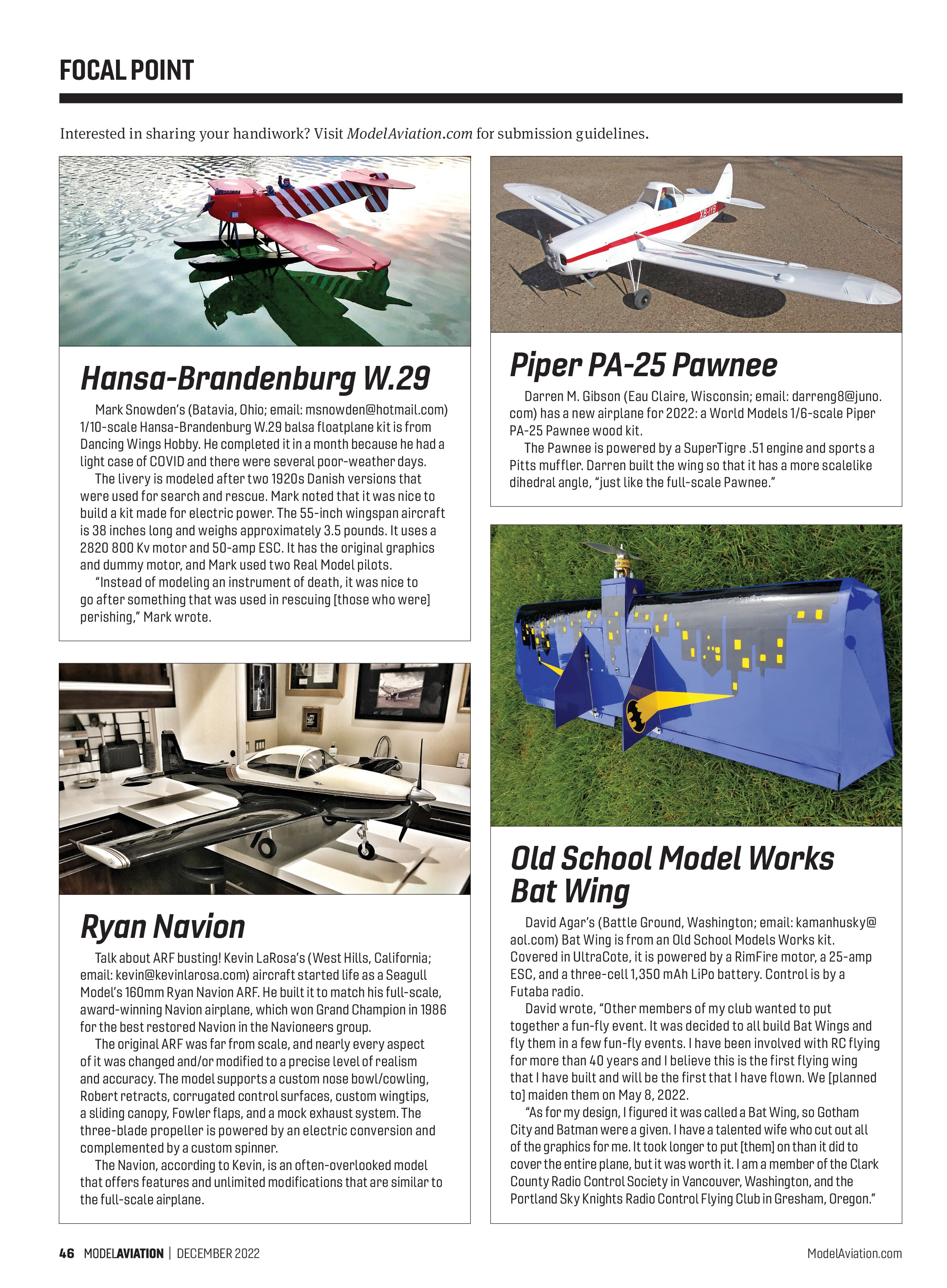
Hansa-Brandenburg W.29

Mark Snowden’s (Batavia, Ohio; email: msnowden@hotmail.com) 1/10-scale Hansa-Brandenburg W.29 balsa floatplane kit is from Dancing Wings Hobby. He completed it in a month because he had a light case of COVID and there were several poor-weather days.
The livery is modeled after two 1920s Danish versions that were used for search and rescue. Mark noted that it was nice to build a kit made for electric power. The 55-inch wingspan aircraft is 38 inches long and weighs approximately 3.5 pounds. It uses a 2820 800 Kv motor and 50-amp ESC. It has the original graphics and dummy motor, and Mark used two Real Model pilots.
“Instead of modeling an instrument of death, it was nice to go after something that was used in rescuing [those who were] perishing,” Mark wrote.
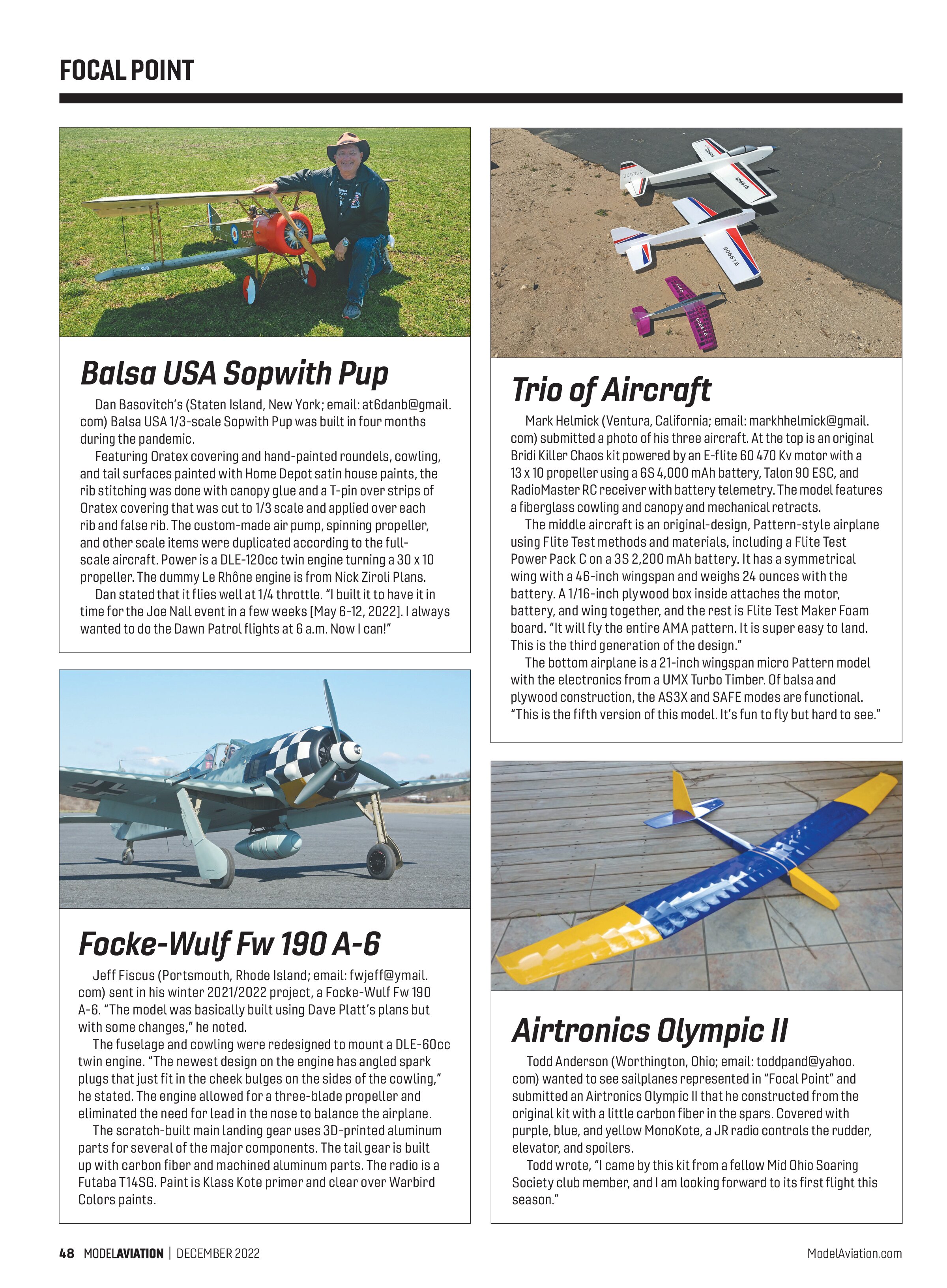
Ryan Navion

Talk about ARF busting! Kevin LaRosa’s (West Hills, California; email: kevin@kevinlarosa.com) aircraft started life as a Seagull Model’s 160mm Ryan Navion ARF. He built it to match his full-scale, award-winning Navion airplane, which won Grand Champion in 1986 for the best restored Navion in the Navioneer's group.
The original ARF was far from scale, and nearly every aspect of it was changed and/or modified to a precise level of realism and accuracy. The model supports a custom nose bowl/cowling, Robert retracts, corrugated control surfaces, custom wingtips, a sliding canopy, Fowler flaps, and a mock exhaust system. The three-blade propeller is powered by an electric conversion and complemented by a custom spinner.
The Navion, according to Kevin, is an often-overlooked model that offers features and unlimited modifications that are similar to the full-scale airplane.
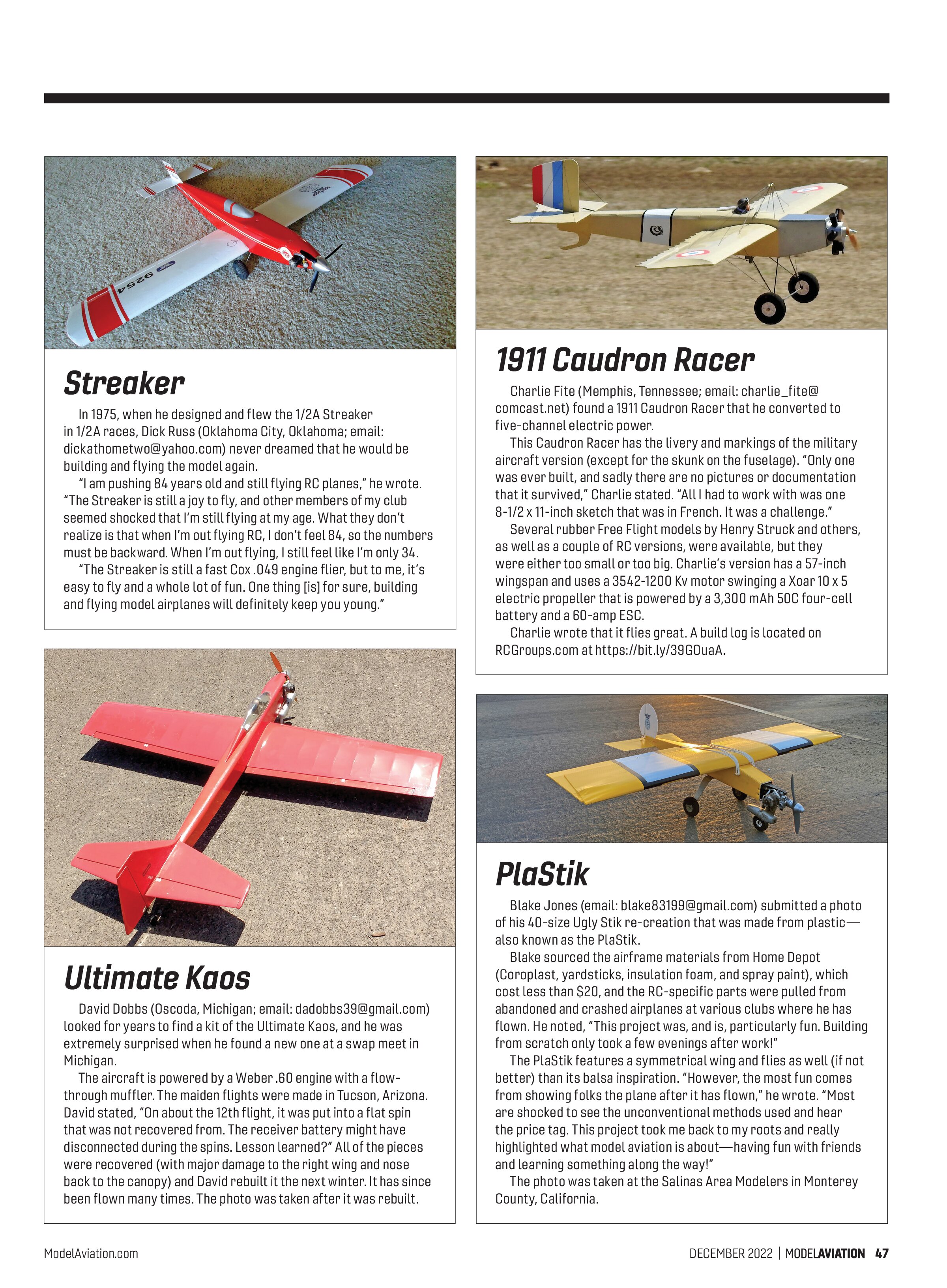
Piper PA-25 Pawnee

Darren M. Gibson (Eau Claire, Wisconsin; email: darreng8@juno.com) has a new airplane for 2022: a World Models 1/6-scale Piper PA-25 Pawnee wood kit.
The Pawnee is powered by a SuperTigre .51 engine and sports a Pitts muffler. Darren built the wing so that it has a more scalelike dihedral angle, “just like the full-scale Pawnee.”
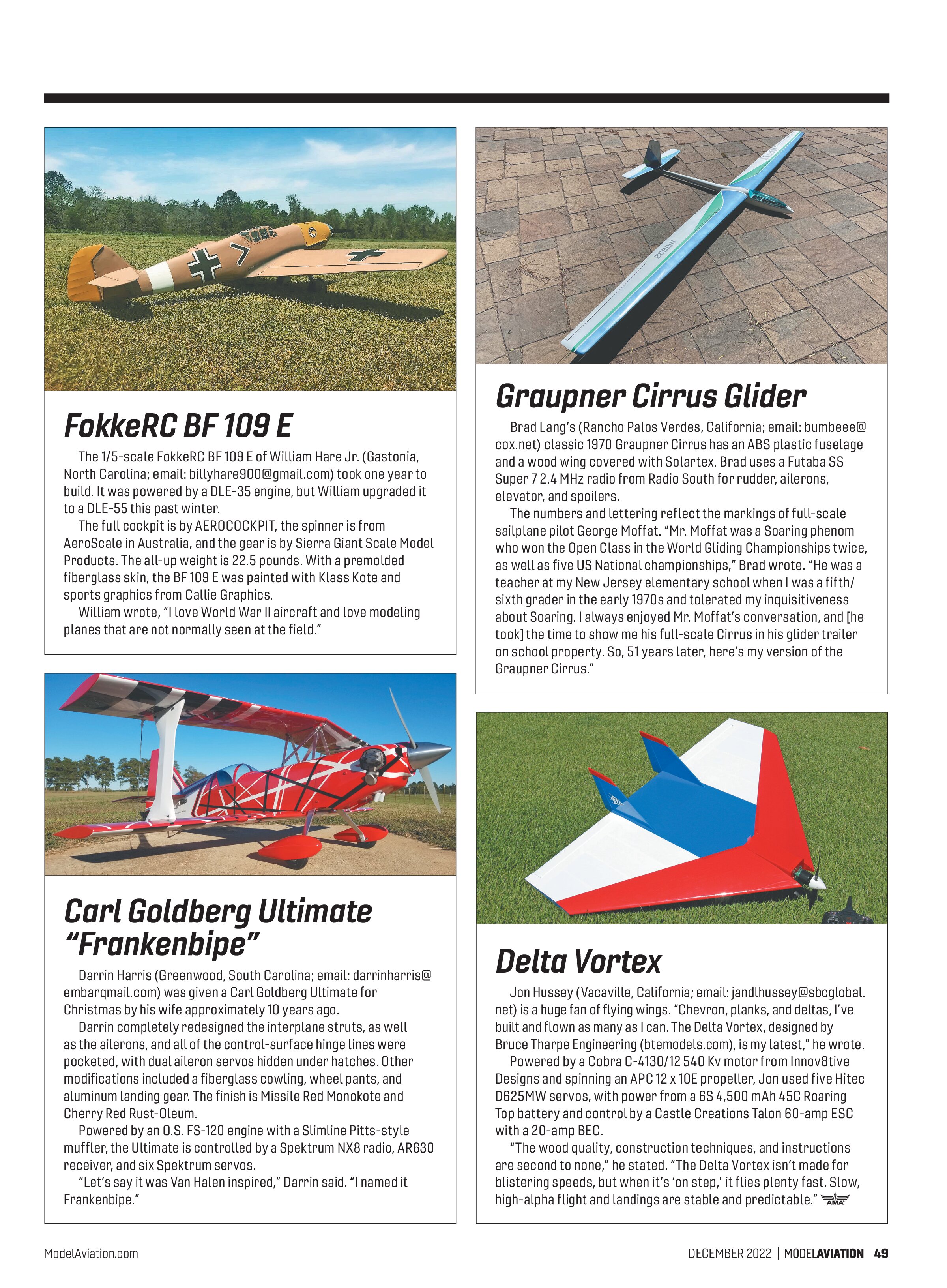
Old School Model Works Bat Wing

David Agar’s (Battle Ground, Washington; email: kamanhusky@aol.com) Bat Wing is from an Old School Models Works kit. Covered in UltraCote, it is powered by a RimFire motor, a 25-amp ESC, and a three-cell 1,350 mAh LiPo battery. Control is by a Futaba radio.
David wrote, “Other members of my club wanted to put together a fun-fly event. It was decided to all build Bat Wings and fly them in a few fun-fly events. I have been involved with RC flying for more than 40 years and I believe this is the first flying wing that I have built and will be the first that I have flown. We [planned to] maiden them on May 8, 2022.
“As for my design, I figured it was called a Bat Wing, so Gotham City and Batman were a given. I have a talented wife who cut out all of the graphics for me. It took longer to put [them] on than it did to cover the entire plane, but it was worth it. I am a member of the Clark County Radio Control Society in Vancouver, Washington, and the Portland Sky Knights Radio Control Flying Club in Gresham, Oregon.”
Streaker

In 1975, when he designed and flew the 1/2A Streaker in 1/2A races, Dick Russ (Oklahoma City, Oklahoma; email: dickathometwo@yahoo.com) never dreamed that he would be building and flying the model again.
“I am pushing 84 years old and still flying RC planes,” he wrote. “The Streaker is still a joy to fly, and other members of my club seemed shocked that I’m still flying at my age. What they don’t realize is that when I’m out flying RC, I don’t feel 84, so the numbers must be backward. When I’m out flying, I still feel like I’m only 34.
“The Streaker is still a fast Cox .049 engine flier, but to me, it’s easy to fly and a whole lot of fun. One thing [is] for sure, building and flying model airplanes will definitely keep you young.”
Ultimate Kaos

David Dobbs (Oscoda, Michigan; email: dadobbs39@gmail.com) looked for years to find a kit of the Ultimate Kaos, and he was extremely surprised when he found a new one at a swap meet in Michigan.
The aircraft is powered by a Weber .60 engine with a flow-through muffler. The maiden flights were made in Tucson, Arizona. David stated, “On about the 12th flight, it was put into a flat spin that was not recovered from. The receiver battery might have disconnected during the spins. Lesson learned?” All of the pieces were recovered (with major damage to the right wing and nose back to the canopy) and David rebuilt it the next winter. It has since been flown many times. The photo was taken after it was rebuilt.
1911 Caudron Racer

Charlie Fite (Memphis, Tennessee; email: charlie_fite@comcast.net) found a 1911 Caudron Racer that he converted to five-channel electric power.
This Caudron Racer has the livery and markings of the military aircraft version (except for the skunk on the fuselage). “Only one was ever built, and sadly there are no pictures or documentation that it survived,” Charlie stated. “All I had to work with was one 8-1/2 x 11-inch sketch that was in French. It was a challenge.”
Several rubber Free Flight models by Henry Struck and others, as well as a couple of RC versions, were available, but they were either too small or too big. Charlie’s version has a 57-inch wingspan and uses a 3542-1200 Kv motor swinging a Xoar 10 x 5 electric propeller that is powered by a 3,300 mAh 50C four-cell battery and a 60-amp ESC.
Charlie wrote that it flies great. A build log is located on RCGroups.com at https://bit.ly/39G0uaA.
PlaStik

Blake Jones (email: blake83199@gmail.com) submitted a photo of his 40-size Ugly Stik re-creation that was made from plastic—also known as the PlaStik.
Blake sourced the airframe materials from Home Depot (Coroplast, yardsticks, insulation foam, and spray paint), which cost less than $20, and the RC-specific parts were pulled from abandoned and crashed airplanes at various clubs where he has flown. He noted, “This project was, and is, particularly fun. Building from scratch only took a few evenings after work!”
The PlaStik features a symmetrical wing and flies as well (if not better) than its balsa inspiration. “However, the most fun comes from showing folks the plane after it has flown,” he wrote. “Most are shocked to see the unconventional methods used and hear the price tag. This project took me back to my roots and really highlighted what model aviation is about—having fun with friends and learning something along the way!”
The photo was taken at the Salinas Area Modelers in Monterey County, California.
Balsa USA Sopwith Pup
Dan Basovitch’s (Staten Island, New York; email: at6danb@gmail.com) Balsa USA 1/3-scale Sopwith Pup was built in four months during the pandemic.
Featuring Oratex covering and hand-painted roundels, cowling, and tail surfaces painted with Home Depot satin house paints, the rib stitching was done with canopy glue and a T-pin over strips of Oratex covering that was cut to 1/3 scale and applied over each rib and false rib. The custom-made air pump, spinning propeller, and other scale items were duplicated according to the full-scale aircraft. Power is a DLE-120cc twin engine turning a 30 x 10 propeller. The dummy Le Rhône engine is from Nick Ziroli Plans.
Dan stated that it flies well at 1/4 throttle. “I built it to have it in time for the Joe Nall event in a few weeks [May 6-12, 2022]. I always wanted to do the Dawn Patrol flights at 6 a.m. Now I can!”

Focke-Wulf Fw 190 A-6
Jeff Fiscus (Portsmouth, Rhode Island; email: fwjeff@ymail.com) sent in his winter 2021/2022 project, a Focke-Wulf Fw 190 A-6. “The model was basically built using Dave Platt’s plans but with some changes,” he noted.
The fuselage and cowling were redesigned to mount a DLE-60cc twin engine. “The newest design on the engine has angled spark plugs that just fit in the cheek bulges on the sides of the cowling,” he stated. The engine allowed for a three-blade propeller and eliminated the need for lead in the nose to balance the airplane.
The scratch-built main landing gear uses 3D-printed aluminum parts for several of the major components. The tail gear is built up with carbon fiber and machined aluminum parts. The radio is a Futaba T14SG. Paint is Klass Kote primer and clear over Warbird Colors paints.

Trio of Aircraft
Mark Helmick (Ventura, California; email: markhelmick@gmail.com) submitted a photo of his three aircraft. At the top is an original Bridi Killer Chaos kit powered by an E-flite 60 470 Kv motor with a 13 x 10 propeller using a 6S 4,000 mAh battery, Talon 90 ESC, and RadioMaster RC receiver with battery telemetry. The model features a fiberglass cowling and canopy and mechanical retracts.
The middle aircraft is an original-design, Pattern-style airplane using Flite Test methods and materials, including a Flite Test Power Pack C on a 3S 2,200 mAh battery. It has a symmetrical wing with a 46-inch wingspan and weighs 24 ounces with the battery. A 1/16-inch plywood box inside attaches the motor, battery, and wing together, and the rest is Flite Test Maker Foam board. “It will fly the entire AMA pattern. It is super easy to land. This is the third generation of the design.”
The bottom airplane is a 21-inch wingspan micro Pattern model with the electronics from a UMX Turbo Timber. Of balsa and plywood construction, the AS3X and SAFE modes are functional. “This is the fifth version of this model. It’s fun to fly but hard to see.”

Airtronics Olympic II
Todd Anderson (Worthington, Ohio; email: toddpand@yahoo.com) wanted to see sailplanes represented in “Focal Point” and submitted an Airtronics Olympic II that he constructed from the original kit with a little carbon fiber in the spars. Covered with purple, blue, and yellow MonoKote, a JR radio controls the rudder, elevator, and spoilers.
Todd wrote, “I came by this kit from a fellow Mid Ohio Soaring Society club member, and I am looking forward to its first flight this season.”

FokkeRC BF 109 E
The 1/5-scale FokkeRC BF 109 E of William Hare Jr. (Gastonia, North Carolina; email: billyhare900@gmail.com) took one year to build. It was powered by a DLE-35 engine, but William upgraded it to a DLE-55 this past winter.
The full cockpit is by AEROCOCKPIT, the spinner is from AeroScale in Australia, and the gear is by Siera Giant Scale Model Products. The all-up weight is 22.5 pounds. With a premolded fiberglass skin, the BF 109 E was painted with Klass Kote and sports graphics from Callie Graphics.
William wrote, “I love World War II aircraft and love modeling planes that are not normally seen at the field.”

Carl Goldberg Ultimate “Frankenbipe”
Darrin Harris (Greenwood, South Carolina; email: darrinharris@embargmail.com) was given a Carl Goldberg Ultimate for Christmas by his wife approximately 10 years ago.
Darrin completely redesigned the interplane struts, as well as the ailerons, and all of the control-surface hinge lines were pocketed, with dual aileron servos hidden under hatches. Other modifications included a fiberglass cowling, wheel pants, and aluminum landing gear. The finish is Missile Red Monokote and Cherry Red Rust-Oleum.
Powered by an O.S. FS-120 engine with a Slimline Pitts-style muffler, the Ultimate is controlled by a Spektrum NX8 radio, AR630 receiver, and six Spektrum servos.
“Let’s say it was Van Halen inspired,” Darrin said. “I named it Frankenbipe.”

Graupner Cirrus Glider
Brad Lang’s (Rancho Palos Verdes, California; email: bumbee@cox.net) classic 1970 Graupner Cirrus has an ABS plastic fuselage and a wood wing covered with Solartex. Brad uses a Futaba SS Super 7 2.4 MHz radio from Radio South for rudder, ailerons, elevator, and spoilers.
The numbers and lettering reflect the markings of full-scale sailplane pilot George Moffat. “Mr. Moffat was a Soaring phenom who won the Open Class in the World Gliding Championships twice, as well as five US National championships,” Brad wrote. “He was a teacher at my New Jersey elementary school when I was a fifth/sixth grader in the early 1970s and tolerated my inquisitiveness about Soaring. I always enjoyed Mr. Moffat’s conversation, and [he took] the time to show me his full-scale Cirrus in his glider trailer on school property. So, 51 years later, here’s my version of the Graupner Cirrus.”

Delta Vortex
Jon Hussey (Vacaville, California; email: jandlhussey@sbcglobal.net) is a huge fan of flying wings. “Chevron, planks, and deltas, I’ve built and flown as many as I can. The Delta Vortex, designed by Bruce Tharpe Engineering (btemodels.com), is my latest,” he wrote.
Powered by a Cobra C-4130/12 540 Kv motor from Innov8tive Designs and spinning an APC 12 x 10E propeller, Jon used five Hitec D625MW servos, with power from a 6S 4,500 mAh 45C Roaring Top battery and control by a Castle Creations Talon 60-amp ESC with a 20-amp BEC.
“The wood quality, construction techniques, and instructions are second to none,” he stated. “The Delta Vortex isn’t made for blistering speeds, but when it’s ‘on step,’ it flies plenty fast. Slow, high-alpha flight and landings are stable and predictable.”