THE PRACTICAL LESSONS OF RC
By Terry Dunn | terrydunn74@gmail.com

AS I AM WRITING this column, I’m currently surrounded by moving boxes that are patiently waiting to be unpacked. Everyone knows that moving is no fun. Moving with lots of fragile model airplanes is even less fun!
I am happy, however, to report that my model fleet suffered only a few minor dings and scratches in the move. I am still trying to get my workshop in order so that I can resume all of the projects that have been on hold. I am anxious to get building again!
Giant Mitchells
My new home is located just north of Green Bay, Wisconsin. I can’t wait to check out all of the RC clubs and events in this part of the country. In fact, I have already attended one event as a spectator. The Fond du Lac Aeromodelers hosted its annual Warbirds and Classics Over the Midwest (WCOM) event August 18-20. The size of the event, the giant flying field, and the huge models totally shocked me.
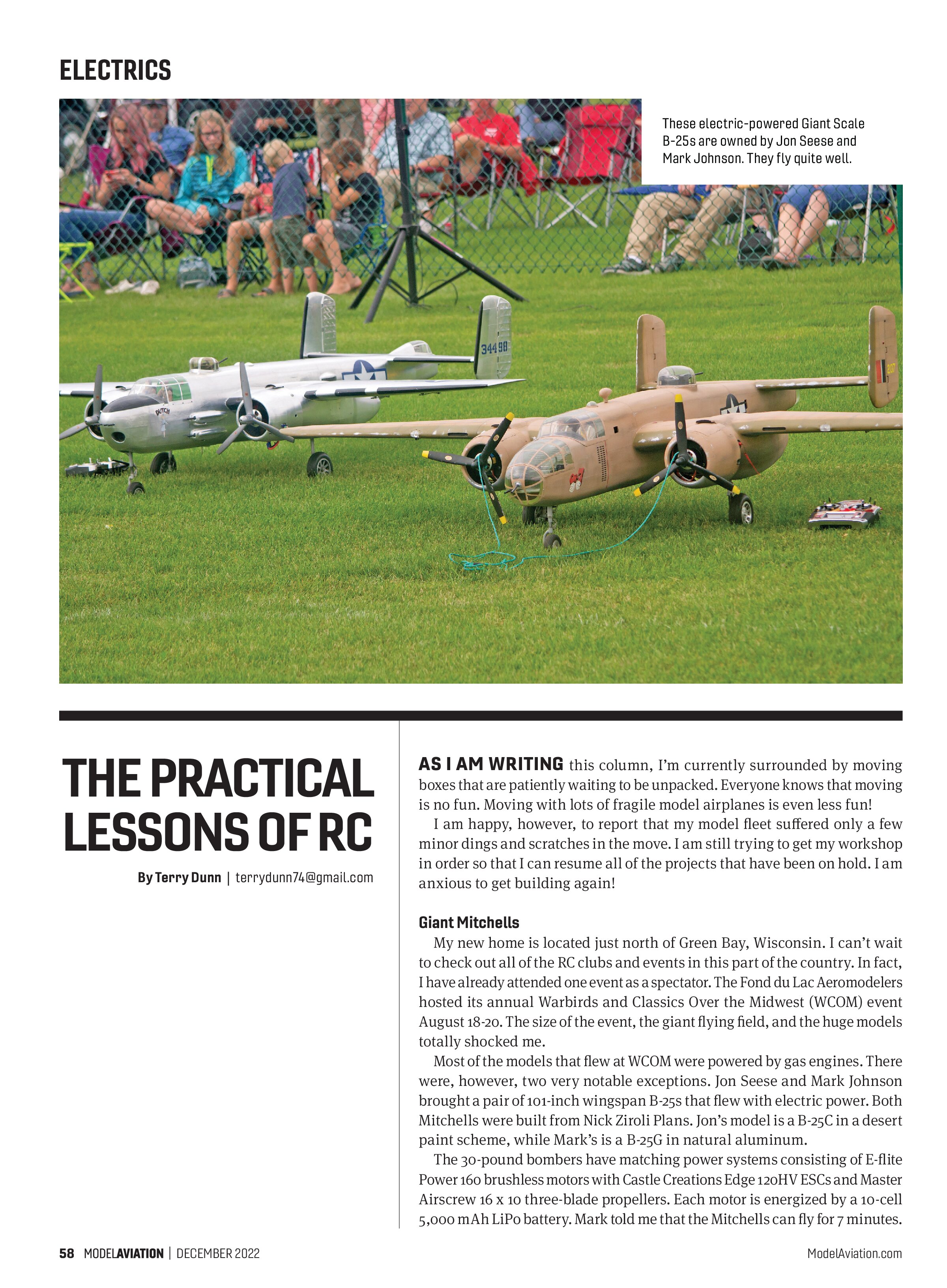
Most of the models that flew at WCOM were powered by gas engines. There were, however, two very notable exceptions. Jon Seese and Mark Johnson brought a pair of 101-inch wingspan B-25s that flew with electric power. Both Mitchells were built from Nick Ziroli Plans. Jon’s model is a B-25C in a desert paint scheme, while Mark’s is a B-25G in natural aluminum.
The 30-pound bombers have matching power systems consisting of E-flite Power 160 brushless motors with Castle Creations Edge 120HV ESCs and Master Airscrew 16 x 10 three-blade propellers. Each motor is energized by a 10-cell 5,000 mAh LiPo battery. Mark told me that the Mitchells can fly for 7 minutes.
After seeing these models fly, I can tell you that they perform well and look spectacular in the air. Jon and Mark even did a good job of flying in formation during the flight that I witnessed. I was truly impressed. I look forward to seeing these B-25s again next year when I return to WCOM as a participant!
Applying RC Knowledge
My previous columns have covered strategies for optimizing the output of our electric power systems while also avoiding trouble spots. Those strategies are not necessarily specific to RC airplanes. My experience with a boat trolling motor is a prime example.
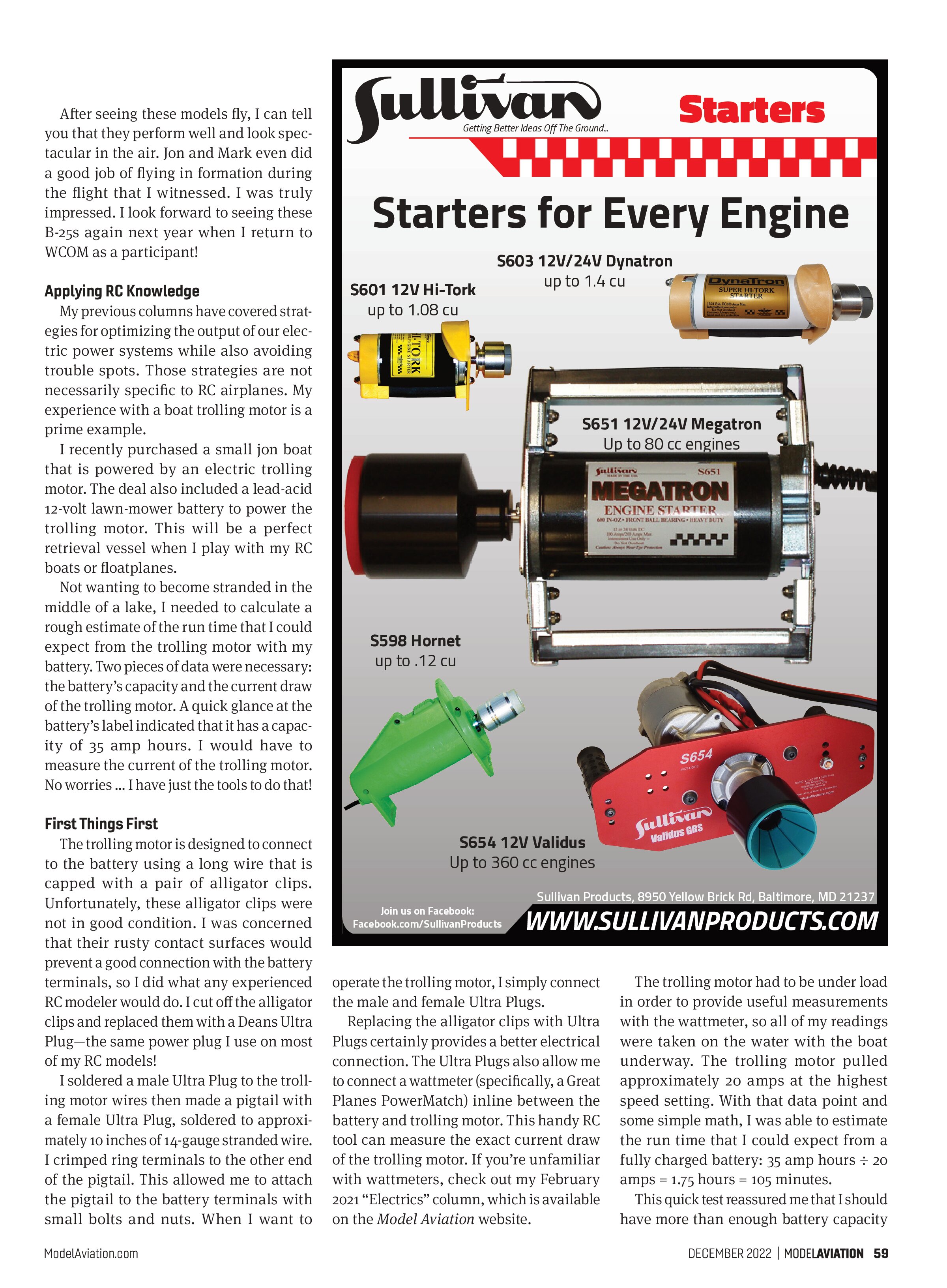
I recently purchased a small jon boat that is powered by an electric trolling motor. The deal also included a lead-acid 12-volt lawn-mower battery to power the trolling motor. This will be a perfect retrieval vessel when I play with my RC boats or floatplanes.
Not wanting to become stranded in the middle of a lake, I needed to calculate a rough estimate of the run time that I could expect from the trolling motor with my battery. Two pieces of data were necessary: the battery’s capacity and the current draw of the trolling motor. A quick glance at the battery’s label indicated that it has a capacity of 35 amp hours. I would have to measure the current of the trolling motor. No worries ... I have just the tools to do that!
First Things First
The trolling motor is designed to connect to the battery using a long wire that is capped with a pair of alligator clips. Unfortunately, these alligator clips were not in good condition. I was concerned that their rusty contact surfaces would prevent a good connection with the battery terminals, so I did what any experienced RC modeler would do. I cut off the alligator clips and replaced them with a Deans Ultra Plug—the same power plug I use on most of my RC models!
I soldered a male Ultra Plug to the trolling motor wires then made a pigtail with a female Ultra Plug, soldered to approximately 10 inches of 14-gauge stranded wire. I crimped ring terminals to the other end of the pigtail. This allowed me to attach the pigtail to the battery terminals with small bolts and nuts. When I want to operate the trolling motor, I simply connect the male and female Ultra Plugs.
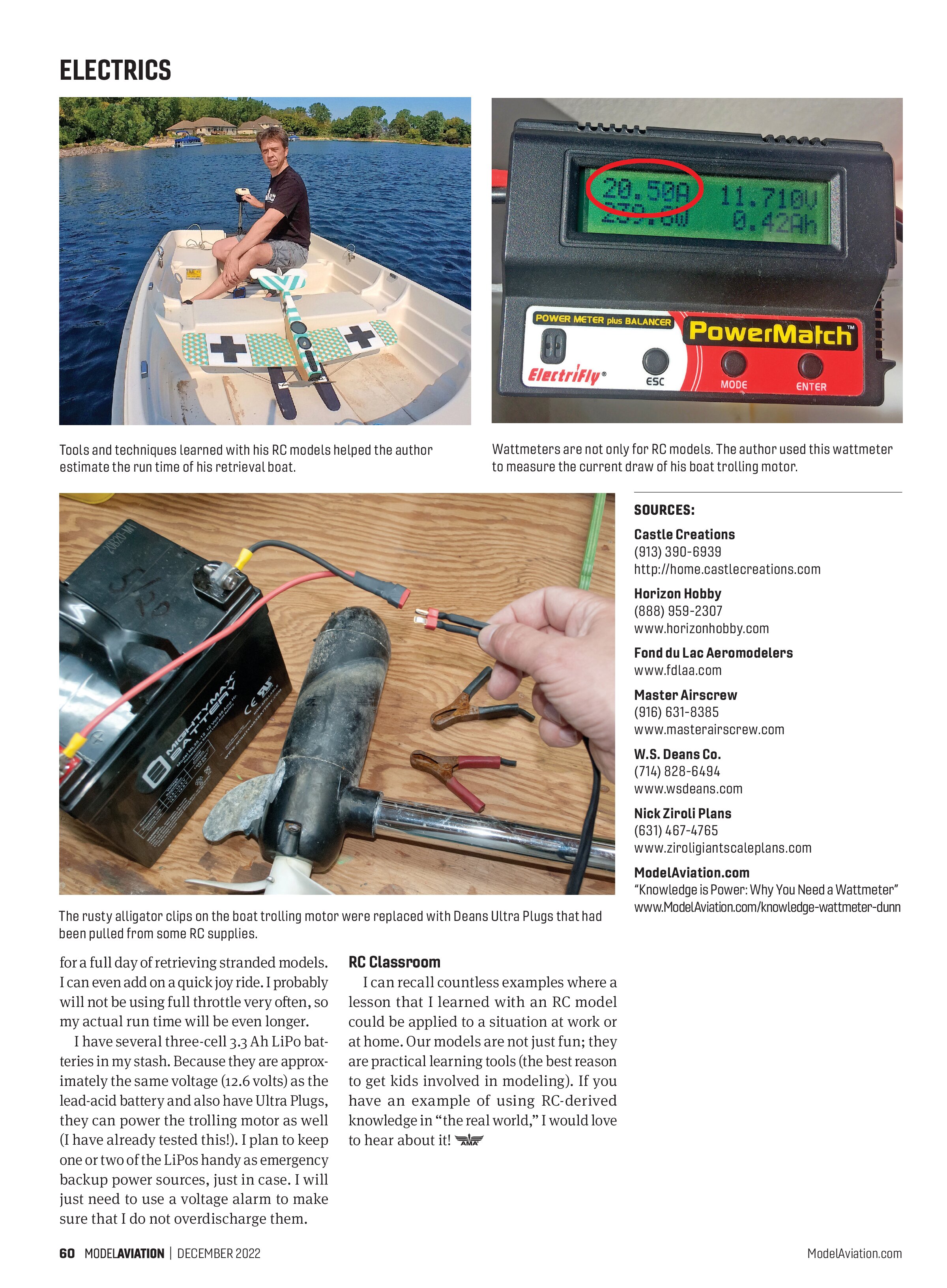
Replacing the alligator clips with Ultra Plugs certainly provides a better electrical connection. The Ultra Plugs also allow me to connect a wattmeter (specifically, a Great Planes PowerMatch) inline between the battery and trolling motor. This handy RC tool can measure the exact current draw of the trolling motor. If you’re unfamiliar with wattmeters, check out my February 2021 “Electrics” column, which is available on the Model Aviation website.
The trolling motor had to be under load in order to provide useful measurements with the wattmeter, so all of my readings were taken on the water with the boat underway. The trolling motor pulled approximately 20 amps at the highest speed setting. With that data point and some simple math, I was able to estimate the run time that I could expect from a fully charged battery: 35 amp hours ÷ 20 amps = 1.75 hours = 105 minutes.
This quick test reassured me that I should have more than enough battery capacity


SOURCES:
Castle Creations
(913) 390-6939
http://home.castlecreations.com
Horizon Hobby
(888) 959-2307
www.horizonhobby.com
Fond du Lac Aeromodelers
www.fdlaa.com
Master Airscrew
(916) 631-8385
www.masterairscrew.com
W.S. Deans Co.
(714) 828-6494
www.wsdeans.com
Nick Ziroli Plans
(631) 467-4765
www.ziroligiantscaleplans.com
ModelAviation.com
“Knowledge is Power: Why You Need a Wattmeter”
www.ModelAviation.com/knowledge-wattmeter-dunn
for a full day of retrieving stranded models. I can even add on a quick joy ride. I probably will not be using full throttle very often, so my actual run time will be even longer.
I have several three-cell 3.3 Ah LiPo batteries in my stash. Because they are approximately the same voltage (12.6 volts) as the lead-acid battery and also have Ultra Plugs, they can power the trolling motor as well (I have already tested this!). I plan to keep one or two of the LiPos handy as emergency backup power sources, just in case. I will just need to use a voltage alarm to make sure that I do not overdischarge them.
RC Classroom
I can recall countless examples where a lesson that I learned with an RC model could be applied to a situation at work or at home. Our models are not just fun; they are practical learning tools (the best reason to get kids involved in modeling). If you have an example of using RC-derived knowledge in “the real world,” I would love to hear about it!