The Deal with Drones

WHY I RACE: NEW COLUMNIST SUSAN SMITH
By Susan Smith | susankaysmith@gmail.com
I SAT DOWN and took a deep breath. This was it. Everything I had worked so hard for culminated in this moment. I pulled my FPV goggles down over my eyes and adjusted them until they felt exactly right. Through the goggles, I saw the video transmitted from my drone. I focused on the start gate visible in front of me. I held my radio transmitter firmly on my lap, my thumb and index fingers poised over the two sticks that controlled my drone. The announcer’s voice boomed, “Pilots, arm your quads, as we go live on the tone in less than five.”
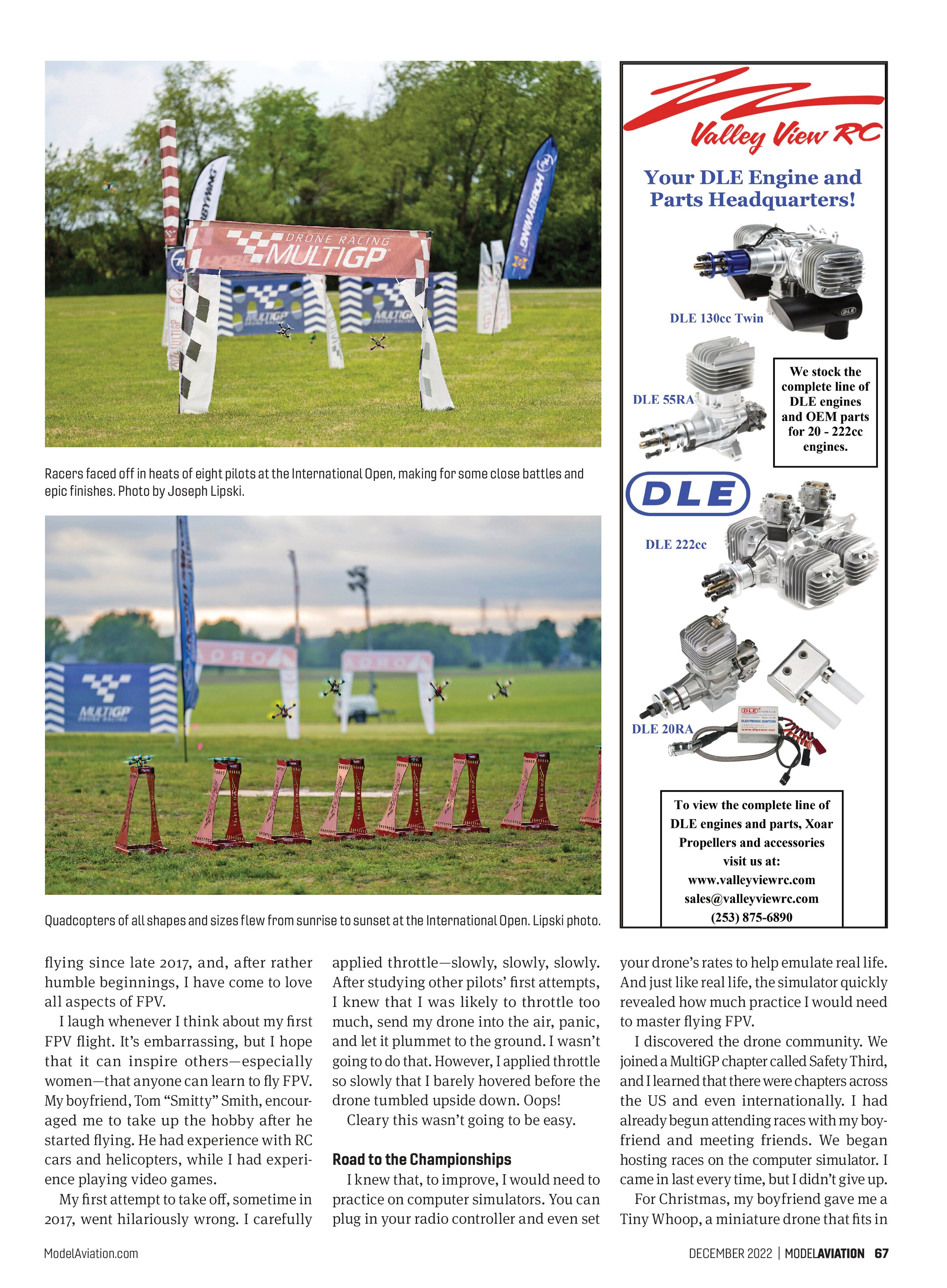
I flicked two switches on my drone and my pink propellers began to spin in my camera feed as I prepared to take off. Beep! I quickly throttled up and pitched forward, sending my drone racing onto the track. I flew my drone quickly through gate after gate, speeding past flags and other obstacles, trying to beat the seven other competitors in the air.
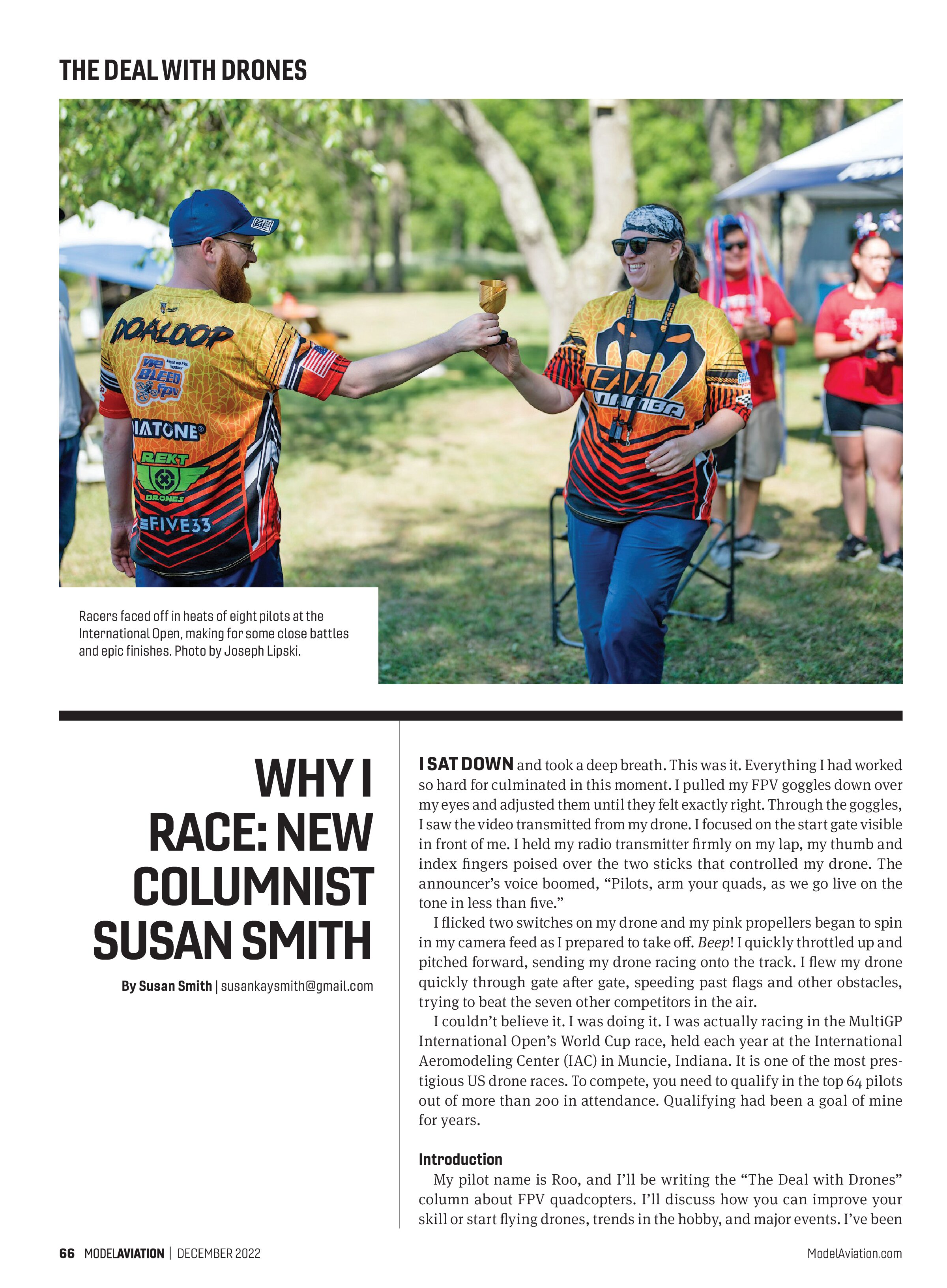
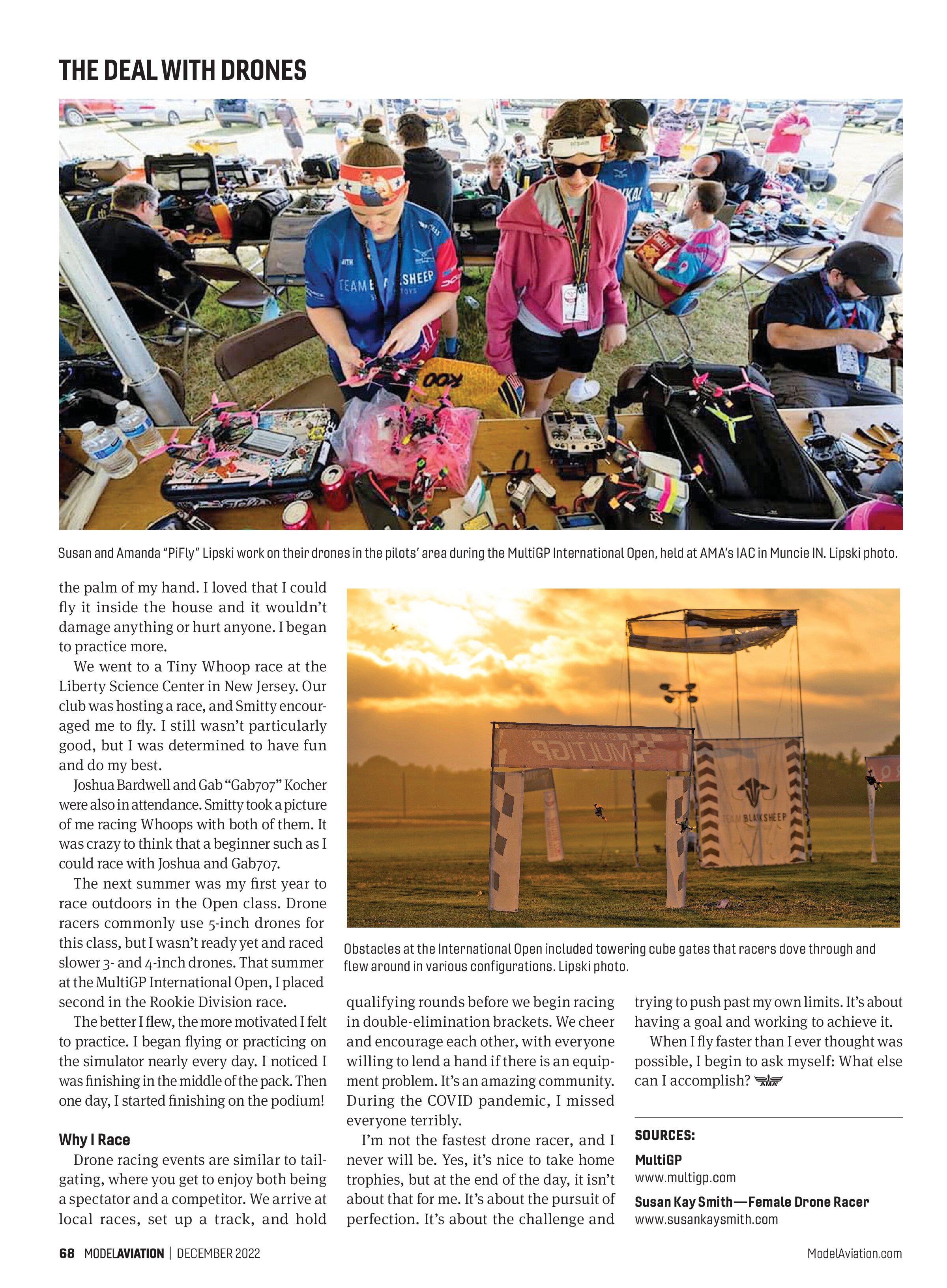
I couldn’t believe it. I was doing it. I was actually racing in the MultiGP International Open’s World Cup race, held each year at the International Aeromodeling Center (IAC) in Muncie, Indiana. It is one of the most prestigious US drone races. To compete, you need to qualify in the top 64 pilots out of more than 200 in attendance. Qualifying had been a goal of mine for years.
Introduction
My pilot name is Roo, and I’ll be writing the “The Deal with Drones” column about FPV quadcopters. I’ll discuss how you can improve your skill or start flying drones, trends in the hobby, and major events. I’ve been


flying since late 2017, and, after rather humble beginnings, I have come to love all aspects of FPV.
I laugh whenever I think about my first FPV flight. It’s embarrassing, but I hope that it can inspire others—especially women—that anyone can learn to fly FPV. My boyfriend, Tom “Smitty” Smith, encouraged me to take up the hobby after he started flying. He had experience with RC cars and helicopters, while I had experience playing video games.
My first attempt to take off, sometime in 2017, went hilariously wrong. I carefully applied throttle—slowly, slowly, slowly. After studying other pilots’ first attempts, I knew that I was likely to throttle too much, send my drone into the air, panic, and let it plummet to the ground. I wasn’t going to do that. However, I applied throttle so slowly that I barely hovered before the drone tumbled upside down. Oops!
Cleary this wasn’t going to be easy.
Road to the Championships
I knew that, to improve, I would need to practice on computer simulators. You can plug in your radio controller and even set your drone’s rates to help emulate real life. And just like real life, the simulator quickly revealed how much practice I would need to master flying FPV.
I discovered the drone community. We joined a MultiGP chapter called Safety Third, and I learned that there were chapters across the US and even internationally. I had already begun attending races with my boyfriend and meeting friends. We began hosting races on the computer simulator. I came in last every time, but I didn’t give up.
For Christmas, my boyfriend gave me a Tiny Whoop, a miniature drone that fits in

the palm of my hand. I loved that I could fly it inside the house and it wouldn’t damage anything or hurt anyone. I began to practice more.
We went to a Tiny Whoop race at the Liberty Science Center in New Jersey. Our club was hosting a race, and Smitty encouraged me to fly. I still wasn’t particularly good, but I was determined to have fun and do my best.
Joshua Bardwell and Gab “Gab707” Kocher were also in attendance. Smitty took a picture of me racing Whoops with both of them. It was crazy to think that a beginner such as I could race with Joshua and Gab707.
The next summer was my first year to race outdoors in the Open class. Drone racers commonly use 5-inch drones for this class, but I wasn’t ready yet and raced slower 3- and 4-inch drones. That summer at the MultiGP International Open, I placed second in the Rookie Division race.
The better I flew, the more motivated I felt to practice. I began flying or practicing on the simulator nearly every day. I noticed I was finishing in the middle of the pack. Then one day, I started finishing on the podium!
Why I Race
Drone racing events are similar to tail-gating, where you get to enjoy both being a spectator and a competitor. We arrive at local races, set up a track, and hold

qualifying rounds before we begin racing in double-elimination brackets. We cheer and encourage each other, with everyone willing to lend a hand if there is an equipment problem. It’s an amazing community. During the COVID pandemic, I missed everyone terribly.
I’m not the fastest drone racer, and I never will be. Yes, it’s nice to take home trophies, but at the end of the day, it isn’t about that for me. It’s about the pursuit of perfection. It’s about the challenge and
trying to push past my own limits. It’s about having a goal and working to achieve it.
When I fly faster than I ever thought was possible, I begin to ask myself: What else can I accomplish?
SOURCES:
MultiGP
www.multigp.com
Susan Kay Smith—Female Drone Racer
www.susankaysmith.com