VINTAGE VIEWPOINT

ANOTHER
TRIP TO BOB’S
MAGAZINE
LIBRARY
By Bob Noll | bobrc@aol.com
Editor’s note: The incorrect “Vintage Viewpoint” column inadvertently ran in the July 2022 issue. Following is the column that should have appeared in the July issue describing magazine issues from April 1972.
THE SNOW HAS MELTED and the temperature is approaching “flying time” here in upstate New York. A trip downstairs to my magazine library amounted to the retrieval of magazines from April 1972. Let’s take a look back 50 years ago in RC.
American Aircraft Modeler (AAM) featured the 45th in a series by Howard McEntee. This issue on “Getting Started in RC” was about throttle pushrod systems. Howard shared a clever way to keep fuel and oil from passing back through the pushrod casing. The trick, as diagrammed by Howard, was to solder a brass tube to the wire pushrod that slips over the pushrod casing. I wish I had discovered this.
The Flying Wing Contest, as reported by D. Walter Clark, was an annual event held at Sepulveda Basin near Los Angeles. There were many event categories with but one restriction—the airplane must not have a tail. The categories included Free Flight (FF) Gas, Towline, FF Scale Jetex, Rubber, and RC.
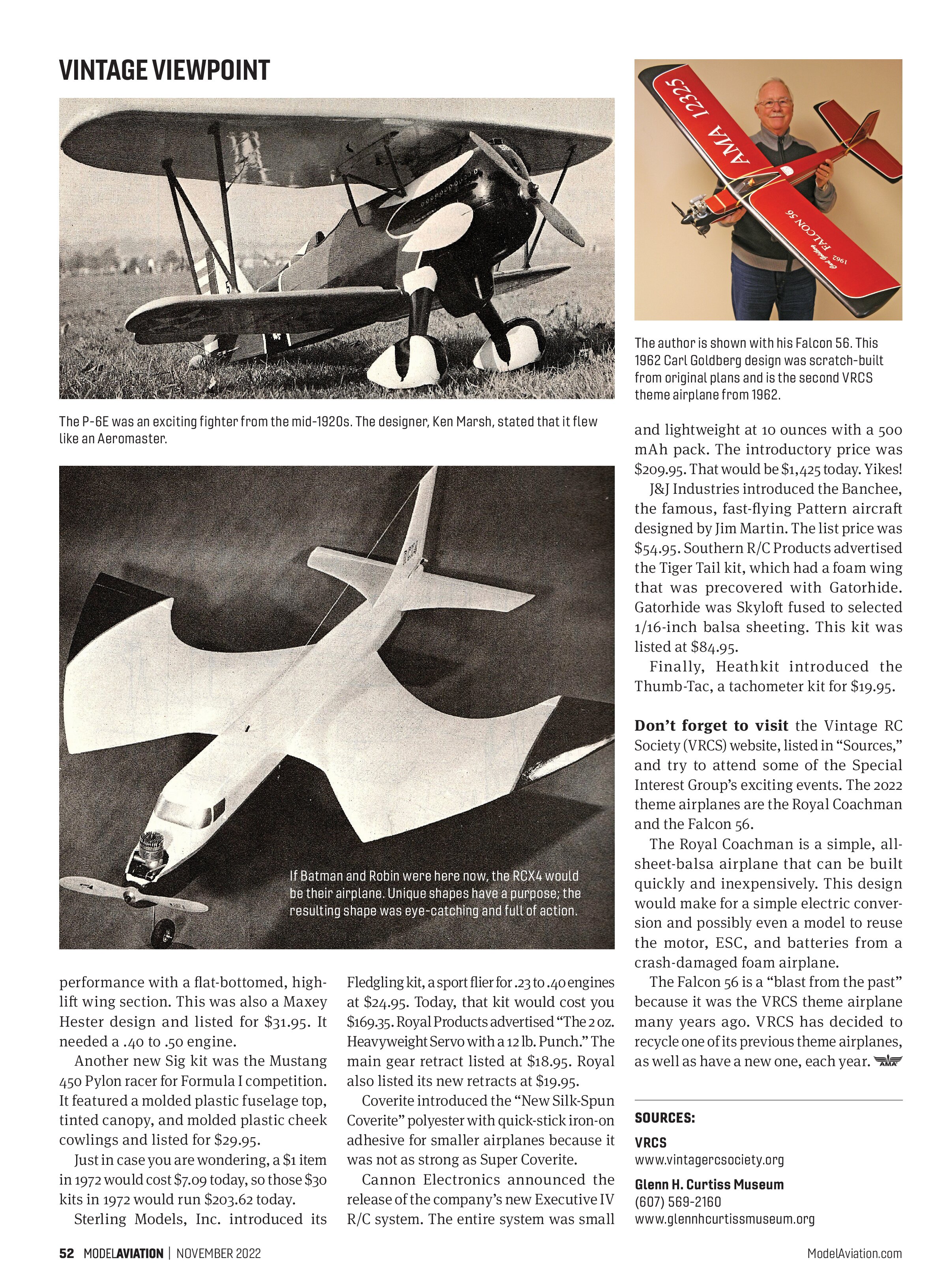
An article about the RCX4, by Milton Schmidt, caught my eye. If Batman and Robin were here now, this would be their airplane. Unique wing shapes were intended to control spanwise airflow patterns to produce a stable flying model. The RCX4 was powered by a .71 cu. in. engine. The author stated that he felt a good .60 engine would do fine.
Jerry Parker presented his Dragonette, a .40-engine-powered, .8-size version of Phil Kraft’s Dragon Fli. The Dragonette weighed 4 pounds and was competitive in Pattern contests.
Fred Marks presented part one of a two-channel digital system he called the AAM Commander. AAM asked Fred to undertake the project and “make it as simple and goof proof as possible.” The article included a parts/manufacturer/distributor list, along with all of the other information that was needed to build the system and make your own printed circuit boards for the transmitter, receiver, and servos.
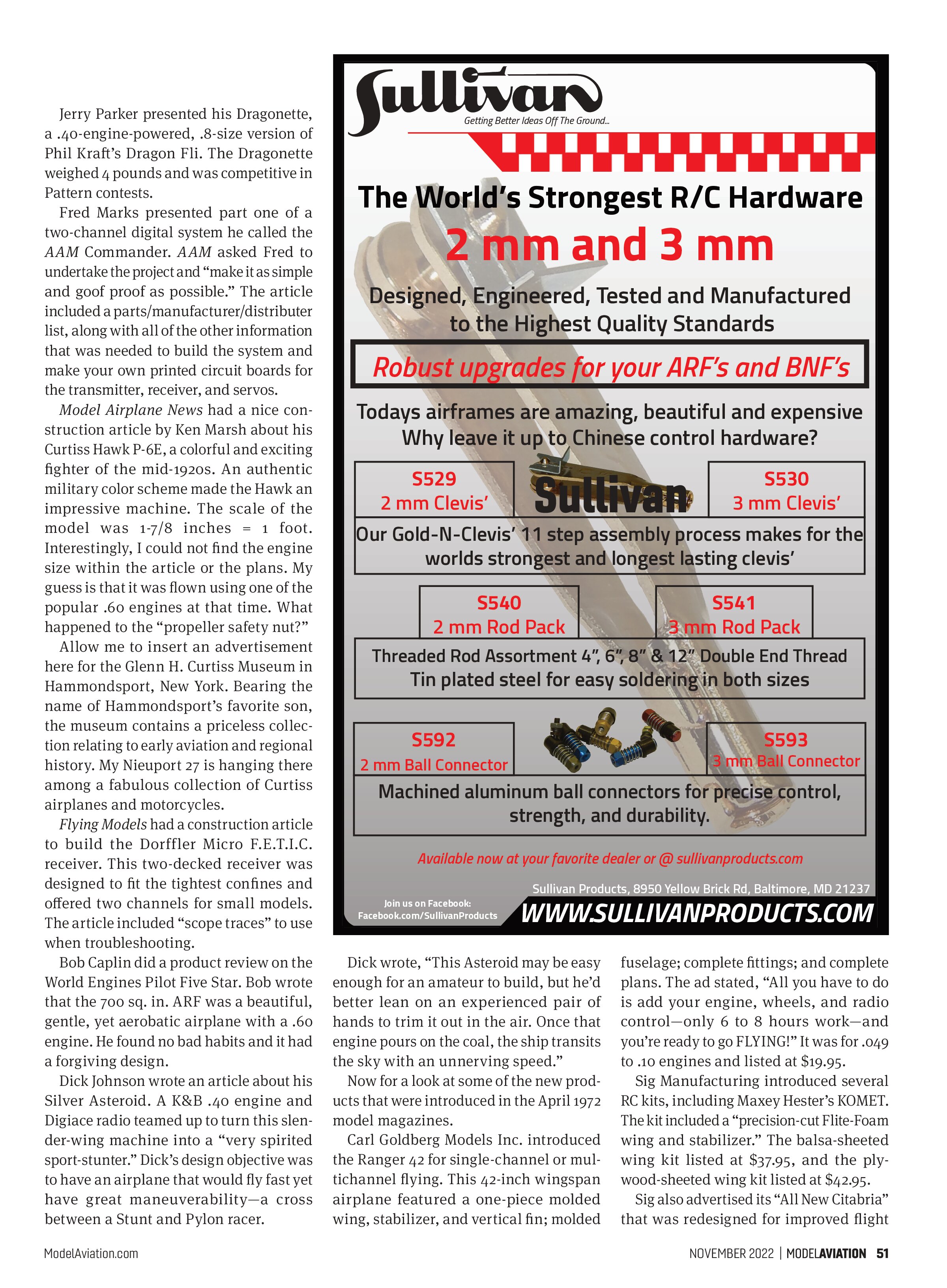
Model Airplane News had a nice construction article by Ken Marsh about his Curtiss Hawk P-6E, a colorful and exciting fighter of the mid-1920s. An authentic military color scheme made the Hawk an impressive machine. The scale of the model was 1-7/8 inches = 1 foot. Interestingly, I could not find the engine size within the article or the plans. My guess is that it was flown using one of the popular .60 engines at that time. What happened to the “propeller safety nut?”
Allow me to insert an advertisement here for the Glenn H. Curtiss Museum in Hammondsport, New York. Bearing the name of Hammondsport’s favorite son, the museum contains a priceless collection relating to early aviation and regional history. My Nieuport 27 is hanging there among a fabulous collection of Curtiss airplanes and motorcycles.
Flying Models had a construction article to build the Dorffler Micro F.E.T.I.C. receiver. This two-decked receiver was designed to fit the tightest confines and offered two channels for small models. The article included “scope traces” to use when troubleshooting.
Bob Caplin did a product review on the World Engines Pilot Five Star. Bob wrote that the 700 sq. in. ARF was a beautiful, gentle, yet acrobatic airplane with a .60 engine. He found no bad habits and it had a forgiving design.
Dick Johnson wrote an article about his Silver Asteroid. A K&B .40 engine and Digiace radio teamed up to turn this slender-wing machine into a “very spirited sport-stunter.” Dick’s design objective was to have an airplane that would fly fast yet have great maneuverability—a cross between a Stunt and Pylon racer.
Dick wrote, “This Asteroid may be easy enough for an amateur to build, but he’d better lean on an experienced pair of hands to trim it out in the air. Once that engine pours on the coal, the ship transits the sky with an unnerving speed.”
Now for a look at some of the new products that were introduced in the April 1972 model magazines.
Carl Goldberg Models Inc. introduced the Ranger 42 for single-channel or multichannel flying. This 42-inch wingspan airplane featured a one-piece molded wing, stabilizer, and vertical fin; molded fuselage; complete fittings; and complete plans. The ad stated, “All you have to do is add your engine, wheels, and radio control—only 6 to 8 hours work—and you’re ready to go FLYING!” It was for .049 to .10 engines and listed at $19.95.
Sig Manufacturing introduced several RC kits, including Maxey Hester’s KOMET. The kit included a “precision-cut Flite-Foam wing and stabilizer.” The balsa-sheeted wing kit listed at $37.95, and the plywood-sheeted wing kit listed at $42.95.
Sig also advertised its “All New Citabria” that was redesigned for improved flight


performance with a flat-bottomed, high-lift wing section. This was also a Maxey Hester design and listed for $31.95. It needed a .40 to .50 engine.
Another new Sig kit was the Mustang 450 Pylon racer for Formula I competition. It featured a molded plastic fuselage top, tinted canopy, and molded plastic cheek cowlings and listed for $29.95.
Just in case you are wondering, a $1 item in 1972 would cost $7.09 today, so those $30 kits in 1972 would run $203.62 today.
Sterling Models, Inc. introduced its Fledgling kit, a sport flier for .23 to .40 engines at $24.95. Today, that kit would cost you $169.35. Royal Products advertised “The 2 oz. Heavyweight Servo with a 12 lb. Punch.” The main gear retract listed at $18.95. Royal also listed its new retracts at $19.95.
Coverite introduced the “New Silk-Spun Coverite” polyester with quick-stick iron-on adhesive for smaller airplanes because it was not as strong as Super Coverite.
Cannon Electronics announced the release of the company’s new Executive IV R/C system. The entire system was small

and lightweight at 10 ounces with a 500 mAh pack. The introductory price was $209.95. That would be $1,425 today. Yikes!
J&J Industries introduced the Banchee, the famous, fast-flying Pattern aircraft designed by Jim Martin. The list price was $54.95. Southern R/C Products advertised the Tiger Tail kit, which had a foam wing that was precovered with Gatorhide. Gatorhide was Skyloft fused to selected 1/16-inch balsa sheeting. This kit was listed at $84.95.
Finally, Heathkit introduced the Thumb-Tac, a tachometer kit for $19.95.
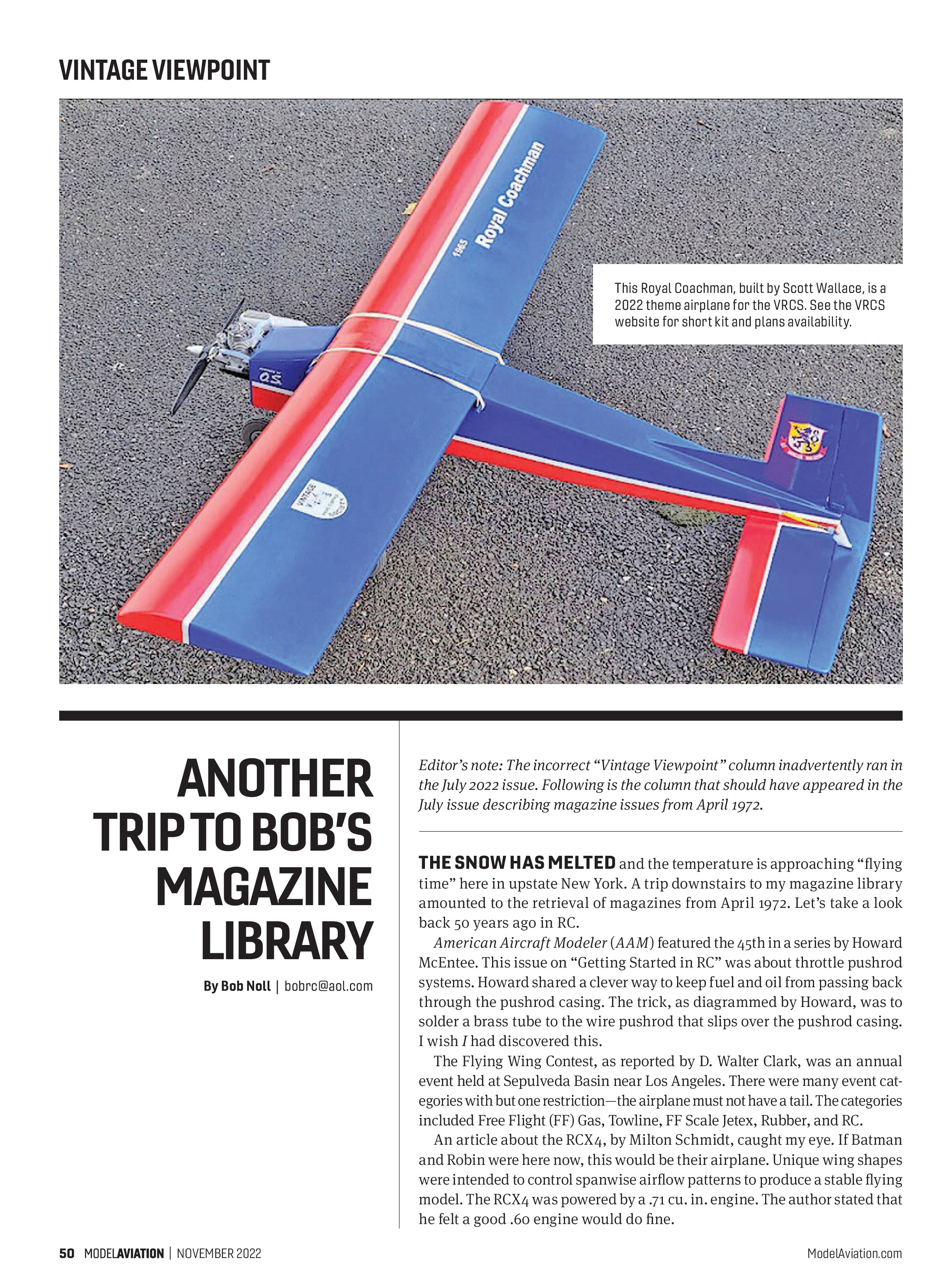
Don’t forget to visit the Vintage RC Society (VRCS) website, listed in “Sources,” and try to attend some of the Special Interest Group’s exciting events. The 2022 theme airplanes are the Royal Coachman and the Falcon 56.
The Royal Coachman is a simple, all-sheet-balsa airplane that can be built quickly and inexpensively. This design would make for a simple electric conversion and possibly even a model to reuse the motor, ESC, and batteries from a crash-damaged foam airplane.
The Falcon 56 is a “blast from the past” because it was the VRCS theme airplane many years ago. VRCS has decided to recycle one of its previous theme airplanes, as well as have a new one, each year.
SOURCES:
Glenn H. Curtiss Museum
(607) 569-2160
www.glennhcurtissmuseum.org